
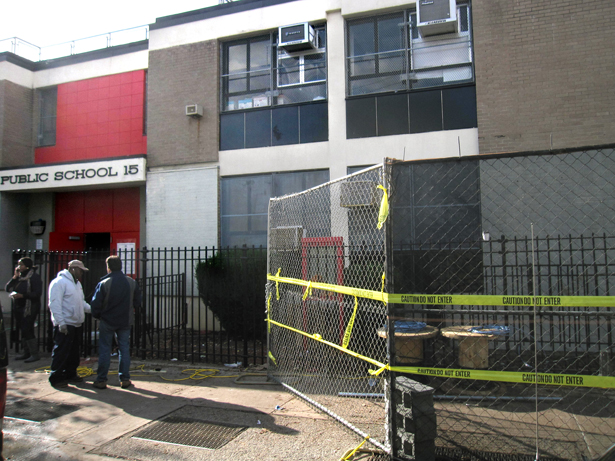
Yellow caution tape tells people not to enter Public School 15 in the Red Hook neighborhood of Brooklyn, New York. (AP Photo/Beth Harpaz)
The superstorm that ravaged Haiti, Cuba and much of the East Coast of the United States last week, just ahead of the elections, may finally turn out to be recognized as the “shock and awe” of climate change’s permanent war against the United States.
Certainly the effects of climate change have been visible elsewhere in the world much earlier. Hurricane Sandy may change that, as the reality of climate chaos becomes irrefutable. Some argued that the storm’s ferocity was the great equalizer, that rich as well as poor were left without power, that luxury townhouses were swept aside along with seaside shacks. But that ignores the stark reality of the wealth-poverty divide in this country—laid newly bare by the storm.
In New York, probably the most unequal city in this country, the collapse of infrastructure under the relentless pounding of hurricane-force wind and rain was not an equal opportunity catastrophe. Who will be able to rebuild—and who will not? Whose lives will be permanently destroyed—and who will ultimately walk away with some frightening memories? Without the subways, people of means could join the endless lines for crowded taxis—poor people walked. When banks and finance companies and the stock market closed, their salaried employees continued to collect their paychecks—poor people, who couldn’t get to their low-wage hourly-paid jobs, didn’t get paid at all. Do we really think that the rebuilding of the opulent high-rises of Manhattan’s Battery Park City will take as long, and leave their residents as desperate, as the reconstruction—or even repair—of the huge public housing projects in Red Hook, Brooklyn, demolished by the raging floods?
Its proximity to the elections means this storm provides a broad test for the capacity and the legitimacy of government: will its response provide for people’s most basic needs, or will it lay bare, as did Katrina, the racism, poverty and disempowerment that still shape so many lives in this country? Sandy posed an immediate choice in the presidential election as well, with voters choosing between campaigns claiming the moment calls for mobilization of every facet of public and government capability, and those insisting FEMA should be defunded and victims of the storm should rely on the largesse of the private sector and church-based charity.
In the longer term, of course, the superstorm’s challenge goes way beyond the election to the far more important question facing our movements: how to fight with renewed urgency to realize Rachel Carson’s vision of the human right to a safe environment for the entire planet.
In the meantime, for those of us in this country unaccustomed to the immediacy and implacability of war, the destruction in much of New Jersey and lower Manhattan, gives us a hint of what it must have been like in Iraq, almost ten years ago, when George W. Bush’s “shock and awe” destroyed power generators, electrical plants, water treatment facilities and more—suddenly rendering the once-modern city of Baghdad, with its skyscrapers and highways, silent and dark. For those on the twentieth floor of urban apartment buildings, the struggle to find clean water and a way to lug it upstairs without elevators could not have been so different than that faced by Iraq’s high-rise dwellers.
Understanding this storm’s impact in the context of our ongoing struggles against inequality and war may turn out to be one of the most important outcomes of this already toxic election season.
Naomi Klein asks whether the storm will serve as a climate change wake-up call.

