On Monday night the London bureau’s youngest member and I were sitting very high up in the stands watching what looked to be a pretty desultory draw between our team, Arsenal, currently in fourth place in the Premier League of English Football (soccer to you), and Leeds, currently languishing in eighth place in the second tier Championship League. The teams were competing for a chance to win the FA Cup, the oldest domestic tournament in football, but the reason we were there on a school night was the chance of witnessing the return of Thierry Henry, the club’s captain a decade ago and a player of immense charm, dignity and talent. Though afflicted with uncomprehending parents, the YM had been to a couple of Henry’s matches before the player was sold to Barcelona in 2007, and even named his cello “Thierry” in homage to his hero.
Now playing for the New York Red Bulls, Henry was on-loan to his old club during Major League Soccer’s off-season. As he came on to the pitch 50,000 fans stood up and cheered. And when, after less than ten minutes, he scored the match’s winning goal, the stadium erupted.
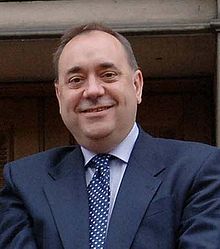
Alex Salmond is no Thierry Henry. Built more for the golf course or the race track, Scotland’s First Minister was expelled from the Scottish National Party as a student for membership in a far-left splinter group. Eventually rising to party leader, he was elected to Parliament in 1987 and to the devolved Scottish Parliament in 1999. However, in 2000, seeming bored by Edinburgh politics, Salmond resigned as party leader and returned to Westminster as a back-bencher, where he strongly opposed the Iraq War. Returning to leadership in 2004, Salmond became First Minister in a minority government, supported by the Greens, in 2007, but in 2011 won re-election in a landslide victory that gave the SNP a majority on a platform promising Scottish voters a referendum on whether the country should become completely independent.
During his four years leading a minority government Salmond kept university tuition free for Scottish students, while older Scots enjoyed government-paid nursing care. But last week David Cameron tried to derail the SNP’s strategy of a slow, stealthy march towards independence, pointing out that under devolution any change in the British constitution, such as independence for any part of the United Kingdom, has to be approved by Westminster. And with opinion polls showing that a majority of Scots don’t currently favor full independence, Cameron said he’d only give permission for a referendum if it happened in the next eighteen months and was restricted to a simple in or out.
What’s interesting is what happened next. Salmond’s deputy, Nicola Sturgeon, denounced Cameron’s announcement as “a blatant attempt to interfere” on the BBC. “The more a Tory government tries to interfere in Scottish democracy, I suspect the greater the support for independence will become,” she said. By the end of the week the truth of that point was so obvious Cameron pulled back, allowing surrogates such as Education Minister Michael Gove, a Scottish-born Tory, and Danny Alexander, chief minister at the Treasury and a Scottish Liberal-Democrat, to take up the fight. Alex Salmond, though furiously insisting this was an issue for Scotland to decide, commited himself to a referendum in 2014—the 700th anniversary of the Battle of Bannockburn, when Scottish troops defeated the English under Edward II.
A lot can—and probably will—happen between now and 2014. The clearcut economic case for Scottish independence based on North Sea Oil and entry into the Euro is a lot cloudier now that the oil is running low and the Euro looks more like a suicide pact. Salmond and his colleagues used to talk a lot about Iceland as proof that a small country, well-educated country without much of a manufacturing base could thrive on the periphery of Europe, but since Iceland went bust you don’t hear so much about the “arc of prosperity” that was going to connect Iceland, Ireland and a newly independent Scotland.
And the British parliamentary politics of the issue are fiendishly complicated. The Tories, whose full name is the Conservative and Unionist Party, are constitutionally committed to preserving the Union with Scotland. Yet with, as a current joke goes, fewer Scottish Tory MPs than there are giant pandas in the Edinburgh zoo, the temptation to hand Salmond his hat must be considerable—especially since without Scottish votes Labour would shrink from a minority party to a marginal one. Which lends Ed Miliband’s efforts to persuade Scottish voters to stay in Britain the stench of desperation.
Last week Miliband gave what was billed as a major speech on the economy. But anyone looking for genuinely effective opposition to Cameron and the coalition would have done better to look further north. Salmond may be trickier than he looks—he’s apparently Rupert Murdoch’s favorite British politican, though that could have more to do with the Australian tycoon’s long-standing preference for winners who will take his calls over losers who will take orders. But listening to Nicola Sturgeon on the radio, and watching Salmond effortlessly tie Cameron in knots on television, I couldn’t help thinking, “At last. Somebody who knows how to play this game.”