
Nearly every night in Ferguson, a group of protesters gathers in front of the police department demanding justice for Michael Brown. The size of the demonstration has varied, depending on people’s availability and on the weather conditions, but the dedication to protesting has remained consistent since Brown’s death.
In these days leading up to the announcement of whether a grand jury has indicted Darren Wilson for killing Brown, everyone is on edge. The uncertainty of when the decision will be released to the public, coupled with Missouri Governor Jay Nixon’s declaration of a state of emergency, has left plans for action up in the air and the quest for justice without answers. But the people still show up to police department.
The anxiety has only been exacerbated the last few nights in Ferguson, as those protests have been met by a show of force on the part of the Ferguson police department. The night I was there—Wednesday, November 19—there were no more than about forty protesters at any given moment, met with police presence of equal or greater number. Of course, the major difference was that the police stood armed, in riot gear, and the protesters had only their bullhorns, chants and emotion.
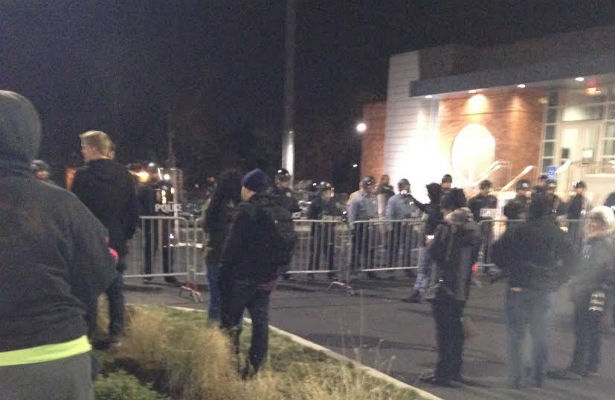
It remained relatively calm for a time. The police, lined up as if to block the passageway to the department doors, already unavailable to anyone because of the metal barricade, played a game of cat and mouse, advancing a few feet and backing protesters up, before retreating themselves. Things escalated when during one of their advances they arrested a young man who had shown up to livestream the event.
The police advanced further as the protesters took to the streets, directing traffic away from their action. Protestors ran to what they thought would be a safe space across the street, but a few weren’t lucky enough to make it. At least five people were arrested that night, mostly for unlawful assembly as well as resisting arrest.
Aside from the chanting, there was no provocation of the police on the part of the protesters. There was one instance of an object a being thrown, a water bottle, but other protesters quickly handled it: the person responsible, dressed in all black from head-to-toe, including a black mask that obscured their face, was run off of the protest site and heckled as an agitator who was putting the lives of the protesters at risk.
“If the media wasn’t out here, they’d have arrested us all,” one protester remarked.
A similar scene played out on Thursday evening, with the lesson here being that a militarized police force isn’t necessary to inflict terror. The police have proved themselves violent even without the use of tanks and tear gas. The people’s right to assemble peacefully won’t be protected. The Ferguson police department hasn’t taken any of the national or international criticism they have received to heart. And as the announcement of the decision on whether to indict Wilson dangles in some unknown future, the anxiety builds and takes an unknowable psychic toll on the most dedicated protesters.
But their resolve to see this through is strong.

