
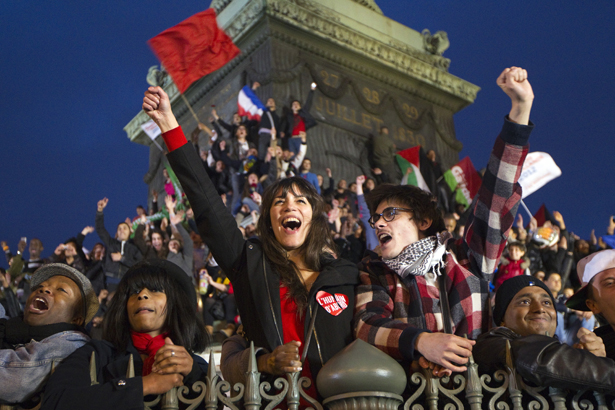
Supporters of France’s newly elected President François Hollande react after the early results during a victory rally at Place de la Bastille in Paris May 6, 2012. France voted in elections on Sunday and Hollande becomes the nation’s first Socialist president in seventeen years. Reuters/Charles Platiau
So the voters have voted—in Britain, in France, in Greece, in Schleswig-Holstein—and the markets are tumbling. In Britain, the Tories took a serious beating from Labour in local elections, though Ken Livingston lost in London to Mayor Boris Johnson; their Liberal Democrat coalition partners were more or less wiped out. France has elected a socialist president for the first time since 1981 (though, as I recall, that one didn’t turn out so well); François Hollande has pledged to challenge European austerity and renegotiate the German-driven fiscal treaty that has effectively outlawed Keynesianism on the continent. Schleswig-Holstein dealt a blow to Angela Merkel’s ruling CDU and elected members of the Pirate Party to its regional assembly. And Greece has voted loudly, if incoherently, against the austerity program imposed by the EU and IMF. Across Europe, it’s no to austerity, and yes to—what?
European voters everywhere are turning against the elites that have managed most of the continent for the last few decades. The financial crisis has broken the illusion of stability; the cracks in the concrete of the Eurozone are gaping. As I wrote here on Friday, the voices being raised against austerity come from the far right as well as the left. Yesterday Greece became the first European country to elect neo-Nazis—twenty-one members of the racist Golden Dawn party—to its parliament. Their leader, Nikolaos Michaloliakos, dedicated his victory to “the brave boys in the black shirts”; some candidates used the rising phoenix, emblem of the colonels’ junta of 1967 to 1974, as their election poster. “Those who slander us,” he barked, and “those who betray this country should be afraid: we’re coming.” Golden Dawn won votes across much of the country—and not just in the inner cities, where its supporters stage pogroms against immigrants and woo old ladies with offers to escort them to the cash machine. It also got the votes of one in ten young people. If you add that vote to those of the other two far-right parties, Laos and Panos Kammenos’ Independent Greeks, then one in five Greeks voted for rabid nationalism and anti-immigrant rhetoric.
I’ve tried to explain the rise of Golden Dawn in my piece for the Guardian today—and also the success of Alexis Tsipras’s Syriza, the Coalition of the Radical Left. Syriza was the breakthrough party of the Greek election, taking all of the greater Athens region and central Thessaloniki and coming in second—ahead of the discredited socialist Pasok—overall. The charismatic Tsipras managed to articulate a very basic program—opposition to the EU/IMF measures, redistribution of wealth, a restoration of welfare rights—that much of the broad left opposition to austerity could sign up to; he’s also the man who figured out how to speak to the people in the streets. “We are the many, they are the few,” goes one of Syriza’s slogans; “They decide without us, we proceed without them,” goes another.
Greeks who remember the ’80s and the speeches of Pasosk’s founder, Andreas Papandreou, find much in Tsipras to remind them of that master rabble-rouser. Although he swears he’s for “the people,” not “the state,” he has refused to talk about the reform of Greece’s creaking bureaucracy, or about how exactly he plans to save the economy, beyond taxing the rich and calling the Europeans’ bluff on ejecting Greece from the Eurozone. But at moment like this, populism can be (very briefly) useful, as well as seductive and dangerous. Set beside Hollande’s victory in France, Tsipras’s success has helped drive home the message that Europeans have had it with austerity. Both elections were referendums on European economic strategy; both roundly rejected it. The German finance minister issued a shameful threat to the Greeks the day before the vote, saying that they must honor their commitments or “take the consequences.” It isn’t clear yet what those consequences will be; but then, what we’ve got now clearly isn’t working either. In the long battle between the markets and democracy, it’s one to democracy, with all its flaws and pitfalls. No one said it would be easy.

