Biden Won’t Win With This Kind of Campaign
The president says he won’t bow out. But his efforts to renew his candidacy are risk-averse, uninspired, and dangerously misguided.
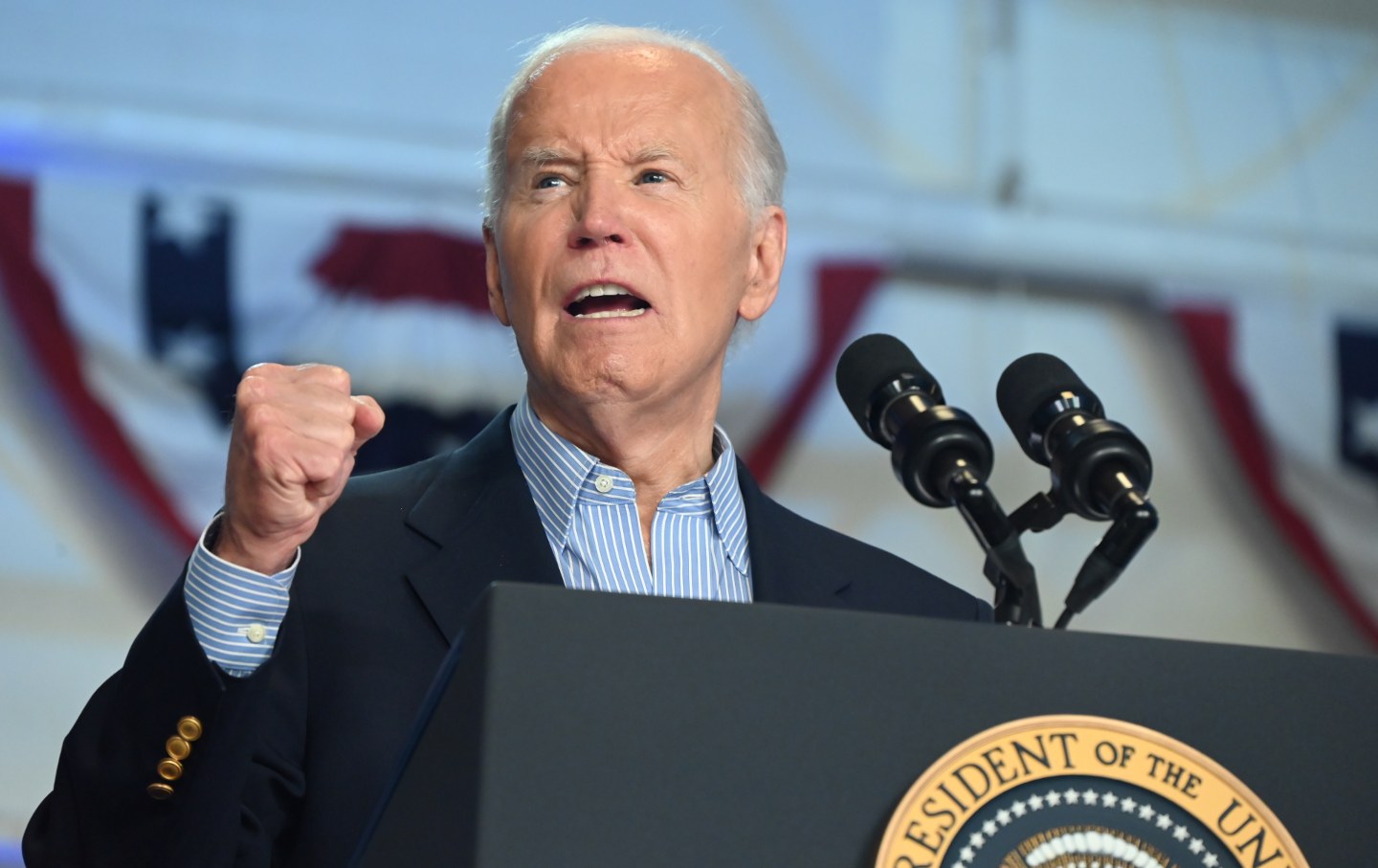
Joe Biden delivers remarks at a campaign rally at Sherman Middle School in Madison, Wisconsin, on July 5, 2024.
(Kyle Mazza / Anadolu via Getty Images)Madison, Wisconsin—In 2012, after a lousy debate performance that led commentators to speculate about whether he might lose his reelection bid, President Barack Obama flew to the Democratic stronghold of Madison, Wisconsin, for a rally on the University of Wisconsin campus. An amazing crowd of 30,000 turned out to hear Obama deliver a pitch-perfect speech that reinvigorated his campaign. Wry and good-humored, the president acknowledged his stumble with an opening announcement that “I met this very spirited fellow who claimed to be Mitt Romney.” The overwhelmingly young crowd laughed and cheered. And Obama never looked back.
The rally helped Obama quell concerns about his bid and chart a course to victory.
Twelve years later, after a dramatically more troublesome debate appearance, President Joe Biden came to Madison with similar hopes for a confidence-renewing moment. But instead of addressing an outdoor crowd of 30,000, Biden spoke to a few hundred party loyalists in a middle-school gymnasium.
That contrast alone should raise alarm bells. The Biden campaign, shaken by a disastrous debate and its aftermath, needed a show of strength. Longtime backers—including Democratic members of Congress and major donors—had been openly urging Biden to stand down. The sense of crisis was building. People were looking for a quick confidence-boost after a miserable week of fevered discussions about whether this president is capable of mounting the kind of campaign that’s needed to beat not just Donald Trump but Trumpism.
Unfortunately, Biden’s rally in Madison raised more questions than it answered. Like the high-stakes interview with ABC News anchor George Stephanopoulos, which was taped at the school and aired later that evening, the rally was serviceable. There were no glaring missteps. But this was an overly cautious approach to an immediate challenge.
It would be unrealistic to demand a presentation to rival that of Obama in 2012. But Biden clearly needs something big. He needs to be delivering game-changing appearances that undo the damage from the debate and cause even his critics to accept that the fiasco on June 27 really was just the “bad episode” that the president describes.
The rally at Madison’s Sherman Middle School didn’t deliver that sort of redemption. Biden’s 17-minute address—delivered with the aid of a Teleprompter—was good enough. And it translated reasonably well on television, especially when he confronted the issue of his age head-on, with a populist appeal, declaring, “I wasn’t too old to create over 15 million new jobs; to make sure 21 million Americans are insured under the Affordable Care Act; to beat Big Pharma—the first one ever to do that—and lower the cost of insulin to $35 for seniors.”
Every line in that litany was greeted with applause from a crowd of Democratic stalwarts that media outlets numbered at around 350. But Biden needed to be making this appeal to a crowd of at least 3,000 or 3,500. Or, preferably, 30,000 or 35,000.
Unfortunately, the Biden camp didn’t risk going big. They went with a modest event in a venue where, one neighborhood mom noted, “we usually hold the middle-school choir concert.”
Biden did his best to suggest that the rally had put to rest the debate about whether he had what it takes to defeat Trump. When Stephanopoulos asked, “What’s your plan to turn the campaign around?” Biden replied, “You saw it today. How many—how many people draw crowds like I did today? Find me more enthusiastic than today?”
But it’s not hard to draw crowds for Democrats in Madison. Nor is it difficult to garner enthusiasm from the most committed partisans, when they have been invited to prop up their candidate. In fairness to Biden, I think he could have drawn a larger crowd in a bigger venue, or an outdoor setting. But that would have involved taking chances that the Biden campaign—which now is faced with embarrassing headlines for providing prepared questions to radio interviewers—doesn’t seem to be willing to embrace at this point.
That’s a serious concern, which stands apart from the broader question of whether Biden should remain in the race. In the face of a rising chorus of calls for him to stand down, the president gives every indication of being determined to keep running. “Now, you probably heard, we had a little debate last week,” he told the rally. “I can’t say it was my best performance. But ever since then, there’s been a lot of speculation. ‘What’s Joe going to do? Is he going to stay in the race?’ ‘Is he going to drop out? What’s he going to do?’ Well, here’s my answer: I am running and going to win again.”
That won’t be the last word on the questions that arose following the debate. But if Biden is determined to stay in, he and his team have got to wrap their heads around the responsibilities that go with this choice.
It’s not enough to campaign carefully when Trump is ahead in most polls and when there is a very real prospect that Republicans could take control of the Senate.
It’s not enough to deliver short speeches at small events in overwhelmingly Democratic cities. It’s not wise to imagine that, when party stalwarts chant, “Let’s go, Joe,” you are generating “more enthusiasm” than another candidate could.
Popular
“swipe left below to view more authors”Swipe →And it is certainly not enough to answer the essential question from Stephanopoulos—“If you stay in and Trump is elected and everything you’re warning about comes to pass, how will you feel in January?”—by saying, as Biden did Friday night, “I’ll feel as long as I gave it my all and I did the good as [sic] job as I know I can do, that’s what this is about.”
Biden says that the country is at “an inflection point,” where the future of American democracy is at stake. This requires more than putting in your best effort in a controlled setting. It requires an absolutely determined candidate and a big, bold, risk-taking campaign that inspires Wisconsinites, and voters nationwide, to defeat Trump and Trumpism. If Biden really is determined to stay in this race, he owes it to himself, his party, and his country to be all in.
More from The Nation
Brazil’s Workers’ Party Is Not Stopping Brazil’s Workers’ Party Is Not Stopping
With just a few days remaining before the runoff election, supporters of Lula’s party are doing everything possible to rally support behind the president.
The Jewish Case Against AI The Jewish Case Against AI
Haredi rabbis and the secular left agree: This technology is a threat to the entire social fabric.
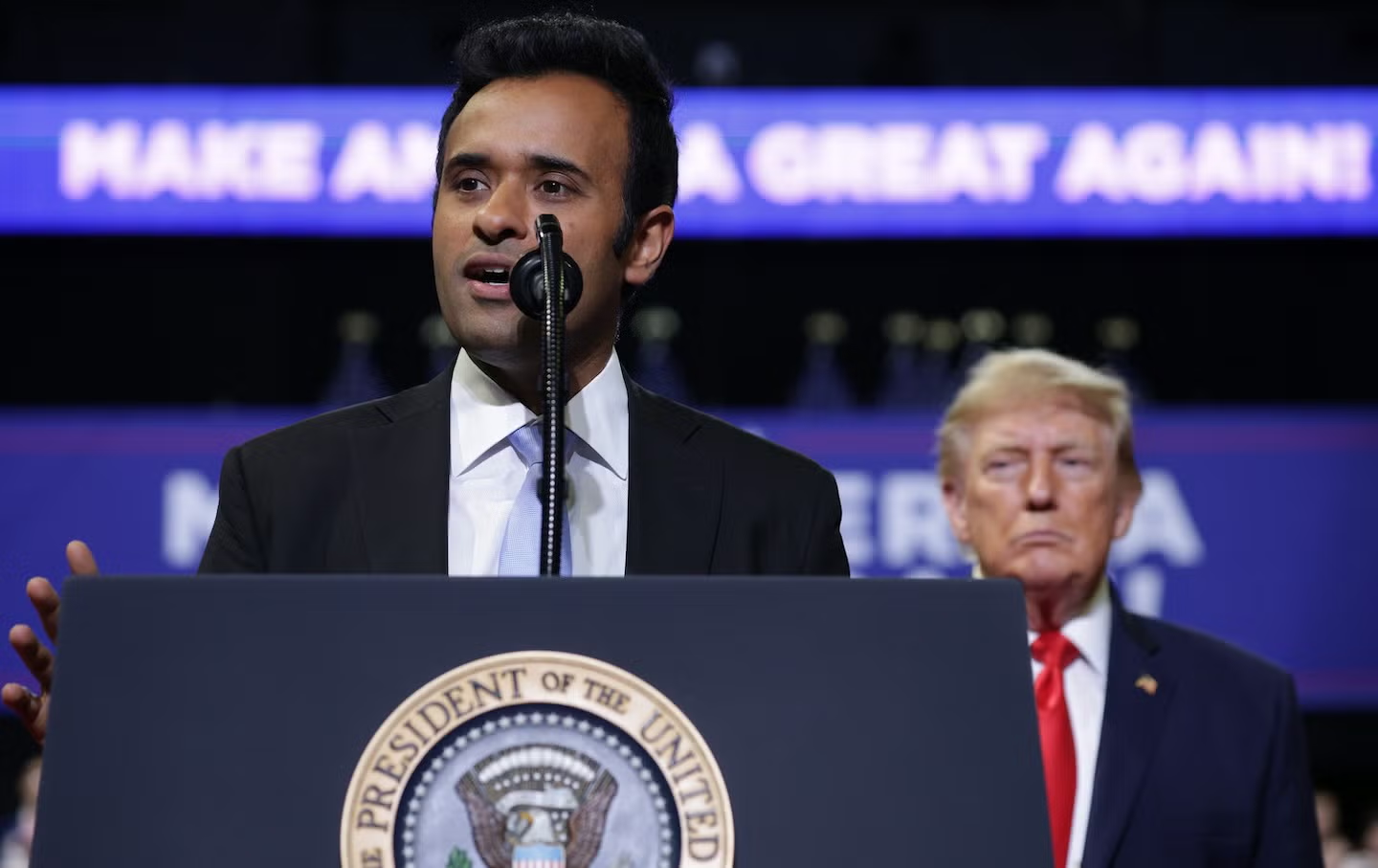
Vivek Ramaswamy’s New Attack Ad Should Be a National Scandal Vivek Ramaswamy’s New Attack Ad Should Be a National Scandal
The Ohio GOP gubernatorial candidate has accused his Democratic opponent, Amy Acton, of lying about being raped when she was 12 years old.

Dirty Business Dirty Business
Trump turns to Russian oil to lower fuel prices in the United States ahead of the midterm elections, throwing Ukraine under the bus.
The Fight for Educational Equality Is Also a Fight for a Just Supreme Court The Fight for Educational Equality Is Also a Fight for a Just Supreme Court
The court has severely weakened our ability to make an education system that fulfills the promise of Brown.