One Year Into Trump 2.0, Elon Musk Is Still Poised to Be Kingmaker
The neofascist tech oligarch was cast out of Trump’s inner circle, but his money and influence are still omnipresent.
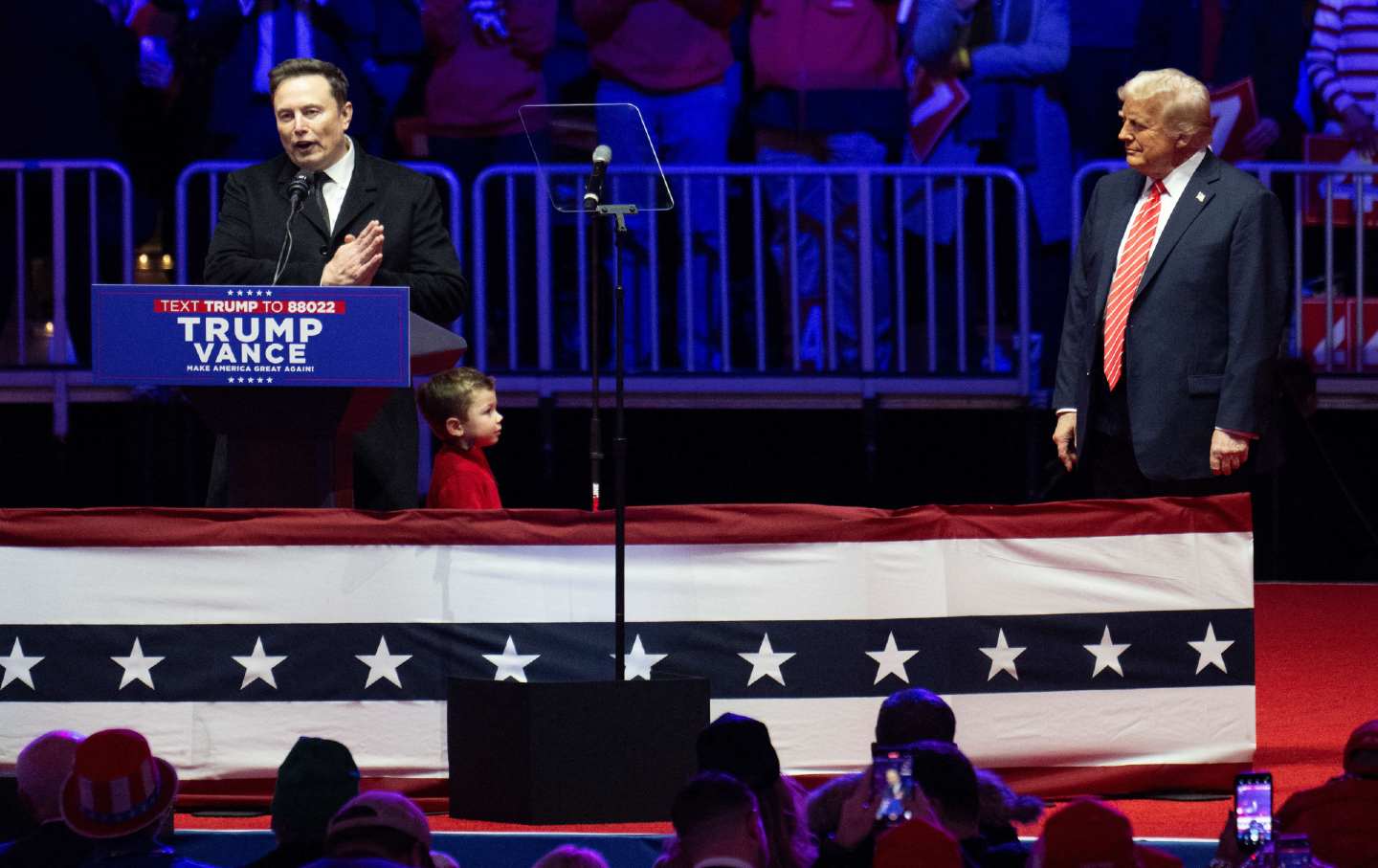
Elon Musk addresses a MAGA rally in Washington on the eve of President Donald Trump’s inauguration last year.
(Jim Watson / AFP via Getty Images)Last June, the relationship between President Donald Trump and his top political benefactor, Elon Musk, seemed to be in shambles. Wrapping up his 180-day tenure as a “special government employee,” Musk had stepped down from the cost-cutting Department of Government Efficiency (DOGE), which had secured for the world’s richest mogul even greater power (and some very valuable government data). Musk’s close involvement with the agenda of the second Trump administration had prompted critics to call it the “Trump-Musk White House”—but the now-sidelined tech oligarch seemed to have become the same sort of obsolete Trump crony that Rex Tillerson or Mike Pence had been in the wake of Trump’s first term.
Despite all the chaos Musk fomented at DOGE by unleashing a corps of twentysomething engineers to wipe out payrolls and agencies under dodgy AI-driven data raids, he failed to sufficiently handicap the administrative state or nuke government spending as he had pledged to. Trump had also decided not to pick Musk’s close ally Jared Isaacman to be NASA administrator—a key post for a tech oligarch with a bevy of government rocket-launch contracts and aspirations to go to Mars—because of Isaacman’s history as a donor to Democratic political campaigns. Things were getting frosty.
Musk, as is his wont, was posting hysterically late into the night on X. Rather than attacking destitute migrants or trans Democrats, Musk was now targeting Trump, whom he accused of various betrayals. The tech mogul claimed to be especially outraged over Trump’s “Big Beautiful Bill” that vastly expanded government spending while slashing taxes—a measure that Musk saw as a “disgusting abomination” certain to balloon the national debt. Finally, Musk wrote on X, it was “time to drop the really big bomb:@realDonaldTrump is in the Epstein files. That is the real reason they have not been made public.”
As the Department of Justice’s dissembling in the ongoing Epstein files farrago has demonstrated, Musk was in some sense correct. But his supposed “really big bomb” had a surprisingly small blast radius. It also seemed to lack the conviction of its poster: Musk eventually deleted the message.
Musk made noise about starting an America Party to challenge Trumpian spending, but it never went beyond a super PAC that seems destined to become another MAGA totem, on course to be folded into the mainstream GOP apparatus. While touting the work of Republican Representative Thomas Massie of Kentucky, a libertarian Trump gadfly, Musk has otherwise continued to put his money into top Republican organizations. He gave $15 million to three Republican super PACs just before he threatened to start his America Party.
Despite being a vindictive president with vast powers at his disposal, Trump did nothing to retaliate against Musk after he began speaking out. There was some public bickering, including Trump threatening to “terminate” Musk’s government contracts. The president and some of his allies described Musk as an erratic drug addict. But the Musk-Trump relationship was easily mended, at least as a combined political project. Their handshake reunion at the Charlie Kirk memorial was a reminder of how quickly transactional political relationships can be repaired—and that Trump and Musk, who traded barbs well before the 2024 election, have done this before.
With an eye toward stopping any blue wave in the 2026 midterms, Musk is continuing to shovel money behind the MAGA electoral juggernaut and other administration priorities. Axios recently reported that Musk attended a meeting with Vice President JD Vance and various Trump advisers to discuss midterm donations and political strategy. Susie Wiles, the influential Trump chief of staff who had recently described Musk as a ketamine addict in an interview with Vanity Fair, was also there.
So in spite of the public furors that have hounded the Trump-Musk alliance, the deeper alignment of interests is clear. Musk needs government contracts and subsidies—which have amounted to $38 billion to date, according to an exhaustive Washington Post investigation. The Department of Defense and the Space Force need SpaceX’s rocket launch capabilities. Trump and the Republican Party need Musk’s money—after raking in some $290 million of it in the 2024 cycle—and the propagandistic power of X, which shouldn’t be underrated. And no one really needs an overblown public media war (that, given past results, would probably be poorly leveraged by Democrats but might fracture an increasingly fragile MAGA base).
Since Musk left DOGE and implied that the president was a pedophile, his companies have continued to accrue valuable contracts, while SpaceX has cemented itself as the premier space-launch vehicle for an administration that would like to colonize everything from Greenland to outer space. In 2025, SpaceX received contracts from the US Space Force worth more than $6 billion. The Department of Defense continues to use Starlink, SpaceX’s Internet service built on thousands of small satellites crowding low-earth orbit, and handed out at least $200 million in contracts for xAI’s Grok, Musk’s Hitlerian, deepfake-crafting chatbot. That software will soon be integrated into military networks, Department of Defense Secretary Pete Hegseth bragged. Other government departments that made deals to use Grok have been slower to roll out the software, citing a need for more testing.
Compared to his colleagues Peter Thiel and David Sacks—both pivotal players in the rise of the tech right and the funneling of massive amounts of cash from Silicon Valley to Republican interests—Musk was late in coming to reactionary techno-fascism. A centi-billionaire who ruled over a large business empire, he was not deeply involved in electoral politics before 2020. That changed thanks to the social, economic, and political upheavals surrounding Covid—as well as the personal ordeal of his daughter Vivian Wilson coming out as trans and publicly disowning him. In response, Musk promptly disowned both social liberalism and democracy itself. He theorized a new public menace that he dubbed the woke mind virus and began setting his sights on controlling public discourse and the highest levels of government. And in his shambolic way, he’s been quite successful at it.
Musk’s behavior may be terribly chaotic and inconsistent, full of impossible promises about technological glories to come and threats to create political organizations that never graduate beyond X posts. But he still has the zeal of the convert and unlimited resources. In his grievances—and in his social and business networks—Musk is firmly enmeshed in the far-right MAGA project underwritten by a new tech aristocracy that has little regard for the basic tenets of electoral democracy. For now, as 2026 approaches, Musk’s pro-Republican donations and rhetoric are already flowing firmly behind the president and his party’s prerogatives. The only question is how far the world’s richest man will go.
Become a Sustaining Donor This September
Between the reemergence of right-wing red-baiting and Donald Trump’s use of the chilling National Security Presidential Memorandum–7 to criminalize left political organizing, we’re seeing McCarthyism reborn before our eyes.
This assault on democracy cannot be ignored or wished away. Resisting it requires bravery in the face of threats and repression, a steadfast commitment to the truth, and the unwavering belief that we can—and will—overcome this darkness.
We must have an independent media that sets the record straight, unearths corruption and abuses of power, and advances a politics of justice and dignity for all if we’re to win this fight.
That’s why I’m writing to you today. This September, The Nation needs to add 100 monthly donors to sustain our progressive journalism. Your contribution makes the next investigative report, the next truth-speaking column, and the next pathbreaking essay all possible.
I hope you’ll support our work with a recurring donation today. If you donate $10 or more a month, we’ll send you a brand new “Hands Off the Free Press!” sticker to recognise your commitment to our cause. Please, donate today.
Onward,
Katrina vanden Heuvel
Editor and Publisher, The Nation