Will More States Try to Protect Marriage Equality With Trump Back in Office?
Voters in California, Colorado, and Hawaii approved ballot proposals in 2024 to protect same-sex marriage rights over fears that the Supreme Court could overturn Obergefell v. Hodges.
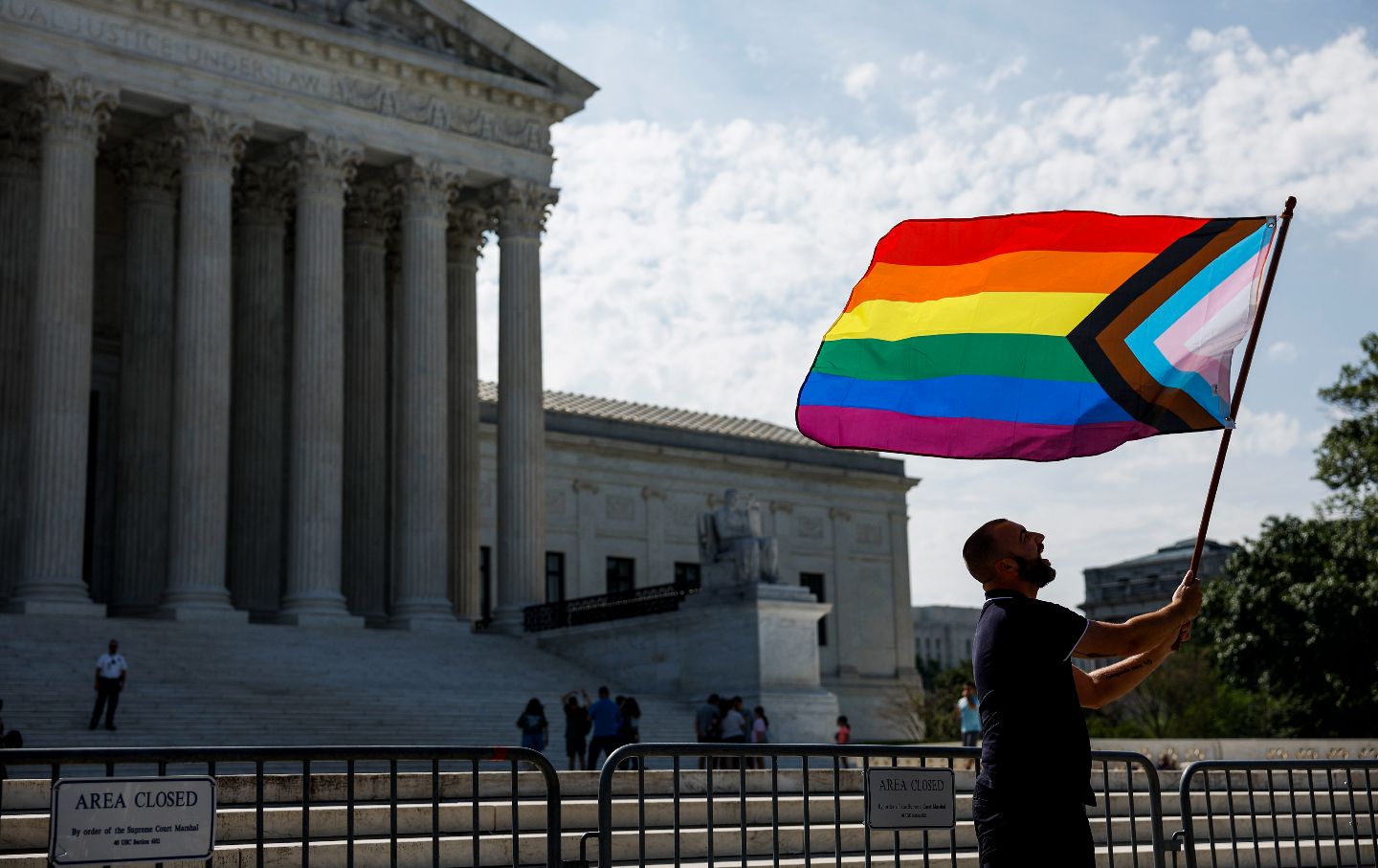
A same-sex marriage supporter waves a Pride flag in front of the US Supreme Court Building.
(Anna Moneymaker / Getty)From Election Day until 12:30 pm on Wednesday, The Trevor Project, a nonprofit LGBTQ+ youth suicide prevention organization, saw its contact volume for live messaging, text, and crisis hotline services jump 125 percent compared to a normal day. The organization expects it to “potentially only increase,” CEO Jaymes Black told The Nation in a statement, as LGBTQ+ advocates fear that a second Trump term could lead the Supreme Court to overturn Obergefell v. Hodges—which required states to recognize same-sex marriage.
Some states were prepared. On Election Day, voters in California, Colorado, and Hawaii passed ballot proposals aimed at protecting same-sex marriage rights. The amendments ultimately will either prevent the state legislature from enacting any restrictions on same-sex marriage, remove constitutional bans, or specifically enshrine same-sex marriage rights in the state’s Constitution. According to the Movement Advancement Project, 32 states—home to nearly 8.5 million, or 61 percent, of LGBTQ+ adults—now have constitutional amendments or statute bans on same-sex marriage that would take effect if Obergefell were overturned.
“It’s great that we got these wins this week, and we hope additional states will seek the same sort of appeals of discriminatory laws,” Logan Casey, director of policy research for equality-focused think tank the Movement Advancement Project, told The Nation. In a deep-blue state like Oregon, which has a constitutional ban on same-sex marriage, similar amendments to California’s, Hawaii’s or Colorado’s could likely pass. But in a more competitive state—like Wisconsin, for example, where Republicans retained control of both state legislative chambers—such an amendment is a tougher prospect.
Despite Kamala Harris’s loss on Tuesday, the marriage equality amendments passed easily; California’s with 61 percent of the vote, Colorado’s with 63.6 percent, and Hawaii’s with 51 percent. The victory of the amendments alongside Harris’s national loss, according to Don Haider-Markel, a University of Kansas political science professor and expert on public opinion regarding same-sex marriage, showed the electoral weakness and unpopularity of the Biden administration. “If you look at a state like Wisconsin, for example, where Tammy Baldwin ended up in a very close reelection battle, if the numbers are accurate right now, she certainly outran Harris in that state,” Haider-Markel said. “It’s very difficult when the economy, at least, feels bad to people, to outrun that for an incumbent.”
Though the same-sex amendments are replicable, Democratic lawmakers might be unlikely to prioritize social equality over “kitchen-table issues” over the next four years, Haider-Markel said. In his view, the party’s focus caused losses among working-class voters and potential Republican Party gains among non-white men. But around 64 percent of people support same-sex marriage in states where it would be illegal if Obergefell were overturned, according to a March 2024 report from the Public Religion Research Institute. Though conservatives may claim success running on anti-trans policies, Casey says, same-sex marriage’s broad approval throughout the electorate leads him to believe it’s not necessarily fair to “be concerned about a marriage amendment in a solidly blue state.”
Seventeen states allow citizens to directly initiate constitutional amendments—though their requirements vary. Successfully advocating for a same-sex marriage measure’s passage, Haider-Markel said, requires citizen advocates to decide if they wish to spend time and effort on a measure that “may or may not be important down the road,” rather than organizing for candidates who support their viewpoints.
But many of those who could be affected by the overturning of Obergefell say a ballot proposal is a worthy endeavor. Acadia Bradley, a junior at the University of Wisconsin–Madison, found Trump’s win devastating, especially given the hope she had felt for the election over recent weeks. During Trump’s presidency from 2016–20, Bradley felt homophobia was emboldened—as if Trump “almost [gave] them a free pass, or a little bit more courage to act on their hatred towards us.”
Wisconsin is one of 24 states with both statutes and constitutional language prohibiting same-sex marriage. But the state has no citizen initiative mechanism—meaning that to remove the constitutional language, lawmakers would have to propose a constitutional amendment that is then brought to voters. Though Democratic lawmakers have attempted to remove both the state’s constitutional and statutory language bans, state Republican lawmakers have let the proposals stall in legislative committees and derided them as unnecessary. State Assembly Speaker Robin Vos, a Republican, did not respond to a question from The Nation asking if he’d support such proposals in the upcoming legislative session.
Students like Bradley feel that it’s natural to worry about the future, given Trump’s past rhetoric toward LGBTQ+ people, and she wants Wisconsin lawmakers to remove those bans. “I think it should have been done already. But pressure is definitely a little bit more on now.”