What’s Old About Biden? (It Isn’t His Age.)
His foreign policy ideas are tired.
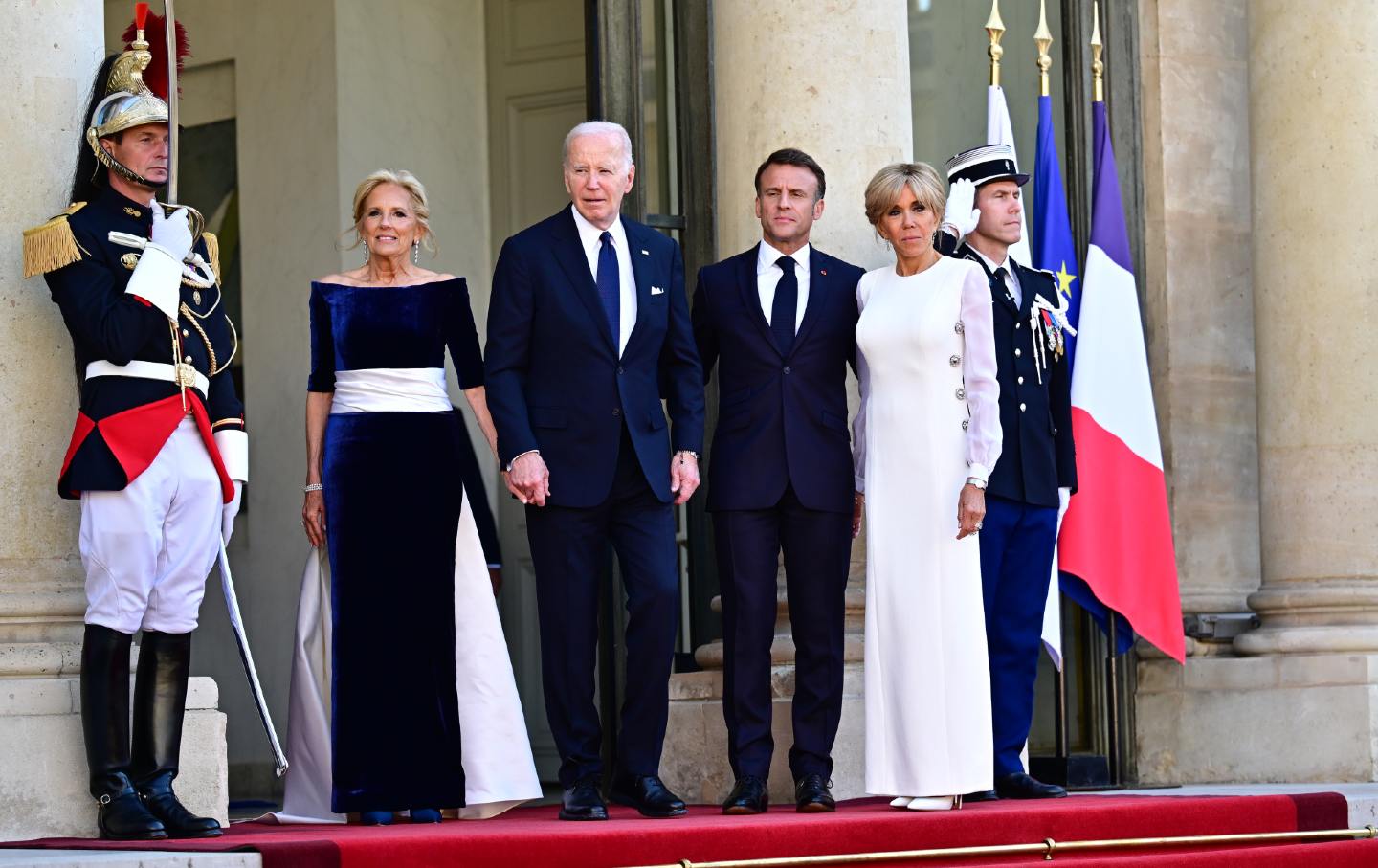
President Biden’s week in France featured a graceful waltz to classic tunes. The president used the D-Day anniversary in Normandy to remind the public about his commitment to defending democracy at home and abroad, and his efforts to expand and reinvigorate the NATO alliance: “Today, NATO stands at 32 countries strong. And NATO is more united than ever and even more prepared to keep the peace, deter aggression, defend freedom all around the world.” Biden even summoned up the famous high notes of Ronald Reagan’s 1987 address at the Brandenburg Gate in Berlin at the height of the Cold War:
History tells us freedom is not free. If you want to know the price of freedom, come here to Normandy. Come to Normandy and look. Go to the other cemeteries in Europe where our fallen heroes rest. Go back home to Arlington Cemetery.
Aides suggested that the ceremonies this week, followed by the G-7 meeting in Italy next week and the 75th anniversary NATO summit in Washington early next month, will draw a sharp contrast with Trump’s erratic and isolationist postures and his perverse attraction to dictators abroad. That contrast, however, pales in comparison to the underlying message conveyed by the ceremonies. On foreign policy, the problem with Biden isn’t that he is old; it is that his ideas are tired, mired in a past that no longer serves the US well.
Biden came to office proclaiming a commitment to a new “foreign policy for the middle class.” Domestically, he broke with the neoliberal gospel of the conservative era, launching a bold progressive economic thrust—the beginnings of a green industrial policy, investment in rebuilding the country, aggressive trade and anti-trust policies, a push for progressive taxation, and more. Abroad, however, his policies have been defined by an emphasis on antiquated Cold War rhetoric and divisions, painting a global struggle between democracy and authoritarianism, defining the response largely in military terms anchored in NATO and other military alliances, expanding already bloated military budgets and presence. While China was designated the new “peer competitor,” the battle with Russia over Ukraine became, for Biden, the signature struggle of the time. Even in the conflict in Gaza, Biden seemed wedded to a myopic support for a reactionary Israeli government that needed to be restrained, not provisioned.
Lost in this focus on old Cold War tropes and divisions are the new security threats that people face in their daily lives. In the United States, a million people died from the Covid pandemic, which is but the first of what surely will be new epidemics that will sweep an increasingly integrated world. Yet Covid has left the public health system here and globally in disarray, discredited, and defensive at a time when basic security requires far greater capacity.
Under relentless assault from the right and from entrenched interests, addressing climate change has lost momentum, even as the world has heated up far faster than predicted. Each of the last 12 months were the hottest in history. Extreme weather wreaks havoc, takes lives, and displaces people here and abroad in ever greater numbers. Yet the Biden administration will spend more on aid to Ukraine in one year than it will expend on its renewable energy investments at home. Abroad, our effort (in Biden’s words) to “defend freedom all around the world” militarily dwarfs urgently needed efforts to help peoples adapt to climate change and rebuild from extreme weather. That reality, in turn, feeds mass migration, increasingly fostering fear and divisions here and abroad.To see the truth of this one need only consider the ascendancy of European far-right parties in the EU elections last weekend.
On its own terms, Biden’s efforts to rally the world to a new cold-war division have failed. Our allies in Europe have paid a greater price from the sanctions on Russia than the Russians have in large part because China, India, and much of the world have rushed in to to buy Russian oil and replace Western suppliers. Russia’s economy continues to grow, with the World Bank recently announcing that it is now the world’s fourth-largest economy, surpassing Germany. This week, Russia plays host to the annual foreign ministers’ meeting of the BRICS countries. Five new countries—Egypt, Ethiopia, Iran, Saudi Arabia, and the UAE—have joined Brazil, Russia, India, China, and South Africa in the group. They represent over one-third of the earth’s land mass, 45 percent of its population, over 40 percent of its oil production, and about one-fourth of its exports. Their combined gross domestic product (in purchasing power parity terms) equals about one-third of world GDP, exceeding that of the G-7, which convenes next week. While BRICS+ is far from a coherent economic block, it does represent the growing efforts to break old patterns and create new economic and political arrangements. Biden’s celebration of NATO and the military defense of democracy is speaking to a world that is no longer listening.
Foreign policies seldom decide presidential elections. Trump’s global posturing—impulsive, ignorant, nativist, isolationist, opportunistic—is a dangerous embarrassment. But Biden’s effort to contrast his steady leadership and embrace of NATO and the old certitudes of the Cold War era isn’t likely to gain traction. The president is focused on a war in Ukraine that isn’t going well and a humanitarian horror in Gaza that is indefensible. The administration has trampled the “rules-based order” that it preaches about. Worse, the president seems wedded to a worldview that is long past its expiration date. Lyndon Johnson, the last Democratic president who offered promise of domestic renewal, lost his war on poverty in the rice paddies of Vietnam. Let us hope that Biden, whose domestic initiatives offer great promise, does not suffer a similar fate.