Politics / StudentNation / June 13, 2024

An Extreme Anti-Immigrant Law Could Threaten Undocumented Youth in Texas

SB 4, which the ACLU called one of the most extreme pieces of anti-immigrant legislation ever enacted, would give Texas police the power to engage in immigration enforcement.
Lajward Zahra

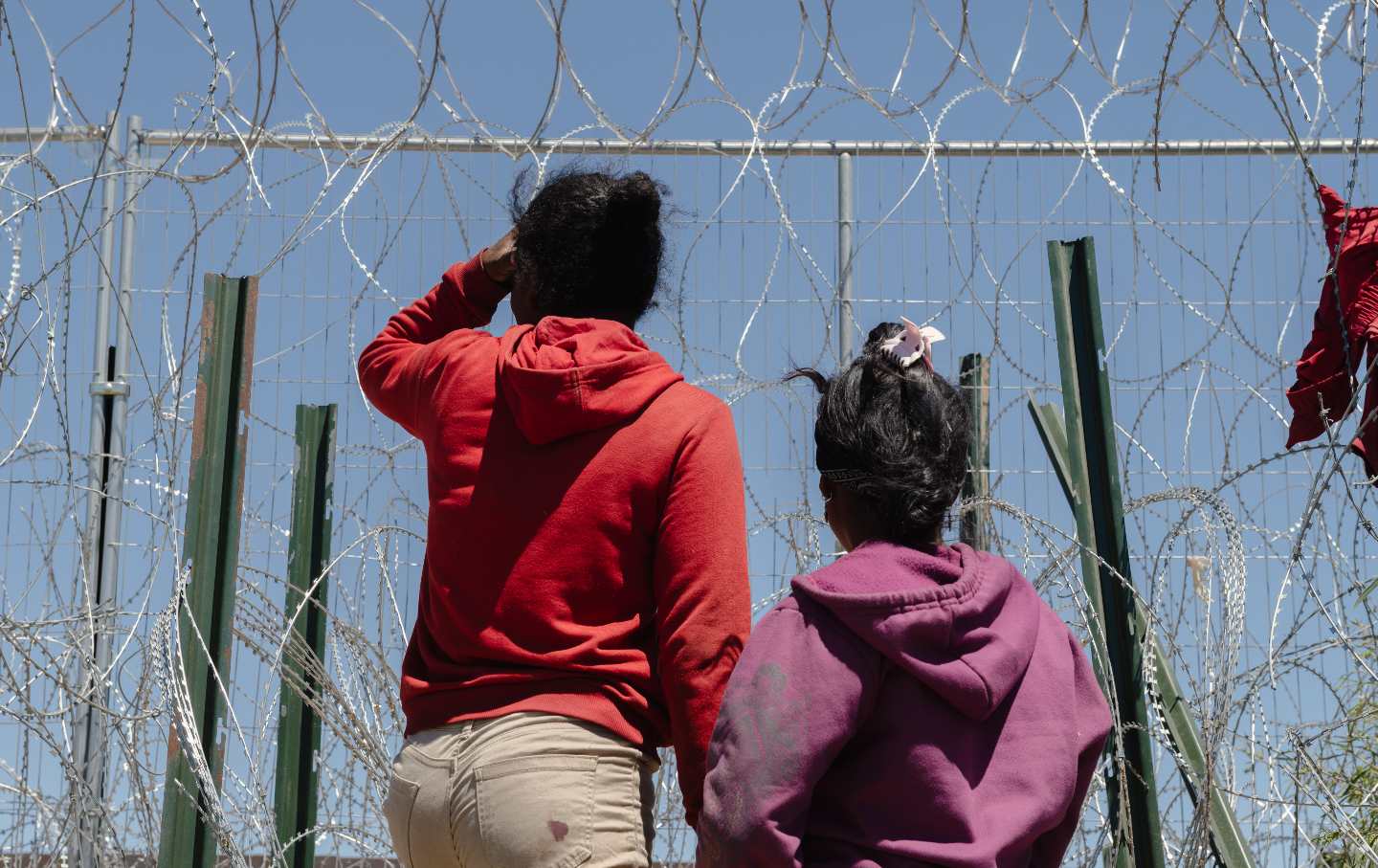
Children look through razor wire after crossing the US-Mexico border.


(Justin Hamel / Getty)

As an undocumented high school sophomore in El Paso, Texas, Sofia has been considering applying exclusively to out-of-state colleges. “I have lived in El Paso since I was a year old. This city has become my home,” she said. “There is no reason I would remain and place myself in so much danger just by existing.”

Sofia was referring to Texas’s Senate Bill 4. Passed in 2022, the law would make unlawful border crossings a state crime and give Texas police officers the power to engage in immigration enforcement, including detaining those suspected of being non-US citizens or having crossed the border without permission. “Police may charge individuals with a new state crime of ‘illegal entry’ to Texas, punishable by up to 6 months in jail,” according to the American Civil Liberties Union.

Initially set to go into effect in March, SB 4 was temporarily delayed in the face of ongoing legal battles around its constitutionality. The ACLU called it “one of the most extreme pieces of anti-immigrant legislation any state legislature has ever enacted,” and filed a lawsuit along with the Texas Civil Rights Project in December to prevent the law from going into effect.

The Department of Justice has since joined the lawsuit, and the US Court of Appeals for the Fifth Circuit Court ruled to keep a block on SB 4 while it unfolds. The process has left Texas’s large immigrant population uncertain and in fear—especially undocumented youth.

Some, like Sofia, are reconsidering remaining in Texas if the bill passes. “This is probably exactly what Texas wants,” said Sofia. “To deter people like me from being here.”

SB 4 follows SB 16, the state’s ban on Diversity, Equity, and Inclusion initiatives, which went into effect on January 1 and prompted many young people to avoid going to Texas colleges. “This is compounded with other recent legislation against the LGBTQ population and women that is going to deter a lot of people from coming to Texas,” said Carlos, a 19-year-old trans man who attended high school in Brownsville, Texas.

Jennifer Babaie, the director of advocacy and legal services at Las Americas Immigrant Advocacy Center, based in El Paso, Texas, said that she has already seen people relocate because of the bill. “Back in March, an advocate [with Las Americas] who was a migrant herself chose to flee to New Mexico.”

“I cannot think of any reason someone would advise an undocumented person to remain in Texas if this bill went into effect,” said Sofia. “When you have an opportunity to leave, like college, that many undocumented people do not get, there is no reason I would not take it.”

Immigrant advocacy groups have criticized the bill for promoting racial profiling. Evelyn, a 20-year-old undocumented student from Honduras, said that the possibility of being pulled over for something minuscule that can turn into something more serious has created “a lot of anxiety, fear, and uncertainty.” Babaie calls the bill “an open license to question whether or not someone fits in. We don’t see or believe it is possible to implement this law without engaging in unlawful racial profiling.”

“The valley is a very Hispanic community,” said Carolina, an 18-year-old from Mattamorros who spent all of high school crossing the border to attend school in Brownsville. Her family consistently crosses the border for work and school and already faces hostile reactions from Customs and Border Protection officials because of their accents and skin color, she says. “If they’re questioning whether you have papers to be here if you look foreign, they would pull people over left and right.”

While going to school in the US, Carlos lived across the border in Matamoros, Mexico. “Even before SB 4, I was always so scared of forgetting my passport because that was the only thing that would keep me safe. Sometimes I worried that might not be enough,” he said. “Today, that’s even more possible.”
Disobey authoritarians, support The Nation

Over the past year you’ve read Nation writers like Elie Mystal, Kaveh Akbar, John Nichols, Joan Walsh, Bryce Covert, Dave Zirin, Jeet Heer, Michael T. Klare, Katha Pollitt, Amy Littlefield, Gregg Gonsalves, and Sasha Abramsky take on the Trump family’s corruption, set the record straight about Robert F. Kennedy Jr.’s catastrophic Make America Healthy Again movement, survey the fallout and human cost of the DOGE wrecking ball, anticipate the Supreme Court’s dangerous antidemocratic rulings, and amplify successful tactics of resistance on the streets and in Congress.

We publish these stories because when members of our communities are being abducted, household debt is climbing, and AI data centers are causing water and electricity shortages, we have a duty as journalists to do all we can to inform the public.

In 2026, our aim is to do more than ever before—but we need your support to make that happen. 

Through December 31, a generous donor will match all donations up to $75,000. That means that your contribution will be doubled, dollar for dollar. If we hit the full match, we’ll be starting 2026 with $150,000 to invest in the stories that impact real people’s lives—the kinds of stories that billionaire-owned, corporate-backed outlets aren’t covering. 

With your support, our team will publish major stories that the president and his allies won’t want you to read. We’ll cover the emerging military-tech industrial complex and matters of war, peace, and surveillance, as well as the affordability crisis, hunger, housing, healthcare, the environment, attacks on reproductive rights, and much more. At the same time, we’ll imagine alternatives to Trumpian rule and uplift efforts to create a better world, here and now. 

While your gift has twice the impact, I’m asking you to support The Nation with a donation today. You’ll empower the journalists, editors, and fact-checkers best equipped to hold this authoritarian administration to account. 

I hope you won’t miss this moment—donate to The Nation today.

Onward,

Katrina vanden Heuvel 

Editor and publisher, The Nation

Lajward Zahra

Lajward Zahra is a sophomore at Rice University. Her work can be found in Teen Vogue, The Nation, Business Insider, and The American Prospect, among others.

More from The Nation

What to Do With the Ballroom in 2029?

What to Do With the Ballroom in 2029? What to Do With the Ballroom in 2029?

Kristi Kremed.

Steve Brodner

The Supreme Court Has a Serial Killer Problem

The Supreme Court Has a Serial Killer Problem The Supreme Court Has a Serial Killer Problem

In this week's Elie v. U.S., The Nation’s justice correspondent recaps a major death penalty case that came before the high court as well as the shenanigans of a man who’s angling...

Elie Mystal

House minority leader Hakeem Jeffries speaks at a news conference at the Capitol on December 1, 2025.

Corporate Democrats Are Foolishly Surrendering the AI Fight Corporate Democrats Are Foolishly Surrendering the AI Fight

Voters want the party to get tough on the industry. But Democratic leaders are following the money instead.

Jeet Heer

Marching Against a Corrupt Regime

Marching Against a Corrupt Regime Marching Against a Corrupt Regime

People taking to the streets for democracy.

OppArt / Josh Gosfield

Attorney General Pam Bondi, Vice President JD Vance, Defense Secretary Pete Hegseth, and Homeland Security Secretary Kristi Noem flank Donald Trump during an executive order signing in the Oval Office, on August 25, 2025.

It Would Be Madness to Give Trump and His Toadies Even More Power It Would Be Madness to Give Trump and His Toadies Even More Power

And yet, that’s what the Supreme Court appears prepared to do.

Sasha Abramsky

Miami Mayor-elect Eileen Higgins speaks to supporters as she celebrates her victory at her election-night party held at the Miami Women's Club on December 9, 2025.

Trump Is Dragging Republicans to Crushing Defeat After Crushing Defeat Trump Is Dragging Republicans to Crushing Defeat After Crushing Defeat

The president is deeply unpopular, his policies are failing, and Republicans are losing—everywhere.

John Nichols