Showing Contempt for Young Voters Is a Great Way for Democrats to Lose in November
Hillary Clinton’s arrogance already lost one election. And if Joe Biden follows her example, it can easily cost another.
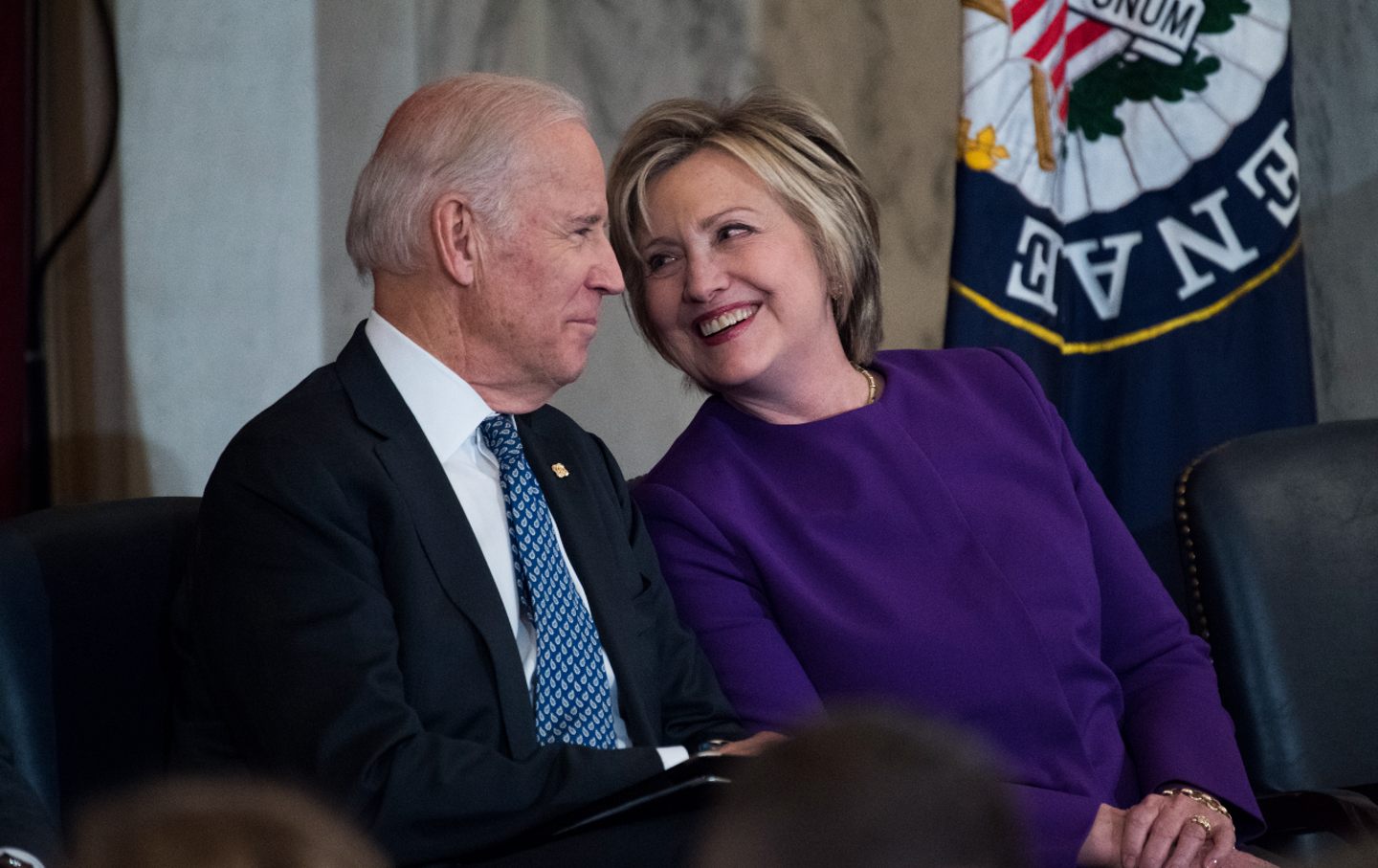
Contempt for the Democratic Party’s progressive base is a sure path to Donald Trump’s return. A specter haunts the Democratic Party: the ghost of Clintonism, an ideology that’s been discredited at the ballot box yet still retains a mysteriously powerful hold on party elders. Hillary Clinton’s defeat in 2016, when she lost a winnable election to a political novice who scored the highest disapproval polling numbers in modern American history, should have sounded the death knell for her brand of politics. Clintonism is all about triangulation—which in practice means building elite comity with establishment Republicans while disdaining populist forces on the right or the left. Pioneered by Bill Clinton in the 1990s with his attack on the rapper Sister Souljah, this strategy initially enjoyed some success—but in the long run it undermined the Democratic coalition, especially as the price of free trade started to be felt by the working class.
In 2016, Hillary Clinton scorned Trump’s supporters as “a basket of deplorables” and was equally dismissive of Bernie Sanders’s voters, telling a confidant that “at least white supremacists shaved.” In other words, the young people who rallied to Sanders because they wanted universal healthcare were just dirty hippies. In answer to Trump’s opportunistic but politically potent economic populism, Clinton offered the smugly complacent slogan “America never stopped being great.”
This disdain, both for working-class whites whose lives had become precarious as a result of the neoliberalism championed by her husband and for young progressives who sought to break the neoliberal consensus, was matched by an eager courting of suburban Republicans. Corporate Democrats thought this overwhelmingly white constituency could be won over by a mixture of performative revulsion at Trump’s personal vulgarity and nationalist celebrations of foreign-policy hawkishness. The elevated spot given to Michael Bloomberg, the formerly Republican ex-mayor of New York City, and a parade of retired military officers at the 2016 Democratic National Convention was one visible manifestation of this strategy. New York Senator Chuck Schumer fatefully summed up the calculus when he declared, “For every blue-collar Democrat we lose in western Pennsylvania, we will pick up two moderate Republicans in the suburbs in Philadelphia, and you can repeat that in Ohio and Illinois and Wisconsin.” Schumer’s faux-sophisticated strategy led to Ohio’s solidifying as a Republican stronghold and the once-mighty blue wall’s crumbling in Pennsylvania, Wisconsin, and Michigan. If the Democrats keep on with this brilliant approach, they might even end up losing Illinois one day.
While Clinton won the popular vote in 2016, she shattered the Obama coalition—which wreaked havoc on the Democratic Party in the Electoral College. Trump’s victory had many causes, but the Clintons’ hostility toward large parts of the Democratic coalition stands out as an unforced error, especially egregious because it was a choice. Hillary Clinton chose to continue within a neoliberal framework—a political philosophy that complemented her eagerness to shake the money trees of the ultrarich in the Hamptons.
Joe Biden’s success in 2020 was due in no small part to his deliberate rejection of Clinton’s failed strategy. “Scranton Joe” courted both Sanders voters and blue-collar whites. He promised expanded infrastructure spending and tougher trade deals. Progressive young people might not have given Biden their votes in the primaries, but he campaigned as a candidate who saw them as part of his coalition and duly won their votes on Election Day.
One side effect of Israel’s ongoing war in Gaza is that it has given Clintonism a new lease on life. Until early May, Biden gave Israel a virtual blank check to fight a ferocious war with massive civilian casualties. This has been enormously unpopular with young people and nonwhite voters, splintering the Democratic coalition anew. A Times/Siena poll in early May showed Biden trailing in the swing states of Michigan, Arizona, Nevada, Georgia, and Pennsylvania.
Perhaps sensing an opportunity, Hillary Clinton has reemerged like the ghost of elections past with incendiary rhetoric designed to deepen the contradictions within the Democratic coalition. On May 9, she told MSNBC host Joe Scarborough, “I have had many conversations, as you have had, with a lot of young people over the last many months now. They don’t know very much at all about the history of the Middle East, or frankly about history in many areas of the world, including in our own country.” Alas, Biden himself has joined in the student-bashing with his own hyperbole about the extent of antisemitism and violence in the pro-Palestinian protests.
Leaving aside the fact that Clinton—who, like Biden, voted for the disastrous Iraq War in 2002—has no great claim to being a scholar of the Middle East, her insulting language seems deliberately designed to dismiss progressive young people horrified by what is happening in Gaza from the Democratic coalition. Since 75 percent of Democrats disapprove of Israel’s onslaught in Gaza, Clinton is in fact articulating a politics of open scorn for the overwhelming base of the party.
Who will replace the young people that Clinton regards as dunces? In 2016, the pitch was made to suburban Republicans of the Never Trump persuasion. In 2024, this has been recast as the Biden campaign’s attempts to appeal to Nikki Haley Republicans. This strategy only makes sense as a response to Biden’s loss of support among young people and nonwhite voters.
Clintonian triangulation failed in 2016, and it will fail again in 2024. You simply can’t win as a Democratic presidential candidate by giving the back of your hand to large parts of your own coalition. Joe Biden understood that in 2020—but tragically seems to be suffering from memory loss in 2024.