
Asking someone at a party how much they make in a year might get you a weird look. Asking someone about their salary at work might get you fired. Seem unfair? Don’t bother complaining: Washington just once again reaffirmed the boss’s inalienable right to punish workers for talking about whether they’re being treated fairly.
In a narrow vote this week, the Senate politely smothered the Paycheck Fairness Act, which would have protected workers’ rights to compare and discuss their wages at work. Aimed at dismantling workplace “pay secrecy” policies, the legislation built on the 2009 Lily Ledbetter Fair Pay Act, which strengthens safeguards for women and other protected groups against wage discrimination. Both measures aim to fill gaps in the enforcement of longstanding civil rights laws, which, half a century on, are still failing to combat the most insidious forms of discrimination—the subtle labor violations that grease the gears of economic inequality. Wage discrimination has persisted in large part because workers are routinely discouraged or outright banned from discussing compensation levels with coworkers.
The Paycheck Fairness Act would have shielded workers from retaliation if they discuss their salaries with coworkers. Employers would have had to “prove that pay disparities exist for legitimate, job-related reasons,” according to the National Partnership for Women & Families. In addition, the bill would have closed disparities in the legal remedies available for violations of the Equal Pay Act, so workers could claim the same kinds of damages provided under other wage discrimination laws. And overall, workers would have had an easier time seeking compensation in federal court, rather than the bureaucracy of the National Labor Relations Board, which tends to yield weaker penalties.
The bill would also have directed the Labor Department and Equal Employment Opportunity Commission to proactively gather data and investigate wage discrimination on a broader scale.
To partially offset the Senate defeat, President Obama signed two executive orders that placed similar mandates on federal contractors, but while that would cover a substantial chunk of the workforce, many millions of workers may remain effectively gagged at work.
Popular
"swipe left below to view more authors"Swipe →
Yet making pay fair is not just a matter of correcting payrolls. Despite all the handwringing on Capitol Hill around the oft-cited seventy-seven-cents-to-a-dollar figure, the restrictions of speech in the workplace attest to a more systemic power imbalance.
According to a 2003 study, “Over one-third of private sector employers…recently surveyed admitted to having specific rules prohibiting employees from discussing their pay with coworkers. In contrast, only about 1 in 14 employers have actively adopted a ‘pay openness’ policy,” which explicitly protects workplace discussion of wages. A 2011 survey estimated that 50 percent of workers are subject to some kind of restriction on discussing their pay with coworkers—slightly more women than men, with the largest concentration among private sector workers (about 60 percent, compared to less than 20 percent of public workers). The gaps vary along demographic lines: women workers, single parents and married childless women tend to face higher rates of these secrecy controls than do married mothers. And although civil servants generally had far lower rates of pay secrecy, the practice was more prevalent among women in the public sector.
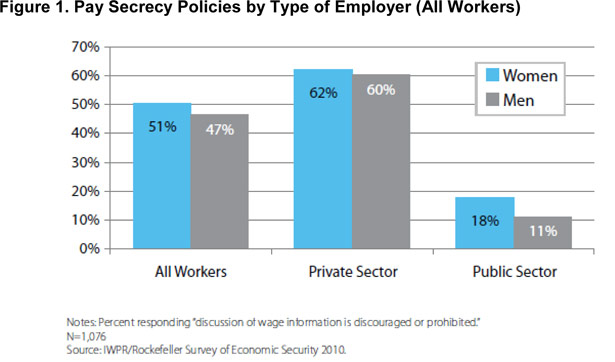
(Courtesy: Institute for Women’s Policy Research)
Many of these workers will never even know that they’ve unfairly benefited from or suffered from unequal pay. Ultimately, the big winner in this game of secrecy is the boss, who profits directly from the ignorance and pliability of workers who don’t grasp their own economic situation.
So there’s a gap between what’s fair and what’s legal. Discussing wages in a private workplace isn’t technically covered by any First Amendment guarantee against censorship, but the issue of pay secrecy raises crucial questions about workers’ freedom to learn and communicate about their labor conditions.
In unionized workplaces particularly, where there is additional protection for organizing-related activities, the National Labor Relations Board and the civil courts have consistently sided with workers, ruling that under the National Labor Relations Act, wage discussions should be considered “concerted activity for the purpose of collective bargaining or other mutual aid or protection.”
Marianne DelPo Kulow, a Bentley University law professor who has researched wage discrimination, explains via e-mail that the right to discuss pay generally hinges on federal labor law, not the Constitution, per se:
This right is premised not on the First Amendment but instead on the notion that workers are in the best position to know whether their employer is following the law and so such conversations not only protect workers but also ensure enforcement of workplace laws and regulations.
But of course, the perennial chicken and egg dilemma is that workers are reluctant to seek this knowledge, or simply are unaware, or in denial, that they might be getting cheated.
Lily Ledbetter had been a loyal employee of Goodyear Tires for nearly two decades before she discovered she had been underpaid for years. What angered her most wasn’t the lost pay but the betrayal of her economic dignity.
“When I was hired they let me know that if I discussed my pay, I wouldn’t have a job. So I had no way to know,” she said in a 2012 interview on One Thing New. When the 60-year-old Alabama mother realized (thanks to an anonymous tip) that she had been paid less as a plant supervisor than male coworkers, she recalled, “I felt devastated. Humiliated…. It just really made me sort of sick that all this time I had been getting awards and being told I was doing a great job, and no one had ever said I wasn’t making what I should be. I had no idea how much less.”
Employers have defended their restraints on workplace speech as a business prerogative, as if payscales were “trade secrets,” or by suggesting that too much disclosure leads to “jealousies and strife among employees.”
In other words, if workers really knew what their bosses were doing, their anger would start to unravel the complacency, along with ingrained fear and anxiety, that employers use to keep their labor obedient and their production chains running smoothly.
The struggle for fair pay isn’t captured in wage statistics; it’s part of a struggle against the asymmetry of knowledge that divides management and labor—and fundamentally, a struggle for a democratic workplace. In the economic superstructure, the real depths of of the wealth gap are not between coworkers but between workers and the CEOs on top. Yet those stunning inequalities are not contemplated in any legal concept of “paycheck fairness.” Workers are, of course, trained to view such inequalities as central pillars of the corporate edifice, just as society has normalized the interlocking inequalities in race and gender that are plainly on display in our communities and workplaces every day.
Whether we’re cheated through clandestine wage discrimination, or facing institutionalized racial and gender segregation, we’re surrounded by reasons for “jealousy and strife”—all hiding in plain sight. But the core social mechanics that drive inequality at all levels of the economy are not so visible, thanks to the rules that enforce our collective blindness.

