
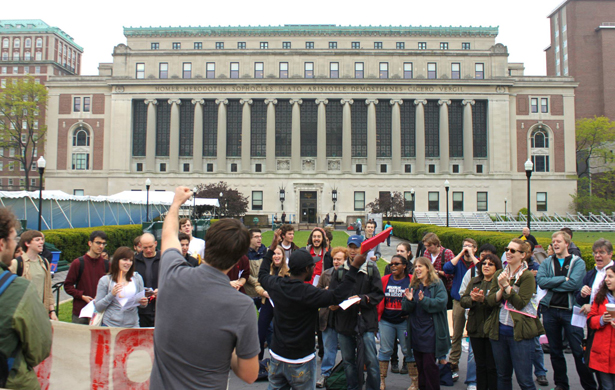
Photo courtesy: Swara Salih
Throughout the world, May 1 means Labor Day: a day to celebrate the contributions of workers and to protest for more equitable conditions. At Columbia, May 1 means that it’s time to start cramming for finals. But uptown from Occupy’s epicenter, a group of Columbia students abandoned their books and papers for the day to express international solidarity this past Tuesday.
More than one hundred Columbia students congregated in the middle of campus to express solidarity with labor and their own personal frustrations with an economy that is run increasingly by the 1%, for the 1%, before heading down to Union Square to join the massive Occupy protest there.
As students and some faculty gathered despite morning drizzle in front of a large banner that read "Columbia Solidarity," students called out the reasons they had come. "To stand in solidarity with labor," said one. "Because no one is illegal," shouted another. "For better education." "To end student debt." The reasons students came to protest were varied, but all of them indicted a system which is increasingly putting the American Dream out of their own reach and out of the reach of millions of Americans.
Student responses gave an answer to a question which hung heavy in the air: is May Day relevant anymore? Yoni Golijov, an organizer of Columbia’s protest and member of the Columbia-Barnard International Socialist Organization, gave the crowd a brief history of May Day in the United States. The first May Day was celebrated in 1886 with a general strike when unions declared that 8 hours should constitute a legal workday. But with deindustrialization and globalization, with the rise of the service industry and the decline of unions, in an age when America’s two biggest employers are Walmart and a temp agency, does a day of protest for labor make sense anymore?
The answer, not just according to Columbia students but also to the thousands of protestors who came out citywide, is a resounding yes. "May Day is more important and more relevant today than it has been in the past 80 years," said Austin Heyroth, a freshman and Columbia Democrats member. "Real wages for most Americans have stagnated since the 1970s and the gap between the richest and everybody else makes it look like we’re in the Gilded Age."
Golijov concurred. "Obviously, we need to keep fighting. Obama isn’t going to legislate an 8-hour workday. We got what gains we have by protesting and agitating." Golijov did not wholly reject the political system, however, saying, "We can work with and push Obama and the Democrats."
Eric Foner, noted professor of history at Columbia, Nation magazine editorial board member and Pulitzer Prize winner, agreed with Golijov. "Obama needs radical pressure. Lincoln needed the abolitionists in order to be Lincoln. FDR needed labor, and maybe even the Communist Party, to achieve the New Deal."
In his remarks at the demonstration, Foner placed the modern-day Occupy movement in a tradition of American radical protest dating back to the American Revolution. Foner invoked figures like abolitionist Frederick Douglass and socialist Eugene Debs as "people we can and must admire" who changed the system through their actions. To Foner, and to many of the student activists gathered at Columbia, the Occupy movement is the logical heir of such radicals.
One distinctive characteristic of the Occupy and labor rights movements which students identified is its inclusivity. "No one is above these kinds of issues," explained a graduating senior. Privileged Columbia graduates are still hampered by an economy in which they can’t get jobs commensurate with their education. This May Day also had the distinction of bringing together immigrants and workers in the same demonstrations; previous May Days had seen two separate marches. The worker’s rights movement is not becoming irrelevant, it is evolving in a world where fewer workers are unionized, more people are immigrants (documented or undocumented), and the economy is increasingly devoted to the enrichment of a few at the expense of the majority.
"We can’t think big and act small," said one student. And by protesting on campus and then joining the demonstrations downtown, by calling for decent hours, salaries, and working conditions regardless of industry, and by refusing to stay silent in the face of ever-increasing inequality, Columbia students are doing big things.

