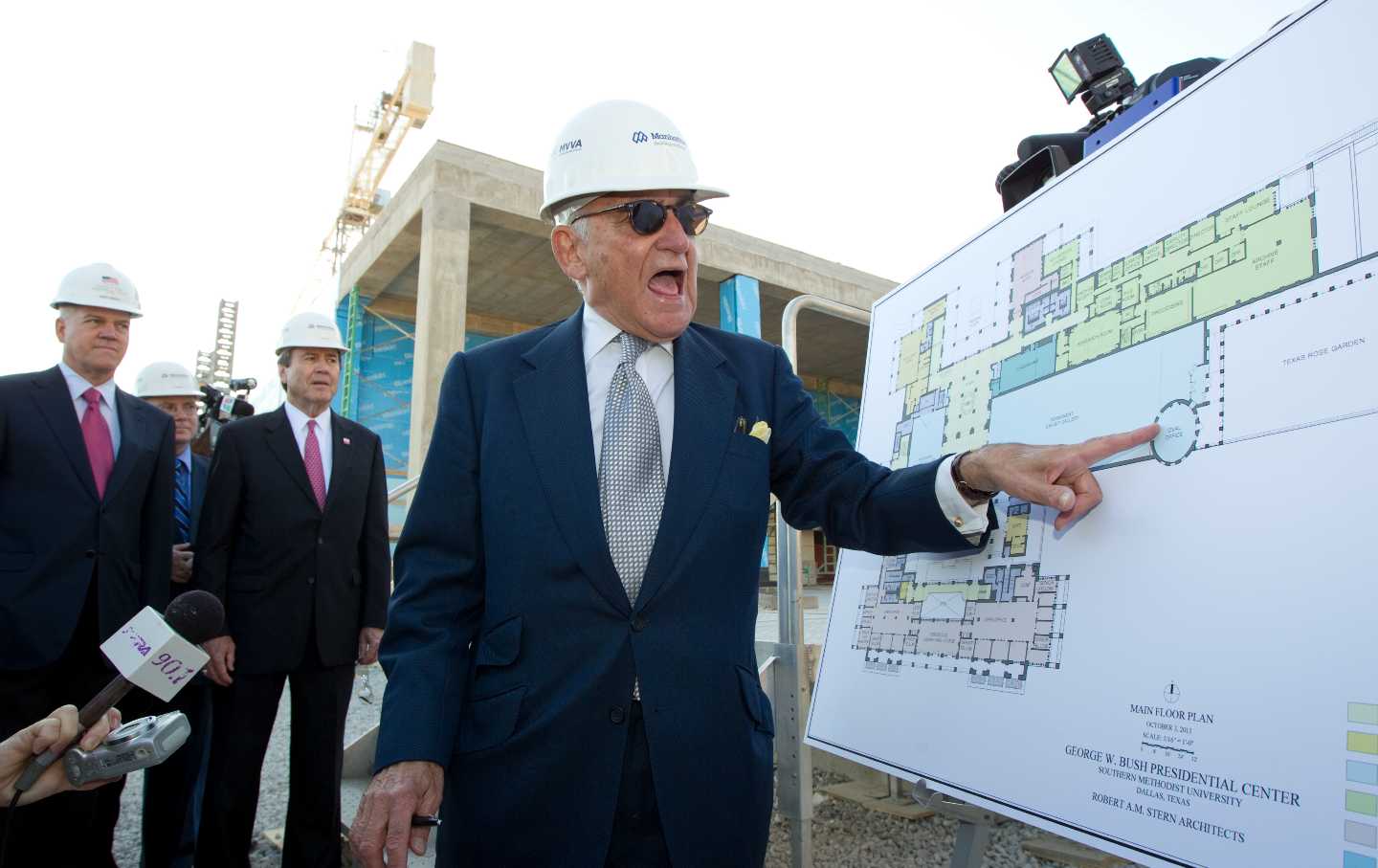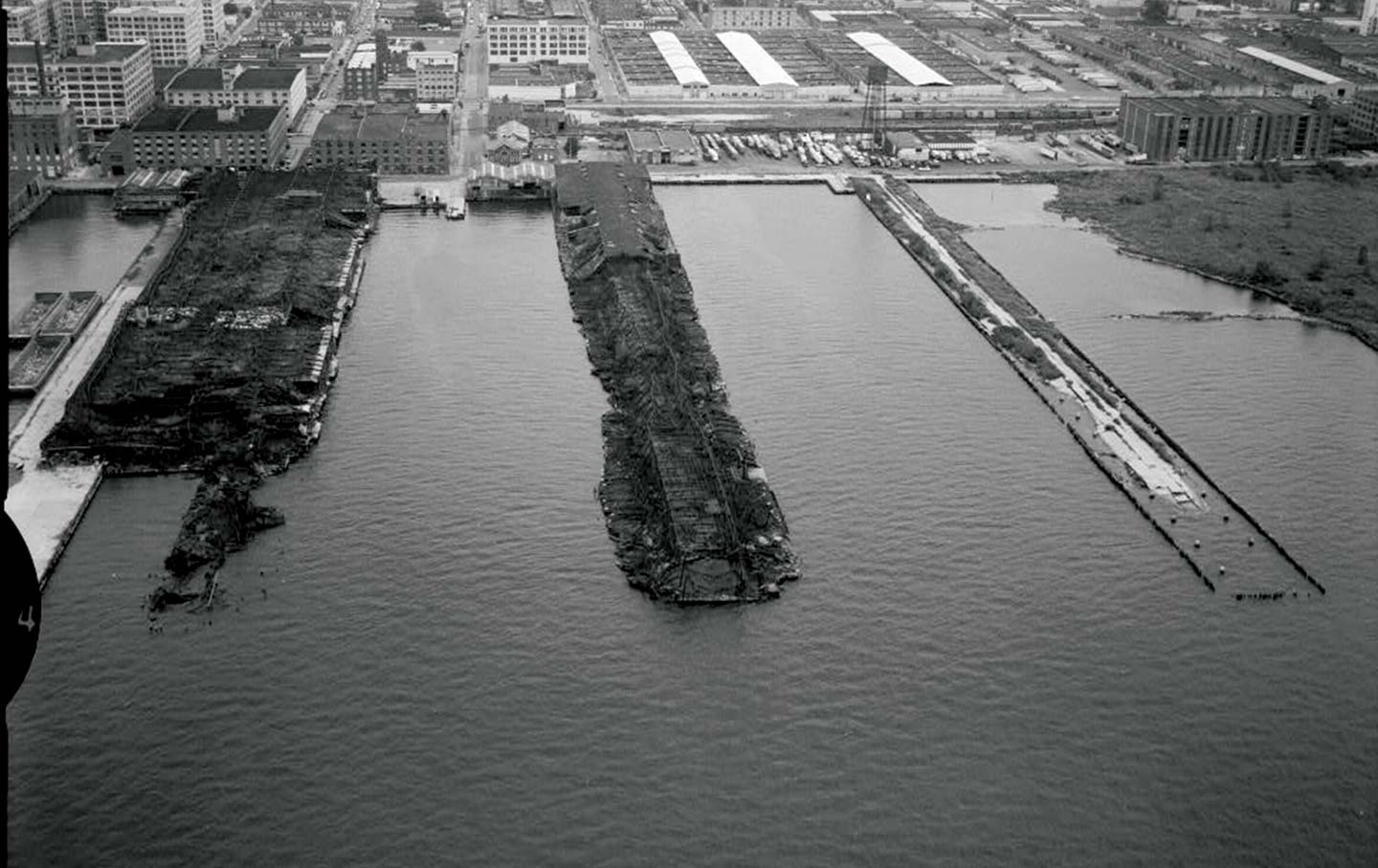
The World Trade Center paved over a patchwork of industrial docks and community businesses to become a planned community catering to high finance.
How the World Trade Center turned Manhattan into a planned community.
There's more to the legend of Jane Jacobs than her showdown with Robert Moses.
Across the border from San Diego in Tijuana, a spontaneous urban space is taking shape off the radar of city planners, as an affluent city sheds its aging houses and its pieces are reassembled into creative dwellings for the poor.
Taking stock of the new New Museum.
A retrospective exhibition of Martin Puryear's sculptures reinvents MoMA's signature atrium space as a site for spiritual longing.
Michael Rakowitz talks about his art, the possibility of public space and the Iraq War.
As conditions worsen inside Baghdad's embattled Green Zone, construction continues on a grandiose US Embassy complex that mirrors Bush Administration delusions of a reordered Middle East. Take a virtual tour.
A tribute to Jane Jacobs's extraordinary vision of urban life and her
passionate care for people and places.
New Orleans did not die an accidental death--it was murdered by
deliberate design and planned neglect. Here are twenty-five urgent
questions from the people who live in a city submerged in anger and
frustration.
Argues that accusations from the right have delayed the construction of two cultural institutions called for in architect Daniel Liebeskind's plans for the World Trade Center site in New York City. Report that the cultural center was to house two of four organizations chosen by the Lower Manhattan Development Corporation, including the Drawing Center art museum and the International Freedom Center (IFC); Report that the Drawing Center was driven away after censorship-like demands for oversight; Demands placed on the IFC by Governor George E. Pataki that the IFC not present exhibits that denigrate the U.S., New York or freedom; Reference to an article by Debra Burlingame in the "Wall Street Journal" that criticized the IFC; Criticism of the IFC for agreeing to Pataki's demands and for being unwilling to say a word in favor of freedom of expression.
The author criticizes documentary filmmaker Errol Morris for failing to take former Defense Secretary Robert McNamara to task for his role in the Vietnam War and other alleged abuses of power during interviews for Morris' documentary, "The Fog of War." McNamara survived the 1960s, when he contributed more than most to the slaughter of 3.4 million Vietnamese (his own estimate). He went on to run the World Bank, where he presided over the impoverishment, eviction from their lands and death of many millions more round the world. And now here he is, the star of Errol Morris's much-praised documentary, talking comfortably about the millions of people he's helped to kill. It reminded me of films of Albert Speer, Hitler's architect and then head of war production. It's good to have a new generation reminded of history's broad outlines, like the firebombing of Japanese cities and Vietnam, but I don't think Morris laid a glove on McNamara, who should be feeling well pleased. Like Speer, he got away with it yet again. Why did Defense Secretary McNamara overrule all expert review and procurement recommendations and insist that General Dynamics rather than Boeing make the F-111? The Six-Day War? The crucial OK came from McNamara, thus launching Israel's long-planned, aggressive war on Egypt, Jordan and Syria, which led to present disasters. And no, Morris didn't quiz McNamara on Israel's deliberate attack on the US ship Liberty during that war. We have so many sponsors of mass murder hanging around, it would be nice to see one of them, once in a while, take a real pasting., U.s. History -- The Cold War & Societal Change (1945-2000), Mcnamara, Robert, United States -- History -- 1961-1969, Vietnamese Conflict, 1961-1975, Morris, Errol, Fog Of War, The (film), Johnson, Lyndon Baines, Mass Murder, Israel -- History -- 1967-1993, Political Corruption, United States, Robert Mcnamara, United States -- History -- 1961-1969, Vietnamese Conflict, 1961-1975, Errol Morris, Fog Of War, The (film), Lyndon Baines Johnson, Mass Murder, Israel -- History -- 1967-1993, Political Corruption
Presents motion picture reviews. "The Revolution Will Not Be Televised," directed by Kim Bartley and Donnacha O'Briain; "The Matrix Revolution," directed by Andy and Larry Wachowski and starring Keanu Reeves and Laurence Fishburne; "My Architect," directed by Nathaniel Kahn.
In late November, the journalism department at New York University hosted a forum on Iraq. The first five speakers, who included such liberal luminaries as historian Frances FitzGerald, cultural critic Todd Gitlin, former UN official Brian Urquhart and political scientist Michael Walzer, all expressed varying degrees of skepticism about the wisdom of invading Iraq. Then it was Kanan Makiya's turn. The son of a prominent Iraqi architect who came to this country in the late 1960s to attend MIT and never left, Makiya has spent the past fifteen years publicizing the horrors taking place in his native land. In 'Republic of Fear' (1989) and 'Cruelty and Silence' (1993) he chronicled the instruments of repression used by Saddam Hussein to brutalize his people and to suppress the Kurdish and Shiite uprisings after the Gulf War. He discussed the steps he and other Iraqi exiles were taking to convince the Bush Administration to make the installation of a democratic government in Baghdad one of its chief war aims. The Bush Administration's preoccupation with Iraq is similarly distracting it from the ongoing violence in the Middle East. There's the fundamental fact that we have not been attacked by Iraq--a major distinction with Afghanistan and Al Qaeda. One nonviolent alternative, proposed recently in these pages by Andrew Mack (a former aide to UN Secretary General Kofi Annan), would seek to bolster the internal Iraqi opposition by lifting most of the sanctions on Iraq and opening up the country to foreign investment and other forms of international engagement. A more hardheaded policy of "containment-plus," proposed by Morton Halperin and others, would combine an expansion of the no-fly zones in Iraq to cover the entire country, more intensive surveillance and inspections, and the use of precision airstrikes against targets not destroyed voluntarily on the ground.
This article presents information on the book "The Rock: A Tale of Seventh-Century Jerusalem," by Kanan Makiya. This book is a beautifully crafted fictionalized account of the Muslim conquest of Jerusalem, related by Ishaq, the architect of the Dome under which the Rock of Foundation now lies. To call it a novel, however, is misleading. It is more a performance, and a highly political one too. The Rock is a chapter in Makiya's complex political program. Principally, Makiya causes concern to his fellow Arab exiles because he has turned their most powerful conceptual tool on its head, and against them. The notion that the West has unconsciously condescended to the Muslim world since first encountering it in the early modern period.
This article focuses on the preference of greener architecture. Every architect wants to build green, one would-be organic architect says longingly, listening to speakers at a conference on Building Energy 2001. Sponsored by the Northeast Sustainable Energy Association at Tufts University, the assembly was one of two events pulling in record numbers of builders looking to tread more lightly on the land. The second, Sustainable Communities by Design, the Southface Energy Institute's annual Greenprints meeting in Atlanta, likewise drew green-minded carpenters-sick-building doctors, clean-air experts, developers, engineers and construction firms-as well as professional architects, landscape architects and planners with a growing green agenda.
The article presents information on the author's experience with murals. Since the days when nearly 80,000 literacy volunteers fanned out across the nation, muralists from twenty-two countries have gone forth. Teaching people to read, cutting coffee and painting murals were equivalent ways of expressing solidarity. Artist Silvia Cluevara told the author last December that the Nicaraguan people learned history from murals, much as U.S. residents learn it from architect Oliver Stone. Murals must have, in other words, an interpretation of history.
The article focuses on the book titled "Julia Morgan, Architect," by Sara Holmes Boutelle. It states that this biography is an exemplary work in the American success-story genre, a story of application and virtue appropriately rewarded. The eldest daughter of a mining engineer of varying fortunes, Julia Morgan was sent to public schools in Oakland and to the nearby University of California. There is no evidence of her being a prodigy, although as an engineering student at Berkeley in the 1890s she was sufficiently outstanding to attract the notice of the philanthropist Phoebe Apperson Hearst, mother of the newspaper baron. It was typical of Morgan's lifelong independence that she declined Phoebe Hearst's offer to pay for her architecture studies, although she would be employed by her later.
This article presents information on the architecture book "House," by Tracy Kidder. The book bears no picture of a house on its cover--just the tools, tool box, saw, level, nails. And no architect either, nor builder or client. After all, an image might undercut its Everyman icon of the house. And icon it is: icon of the American dream, the single-family home stands on its solitary lot. Anonymous, unadulterated by any particular size or shape, it may lack that identifiable form called architecture, but it lives in the mind all the same.
Discusses the book 'Dos Passos: A Life,' by Virginia Spencer Carr. Theme of the book; Details on how the contents of the book were organized; Positive aspects of the book; Negative aspects of the book.