Quantcast

January 8, 2001 | The Nation

In the Magazine

January 8, 2001

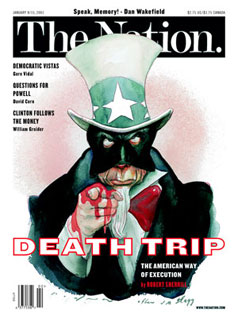
Cover:

Browse Selections From Recent Years

2013

2012

2011

2010

2009

2008

2007

2006

2005

2004

2003

Letters


DIVORCE, AMERICAN STYLE REDUX

Las Vegas

Perhaps I can have the last word on Katha Pollitt's review of Judith Wallerstein's Legacy of Divorce ["Subject to Debate," Oct. 23; "Exchange," Dec. 4]. I'm a sociologist who has written and taught about marriage and family for seven years. Whatever the merits of the methodological debate on Wallerstein, I have my own method of truth, which although nonscientific has proven extremely reliable. Every semester I ask my students to raise their hands if their parents are divorced. As in the rest of the population, around half raise their hands. I then ask them to keep their hands raised if they wish their parents had not divorced. Without exception, all but one or two hands fall. When I ask those who lowered their hands, "Why?" they respond that the stress and conflict of unhappy parents took an intense emotional toll on them.

If the children themselves have no regrets, why should we?

DR. ROBERT MANIS


THE TENNIS, POKER & BLACKLIST BOYS

New York City

The recent moving tributes to the late Ring Lardner Jr. by Victor Navasky [Nov. 27] and Roger Kahn [Dec. 4] encourage me to add my own, as one of Ring's few contemporaries still alive. Ring and I were both born in Chicago on the same day--August 19, 1915.

I was privileged to be part of a poker game that began in the 1950s when Ring and Ian Hunter, with Maurice Rapf and the composer Sol Kaplan, moved to New York after the blacklist drove them out of Hollywood, and included many of the lawyers who defended them, like Martin Popper, Jerry Lurie and his law partner Sidney Cohen. Sidney had invented what came to be known as the "diminished Fifth," which would have permitted answers to the key question raised by HUAC without naming names, which Ring famously said he could answer but that he would hate himself in the morning.

We had all reached the age when we felt that for health reasons we would meet every Thursday to play two hours of tennis at 4 pm before reassembling for poker in the evening. For about thirty years, until we could no longer play either tennis or poker, Thursday became for all of us the high spot of the week. We began by occasionally joining a poker game on 28th Street, dominated by Zero Mostel and his former WPA artist friends, that had begun back in the Depression; but the high decibel level of any game with both Zero and sculptor Herb Kallem drove us to organize our own Upper West Side tennis/poker group. To fulfill our wildest fantasies, we decided to play our first game at a Turkish bath at Al Roon's on West 73rd Street, as suggested by a short story by Irwin Shaw, but we found that the steam melted the cards, and we were forced to rent a room to finish the evening.

For the next thirty years the game was held at Ian's apartment in the Belnord on 86th Street. Ian was a great cook and would sometimes prepare a delicious roast beef for us. Otherwise, the kitty would permit us to order from the Stage Door Delicatessen or the Tip Toe Inn.

When the blacklist was finally broken and Ring could write under his own name, I like to think that we all had a hand in his script for The Cincinnati Kid. After Ring's second Oscar, for M*A*S*H, we all enjoyed hearing that the pendulum in Hollywood had swung to the point that blacklisted writers had become social lions, and some people were now lying that they had been blacklisted.

While we almost never talked about our personal problems all through those years, the weekly meeting became a refuge from a hostile world for those of us who retained the ideals we had formed in the Depression years. In addition to the original group, we were later joined by Bella Abzug's husband, Martin, Peter Bernard and Jesse Reed. Maurice and I, alas, are the sole survivors. The group left an important legacy to our children--to appreciate the joys of living a life of principle.

JAY M. GOULD


WHAT WORKS: METROPOLITICS

Orange, Va.

Thanks to Jay Walljasper for a terrific article ["From the 'Burbs to the 'Hood," Nov. 20] on Myron Orfield and his plans (and achievements) for metropolitics! Orfield explains why, in the words of many a Republican, "schools need more than just money." Schools--all schools--need more money and lots of it. But the concentration of severely poor students in certain schools, not relative underfunding, is key to their relative failure. Vouchers will only aggravate this problem, but voucher proponents have one thing right: Students do better in schools with other students who bring learning from home. Orfield's ideas for regional planning offer an actual solution to this national disaster--the reduction of concentrated poverty.

Walljasper concluded by suggesting we promote metropolitics as something "pragmatic" rather than just. I'm not sure, but it sounds like an underestimation. Increasingly, labor unions and environmental groups are forming blue-green alliances against sprawl, big-box employers, the defunding of mass transit and affordable housing, the lengthening of commuting time and the transfer of jobs to suburban un-unionized companies. "Unions are basically an urban institution," Don Turner, president of the Chicago Federation of Labor told me in arguing for such efforts, which are being led by a group called Good Jobs First (www.goodjobsfirst.org).

At a national conference on living-wage campaigns in Baltimore recently, ACORN discussed building coalitions with environmentalists. Wade Rathke of ACORN and SEIU in New Orleans (where a living wage of $1 above the minimum wage will be on a ballot soon) said, "You cannot separate economic development from income policy." Other conferees recommended working for laws requiring economic development commissions to bring any decision above a certain dollar figure before elected officials for a public vote. In Minnesota a law now requires these commissions to establish criteria for giving out their (that is, the public's) money. With advocates for the working poor pushing such issues, it's hard not to see regional planning as a matter of justice.

DAVID SWANSON


A KVITCH, A KVETCH, A KRECHTZ

Morris Plains, N.J.

Ilan Stavans criticizes Ruth Wisse for neglecting the Sephardic contribution to Jewish literature, but in his own anthology, The Oxford Book of Jewish Stories, less than 10 percent of the authors are Sephardic ["Mr. Sammler's Planet," Nov. 27]. There's a good reason, and it has nothing to do with bias. Modern Jewish literature flourished in Europe among Ashkenazic Jews, because of the influence of the Enlightenment. Few Sephardic Jews lived there. The heyday of Sephardic literature was the Golden Age in Spain, and US Jewish scholars have not neglected these writings, as Stavans claims. They can be found in well-known sources, including Lewis Browne's The Wisdom of Israel, Nahum Glatzer's The Judaic Tradition and Nathan Ausubel's A Treasury of Jewish Poetry.

Stavans's claim that Jews have not created their own literary canon is also questionable. In addition to his own anthology, which Stavans is perhaps too modest to mention, there are excellent collections edited by Joseph Leftwich, Leo W. Schwarz and Saul Bellow.

Other peculiarities in his review include his characterization of Bialik, the Hebrew poet, as "proto-Zionist" and Wisse's book as "proto-Ashkenazic." In both cases, the prefix "proto" is superfluous. Finally the first name of Peretz, the Yiddish writer, can be written as Yitchak or Isaac, but never "Itzjak," and kvetch is a perfectly good Yiddish word, not "Yinglish." So please accept this kvetch as an antidote to Stavans's.

BENNETT MURASKIN


GIVE THE FALUN GONG A BREAK

New York City

Something weird happens to people of the left persuasion when they travel to countries flying the red star (I know, it happened to me). They tend to lose perspective, as has my old pal Christopher Hitchens, judging by his vitriolic put-down of Falun Gong ["Minority Report," Nov. 20]. How odd that he echoes the language of a Chinese Communist Party campaign of defamation, cult-bashing and false allegations in a crackdown even Hitch calls "clumsy" and "probably counterproductive" (probably?).

Yo, brother, we are talking about more than seventy people dead in police custody so far, and as many as 50,000 detained, many of them subjected to torture and abuse (including being involuntarily tossed into mental hospitals). I have just published Falun Gong's Challenge to China (Akashic Books) and have also produced a film by the same title, which offer an independent assessment of this crisis.

In all my research, I didn't find a shred of evidence to substantiate the state media's accusations that Falun Gong founder Li Hongzhi has used "tricks" to "induce the credulous to part with their money" (Hitchens's words, though they sound like they come from Beijing's People's Daily) or to suggest that these nonviolent practitioners have been programmed to protest. (Remember the civil rights movement?) Ironically, many are pro-party and pro-government and have been appealing for justice from a regime that won't hear them. These folks preach tolerance and compassion. How about showing some?

DANNY SCHECHTER


HITCHENS REPLIES

Washington, D.C.

Danny Schechter--who is not my old pal--can certainly speak for himself when it comes to credulity. He fell for everything from the Khmer Rouge to Clinton, and now the Falun Gong has helped him get in touch with his inner swastika. Check out the FG website (www.falundafa.org) if you think I jest.

CHRISTOPHER HITCHENS


PRONOUNCE IT 'PERFECTION'

Santa Rosa, Calif.

After all these years of wondering, I finally have heard the way to say "Klawans"! The eminent film critic would not divulge this information when a reader wrote in some time back ["Letters," July 19, 1999]. Many of us consider Mr. K the best movie critic in the (small n) nation if not the world, so now when we read a review in his excellent style, we'll know it's Kla-wans. Anyway, so said the MC introducing him during the TMC movie classics program.

CELIA TALBOT


New York City

If you ever fire Stuart Klawans as your reviewer, I'll drop your rag like a Republican Party membership card. In a world gone mad, he is my only idol.

CARL SKUTSCH

Editorials

The power play was swift, effective and ugly. Within hours of Albert Gore's concession, Bill Clinton was moving the levers of insider politics to install his personal money guy, Terry McAuliffe, as the next chairman of the Democratic National Committee. Mr. Albert is already history because Mr. Bill intends to run this party for the next four years. That is terrible news for any hope that the out-of-power Democrats might regenerate themselves as the party of new ideas and fundamental reforms. Clinton will defend his checkered legacy and advance his own unspecified ambitions by dispensing the mother's milk of politics--money--to those Democrats who adhere to his manipulative, hollow style of leadership. Think small, act symbolically. Talk reform, but stick with the New Democrat moneybags on the big economic questions.

Among other things, this move makes a weak joke out of the Democrats' supposed commitment to campaign finance reform. Indeed, it insures that the stench of extralegal money scandals that Clinton-McAuliffe generated will continue to hang over the party. Only now, George Bush's Justice Department will be in charge of the investigations and may show more thoroughness than Clinton's has. Has the statute of limitations expired on the 1996 election and other money schemes connected to McAuliffe? Democrats must hope so if they allow this guy to become nominal party leader.

The DNC has not been a meaningful institution for many years--it's a mail drop for political money, that's all--and normally no one except insiders should care who's in charge. But Terry McAuliffe is special. This man has fabulous connections--he reeks of them--but party-building is not among his talents. He raises big bucks for the Clintons' personal debts and the presidential library, even offered to put up $1.35 million in earnest money for their mortgage. He was leading co-engineer of the 1996 fundraising scandals when Clinton blew out the gaskets on the campaign finance laws, when reformers plausibly argued that the "soft money" law (not to mention perjury laws) had been violated by the Clinton money machine. McAuliffe, furthermore, was named in court testimony by a former DNC finance director as the inside player who repeatedly promoted an illegal money swap between the Teamsters and party donors. Teamsters president Ron Carey, the supposed reformer, was tossed from office, two aides pleaded guilty and a third was convicted. McAuliffe's ascension should provide good grist for Senator John McCain's floor speeches on campaign finance reform.

Party leaders and rank-and-file activists should rise up in anger and reject Clinton's clever ploy, though there is little reason to hope they will do so. This deal is wired at the top. House minority leader Dick Gephardt was an usher at McAuliffe's wedding. Democratic Senate leader Tom Daschle bubbles up with praise. Leaders of organized labor are cozy with Terry, too. They do union business deals and pension-fund investments with him (including one Florida real estate project the Labor Department investigated because, according to the Orlando Sentinel, McAuliffe realized a $2.4 million profit without investing any money of his own). Friendship trumps principle, especially when money makes the friends.

If McAuliffe gets the DNC job, he will be a living window on the party's cynicism. A few weeks ago, its nominee was promising to fight for "the people against the powerful." The election's over--hold that happy talk about "the people" until the next campaign.

We shall see very little of the charmingly simian George W. Bush. The military--Cheney, Powell et al.--will be calling the tune, and the whole nation will be on constant alert, for, James Baker has already warned us, Terrorism is everywhere on the march. We cannot be too vigilant.

Evidence is mounting that the coming twelve months hold the best opportunity for a fundamental change in death-penalty politics since the Supreme Court reinstated capital punishment in 1976. You wouldn't know this from the sclerotic policies of the nation's pre-eminent political leaders. George W. Bush will take the oath of office bearing the all-time record for signing off on executions: forty in Texas this past year. President Clinton, meanwhile, leaves office playing politics with death as surely as he did in the case of Rickey Ray Rector in 1992. Faced with the first federal execution in forty years, Clinton had the chance to impose a moratorium and instead punted with a six-month stay, sticking George W. Bush with the troublesome case of Juan Raul Garza and thus in all likelihood leaving Garza to face lethal injection.

None of these men seem to have noticed how profoundly and rapidly the public's attitude toward capital punishment shifted in 2000. Thanks in part to the Illinois death-penalty moratorium imposed last January by Governor George Ryan, a majority of Americans now seem ready to consider whether capital punishment might be, as Robert Sherrill writes in this issue, a bad bargain in every way. In August an NBC News/Wall Street Journal poll found that 63 percent of Americans now favor a suspension of executions until the fairness of capital trials can be studied. This followed earlier Gallup polls showing that overall support for capital punishment has fallen by about 15 points in the past few years and that nearly half would abandon executions altogether if given the option of life imprisonment without parole. Even Texas's record number of executions bucks a national trend: Executions fell nationwide last year by 13 percent.

Forces and trends that will make capital punishment one of the defining issues of the coming year are converging from several directions. Bush's record in Texas will focus new attention on the Garza case. Even some previously silent Congressional Democrats may see cold political currency in seizing the initiative. Representative Jesse Jackson Jr. and Senator Patrick Leahy plan to reintroduce their national death-penalty-moratorium proposals, which will likely surface just as the Garza case approaches its deadline. Their bills will be propelled by a raft of credible recent studies on flawed convictions.

At the grassroots, capital punishment has suddenly caught fire: Thirty-eight municipalities and more than 1,200 organizations have passed resolutions or referendums calling for a national death-penalty moratorium, including cities on such traditional death-penalty terrain as North Carolina and Georgia. And in the media, the Chicago Tribune, whose revelation of systematic flaws in Illinois death-row justice prodded Governor Ryan to his moratorium, has expanded its ongoing inquiry into capital injustice to the national stage, most recently (December 18) detailing the 1998 Florida execution of Leo Jones, who may well have been an innocent man.

The death penalty has long isolated the United States among Western industrial nations, but Bush's elevation seems certain to escalate tensions. Protests about the plight of Mexican nationals on Texas's death row--people who often spend years without proper consular access--have recently driven a wedge between Washington and Mexico City. In Europe, US executions routinely attain a front-page status rarely accorded them on this side of the water. The European Union, which does not hesitate to sanction its own members for human rights violations, is looking for new avenues to pressure the United States. On December 19 United Nations Secretary General Kofi Annan endorsed the call for a moratorium.

The year 2001 could be the one in which America calls a halt to its long love affair with capital punishment. But the people must make it loudly clear to politicians that the death trip is over.

PROGRESSIVES FRISK IN FRISCO

Tom Gallagher writes: They don't make routs much bigger than the one San Francisco Mayor Willie Brown and allies experienced on December 12. After the runoffs of the city's first district Board of Supervisors elections since the days of Harvey Milk and Dan White, Brown-backed candidates had lost nine of eleven seats to an insurgency built to a considerable extent on Tom Ammiano's remarkable 1999 write-in mayoral campaign and fueled by the widespread perception of a city for sale. While deputy public defender Matt Gonzalez increased his 44-to-28 percent preliminary edge to 66-to-34--despite switching from Democrat to Green in the interim--none of Brown's runoff candidates reached even 52 percent (one drew only 19 percent) despite an overwhelming soft-money advantage.

DEATH ROW SURVIVORS

Scattered through the text of Robert Sherrill's article in this issue are photographs of eight former Illinois death-row prisoners taken by Loren Santow, a Chicago-based, widely published freelance photographer. The photos of men wrongly condemned to death were taken for a poster conceived by Rob Warden, a writer and activist, to publicize the errors endemic to the system. Before the present moratorium and since the restoration of capital punishment in Illinois, twelve prisoners have been executed, and thirteen freed because of innocence or lack of evidence. See Death Row Roll Call on the Nation website (www.thenation.com/deathrow) for a list of inmates awaiting execution and links to register a protest.


NATION
NOTES

We congratulate the following friends who were awarded the National Humanities Medal: Toni Morrison, editorial board member; Barbara Kingsolver, Nation cruise panelist; and Earl Shorris, contributor and founder of classics courses for the poor. And National Medal of the Arts winner Benny Carter, reader.

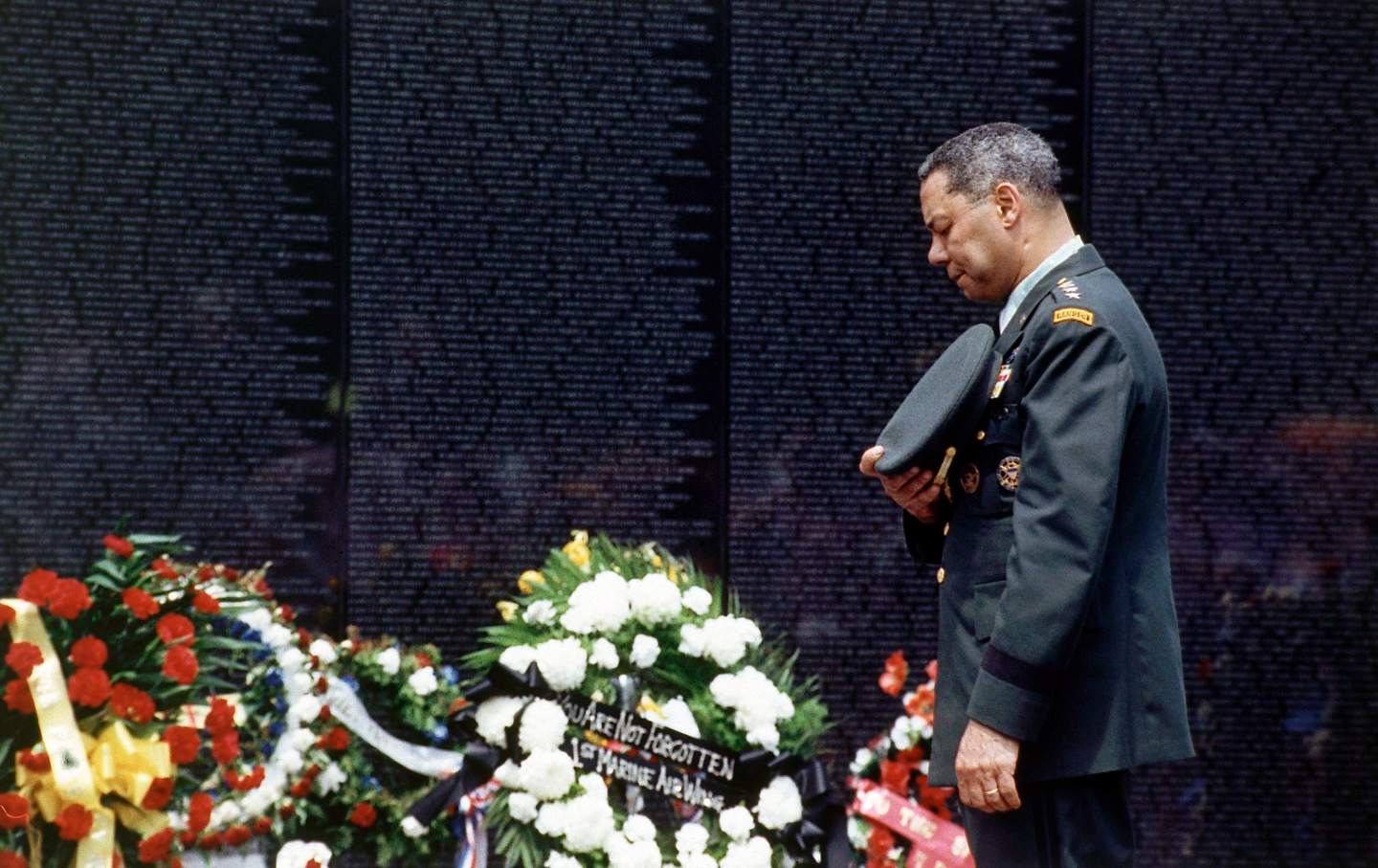
Colin Powell, George W. Bush's designated Secretary of State, is a national icon, with a personal story celebrated by millions. When he hits Capitol Hill for his confirmation, he can expect to receive a fair dose of senatorial genuflection. But the retired general does not deserve hands-off hearings. On policy matters, he may be asked to explain the so-called Powell Doctrine (which calls for an overwhelming use of force when the military is unleashed), his initial skepticism toward US involvement in the Gulf War and his advocacy of a Pentagon budget that would permit the United States to fight two regional conflicts simultaneously. Such matters could be respectfully broached by senators. But there are also some indelicate questions about Powell's past deeds--queries that challenge the image of Powell the Hero--that ought to be posed.

§ My Lai. In July 1968, Powell was sent to Vietnam and assigned to the Americal Division as an executive officer. On March 16, 1968, troops from this division had slaughtered more than 300 civilians in the hamlet of My Lai, and the massacre went unreported. In December 1968, after Powell had been promoted to operations officer at division headquarters, he was forwarded a letter written by Tom Glen, a former GI, who criticized the American military for brutalizing civilians, torturing prisoners and for, "without provocation or justification," shooting at "the people themselves." As The New Republic reported in 1995, Powell was told to check out the allegations, which did not mention My Lai. Powell interviewed a few officers and reported that there was nothing to Glen's assertions. He didn't bother to ask Glen for more specific information. Powell did not mention this inquiry in his 1995 memoir, An American Journey. He did, however, recall the occasion in March 1969, when an Army investigator visited his office and asked to see the enemy-kill records of March 1968. Powell found a high number--128--for March 16 and read the number into the investigator's tape recorder. (That investigator, who was probing specific allegations about My Lai, subsequently reported that there had been no massacre.) In his autobiography, Powell noted that his "curiosity" was aroused by the investigator. But he did not pursue the matter. Why not? And why had he taken a less-than-vigorous approach when conducting the earlier investigation? Why didn't he seek more information from Glen? Once the My Lai story broke in November 1969, why didn't Powell look into whether he had been lied to by his fellow officers? Moreover, what did he learn from this experience about conducting internal investigations within a bureaucracy?

§ Human rights abuses. In the 1980s Powell served on Ronald Reagan's national security team. He was the special military assistant to Defense Secretary Caspar Weinberger from 1983 to 1986, then deputy national security adviser from late 1986 to 1987 and, after that, National Security Adviser. Throughout the Reagan years, the Administration supported militaries in Guatemala, El Salvador and Honduras--and the contras in Nicaragua--which engaged in blatant human rights abuses, misdeeds that frequently were publicized by human rights advocates and dismissed by the Reagan Administration. In his book Powell noted that during his stint with Weinberger, he became "the chief administration advocate" for the contras. Referring to the corruption of several contra leaders, Powell wrote, "In the old days of East-West polarization, we worked with what we had." What today might justify Washington's support for corrupt or abusive forces abroad? Did Powell ever take an interest in the human-rights violations committed by the contras and the US-backed armies in Central America?

§ Iran/contra. In 1987 independent counsel Lawrence Walsh asked Weinberger to hand over records regarding the Iran/contra scandal. Weinberger produced a modest amount of nonincriminating material. That same year, Congressional investigators questioned Powell about the scandal and asked whether Weinberger maintained a diary. In sworn testimony, Powell replied, "The secretary, to my knowledge, did not keep a diary." In 1991 Walsh discovered that Weinberger had written thousands of pages of diary notes--which included material contradicting his Iran/contra testimony. A grand jury indicted Weinberger for concealing these records. Weinberger's lawyers asked Powell for a sworn statement in which he would confirm that Weinberger had not treated these diaries as secret material that could be hidden from Walsh. Powell obliged and declared, "I observed on his desk a small pad of white paper, approximately 5'' X 7''. He would jot down on this pad in abbreviated form various calls and events during the day. I viewed it as his personal diary." This sworn affidavit contradicted Powell's 1987 sworn statement. In his final report, Walsh concluded that Powell's 1987 testimony was "at least misleading" and "designed to protect Weinberger." But Walsh opted not to prosecute Powell. In his memoirs Powell claimed that he told the investigators in 1987 that Weinberger kept notes but that he (Powell) had not considered these papers to be a diary until they were shown to him in 1991. But in 1987 Powell had not stated that Weinberger kept specific notes. And Walsh produced evidence indicating that Powell had actually helped create Weinberger's daily diary entries. So why didn't Powell in 1987 describe the diaries to the investigators in the detailed terms he used in 1991? According to his book, Powell waited for the investigators to "press" him with "follow-up questions" and said nothing more because they didn't ask. Is this his view of cooperation with Congress--never volunteer?

§ Operation Just Cause. In December 1989 Powell, then Chairman of the Joint Chiefs of Staff, oversaw the US invasion of Panama. As American troops pursued narco-dictator and onetime US asset Manuel Noriega, they swept through El Chorrillo, a poor neighborhood in Panama City, and many civilians were caught in the combat. At first, the Pentagon referred to civilian casualties vaguely as "collateral damage." Two weeks later--after Noriega was nabbed--the Pentagon announced that 201 Panamanian civilians had been killed (and twenty-three American troops). Several months later, Americas Watch, a human rights organization, released a report finding that US forces had violated the Geneva Conventions by failing to minimize harm to the civilian population. The report noted that the "command of the American forces also failed to live up to its duties as to the collection of and accounting for the wounded and the dead among civilians." And a Physicians for Human Rights inquiry found that at least 300 civilians had died in the invasion, that 3,000 Panamanians received serious injuries during the operation and that 15,000 Panamanians were displaced (of which only 3,000 received US assistance). In his book, Powell concluded that Just Cause confirmed the Powell Doctrine: "Use all the force necessary and do not apologize for going in big if that's what it takes." Why did his military not conduct a thorough evaluation of civilian casualties and better tend to the displaced and injured? How does he reconcile the Powell Doctrine with the Geneva Conventions?

§ Gulf War Syndrome. The Persian Gulf War turned Powell into a star. But in the years following Desert Storm, thousands of vets developed a variety of illnesses. As of the end of 1999, 184,000 of the 697,000 Gulf War troops had filed disability claims with the Department of Veterans Affairs, of which 136,000 were approved. The VA has acknowledged that Gulf War veterans suffer from chronic and ill-defined symptoms, including fatigue and neurocognitive and musculoskeletal problems. The Pentagon concedes that 100,000 US troops were exposed to low levels of nerve gas. Veterans advocates have accused Powell of being MIA on Gulf War Syndrome. "Four to five years ago, Gulf War vets were being turned away from the VA," says Charles Sheehan-Miles, a director of the National Gulf War Resource Center and a healthy Gulf War tank crewman. "You'd expect the military leaders would have something to say about that. We got silence from Powell, Schwarzkopf and Cheney. We wrote a couple of letters to Powell asking for help and never got a response. This was a severe disappointment." In 1998, when studies showed that Gulf War vets were sick possibly due to nerve gas exposure, Powell, in an interview, downplayed the link between Gulf War service and illness. Why was Powell reluctant to recognize Gulf War syndrome? Why has he not been a vocal supporter of the troops who fought for him?

Not standing with sick veterans, misleading Congressional investigators, leaving the counting of civilian dead to others, participating in a foreign policy apparatus that ignored and discounted human rights violations, mounting a less-than-vigorous inquiry into charges of military atrocities--all is not glory with Colin Powell. It is unlikely senators will wade too far into the muck of Powell's none-too-heroic past. Powell's rise--often hailed as proof that the American Dream is real--demonstrates a potent political reality: Star-power shine can be a most effective camouflage.

The most enduring debate among twentieth-century legal analysts has been that between "legal realists" and those who believe in a reasonably strong version of "the rule of law." Though legal realism was often caricatured as reducing law to what the judge ate for breakfast, what it was really about was attacking the notion of the majestic impersonality of the judge, who was above politics. As Felix Frankfurter once put it, "as judges we are neither Jew nor Gentile, neither Catholic nor agnostic [and, presumably, neither Democrat nor Republican]. We owe equal attachment to the Constitution and are equally bound by our judicial obligations." Such claims were derided by realists like Yale law professor Fred Rodell, who viewed judges as no more than politicians in robes using legalistic mumbo-jumbo to write their politics into law. The argument has proceeded apace into the twenty-first century.

Almost everyone has accepted what might be termed a "soft" legal realism, one articulated by Frankfurter himself when he wrote in 1930 that "the controlling conceptions of the justices are their 'idealized political pictures' of the existing social order." Thus it is a commonplace to refer to "conservative" and "liberal" wings of the Supreme Court as a shorthand reference to two quite different pictures painted by the two sides in cases involving race relations, the autonomy of states, the death penalty and the like. Though judges are "political," the politics are "high" rather than "low"; that is, decisions are based on ideology rather than a simple desire to help out one's political friends in the short run.

Thus the legal attack on racial gerrymandering led by "conservative" judges probably favors the interests of the Democratic Party, while its defense by "liberal" judges probably enhances the power of the Republican Party (because it "packs" overwhelmingly Democratic black voters into relatively few Congressional districts). Ideology seems to be a better explanation of the two positions than a desire to maximize the interests of one or the other party.

The Court's decision in Bush v. Gore, however, seems an exercise in low rather than high politics. How can one take seriously the majority's claims that their award of the presidency to Bush is based on their deep concern for safeguarding the fundamental values of equality? This majority has been infamous in recent years for relentlessly defending states' rights against the invocation of national legal or constitutional norms. Bush v. Gore is all too easily explainable as the decision by five conservative Republicans--at least two of whom are eager to retire and be replaced by Republicans nominated by a Republican President--to assure the triumph of a fellow Republican who might not become President if Florida were left to its own legal process.

Of course, a consistent realist might point to tension between the generally nationalist, equality-protecting positions taken by the dissenters and their esteem in Bush v. Gore for state autonomy and, concomitantly, for the different standards being applied in various county recounts. It is decidedly "unrealist" to denounce one group of judges as behaving politically while praising another for simply following the "rule of law." Rodell or any other hard-core realist would deride any praise of the Florida Supreme Court for its wisdom in construing the Florida statutes. Those judges, too, could easily be depicted as Democratic partisans manipulating the law to serve their political favorite, Al Gore.

Few Americans, however, and almost no law professors, embrace such a complete legal realism, even if they rightly accept its "softer," more ideologically oriented version. Full-scale realism leaves one without the ability to argue that legal arguments can be assessed by their conformity to norms that can be invoked, by judges and others, to discipline the vagaries of political choice. But a strong critique of the Court's opinion that presupposes that it indeed violated basic norms and "descended" into raw politics would violate the premise of an unabashedly "political" realism.

That "hard" realism has nihilistic overtones might explain why we resist it so strongly, but it does not constitute a genuine refutation of the position. It is a sign of the truly unprecedented nature of Bush v. Gore that many liberal law professors, who have spent much of their career asserting the reality of the rule of law (and of the Supreme Court as what Ronald Dworkin terms "the forum of principle," even if they sometimes disagree with particular principles enunciated by the Court), find themselves wondering if they can continue to do so. Bush v. Gore may have superficially resolved a short-run political crisis, but it has triggered the deepest intellectual crisis--at least for people who profess to take the law seriously--in decades.

We're sorry, but Doug Henwood's enlightening charts and graphs can be seen only in our print edition, as it is not technically feasible at this time to post them on our website..

Columns

scheer

Capitalism is falling apart. Tires explode, utility rates
skyrocket, pharmaceuticals kill patients, telephone service is a mess,
airports are gridlocked, broadcasters rip off scarce airwave spectrum for
free and salmon in the Northwest are becoming transgendered and unable to
breed. Even successful dot-commers are an endangered species.

Yes, Virginia, we do need government regulation. Not to build
socialism but to save capitalism, because the market mechanism left to
its own devices inevitably spirals out of control. Recognition of that
reality has guided this country to prosperity ever since Franklin D.
Roosevelt pulled us out of the Great Depression.

But in recent decades, conservative economists and their fat-cat
corporate sponsors have led us down the yellow brick road of
deregulation. Getting government out of the market would free creativity
and investment, leading us to the magic kingdom of Oz, where all would
prosper. If anything went wrong, the wizard of Oz--a k a Alan
Greenspan--would make it all better.

Well, in real life, Greenspan is a competent fellow, but he knows
better than anyone that, while fiddling with interest rates can modulate
the business cycle, it is hardly an adequate remedy for all of the
problems of a modern economy. Setting the interest rate does not ensure
safe water, air, tires or medicines.

Suddenly we are confronted with a series of crises resulting from the
deregulation craze, from energy policy to telecommunications, from
financial markets to food and drugs. In 1996, the California Legislature
deregulated the energy market. The result is now bordering on the
catastrophic, with utility companies demanding enormous rate increases or
they will declare bankruptcy.

Those are the same utility companies that a scant four years ago
assured Californians that deregulation would lead to sharply lowered
energy prices. Today, the bright spots in California are the publicly run
utilities, which are not part of the deregulation scam and which, in
places like Los Angeles, remain solvent and supply relatively low-cost
electricity.

The same thoughtless rush to deregulation led the US Congress, also
in 1996, to deregulate the telecommunications industry. The result has
been across-the-board chaos in the once-efficient telephone industry:
mergers of the AOL-Time Warner sort, which seriously threaten to destroy
the free marketplace of ideas through corporate concentration; ballooning
cable costs; the giveaway of valuable airwave spectrum to broadcasters;
and the grabbing of blocks of phone numbers, creating a false area-code
shortage.

Last year, Congress passed the Financial Services Modernization Act,
which ended a sixty-five-year ban on the merging of banks, insurance companies
and stock brokerages. One consequence is that those companies also can
merge your financial, medical and credit records to market your personal
profile--the most sweeping invasion of personal privacy in the nation's
history.

The deregulation virus is wreaking mayhem everywhere. Last week, the Los Angeles Times carried a devastating investigative story on how the US Food and
Drug Administration transformed itself into a partner of the
pharmaceutical industry instead of its time-honored role as watchdog over
the production of medications. The Times concluded after an exhaustive
two-year investigation that the "seven deadly drugs" that were approved
after this expedited review process was in place are suspected in causing
more than 1,000 deaths.

The mad cow epidemic in Europe and the genetic altering of US foods
are both stark reminders that the rampant changes in economic production
induced by scientific breakthroughs are particularly demanding of
government scrutiny. Yet at a time of such change, the free-market
ideologues have done everything they can to leave the public unprotected.

Those true believers in unregulated markets are abundantly represented
in the forthcoming Bush Administration. They will be buttressed in their
zeal to further dismantle government protection of the consumer by a vast
army of lobbyists, who provide the main financial backing for both
parties. For example, AT&T, which has pushed for much of the
telecommunications deregulation, is the largest donor to the Republican
Party and the second largest to the Democrats. The Financial Service
Modernization Act passed with overwhelming bipartisan support after the
most lavishly funded lobbying effort ever.

What this all adds up to is a compelling argument for mitigating the
corrupting influence of corporate money over our political system.

Passage of the McCain-Feingold campaign finance reform bill would be
one place to start. The revival of the consumer movement is another. We
need more, not less, regulation in the public interest.

Throughout our history, when corporate greed has gotten out of hand,
the public has demanded that government act. Let this be one of those
times.

Dear Virginia,

Thanks so much for your sweet letter, but it is my sad duty to inform you that Santa passed on last month, his spirit rising to the great sleigh in the sky, then he was gone forever. It was quite a year up at the North Pole, what with the ozone and the icecap and the flood of ecotourism. And when the elves went off to work on the oil rigs, I think it was just too much for his old heart to take. To say nothing of his lungs: All that chimney particulate finally took its toll.

Anyway, my dear, the hard times had cost us in other ways too: I suppose you should know Santa left me just two days short of our millennial anniversary and took up with that notorious little housewrecker, Tinker Bell. Let's just say she grew up a whole lot faster than poor, clueless Peter Pan. What's worse, Santa left her the whole of Candyland, citing her part in what he described as the ten jolliest months of his life.

It broke my heart, I can tell you, but I do believe he was not in his right mind at the end--fairydust, the vixen. I plan to sue and am looking for a good lawyer, someone really devious because the polar court system is a bit of a joke. After all, we've never had to deal with real life way up here before. The original court was designed for theatrical functions only, and the judge was rescued from a puppet production of Gilbert and Sullivan's comic operettas--you can tell by the gaudy gold stripes on his robes and the way he keeps humming: "Though all my law be fudge,/Yet I'll never, never budge,/But I'll live and die a judge." Anyway, you asked after the old-timers, most of whom have moved on or passed on. Bambi wandered into Scarsdale and was made an example of by the local zoning board. Billy Badger disappeared beneath a shopping mall. Eager Beaver met up with a drunk on Jet Skis.

On the brighter side, Chicken Little is doing Larry King after all those years of being dismissed as paranoid and fluffy. Who knew she had a degree in atmospheric studies? Jack Sprat wrote a diet book called Living on Air, and his wife wrote a cookbook called Goodies to Die For. And so between them both, they have spots on Oprah every other week. Loosey Goosey is a reporter for the Foxy Network. She always did believe everything she heard, but now that there's a market for it, she's sitting pretty. Punch and Judy have updated their act and have a regular gig doing political commentary for Hardball.

Baby Bear left the forest and moved to Manhattan, where he's an investment adviser to the Internet industry. He married that hungry Goldilocks woman, and his parents are just heartbroken. Cock Robin succumbed to the West Nile plague, but not before being accidentally baked in a pie along with four and twenty infected blackbirds. The pie was served to Solomon Grundy, who took ill on a Thursday, was turned down by his HMO on Friday, died on Saturday, was buried on Sunday. The EPA was asked to investigate, but before a report could be issued, the agency's three remaining wise men put out to sea in a bowl, under very suspicious circumstances. Their jobs were filled by three blind mice, and it's been all downhill since then. Industry wolves have been huffing and puffing and getting their way.

They finally put old Humpty Dumpty back together again, added a few shell-enhancing hormones and pumped him so full of antibiotics that all it would take would be one good resistant bacterial strain to kill him and all the other good eggs on the planet. The Old Woman Who Lives in a Shoe is 700 years old these days, but thanks to the over-the-counter fertility pill they just approved, she still has so many children she doesn't know what to do. Meanwhile, poor Baba Black Sheep says she was force-fed a new sterility pill because she hadn't any wool. And I don't know if you ever met Little Dolly Lamb--the one whose fleece was white as snow? Turns out scientists were able to enhance her standardized-test-taking ability so significantly that she followed some little girl named Mary to school one day, enrolled and then graduated at the top of the class before Mary could so much as learn her ABCs. They've been cloning her like mad.

Through the miracle of the same technology, Little Boy Blue was able to beef up his business by literally putting cows in the corn. Corned-beef-on-the-cob seemed like a good idea at first, but now all kinds of things have leaped the species barrier, and mad corn disease has been spreading throughout Storyland. Thus far they have had to destroy a billion big bottomless barrels of barley, a million mounds of moldering millet, seventy-six secret sources of seriously soured soy, hundreds of hidden holdings of hacked and hindered hay, and a plethora of prematurely prepaid pots, parcels and pecks of partly pickled peppers that Peter Piper picked.

Jack's beanstalk is still hardy though, as are all unnatural things. Two of my brothers over the sea each recently sent a present to me: The first sent a chicken without any bones; the second, a cherry without any stones. And Mistress Mary's garden, which was quite contrary under the best of circumstances, is now just chock-full of weird pesticidal silver bells, fly-swallowing cockleshells and pretty maids snapping at dragonflies all in a row.

On other fronts, the loss of faith in fairy tales has taken a terrible toll. Br'er Rabbit turned into a sad cabbage junkie and was last seen braised, with a shallot, tarragon and champagne vinegar reduction. Tom-Tom the piper's son stole one too many pigs and, thanks to the new three-pigs-and-you're-out law, is doing life in Sing-a-Ling. Br'er Fox, on the other hand, claims to have given up terrorizing chickens, even hired two of them as his bodyguards, the sly old coot. He's running the barnyard these days. It's hard to believe, I know, but even Farmer Brown has appeared on television to extend the hand of reconciliation, insisting that Br'er Fox is most worthy of our trust.

It's good to know you're still holding a candle, my dear Virginia. But don't let that milk and cookies go to waste. Buy some videos. Join a chatroom. And if you hear someone climbing down the chimney, light a fire.

Stop the Presses

Historians are fond of quoting Lionel Trilling's famous observation that the United States lacks a conservative intellectual tradition and that this vacuum has weakened liberalism, encouraging intellectual smugness and flaccidity for want of a worthy challenge. If Trilling was right, then liberals are in for some lean years indeed. Never has the moral and intellectual bankruptcy of conservative intellectuals been on more prominent display than in the wake of the decision by five Supreme Court Justices to end the 2000 election in favor of their man. So muddled were the Justices' arguments, historian Alan Brinkley noted, that not one of them "command[ed] a majority even of the Court itself."

In embarking on this course in the dead of our political night, Rehnquist, Scalia and their fellow ideologues managed to sever one of the few nonpartisan links between the governed and the governing in our democracy. Witness the rare combination of outrage and sense of personal betrayal on the part of so many of the independent judiciary's most eloquent and devoted defenders--not only Alan Brinkley but writers like E.J. Dionne of the Washington Post, author/attorney Scott Turow, Jeffrey Rosen of The New Republic, Terrance Sandalow, the conservative former dean of the University of Michigan Law School, and Linda Greenhouse and Anthony Lewis of the New York Times, among others. The language of each of those writers, who variously termed the majority decision "grotesque" (Dionne), "judicial lawlessness" (Turow), a "disgrace" (Rosen), "incomprehensible" and "without any foundation in law" (Sandalow), "baffling" (Greenhouse) and a "rush to judgment [with] no credible explanation" (Lewis), serves as a warning that the Court's damage to itself and to our political system may very well outlast any damage "W" might be capable of inflicting on the Republic.

Now, even to discuss the merit of the Court's decision rationally, one must first grant its historic significance: A narrow 5-to-4 majority agreed to prevent a count of all potentially legal ballots in order to insure its man's ability to run out the clock on an arbitrarily imposed deadline. Yet in the world of conservative punditry, the Court's historic election-ending sleight-of-hand was somehow beside the point. 7-2, it's over, was the deliberately misleading headline above a dishonest Wall Street Journal editorial the next morning. The Court, it reported, had allegedly "decided 7 to 2 that the Florida Supreme Court's intervention violated the Constitution of the United States. The High Court ruled that the varying standards of assigning ballot wins, on view to the entire nation for a month, could not pass Constitutional muster." Even with a full day to sort matters out, William Safire could do no better. Writing beneath a Washington dateline but filing as if on Mars, the Times pundit somehow reported that "the whole Court did itself proud"; its alleged "7-to-2 agreement" represented "the product of fine legal minds thinking fast, unafraid of complexity, unsullied by rancor." Washington Post hatchet man Michael Kelly joined in this macarena of meretricious mendacity. Forget the 5-to-4 split ending the election, he advised. "The heart of the court's decision is not found in the fact that five conservative justices ruled to reverse the split decision rendered by four liberal justices on the Florida Supreme Court. The heart is found in two sentences from the majority decision: 'Seven justices of the court agree that there are constitutional problems with the recount ordered by the Florida Supreme Court.... The only disagreement is as to the remedy.'" Thus did the renegade Justices "rescue democracy" in Mr. Kelly's universe.

The intellectual dishonesty of these statements is so transparent that, pace Lionel Trilling, it embarrasses this liberal to have to point it out. To a man, these pundits attempt to attribute to the dissenters beliefs each one specifically rejected in some of the most unvarnished language ever to emanate from the bench. Could Steven Breyer possibly have been any clearer than to write of the Court's decision, "What it does today the Court should have left undone"? And should David Souter, the seventh member of the conservatives' alleged majority, have used smaller words when writing, "There is no justification for denying the state the opportunity to try to count all disputed ballots now"? Should the Justices have published their dissents in Braille? Broadcast them on Rush Limbaugh or the Drudge Report?

Well, never mind. If there is one sure bet in American politics, it's historical amnesia. Soon the machinations of James Baker, Jeb Bush, Katherine Harris, Tom DeLay and their allies inside the violent mobs of Miami and the velvet robes of the nation's capital will evaporate into the endangered ozone layer. Al Gore has already brilliantly played his assigned role in the new chapter, moving Chris Matthews almost to tears by giving, "beautifully," what the hysterical MSNBC pundit celebrated as "the most prostrate concession speech I've ever heard."

"The vast majority of the people in America," Tim Russert advised, want to wake up and say, "You know, we went through something extraordinary and yet we saw last night the peaceful transfer of power--no troops in the street, no tanks rolling down Pennsylvania Avenue...." Well, if the absence of soldiers seizing cable networks is the ultimate standard of meaningful democratic empowerment, then Russert is right, we're not doing half bad; not up to the standards of, say, the Grecians, but we sure beat the heck out of the Kosovars.

In closing, I leave you with the wise words of Weekly Standard editor William Kristol, who was turned into an accidental prophet by virtue of his magazine's inopportune deadline. Our next President, Kristol wrote, "gained office through an act of judicial usurpation. We will not 'move on.' Indeed, some of us will work for the next four years to correct this affront to our constitutional order.... The best that can be hoped for under such circumstances is that this illegitimately gained presidency will give rise to a determination on the part of the people to resume the burden and the privileges of self-government."

The last time I had fun at a counter-Inaugural was when Nixon was sworn in, on January 20, 1973. As he launched his second term with the traditional piece of perjury about upholding the law, we all looked forward to four more years, but of course Nixon was gone in less than two, which proves yet again it's always a mistake to lower one's expectations.

No one has ever said that Nixon didn't win the popular vote and the Electoral College fair and square in 1972. He came by his victory at the polls honestly enough, unlike George W. Bush, with his prime-time coup d'état. Watergate seeped out slowly over two years, amid just the same sort of cries from Republicans and most of the press for "closure" (i.e., letting Nixon off the hook) as we've just endured. There should be some formal, legally based venue now in which evidence about the stolen election can steadily pile up, day by day. Even as I type these words, St. Clair sends me a news story from the Orlando Sentinel, starting as follows:

tavares--An inspection of more than 6,000 discarded presidential ballots in Lake County on Monday revealed that Vice President Al Gore lost a net 130 votes that were clearly his even in a conservative, GOP bastion.

What an opportunity for the radicals, the Greens, our crowd by any useful name! A stolen election, wrought by expedients so coarsely apparent that the only thing the respectable opinion-formers can do is avert their eyes and call for "closure." And better yet, the Democratic Party is as eager as the Republicans to change the subject from the poll-rigging and abuse of minority rights in Florida.

I wish Ralph Nader had been, over the past few weeks, as vociferous as Jesse Jackson, who is now calling for a series of voter-registration rallies across the country, January 15-19, with the theme of "Count the Vote--Every Vote Counts."

Maybe I've missed them, but I've seen no reports of Nader holding rallies and press conferences to emphasize that the entire saga of the stolen election proves his fundamental point this year about the utter corruption of the two-party system. (The Democrats, like other parties with more revolutionary pretensions than theirs, have made it consistent policy to imprison the party's most loyal supporters. The prison and jail population in Clinton-time has ballooned to more than 2 million. Count how many lost votes that meant for the party last November 7.)

I fear that Nader is stuck in a defensive posture, dealing with all those accusations that he spoiled things for Gore. Let's just stipulate that he did, that he was correct in so doing and that now it's time to move on and start setting our agenda for the next four years. No one attacks the Democratic Leadership Council for denying Gore the presidency, though the gutless campaign run by two of its members, Gore and Lieberman, can in vast measure be ascribed to this same repellent council.

And yet here's the DLC hastening forward with the claim that Gore lost because he wasn't enough of a DLC-er, had become a "populist" and betrayed the council's pro-corporate posture. But hold! Wasn't it the DLC's strategy to win back the South with attacks on welfare and so forth? As we all know, the only Southern state Gore won was Florida, not because of the DLC but by reason of the usual progressive constituencies of blacks (or at least those who surmounted the fearsome obstacles of voting-while-black in Florida), Jews and snowbirds from the Rustbelt.

Nader should take comfort from the DLC's chutzpah and start rallying and inspiring the green legions, who are eager to get on with things and who, to judge by the ones I've talked to, don't feel in the least defensive in the face of charges that they sabotaged the Prince of Tennessee. The counter-Inaugural, for which outfits like the New York-based International Action Center are already busily organizing (www.iacenter.org), is obviously one opportunity, perhaps with some sort of conference either to coincide with it or to occur not long thereafter.

The conduct of the Supreme Court obviously offers another opportunity to underline the corruption of the judiciary, another theme I would assume to be dear to Nader's heart. There's a strong case to be made for the impeachment of both Justices Scalia and Thomas, on grounds of failure to recuse themselves even though family members were part of or close to the Bush campaign.

A legal action to remove Thomas from the Supreme Court bench on simple grounds of incompetence also surely has a future. Here's a man who managed to get through two of the most momentous hearings in the history of the Court without asking a single question. On December 17 Courtland Milloy had a devastating piece in the Washington Post about Thomas's ghastly performance in front of a group of high school students, recorded in a C-SPAN forum. The encounter was the day after Thomas had voted with four other Justices to shut down the Florida count.

Thomas was asked why he rarely asks questions from the bench. "Oh, boy, that's a good question," Thomas replied. His answer, however, was not good at all. "When I was 16," Thomas said, "I was sitting as the only black kid in my class, and I had grown up speaking a kind of dialect. It's called Geechee. But some people call it Gullah now, and people praise it now. But they used to make fun of us back then.... And the problem was that I would correct myself mid-sentence. I was trying to speak standard English. I was thinking in standard English but speaking another language. So I learned that--I just started developing the habit of listening."

Here was a grown man, a member of the highest court in the nation, telling students that he doesn't ask questions because he got his feelings hurt back in high school.

The kids were evidently unimpressed. "Justice Thomas," one of them asked, "how does the Court handle a Justice that has become mentally incapable of serving the court?" "Hopefully, that doesn't happen here," Thomas replied. "But there are statutory provisions for that." Hear! Hear!

Though "activist" is what they've railed against,
These five Supremes said, "Just this once, let's try it.
We know which candidate we want to win.
We'll simply find some law to justify it."

scheer

The right wing has long believed that the best defense is a good
offense. Not surprisingly then, they accuse those who dare criticize
George W. Bush's attorney general nominee, John Ashcroft, of engaging in
the "politics of personal destruction," as the President-elect's
attorney, Theodore B. Olson, put it in a L.A. Times column.

That is nonsense. The criticisms of Ashcroft have nothing to do with
his personal behavior and everything to do with his long and consistent
advocacy for an extreme right-wing political agenda. It's perfectly
reasonable to question whether an attorney general who has celebrated the
angry mobs demonstrating at abortion clinics will also defend the legal
right of those clinics to function.

Ashcroft is an avowed enemy of moderation, as he spelled out to a GOP
gathering in 1998: "There are voices in the Republican Party today who
preach pragmatism, who champion conciliation, who counsel compromise. I
stand here today to reject those deceptions. If ever there is a time to
unfurl the banner of unabashed conservatism, it is now."

To place such an ideologue in charge of the Justice Department was
Bush's payoff to the right wing, but it is at best a cynical choice that
certainly deserves to be strongly challenged in the Senate. Such
challenges were a specialty of Ashcroft, who turned the Senate into an
ideological black hole for Clinton nominees. Yet his defenders now claim
that Ashcroft should be immune to criticism because, as Olson claims,
"Presidents are customarily given great latitude" in such nominations.

How hypocritical to make that argument on behalf of a man who
specialized in savaging Clinton's choices. Ashcroft held up the
nomination of two of Clinton's picks to head the Justice Department's
Civil Rights Division. Bill Lann Lee, who has impeccable credentials, now
serves in that capacity on a temporary basis only because he was
appointed when the Senate was not in session. "I doubt seriously whether
the nomination will get out of committee," Ashcroft boasted, claiming
that Lee could not enforce the laws fairly because he had worked as a
lawyer for the NAACP Legal Defense Fund, which is the fabled organization
that successfully sued to end segregation in the United States.

Ashcroft has been the Senate's leader in blocking many of Clinton's
judicial nominees, including Margaret Morrow, a centrist and highly
regarded leader of the bar, because he did not agree with a sentence she
wrote in a Law Review article. Morrow was finally approved, over
Ashcroft's objections, when many of his Republican colleagues came to
recognize that there simply was no basis for rejecting someone as
qualified as Morrow.

In another among many such cases, Ashcroft held up the appointment of
Missouri's Supreme Court Justice Ronnie L. White, an African-American, to
the federal bench. White was twice approved by the Senate Judiciary
Committee, but Ashcroft managed a two-year delay in the vote coming
before the full Senate, where Ashcroft managed to get White defeated on a
party-line vote.

Ashcroft was less successful in blocking the appointment of David
Satcher to become US surgeon general because they differed on
partial-birth abortion. The Senate handily approved Satcher, but it was
over Ashcroft's strenuous objections. How ironic that Ashcroft's
supporters now ask that he be treated with kid gloves during his own
nomination hearings.

Such obstructionist tactics in the Senate came to an abrupt and
embarrassing end with Ashcroft's defeat in November by a deceased
opponent, providing as clear a case of voter rejection as one can
imagine. Obviously, voters were not swayed by the huge publicity Ashcroft
received for his vitriolic campaign demanding the impeachment of
President Clinton. Given that the charges against the President have not
been fully resolved, are we to expect that Ashcroft will dispose of them
in an objective manner?

Ashcroft's hysterical attacks on Clinton and his fervent embrace of
the right-wing social agenda led him to explore a bid for the presidency
as the ultra-right alternative to Bush. He seemed to be attacking Bush
when he told a New Hampshire television interviewer that there are "two
things you find in the middle of the road: a moderate and a dead skunk,
and I don't want to be either one of them."

Surely most Americans would insist that the man who oversees the FBI
and all federal prosecution be a genuine moderate capable of evenhanded
enforcement of the nation's laws. The voters gave the Democrats equal
strength in the Senate and defeated Bush by more than half a million
votes in the popular election. That is a mandate for Bush to appoint
moderates and for Democratic and reasonable Republican senators to hold
him to his pledge, with a thumbs down to Ashcroft.

Articles

If you sent to central casting for a Midwestern conservative, they'd send back Governor George Ryan of Illinois. With his white hair, plain business suit and heartland directness, Ryan is nobody's image of a crusading criminal-justice reformer. Not even his own. "I mean, I am a Republican pharmacist from Kankakee. All of a sudden I've got gays and lesbians by my side. African-Americans. Senators from Italy, groups from around the world. It's a little surprising."

A year ago in January, Ryan took a step unprecedented in the history of American capital punishment: He issued an open-ended moratorium on executions in Illinois. The immediate impetus: the exoneration of thirteen death-row inmates. Ryan's predecessor, Governor Jim Edgar, called those exonerations proof that "the system works." Ryan saw something different.

Ryan's moratorium received international attention, but his journey to that decision remained a largely private matter. He did not make the decision in a vacuum--legislators, lawyers and the media played a big role--but what led him to break so definitively with the bipartisan pro-execution consensus, and where his thinking has gone since, strikes at the core of the shifting politics of death.

Ryan, whose family owned several neighborhood drugstores in Kankakee for forty years, joined the Illinois legislature in the 1970s as a staunch law-and-order man. "I believed some crimes were so heinous that the only proper way of protecting society was execution. I saw a nation in the grip of increasing crime rates; and tough sentences, more jails, the death penalty--that was good government." In 1977, after the Supreme Court lifted its ban on execution, a bill to reinstate the death penalty came before the Statehouse in Springfield. When an anti-death-penalty legislator asked his colleagues to consider whether they personally would be willing to throw the switch, Ryan rose to his feet with "unequivocal words of support" for execution--words he now regrets. The truth, though, was that Ryan never thought about capital punishment much, before that vote or for more than twenty years afterward, except as an abstract idea of justice. "I supported the death penalty, I believed in the death penalty, I voted for the death penalty."

In September 1998, as Ryan was running for governor, an Illinois inmate named Anthony Porter, a man with an IQ of 51, was scheduled to die for a 1982 murder. Two days before Porter's execution date his lawyers won a temporary reprieve. Northwestern University journalism professor David Protess turned his investigative-reporting students loose on the case, and by February the evidence they obtained left the newly inaugurated Governor Ryan reeling: a videotaped confession by the real killer, freeing Porter after eighteen years. "I was caught completely off-guard. Maybe I shouldn't have been, but I was. That mentally retarded man came within two days of execution, and but for those students Anthony Porter would have been dead and buried. I felt jolted into re-examining everything I believed in." At first, a conflicted Ryan waffled on a full-fledged review of Illinois's capital apparatus, but ultimately he endorsed one concrete initiative: an $18 million capital-crimes-litigation fund to insure that defendants like Porter, as well as prosecutors, have access to investigative resources.

That experience also collided, within weeks, with a gubernatorial responsibility Ryan himself had helped enact: signing off on an execution. In the spring of 1999 the case of Andrew Kokoraleis landed on Ryan's desk. Kokoraleis had been found guilty of the rape, mutilation and murder of a 21-year-old woman. "This was a horrible crime, and I am the father of five daughters. But after the mistakes the system had made with Porter, I wasn't sure what to do. I agonized. I checked and double-checked and triple-checked the facts." In the end Ryan went through with it, and Kokoraleis was executed. But, says Ryan, "it was the most emotional experience I have ever been through in my life. It all came down to me--the one fellow who has to pull the switch. Quite frankly, that is too much to ask of one person."

Within three months, two more Illinois death-row inmates were exonerated: one by DNA evidence, the other when a jailhouse informant's testimony was discredited. The state judiciary began its own investigation, and the calls for a moratorium grew. Still, "I was resisting." But one day "the attorney general called seeking a new execution date for an inmate. In my heart at that moment, I couldn't go forward with it." Political cynics wondered if Ryan shifted his position to deflect attention from charges of corruption against his Secretary of State, but Ryan's description of his internal turmoil is compelling. "I knew I couldn't make myself live through what I'd experienced with Kokoraleis," he says. "I just couldn't do it again."

In the fall of 1999 the Chicago Tribune published an examination of every Illinois death-row case since 1977, revealing, among other things, that more than one-third of all 285 Illinois capital convictions over that period had been reversed because of "fundamental error." It was the final straw. Last January Ryan acted, unilaterally issuing his moratorium. He also assembled a commission, including such notable death-penalty opponents as Scott Turow and former Senator Paul Simon, to report on the roots of Illinois's false-conviction record. Ryan's moratorium--combined with relentless reporting by the Tribune--has had a seismic impact on Illinois politics. The commission's hearings have insured that death-row injustice is never far from the front page.

Ryan's position has changed over the past year. In May he told Northwestern students he doubted there would be another execution on his watch. Now, he is convinced that "moral certainty" in capital cases isn't possible. And he's broadened his focus: "My concern is not just with the death penalty as a singular issue; it's with the entire criminal justice system. If innocent people are sentenced to death--cases that get all kinds of scrutiny--what does that say about invisible, low-level cases, drug cases and so on?" Ryan has ordered the first wholesale reassessment of Illinois's criminal code in forty years; when he talks about sentencing disparities for drug offenses he sounds more like Jesse Jackson than Dennis Hastert.

Ryan argues, with great passion, that criminal-justice reformers need to extend their traditional concern for the poor to middle-class and suburban defendants--building a bridge to new constituencies. "I have seen people charged in drug cases where down comes the full force of the federal Treasury," he says. "Someone who is poor will get a free lawyer. But a truck driver, for instance, will have to mortgage his house and sell his rig to pay a lawyer. Then, when he is found not guilty, where can he go to get that house back, to get on with his life?"

These days Ryan often gets asked how he feels about fellow Republican George W. Bush's love affair with executions. He says he's had a "short conversation" with Bush about it and quickly adds that he has far more authority than Bush to halt individual executions.

Ryan's transformation is a journey still in progress. Most Americans will never have the occasion to feel revulsion for their own role in an execution. But that "jolt" he felt, and the moral anguish that followed, mirror a growing public unease. "A lot of people are like me, I think. The death penalty was a fact of life," he says. "But as people become more and more aware of the unfairness, they become less enthusiastic." Ryan, the heartland conservative, has tested his lifelong support for the death penalty against the evidence, and the institution has come up short: "I question the entire system and the people connected with it."

Conservative religious groups, representing an enormous constituency and wielding obvious political clout, may be the power that turns the tide of public opinion decisively against the death penalty. Strong support for capital punishment among Christian conservatives has long led an uneasy coexistence with ideals of life, love and tolerance, but until recently this hypocrisy stood unquestioned in the public arena. In the past couple of years, however, Catholic leaders have firmly established the Church's opposition to the death penalty, while leaders of the fundamentalist Christian community have experienced a dramatic turnaround in their stance on the issue. With the support of these leaders comes the possibility that one day soon the majority of Americans may actively oppose the death penalty.

The 1998 execution of Karla Faye Tucker, who became a born-again Christian while in prison, shattered faith in capital punishment in the right-wing evangelical community. Led by Pat Robertson, Christian conservatives had called for clemency in Tucker's case, citing her religious conversion as a reason for mercy. When their efforts failed and Tucker was executed, Robertson was horrified, denouncing the "animal vengeance" corrupting American society. Soon after Tucker's execution, the leading evangelical publication Christianity Today ran an editorial with the revolutionary headline "Evangelical Instincts Against Her Execution Were Right, But Not Because She Was a Christian." Criticizing capital punishment as discriminatory and vengeful, the editors concluded that "the death penalty has outlived its usefulness." To the delight of abolitionist groups, Robertson went even further this past April when he voiced his support for a general moratorium on the death penalty. This move, coming from a man who as recently as 1988 called capital punishment "a necessary corrective to violent crime," highlights just how radically discussion of the issue has evolved among Christian fundamentalists.

Catholics received a similar wake-up call in January of 1999, when the Pope made his opposition to the death penalty a public focus of his visit to the United States. In a speech in St. Louis, he used the strongest language against the death penalty he has ever used in this country, stressing that "the new evangelization calls for followers of Christ who are unconditionally pro-life...in every situation." He also made a dramatic (and successful) appeal to Missouri Governor Mel Carnahan to spare the life of death-row inmate Darrell Mease. The Pope's zeal, and his willingness to use his position to push his political views, underscore the potential influence of religious organizations on policy. While it is too soon to tell what impact recent events will have on the religious right, the Pope's speech spurred Catholics to assume an increasingly activist role. A few months after the Pope's visit, Massachusetts bishops fiercely denounced legislation that would have restored the death penalty in their state. Bernard Cardinal Law testified against the bill before the Massachusetts legislature and warned at a press conference that for a Catholic to support the death penalty would be "wrong, morally evil and a sin." Similar legislation had failed to pass by only one vote in 1997, but this time it failed by a seven-vote margin. Newspaper accounts noted a change in the public mood from two years earlier, citing the "moral authority" of Law's intensive lobbying as a possible reason for the change.

Growing political activism among Catholics and evangelical Christians builds on a strong tradition of religious anti-death-penalty activism. The national coalition Religious Organizing Against the Death Penalty Project provides an impressive array of educational materials for use in religious communities; it also sponsors conferences and demonstrations all over the country. Its conference in November 1999 was the largest gathering of abolitionist groups in the history of the movement. It focused in part on organizing techniques for religious communities. ROADP is supported by numerous grassroots religious abolitionist groups, among them People of Faith Against the Death Penalty in North Carolina. PFADP has organized more than sixty protests over the past two years and has persuaded three cities and one county in North Carolina to pass moratorium resolutions. Its moratorium campaign is linked to the larger Moratorium 2000 petition movement, led by Sr. Helen Prejean and the faith-based Quixote Center. This past fall, California People of Faith Working Against the Death Penalty held its annual "Weekend of Faith in Action," in which religious congregations across California spend two days organizing their local communities to take action against capital punishment.

Religious groups add energy and accessibility to a movement that not long ago seemed too radical to appeal to the American mainstream. If Catholics and fundamentalists follow their leadership in crusading against the death penalty, public sentiment may bring abolitionism back into fashion. Let's hope religious conservatives win this battle in their war for the American soul.

Books & the Arts

Book

If book publishing were subject to truth-in-labeling laws--a concept we should all abominate--Herbert Romerstein would be in serious trouble.

First, this book presents itself as jointly written by Romerstein, a veteran federal investigator of Soviet activities in the United States, and the late New York Post editorial-page editor Eric Breindel. But I could find no evidence whatever of textual input by Breindel in this volume, which appears two and a half years after he died. Love him or hate him (and I am fairly certain most Nation readers fall in the latter category), Breindel was a working journalist who knew how to write. However, this production is so leaden, prosaic and perfunctory it is hard to imagine a professional scribe having had anything to do with it. It reads like a printout of several government reports, strung together.

Further, it offers very little that is new about the Venona program, a US-run interception and decryption of some 2,900 secret Soviet communications originally transmitted in the 1940s. Nearly everything important to be said about this phenomenon, from an anti-Soviet perspective, was published in Venona: Decoding Soviet Espionage in America, a meticulous and detailed examination by the historians John Earl Haynes and Harvey Klehr, issued by Yale University Press in 1999 [see Walter Schneir and Miriam Schneir, "Cables Coming in From the Cold," July 5, 1999].

This is not to say there is nothing new or interesting in this book. In addition to Venona, Romerstein has trolled through other US files, as well as the "MASK" decryptions, Soviet communications captured by the British intelligence before World War II, and he has dipped into Soviet and East German archives, although in a haphazard way. But because Romerstein's approach is only thorough in certain instances, he leaves some useful items hanging, unelucidated.

One of these involves the disappearance, in Barcelona during the Spanish Civil War, of Mark Rein, son of the exiled Russian Menshevik Rafail Abramovich. Rein was associated with Scandinavian social democracy when he vanished in wartime Catalonia. His case is one of a short list of unsolved atrocities alleged against the Soviet secret police on Spanish Republican territory. According to Romerstein, Rein may have been betrayed to Stalin's agents by a German leftist named Paul Hagen. A footnote discloses that sources on the Rein affair may be found in the German Communist Party Archives. (Hagen is discussed in a recent work that, although self-published, is written to a high standard and is of considerable interest, Wilhelm Reich and the Cold War, by Jim Martin. For information, see flatlandbooks.com.)

But Romerstein handles this revelation--which, although significant, has very little to do with Venona--in a sloppy and incomplete way because such episodes, and indeed, Venona itself, are not what really interests him. Romerstein is a man of obsessions, and his obsessions are familiar to Nation readers. The main example in this book involves his crusade to incriminate the journalist I.F. Stone as a Soviet spy.

Romerstein has previously been burned by this topic [see D.D. Guttenplan, "Izzy an Agent?" August 3/10, 1992; Romerstein's letter in response and Guttenplan's "Stone Unturned," September 28, 1992; and Walter Schneir and Miriam Schneir's "Stone Miscast," November 4, 1996]. But caution and precision are not his touchstones, as his argument on Stone exemplifies.

As shown in the Venona messages, Stone rebuffed Soviet attempts to enlist him, although one Soviet report states that the journalist "would not be averse to having a supplementary income." However, there is no evidence that any money ever changed hands or that Stone was alluding to anything other than, for example, Soviet translation and publication of his work by the news agency TASS, which was the cover under which some agents in New York worked. Haynes and Klehr dealt with Stone's appearance in these messages with laudable objectivity, declaring, "There is no evidence in Venona that Stone ever was recruited by the KGB."

Yet Romerstein seems determined to smear Stone whether or not he can prove his charges. According to him, an NKVD "business" relationship with Stone "worked out" when at the end of 1944 "a group of journalists, including Stone, provided [Soviet spy Vladimir] Pravdin with information" about US military plans in fighting the Germans. At the end of the paragraph, Romerstein breezily admits that the journalists in the group, aside from Stone, were not spies and did not know that Pravdin was a spy. Nor is there any indication the information they transmitted was secret.

Thus, there was nothing questionable about these American journalists briefing a Soviet colleague. Still, according to Romerstein, because "Stone knew full well" that Pravdin was a spy, the incident was "evidence that Stone was indeed a Soviet agent." But given that so many top Soviet representatives in America were spies, and that a considerable number of intelligent people knew this or took it for granted, what difference did it make?

The remainder of Romerstein's summary case against Stone consists of some garbled gossip by Russian retired spy Oleg Kalugin, which Kalugin himself disclaimed, followed by an absurdly convoluted and arbitrary argument. Romerstein points out that Soviet agents referred to Stone by the code alias "Blin," the Russian word for pancake, from which the word "blintz" is derived. He then notes that in 1951 Stone complained in a column that he would not be surprised to be accused in the anti-Communist press of having been "smuggled in from Pinsk in a carton of blintzes." To Romerstein, this is not only a dead giveaway, it is the clincher.

He writes, "Intelligence tradecraft requires that agents not know their codenames, but as Venona revealed, in a number of cases it seems some did." He continues, apparently on no evidence whatever, "Stone was one of them. His inside joke was odd. You might talk about smuggling something from Russia in a vodka bottle or caviar jar or some other normal Soviet export, but blintzes?" Well, Izzy Stone was diminutive, but he wouldn't have fit in either a bottle of booze or a can of caviar.

All this goes far beyond stretching the truth in the interest of ideology. One could say that when inquisitors like Romerstein are reduced to deconstructing wisecracks, Marx's famous transition from tragedy to farce has come into full effect. But the overall enterprise pursued by Romerstein remains both historically meretricious and socially evil, in that it obstructs meaningful debate on meaningful issues, of which the activities of Soviet secret agents in the West is certainly one.

One might also dismiss Romerstein as a McCarthyite, but that would be a mistake. Romerstein is not a McCarthy--that is, a hysteric lashing out at perceived enemies. He is something worse: a Stalinist who changed sides and joined the West, without changing his essential mindset. The fabrication of arguments like those presented against I.F. Stone, based on attempts to read nonexistent significance into trivial details, is reminiscent of nothing so much as the Soviet demonization of Trotskyists, Mensheviks, anarchists and other alleged counterrevolutionaries. Indeed, this method is typically visible in the hallucinated documents of the Moscow trials, in Chinese denunciations during the Cultural Revolution, in the interrogations practiced under Pol Pot in Cambodia, in American conspiracy literature and, in the KGB canon, in the writings of Herbert Romerstein.

Haynes and Klehr showed that Venona represents a documentary resource that historians of the twentieth-century left can ignore only at considerable risk. Venona materials interpreted as referring to the Rosenbergs and Alger Hiss cannot be dismissed. More, the attempt by some historians to discredit the Venona communications as bragging and exaggeration by Soviet operatives runs up against a notable aspect of Soviet intelligence history. The Russian security organs, unlike the US and British agencies, underwent a series of purges in the late 1930s that can only be described as wholesale massacres.

The ferocity of these murderous campaigns impelled the most important defectors from Soviet service in the 1930s to flee their fellow agents or "go private," in the parlance of the secret police. These included Ignacy Porecki, a k a Reiss, murdered within three months of his break with Stalin in 1937, and Lev Lazarevich Feldbin, alias Aleksandr Orlov, who escaped to the United States and remained underground for more than a decade. The "renegacy" of Whittaker Chambers was driven by physical fear, at the height of the purges, that he would be kidnapped and taken to Moscow for execution. Other cases included that of the legendary Bolshevik diplomat and operative Fyodor Raskolnikov, who jumped, fell or was thrown from a window to his death in France soon after his break, and, of course, the well-known Samuel Ginsberg, or Walter Krivitsky.

Krivitsky, who had been a comrade of Reiss and Orlov, died in a Washington hotel room in 1941, allegedly a suicide. The case remains mysterious, and Haynes and Klehr employ great care in their comment on it: "There were some puzzling aspects to his death that suggested murder." But once again, Romerstein knows no hesitancy; he writes, offering no substantiation, "Krivitsky was murdered."

Given the fate of individuals like Reiss, emblematic of the thousands of agents purged and executed within Russia in the late 1930s, the suggestion that any Soviet operative would have engaged in false reporting, which would have excited fatal suspicions in the higher ranks, is untenable if not surrealistic.

However, there is a major lesson to be drawn from Venona that for political reasons has been somewhat underestimated by historians of both the right and the left. It involves the extraordinary energy Soviet agents all over the globe dedicated to the pursuit and persecution of dissident leftists, both Russian and foreign, American as well as Spanish, German and other.

The extent of these obsessions is revealed in Venona not only by messages describing infiltration and manipulation of the American Trotskyist movement but even more so by those attesting to Soviet surveillance of various political targets on Mexican soil. The long list of enemies is eloquently presented in a Venona communication from Moscow to Mexico City dated June 11, 1945, a few days before a massive victory parade scheduled in Moscow to celebrate the end of World War II. This communiqué, sent simultaneously to KGB stations in Algiers, Bogotá, Brussels, London, Montevideo, New York, Ottawa, Paris, San Francisco, Tokyo, Washington and Zagreb, prohibits the issuance of visas to any nondiplomatic foreigner for a period of eleven days from June 15 to June 25.

The communiqué additionally demands special vigilance to make sure that none of the following elements might utilize the occasion of the victory celebration to infiltrate the Soviet Union "on terrorist missions": White Russian émigrés, nationalists (that is, Ukrainians or Armenians), Trotskyists, Zionists, priests, veterans of the "national legions" (presumably, foreign anti-Bolshevik forces during the Russian civil war), Mensheviks, Russian Constitutional Democrats and monarchists. A later message demands a survey and analysis of the presence in Mexico City (no doubt extremely marginal) of Russians, Ukrainians, Belarussians, Armenians, Georgians, mountain folk from the northern Caucasus, Central Asians and Balts who might have emigrated from the USSR. One can only add that the life of a northern Caucasian mountaineer, say a Chechen or Daghestani, in Mexico City in 1945, is a topic to which only literature, and that of a high imaginative order, could possibly do justice.

That the majority of these "anti-Soviet elements," such as Trotskyists, Mensheviks, Constitutional Democrats and monarchists, were, at that time, politically and organizationally on the edge of extinction, and that they had little or no presence in Mexico, to say nothing of Bogotá or Montevideo, seems to have been irrelevant to the KGB bosses in Moscow. In any case, thousands of refugees from the Soviet Union had attempted to remain in Western Europe, and some must have escaped to the Western Hemisphere. Polish exiles in Mexico were followed and surveilled to gauge the utility of clandestine operations against them. Nevertheless, the apprehensions of Moscow regarding such minuscule groups must appear absurdly exaggerated. As an additional example, on February 21, 1945, Moscow commanded that the KGB in Mexico City report on "the reaction in Armenian circles," presumably in the capital, to a synod of the Armenian Orthodox Church that had been held in the monastery of Echmiadzin in Armenia.

The irrational character of KGB orders is especially obvious in the continued tracking of Natalya Ivanovna Sedova, the isolated and psychologically bereft widow of the murdered Trotsky. After the 1940 slaying, Sedova lived for twenty more years just outside Mexico City on Calle Viena in the little house (a narrow and somewhat claustrophobic space that's more like a stone cabin) that had been inhabited by the couple for a year and a half before the killing. Her circle was small. Apart from Trotskyist militants like the Mexican writer Manuel Fernández Grandizo (G. Munis) and other exiles like Victor Serge, Sedova received few visitors and none of influence in the outside world. Even so, the KGB maintained a rigorous scrutiny over her activities.

In general, few who have examined KGB history have grasped how crucial the harassment of dissident leftists was to its mission. For the pro-Washington faction, only treason to the Stars and Stripes is important; to their critics, it is replying to the accusation of lack of patriotism in the American Communist milieu. In addition, the perception of KGB assassins hunting down Trotskyists and social democrats clashes with the sentimental idea of "the family of the left."

Romerstein has grasped some of the irony of this situation, but he applies to it his usual sloppiness. He asserts that aside from Sedova and their son, Leon Sedov, who was murdered in Paris in 1938, "the rest of Trotsky's family, with the exception of his young grandson, had all been killed or forced to commit suicide in Stalin's USSR." This is inaccurate, as anyone knowledgeable about post-Gorbachev Russian journalism and historiography should know.

One of Trotsky's grandchildren, who lives in Mexico today under the name Esteban Volkov, but who was born Vsevolod and is also known as Seva, had a sister, Alexandra, who remained in Russia and died of cancer in 1988. They were children of Trotsky's elder daughter, Zinaida, who committed suicide in Berlin, not in Russia, after a nervous breakdown. But they also had two cousins, the offspring of Trotsky's other daughter, Nina, who succumbed to tuberculosis in 1928. None of this third generation are known to have "been killed or forced to commit suicide." Numerous similar gaffes appear in this book.

Trotskyists were "polecats" in the Venona code vocabulary. This was not the only example of such insults; Zionists were referred to as "rats." This is unpleasant enough; but once again Romerstein ups the ante. On the dust jacket and in the book's text and footnotes, it is asserted that "the code word 'Rats' was used by NKVD both for Jews, generally, and for the Zionists.... They considered all Jews 'Jewish nationalists,' i.e., Zionists, and even distrusted the small group of Jewish Communists."

Unfortunately for Romerstein, there is not a single example in Venona that I'm aware of--and I've reviewed much of the material for books and articles of my own--of the use of "rat" to refer to Jews in general. And regardless of how few Communists were Jewish in the longer run of history, the roster of KGB agents of Jewish origin speaking to one another in Venona is, sadly, pretty long. They include, among a great many others, Gen. Naum Eitingon, organizer of the attack on Trotsky ("Tom"); Grigory Kheifitz ("Kharon"), who was KGB "rezident" (local chief) in San Francisco; and one of the most assiduous and deadly of all Soviet spies, Mark Zborowski ("Tulip"). An accomplice in the murder of Ignacy Reiss, betrayer of Leon Sedov and co-conspirator in numerous other crimes, Zborowski reinvented himself in America as a medical anthropologist. It is difficult to imagine Moscow referring to any of these valuable assets as "rats," even though many of them were purged under Khrushchev and imprisoned after the elimination of their master, Lavrenti Beria.

Stalinism remains among the most horrifying features of the twentieth century. Millions of innocents were killed, and millions of idealists were used and destroyed--the original, honorable socialist and labor movements were often profoundly undermined and in certain cases wrecked. Some of the countries that lived under Stalinist regimes may not recover for generations. To distort and exploit this tragedy for any ideological goal, either leftist or rightist, is as distasteful as it is in the case of the Jewish Holocaust. Herbert Romerstein, like David Horowitz and others of their cohort, is, to recall a phrase from the 1960s, part of the problem, not part of the solution.

Book

A woman left her abusive husband in the middle of the night and, taking their 3-year-old son with her, drove through the dark from Ohio to Boston, reaching across the boy to hold the broken handle on the passenger door to make sure he didn't fall out. The scene stuck with me, like many others I heard in workshops I began leading in writing autobiography a decade or so ago. It seemed to me that these true stories, personal slices of American life, conveyed the feel and taste and sense of this society more faithfully and compellingly than the novels I used to count on for such understanding. Current novels continue to seem to me less revealing of "the way we live now" than the best of the memoirs that appear with increasing regularity on bookshelves and even bestseller lists.

The breakthrough contemporary memoir was Mary Karr's The Liars' Club in 1995, accelerating what was already a popular trend and upping the literary stakes of the genre by the poetic precision of its language and the headlong thrust of its narrative. Now she is back with a sequel to her childhood, the adolescent era whose major symbolic (as well as physical/mental/emotional/psychic) event was losing one's virginity. In typical Karr-like celebration of the vernacular, the title, of course, is Cherry.

If her second effort is not as uniquely satisfying as the first, it is not because Karr has lost any of her considerable powers as a prose stylist or suffered from the ancient curse that allegedly plagues any follow-up with mediocrity. The problem--or at least the difference--is simply that The Liars' Club was based not only on the author's experience but on the soap-operatic adventures of her boozing, man-loving, peregrinating mother. Mary's mom not only blessed her with life but also with as colorful a ready-made character as any author-daughter could wish for to star in her first memoir. Like Mary as a child and her sister, Lecia, the reader of The Liars' Club is carried along by their mother's dramatic ups and downs and outs, providing in the process plenty of plot. Agnes Nixon, creator of the longtime favorite soap opera All My Children (as well as nearly the entire ABC lineup of daytime drama) once defined the basic rule of plot as "the heroine must always be in peril," and Mary's mother followed that rule.

Focusing this time on adolescence, Karr is true to the inherent ennui of the teenage years, which means that Cherry is long on mood and short on plot (for one thing, Mom stays put in this era). Karr explains that "no long episodes from that dull time exist.... There are only brief snippets of memory, outtakes, captured instants where your sagging performance becomes plain." Her teenage best friend shares with teenage Mary "a monastic passion for doing virtually nothing." Reflecting on that era of her life the author reports that "a camera trailing you would find neither plot nor action--two girls laze around on sofas at various stages of torpor reading or talking about what they will read or have read or plan to write or make or do in some vaporous future."

True as this is to adolescent life, and as artfully as it is described, torpor is hardly riveting. Nor does the small-town East Texas setting of Leechfield provide much to write from home about, "with its mind-crushing atmosphere of sameness.... Sometimes you even fancied you could hear the traffic light over deserted main street blink. Time lagged mule-like in muddy tracks."

As if to compensate for the lack of action or drama in her story, Karr jazzes things up with a barrage of the sexual slang of time and place. She tells us of boys "talking about how they finger-fucked you and your ying-yang made their hand smell like tuna fish," a "dick hard as a crescent wrench," a girl whose "knockers" are like "headlights," another who "yanks both her pants and undersancies down," and wonders how Wonder Woman "keeps her D-cup boobs from flopping out of the red strapless bra top she's got on," while "your mother holds loudly forth on any and all pussy-related subjects," and you call your sister "Old moose-boobs." Sexual lore is passed on and learned ("After a date, throw your panties against the wall, and if they stick, you had a good time") as well as proposed initiation rites for a teen sex club ("Blindfold Davie Ray Hawks and tell him he's putting his finger up somebody's butt, but really it's just wet bread wadded up in a soup can"). As Karr puts it, "I had a lot of double-dog fuck-you in me by then."

As well as employing a blitz of teen sex slang, Karr sometimes slips into a kind of collegiate cuteness as she looks back at her adolescent self: "The stoicism I favored was less in the mode of Marcus Aurelius and more reminiscent of the donkey Eeyore from Winnie the Pooh."

But just as she seems to be bogging down in the mire of teenage torpor, dutifully slogging on to close out this era of her experience, Karr taps into a real narrative that gathers speed and carries us breathless to the end. It happens when

one legendary night you travel to Effie's Go-Go, a black juke joint in the bowels of Beaumont behind the shipyards where no underage girl of any color should be granted admission. You drive there flaming so luminously on orange sunshine that dark trees on the roadside seem to rear back to let you pass, and your bare arms and hands glow in the car's hull like fine marble.

Karr returns from what seems a near-death acid trip with the hallucinated illusion that she has found the meaning of life, reduced to one sentence, only to realize it's the kind of commonplace Grandma might have stitched on a pillow. After sharing her revelation with her best friend, adolescent Mary comes down from her illusory nirvana, and Karr the writer looks back to see that what's unalterable as bronze, though, is the image of your radiant friend that morning barefoot on the porch with sun in her rampant hair. She's holding out that bowl of Froot Loops and touching your shoulder as if to bestow the right name upon you, the one you'll bear before you through the world, each letter forged into a gleaming shield.

Stephen King, author of thirty "worldwide bestsellers," was "stunned" by The Liars' Club, and his admiration for the "beauty" and "ferocity" of Karr's memoir seems to have inspired him to try his own, yet he feels he lacks the "totality" of her memory. His own "herky-jerky childhood" seems to him more like "a fogged out landscape from which occasional memories appear like isolated trees...the kind that look like they might like to grab and eat you." His father "did a runout" after piling up a lot of bills when Stephen was 2, and he was raised by his mother, moving around to different relatives and different jobs in different places, trying to keep it all together.

King stresses that his own On Writing is "not an autobiography" but "a kind of curriculum vitae--my attempt to show how one writer was formed." It is also an attempt to help aspiring writers with advice, counsel, exercises in writing and even an offer of personal criticism:

When you finish your exercise, drop me a line at www.stephenking.com and tell me how it worked for you. I can't promise to vet every reply, but I can promise to read at least some of your adventures with great interest.

King is not only a popular but also a populist writer who believes that "large numbers of people have at least some talent as writers and storytellers, and that these talents can be strengthened and sharpened." And he seems to have written this book primarily for the purpose of helping them. Maybe this generosity of spirit comes from memories of his own down-and-almost-out days, when he pieced together a living teaching high school English and writing stories for magazines like Cavalier at night and on weekends, barely able to pay for his daughter's needed medicine.

Prickly from nonappreciation by the literary high priests, King complains that "critics and scholars have always been suspicious of popular success" and cites Dickens, "the Shakespeare of the novel," as a victim of "constant critical attack" because of his "sensational subject matter," his prolific output and, "of course, his success with the book-reading groundlings of his time."

It is to the groundlings that King speaks here, not in the memoir-writing manner he admires in Karr, who shapes and re-creates experience into novelistic scenes and dialogue, but rather in chatty, informal talk. Perhaps the best of that talk--and the most useful--is on one of the subjects King feels most strongly about, his own recovery from drugs and booze, and the mythology of those substances as useful muses.

King had fallen so far into addiction that "in the spring and summer of 1986 I wrote The Tommyknockers, often working until midnight with my heart running at a hundred and thirty beats a minute and cotton swabs stuck up my nose to stem the coke-induced bleeding." The intervention that saved him was organized by his wife, Tabitha, who emerges as King's favorite character in this book as in his life. Mrs. King and his children gave him the ultimatum of rehab or leave, and he chose life.

"The idea that creative endeavor and mind-altering substances are entwined is one of the great pop-intellectual myths of our time," King writes.

Substance abusing writers are just substance abusers--common garden variety drunks and druggies, in other words. Any claims that the drugs and alcohol are necessary to dull a finer sensibility are just the usual self-serving bullshit. I've heard alcoholic snowplow drivers make the same claim, that they drink to still the demons.

If his prose lacks the beauty he admired in Karr's memoir of her childhood (a gift, I suspect, that can't be taught), King dispenses good common sense on life as well as writing.

The calling that led to Frank Rich's career as chief drama critic of the New York Times not only helped him survive a turbulent childhood but provides the theme and narrative line of his memoir: "I was now destined to trace my childhood almost exclusively through an accelerating progression of plays, good and bad, that would captivate and kidnap me in circumstances both mundane and dramatic, in different cities, in the company of a multitude of audiences."

More than the story of Rich's childhood and adolescence, Ghost Light could well be described as the memoir of a calling. It began even before he was born, when his mother felt "transformed" by the songs of South Pacific, the premier musical of its era (and perhaps of the entire American theater). She listened to the record "over and over, she liked to recall, when it was time to go to the hospital and have her first baby." One of the child's earliest memories was of his mother singing songs from the musical and playing the record, explaining that it was from a Broadway "show" in New York and therefore "magical" to her; and so, it turns out, to her son.

Successive records of musical shows his parents brought home heightened the child's fascination, and though Broadway was far from his suburban DC home, young Frank was taken to a road company performance of Damn Yankees at Washington's venerable National Theatre. He went home to play the record and relive the show, wanting to learn "how each piece of the whole big Tinkertoy worked."

The "ghost light" of the title refers to the old theatrical superstition that if the stage is left dark a ghost will move in, so a single bulb is kept burning at center stage after everyone goes home. The term also has an eerie relevance to this memoir, for the author as a child suffered from night fears and insomnia, and a truly fearful menace entered his life when his mother remarried. Rich's mercurial stepfather, Joel, at first bears a harrowing resemblance to the nightmarish stepfather of another compelling memoir of the first rank, Tobias Wolfe's This Boy's Life.

The wheeling and dealing, larger-than-life lawyer Joel was alternately generous and abusive with his own children as well as his new wife and son. Though he never physically attacked Frank's sister, he lashed out at the boy in brutal scenes like this one in front of a crowd of onlookers at a family summer camp:

Joel slapped me to the ground with his huge hand. My brain felt as if it was knocking against my head. Then he grabbed me by the ankles and started dragging me up the road on my back, the dirt and gravel scraping against my skin. We were at the next building--some fifty yards away--before he dropped me in a heap in the center of the road.

Yet unlike Tobias Wolfe's stepfather, the volatile Joel was supportive and encouraging of Rich's talent and ambition, taking him to the theater, sending him to New York with tickets for Broadway plays, cheering his achievements and acceptance to Harvard. Rich is somehow able to give a balanced portrait of this brilliant and deeply troubled man who ended in a nursing home with terminal dementia.

Through the tension and fears of his stepfather's outbursts and his mother's tears, the theater served as solace, haven and home. When he got his first job as an usher at the National Theatre in high school and walked past the line of ticket buyers, he felt as if "some powerful, nameless spirit were rising within me, raising my whole being to a more elevated place, the sort of heaven people talked about in religious school but that I had never glimpsed before." He knew from then on that no matter what bad scenes erupted at home, "whatever else happened, I'd be remembered at the National Theatre and be at home there, if nowhere else."

Rich is able to convey the excitement for the theater he felt as a child, watching spellbound as

The lights shining on the curtain dimmed, too, plunging the theater into complete darkness. Then, just when the suspense became overwhelming, the whole audience holding its breath, the curtain did rise, ascending heavenward so fast (where did it go?) and revealing such an explosive cacophony of light and costumes and people singing and dancing that it was more than I could absorb. The whole whirligig of sights and sounds and bodies rushing forward seemed to be aimed directly at me.

The words of his compelling memoir seem aimed directly at us. Perhaps it's that quality of direct experience, without the artifice of fiction, that makes the memoir so popular now and has earned it a respected place in our literature.

Book

William Trevor is in some ways the last Edwardian. The shabby-genteel elegance is always there, the archaic turns of speech, the fraying tweeds and musty old homes full of knickknacks, the family heirlooms dusting over in cupboards and attic closets, on window sills. Trevor's characters often have something anachronistic about them; even if tolerably comfortable in their skins, they are seldom so in their times. And yet few story writers are so timely. Trevor, who has been publishing story collections for more than thirty years (The Hill Bachelors is his ninth; The Day We Got Drunk on Cake, his first, was published in 1967), somehow knows the world of urban down-and-outs, the contemporary Britain to which US Anglophiles are blind: the greasy curry houses, tattered news agents and rundown off-licenses of the high street; the sour industrial hinterlands of Felicia's Journey; the drab cavernous railway and tube stations of Death in Summer; the blaring pop music that is the city's perennial soundtrack. Trevor has written stories of Northern Ireland's Troubles that are contemporary and unutterably poignant, like "Lost Ground" in his previous collection, After Rain; and "The Mourning," in The Hill Bachelors; also "Against the Odds," with its hint of the breakdown of the Good Friday Agreement, its mention of Drumcree and Omagh.

The modern world is bearing down relentlessly on Trevor's characters, and most are overwhelmed. To recoil from sex, any intimacy, is an instinctive move against annihilation. When it happens at all, it takes on an unusually decorous edge. In "Lovers of Their Time," from the 1978 volume of that name, illicit sex loses all sense of sweat or fear or reckless abandonment; the prevailing image is of a sumptuous hotel bathroom with "delicately veined marble and the great brass taps, and the bath that was big enough for two," with the Beatles playing "Eleanor Rigby" and Union Jack-bedecked mods sauntering down Carnaby Street. Lacking eroticism of any flavor, it is vaguely unreal; it seems mistaken.

Yet this story is the exception. For Trevor, a paralyzing detachment coupled with the terrors of sexual yearning is more usual. A classic story of his is "In Isfahan," from Angels at the Ritz and Other Stories (1975), where a lone English traveler falters at a very real romantic possibility he has surrendered for no good reason other than his fear:

It was a story no better than hers, certainly as unpleasant. Yet he hadn't had the courage to tell it because it cast him in a certain light. He travelled easily, moving over surfaces and revealing only surfaces himself. He was acceptable as a stranger: in two marriages he had not been forgiven for turning out to be different from what he seemed.

Still he has his chance: He can dress, chase the woman down at the bus station, persuade her to stay, travel with her to Shiraz, "city of wine and roses and nightingales." None of that; he hasn't the courage. The story ends: "He was the stuff of fantasy. She had quality, he had none."

Trevor has been rewriting the same story ever since. It is the avoidance of confrontation, the concealment of true feeling, the traveling in surfaces, mistaken for privacy. The difference now is that his characters have attained quality, the "stuff of fantasy" dissipating with the times.

One of the more celebrated Irish novels of recent years, John McGahern's Amongst Women, ends with a country funeral; the title story of The Hill Bachelors begins with one. The cast is nearly the same as McGahern's: The family tyrant is dead, leaving a widow; the children, a looked-down-upon son among them, return from their far-flung livings (Dublin, other parts of Ireland, Boston) and just as quickly take off again, having sorted out their mother with a little help around the farm and arranged for a neighbor to look in from time to time. For years they have known there is no life for them there. The outcast son stays behind, however. For his mother, who has never really known him, it is a pleasant surprise, and she is complimented on her good fortune by the parish priest. "Isn't he the good boy to you?" remarks Father Kinally. "Isn't it grand the way it's turned out for you?" Yet the son knows otherwise: "Guilt was misplaced, goodness hardly came into it." He has become one of the hill bachelors, forever unmarrying--no woman will have him now. "Enduring, unchanging, the hills had waited for him, claiming one of their own."

This is the significant departure from McGahern (author of a novel called The Pornographer), who writes with the hair-raising frisson of the erotic, whose characters are carnal in their desires and attainments. One should count sometime how many sexually forlorn characters there are in a volume of Trevor stories, by way of contrast: the virginal, the celibate, the asexual--the men or women, it is clear, who will never marry, never couple; the ones for whom the carnal urge has forever left, even if at one time they had it. In The Hill Bachelors seven of its dozen stories prominently feature such characters. These people are not always priests, although, of course, some are. There is Michingthorpe, the eponymous "A Friend in the Trade," who might in his late middle age still be a virgin; the celibate Protestant clergyman Grattan Fitzmaurice in "Of the Cloth," keeping company with Father Leahy, whose joint affirmation that they have never left Ireland ("I have never been outside it") might speak equally for other deprivations in their lives; Vera in "Three People," whose elderly father knows she "will be alone for the rest of her days." Sexual frustration might be one of the reasons driving the laborer Liam Pat Brogan back to Ireland from the London building sites at which he toils in "The Mourning." When he opens his Irish mouth, girls turn away. His mourning, which is of several kinds, all "lonely and private," will never leave him, it is implied; this too might speak for another loneliness and isolation that is the peculiar sexual geography of William Trevor.

Irish writers are usually more red-blooded, even lusty. One thinks not only of McGahern but also of Joyce, O'Casey, Edna O'Brien. But Trevor is unlike other Irish writers: a Protestant, for starters, and a long-term émigré, living in England for over forty years. Other Irish writers who are exiles have tended to flee the smothering influence of the British Isles; Trevor rather bravely has embraced it, becoming something in between Irish and British. Among prominent English-language writers it is a territory inhabited only by himself, and his most deeply felt fiction reflects its author's aloneness. The man is standing still, but still reaching out.

In The Hill Bachelors bravery takes on a certain passivity and becomes nobility. In "Death of a Professor," a scholarly victim of a prank (Trevor has been here before with his academic hoaxes: Witness "Two More Gallants" in The News From Ireland) carefully reviews his life, wondering how he has become hated: "He is not arrogant that he's aware of, or aloof among his students; he does not seek to put them in their place." A proud Ulster widower, victim of a more serious treachery from a Belfast woman in "Against the Odds," feels himself a fool ("His resistance had been there, he had let it slip away") but nevertheless puts on his suit on the day of their rendezvous: "He waited for an hour in their corner of the bar, believing that against the odds there might somehow be an explanation."

What redeems the men is kindliness or patience or some similar quality; for the widower it is "a flicker of optimism, although he did not know where it came from or even if what it promised was sensible. He did not dwell upon his mood; it was simply there." For the professor, in the eyes of his wife, it is not brains or skill or knowing a lot but wisdom, "almost indefinable, what a roadworker might have, a cinema usher or a clergyman, or a child." This voice is that of an old-fashioned moralist: humble, rather shy, uninterested in success and accomplishment and fulfillment as we perceive it nowadays. Dignity instead emerges from within and remains private, known only to loved ones or, if there are none, to the self. A good part of life is keeping secrets: Vera's in "Three People," the laborer Liam Pat's in "The Mourning" and (a rare foreign protagonist) the Frenchman Guy's in "Le Visiteur." Retreating from an awkward encounter with a married woman traveling with her stone-drunk husband, Guy sits down among the rocks, wondering if he would tell anyone, and if he did, how exactly he would put it. It was how they lived, he might say; it was how they belonged to one another, not that he understood. In the cold moonlight he felt his solitude a comfort.

The oddest story in The Hill Bachelors is "The Virgin's Gift," an allegory set in Ireland's premechanical, possibly medieval past, where the gift of the Virgin's first visitation to a young man named Michael is solitude. First he is sent to an abbey, which means breaking with his love, a girl named Fódla; then to an island off Ireland's coast, where he will be truly alone. He is happy there, loving his solitude, and resents the Virgin's final visitation when instructed that he must leave it. There is a purpose, of course: a return home to his elderly parents, his father now blind, the farm fallen to pieces. The moment--"the gift of a son given again"--is quiet, not sensational: "No choirs sang, there was no sudden splendour, only limbs racked by toil in a smoky hovel, a hand that blindly searched the air." It makes perfect sense for Trevor--homecoming is a triumph allowed even the defeated, as we know from Robert Frost: "the place where, when you have to go there,/ they have to take you in." Frost's was a sexless creature, too, the old hired hand coming home to die, without a past that implies at all the intimate mark of other people.

The Hill Bachelors is mostly, too, a book of homecomings. Paulie in the title story comes home in the literal sense; so too Liam Pat. The happily married couple of "A Friend in the Trade" sell their London home in which they have raised three children; yet the home to which they will retire--an oast-house in rural Sussex--will, it seems, be a more private and intimate place for the two of them than their city home has ever been, with its frequent visitor and interloper Michingthorpe.

There is no sense that William Trevor, who is 72, is about to give up writing; yet in nearly every tale in this collection there is a hint of his valediction: that his characters, whether they live or die, are alone or intimately involved, have come home to rest and so too has their author. A fine and careful writer, master of the perfectly oblique sentence, the sly and compassionate aside, rarely arouses himself to something approaching a speech, a pronouncement on the times. More common is the terse peroration, as in the finale of "Of the Cloth": "Small gestures mattered now, and statements in the dark were a way to keep the faith." And yet in "Against the Odds" we have epiphany presented newsreel-style, the March of Time, the broad, wet stroke of the brush from the exacting miniaturist:

The troubles had returned since Mrs Kincaid had travelled back to Belfast. There had been murder and punishment, the burning of churches, the barricades at Drumcree, the destruction of the town of Omagh. Yet belief in the fragile peace persisted, too precious after so long to abandon. Stubbornly the people of the troubles honoured the hope that had spread among them, fierce in their clamour that it should not go away. In spite of the quiet made noisy again, its benign infection had reached out for Blakely; it did so for Mrs Kincaid also, even though her trouble was her own. Weary at last of making entries in a notebook, she wrote her letter.

It is not Trevor's finest writing: too general, too rushed, too naïve, perhaps, even untrue; a writer who has visited with pinpoint precision his character's deepest fears and isolation is not likely to seem so hopeful about the fate of nations. Yet in its generosity, its kindness, its making the general personal, domestic ("Weary at last...she wrote her letter"), its final ambiguousness, it is unambiguously William Trevor's, a landmark in the terrain he has mapped out for us in thirty years of telling stories. In anticipation of when he will finally leave us, we have the words from another story in this collection: "The long acquaintanceship seems already over, the geography of their lives no longer able to contain it."

Book

We're sorry, but we do not have permission to present this article on our website. It is an excerpt from Upside Down: A Primer for the Looking-Glass World (Metropolitan). © 2000 by Eduardo Galeano. Translation © 2000 by Mark Fried.

Poetry

Have you been there?
If so, can you describe the shape of the shadows?
When you entered, did anyone greet you?
Did the moss hug your foot or a jay screech in your ear?
Were you afraid you would not get back?
Did they ring a bell?
How many times, and what did it sound like?
Did a horse bow its head by the side of a road?

Did a single feather lie at the clearing?

Did a green wave cascade into a grove?

Did the flavor of light infect your sleep?

Did a toad leap from the dust onto a twig?

Did deer turn in terror as you passed?

Did a doe lick your hand and find you wanting?

Did you behold a flower that cannot fade?

Was the sky so empty that you fell upward?

Did the needles of a pine tickle your nose?

Did you sniff the ghost of the cedars of Lebanon?

Did you follow a petal blown to the edge of the sea?

Did you wake with a sheet twisted around your throat?

Did you call out?

Did you kneel at a blade of grass or at the mound of an anthill?

Did you ask for a way in or a way out?

Did a bough sway imperceptibly?

Did you rest your hand on the shoulder of a god?

Did you open a piece of fruit and offer a portion of it to the sun?

How long did it take to finish, and were you satisfied?

Did a fly sip some water from a stone?

Did you touch the haze on a plum, its blue cloud?

Did you rub its skin until it lost its bloom?

Did the day burn in a crow's eye?

Were the stars so clear another heaven appeared behind them?

Did you hear the wind consoling the leaves?

Did you look inside the cap of a mushroom, and part the curtain of disbelief?

Close