
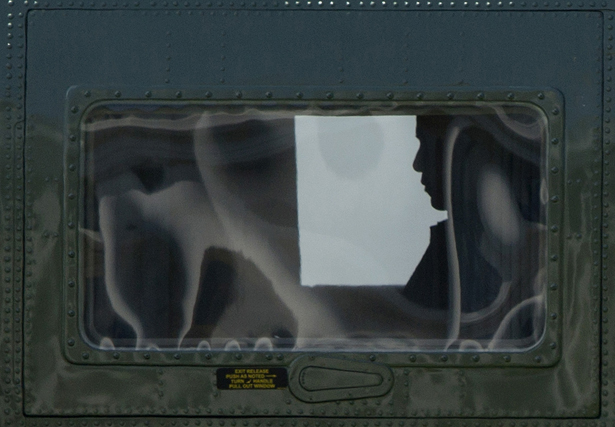
The silhouette of U.S. President Barack Obama is seen as he sits in the back of the Marine One helicopter, landing on the South Lawn of the White House in Washington June 3, 2012. Reuters/Joshua Roberts
The “war on terror” has its own corrupting logic, leading otherwise morally responsible leaders to do unspeakable things. Such is the case with the Obama administration’s descent into the world of kill lists and drone assassinations.
 TAKE ACTION: Kill the ‘Kill List’
The image of President Obama poring over baseball-card profiles of terror suspects in Jo Becker and Scott Shane’s now famous New York Times “kill list” exposé probably pleased the administration officials whose cooperation made the story possible, wrapping the president in glinting “warrior in chief” election year packaging. For those concerned about the constitutional protection of civil liberties and the rule of law, however, that image, and the extraordinary practices it represents, was profoundly disturbing. The drone policy the president has developed not only infringes on the sovereignty of other nations, but the assassinations violate laws put in place in the 1970s after scandals enveloped an earlier era of CIA criminality. The new details about Obama’s assassination program also remind us how the 2001 Congressional Authorization of the Use of Military Force established a disastrous policy of “borderless and open-ended war that threatens to indefinitely extend US military engagement around the world,” in the words of the only member of the House to vote against it, Barbara Lee.
The kill list makes a mockery of due process by circumventing judicial review, and turning the executive into judge, jury and executioner. Even worse, the “signature” strikes described in the Times article, in which nameless individuals are assassinated based merely on patterns of behavior, dispense with any semblance of habeas corpus altogether. According to the Center for Constitutional Rights, signature strikes account for most of the attacks in Pakistan today, and they were recently approved for use in Yemen.
One of the darkest aspects of this story involves the administration’s method of counting civilian casualties: The CIA simply assumes that any military-age male in the vicinity of a terror suspect must be a militant too. Thus, counterterrorism chief John Brennan was able to state with a straight face in August 2011 that not one civilian had perished from US strikes outside Afghanistan and Iraq in more than a year—a declaration that was greeted with incredulity and outrage in Pakistan, where witnesses have attested to hundreds of civilian deaths.
The drone strikes are inciting even more anti-American hatred in troubled places like Yemen as well as Pakistan (see Jeremy Scahill, “Target: Yemen,” March 5/12). It is hard to argue that they are making us safer when, for every suspect killed, one or more newly embittered militants emerge to take his place. This is not a prescription for American security but for an endless war that will sap our moral core and put in jeopardy our most cherished freedoms at home.
The new revelations also highlight the dangers of official secrecy, as we now glimpse some of what the administration was hiding through its invocation of the state secrets privilege in court proceedings. But as urgent as the demand for transparency remains, we know more than enough to conclude that President Obama’s continuation and expansion of George W. Bush’s “war on terror” has further eroded legal barriers built over decades to limit executive power. For those who believed Obama would restore the rule of law after Bush’s imperial overreach, learning the details of these operations has been troubling. Liberals raised a ruckus about Bush’s abuses. Silence now is not an option.
Read this editorial in Spanish.

