
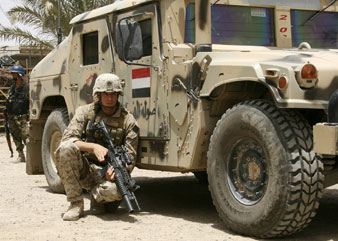
 AP ImagesUS Marine takes cover behind an Iraqi Army humvee in Amarah, Iraq.
President Obama owes his election in part to his early, forceful opposition to the Iraq War and to the antiwar movement, which rallied around his candidacy. It is fitting, then, that one of the early acts of his presidency was to announce a plan to withdraw US forces from Iraq.
For the most part, Obama’s plan is faithful to his campaign promises. It calls for the end of combat operations and the withdrawal of most of the 142,000 troops in Iraq by August 31, 2010 (slightly longer than the sixteen-month timeline he proposed during the election). But the plan includes a major asterisk that should be of concern to all who opposed the war and who supported a complete withdrawal of American forces: it would leave in Iraq a residual force of as many as 50,000 troops until the end of 2011, the date the US-Iraq Status of Forces Agreement stipulates the removal of all US troops. According to the president, this transitional force would have three missions: training Iraqi security forces, carrying out anti-terrorism missions and protecting American civilian and military forces.
In his speech at Camp Lejeune, Obama stressed the importance of diplomacy, “comprehensive engagement across the region” and cooperation with Iraq’s neighbors and with the United Nations–signaling to the people of Iraq and the Middle East that the United States has no intention of permanently occupying Iraq or determining its future. But the presence of so many residual forces undercuts this message and undermines the main strategic reasons for an American withdrawal. The American troops–some stationed at the heavily militarized US Embassy, for example–will be a continual reminder of the occupation. At the least, they will be a diversion from the reconciliation within Iraq that is needed if it is to emerge as a stable country free of large-scale violence.
At worst, such a sizable force increases the risk that factions in Iraq will draw Washington back into the conflict by attacking US troops. Indeed, the presence of our forces beyond August 2010 makes a tempting target for groups in Iraq that would like nothing better than to rally an insurgency to challenge the dominant Shiite government. As we learned in Saudi Arabia after the Gulf War, keeping US forces in a Muslim country can spark radicalization. For now, Al Qaeda has discredited itself in much of the Muslim world, and Sunnis in Iraq have turned against its senseless violence. But a large US military presence, rather than ensuring against Al Qaeda’s return, would be an invitation for it and other Islamist groups to rally recruits to their cause. Maintaining 50,000 troops in one of the most dangerous countries in the Middle East for nearly three more years will be a huge drag on the budget, adding to the $3 trillion price tag of the Iraq War when all our resources are needed to rebuild our tanking economy.
Finally, there are significant gaps in Obama’s Iraq plan that deserve scrutiny. On March 4 he launched a crackdown on wasteful and fraudulent spending, declaring that “the days of giving defense contractors a blank check are over.” This valuable initiative could be a first step toward removing the 150,000 mercenaries and private contractors in Iraq, who now outnumber US military forces, but Obama’s current Iraq plan does not lay out a timeline for their withdrawal. It should. Likewise, Obama has not ruled out permanent US military bases in Iraq; an announcement to that effect would bolster the chances for genuine Iraqi sovereignty. We welcome Obama’s decision to withdraw troops, but let’s make sure he sticks to his timeline for ending this war.

