
In the “Year of Elections,” Is AI on the Ballot?
Politicians like Pakistan’s Imran Khan have found themselves duplicated by artificial intelligence—sometimes by their own parties.
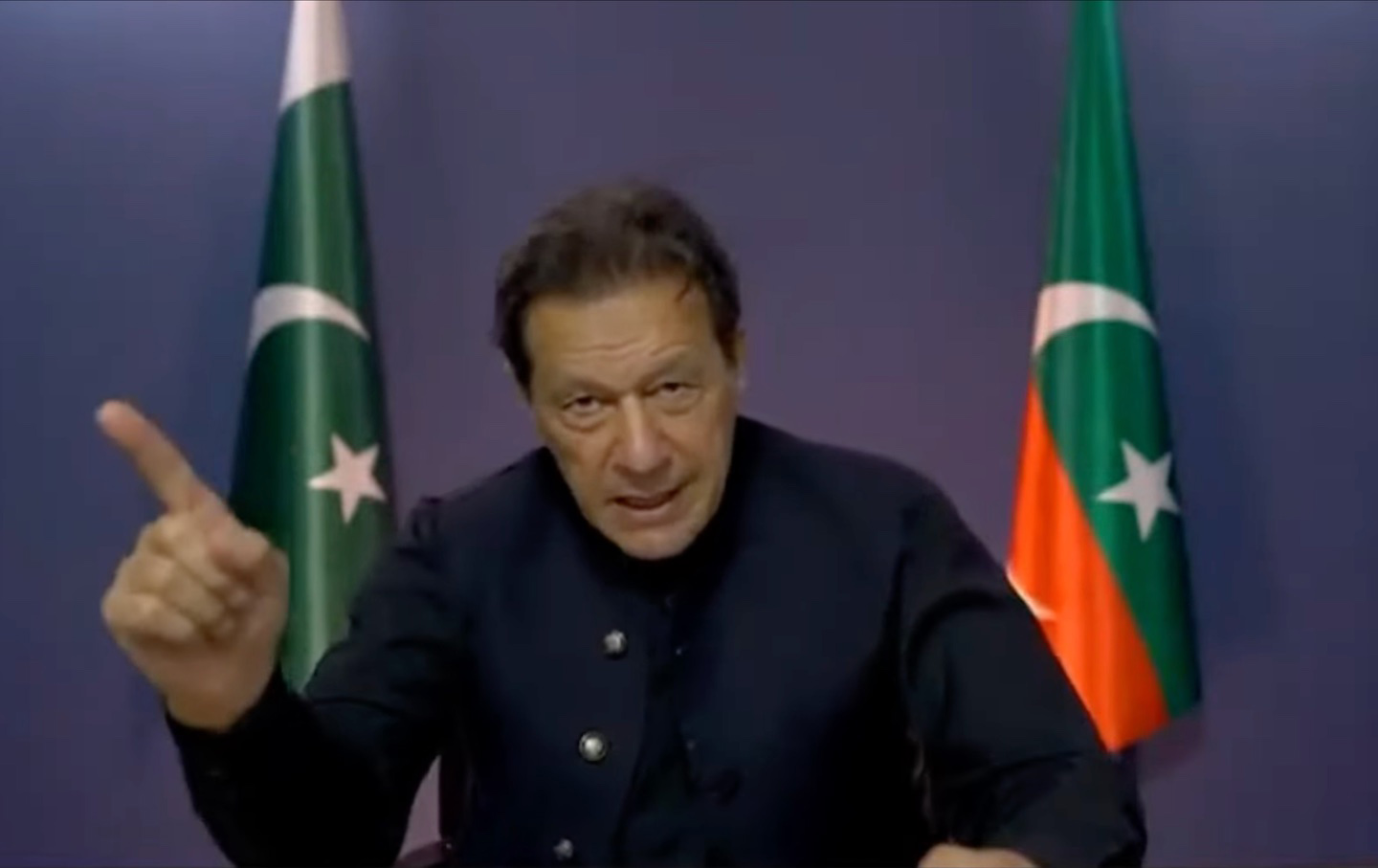
On December 17, 2023, more than a million supporters of Imran Khan, the former prime minister of Pakistan, fired up their browsers to take part in Pakistan’s first ever virtual rally. Khan’s party, the Pakistan Tehreek-e-Insaaf (PTI), has been the subject of a brutal crackdown by the country’s powerful military establishment, after thousands of his supporters laid siege to military installations in opposition to his arrest last May. Toward the end of the nearly five-hour virtual event—which was made necessary by the restrictions placed on the party assembling in public—something seemingly inexplicable happened. Viewers were treated to a keynote speech by Khan himself, in spite of his being incarcerated in Adiala Jail. “You all must be wondering how I’m doing in prison,” he said. “The first thing I want to make clear is that if it brings Pakistan true freedom, living in jail for me is an act of worship.”
In actual fact, the voice was not that of Imran Khan. The digital media team of the PTI had trained an artificial intelligence program to mimic Khan’s speech patterns by feeding it a selection of his oratory, and then used the clone to deliver a speech based on notes smuggled out of prison by the PTI chairman’s lawyers.
“What we wanted to give the audience was the feeling that Imran Khan was there, but with the disclaimer that this was the AI voice of Imran Khan based on his notes from jail,” says Chicago-based Khan loyalist, Jibran Ilyas, who masterminded the initiative. “It helped us get his message across, and that’s the most important thing, because people are really looking at him to guide not just the PTI but Pakistan as a whole.”
In 2024, a year when it is estimated that more than 2 billion people worldwide will go to the polls to choose their representatives, policymakers, and strategists have begun to turn their eyes toward the possibility of artificial intelligence playing a decisive role in global democracy. Kat Duffy of the Council of Foreign Relations has described the current environment as a “post-market, pre-norms space,” one where emergent technologies have entered the marketplace but the regulation to control their output is yet to be determined.
Throughout South Asia, machine-learning and AI technologies have already begun to play a significant role in the democratic process. There is the now infamous case of Indian Prime Minister Narendra Modi, whose AI-cloned voice has been made to sing songs in a variety of regional languages he is known not to speak—an innovation that raises the possibility of the same being done to make his speeches accessible in parts of the country where Hindi is either not the first language or is poorly understood.
In Pakistan, commentators and digital media specialists have hailed PTI’s strategy as a significant milestone. “I thought it was a pretty effective way of circumventing the persecution that the political party has been facing,” says Islamabad-based digital rights activist, Usama Khilji. “Now you have a dude who’s in jail addressing everyone through AI because you can, so I thought it was pretty innovative.”
The recently concluded election in Bangladesh, however, became a case study in how artificial intelligence can be used to peddle disinformation, particularly among voters who lack the sophistication to differentiate between authentic audiovisual content and deepfake clones. In one instance, an AI-generated video posted on Facebook showed exiled opposition leader Tarique Rahman arguing that his political party, the BNP, ought to placate the United States by keeping quiet about the Israeli offensive in Gaza—a potentially disastrous position to take in a country where more than 90 percent of the population is Muslim.
A report by the Financial Times published last month uncovered a campaign of disinformation in Bangladesh, where pro-government news outlets were promoting deepfakes and other AI-created media to manipulate public opinion in the run-up to the January 7 general election. Sayeed Al-Zaman, a Bangladeshi academic whose research focuses on digital information, believes that “tools and techniques such as deepfakes, autogenerated content, and AI bots could become potent carriers of political propaganda” in Bangladesh and worldwide.
According to Al-Zaman, whose research indicates that over 60 percent of individuals exposed to online disinformation are susceptible to believing it, the advent of artificial intelligence has made the challenge of verification more difficult for two reasons. “Firstly, effective AI-based misinformation detection tools are not yet widely available, making it difficult for the masses to discern between fact and fiction,” he tells The Nation. “Secondly, digital information literacy offers limited assistance in cases of AI-based misinformation due to its heightened level of sophistication.”
Even in the United States, AI-generated content has been deployed in attempts to influence voters. On Monday, NBC News reported that a robocall featuring an AI voice clone of President Biden was being used to discourage New Hampshire residents from voting in its presidential primary. Last year, deepfake photographs surfaced on social media showing Donald Trump wrestling with police officers.
In November, social-media giant Meta announced that it would require political campaigns to disclose their use of artificial intelligence in advertisements published on all of its platforms, a policy meant to be rolled out this month. But at precisely the moment when the need for content moderation has reached its highest point, the tech sector is experiencing mass layoffs. Last year, Twitter instituted a number of cuts to its trust and safety team under the leadership of Elon Musk—a decision that was copied by a number of other tech giants including Meta and Amazon. All in all, the industry tracker Layoffs.fyi estimates that around 250,000 tech workers were let go in 2023.
The implications for the Global South are obvious; in a country like Pakistan, where 60 million people are classified as illiterate, the electorate is ripe for manipulation. But the danger of election interference is also considerable in affluent countries, where these AI technologies are at their most developed and sophisticated. It is not out of the question that 2024, which has been dubbed the year of the election, turns out instead to be the year of misinformation.
Support independent journalism that does not fall in line
Even before February 28, the reasons for Donald Trump’s imploding approval rating were abundantly clear: untrammeled corruption and personal enrichment to the tune of billions of dollars during an affordability crisis, a foreign policy guided only by his own derelict sense of morality, and the deployment of a murderous campaign of occupation, detention, and deportation on American streets.
Now an undeclared, unauthorized, unpopular, and unconstitutional war of aggression against Iran has spread like wildfire through the region and into Europe. A new “forever war”—with an ever-increasing likelihood of American troops on the ground—may very well be upon us.
As we’ve seen over and over, this administration uses lies, misdirection, and attempts to flood the zone to justify its abuses of power at home and abroad. Just as Trump, Marco Rubio, and Pete Hegseth offer erratic and contradictory rationales for the attacks on Iran, the administration is also spreading the lie that the upcoming midterm elections are under threat from noncitizens on voter rolls. When these lies go unchecked, they become the basis for further authoritarian encroachment and war.
In these dark times, independent journalism is uniquely able to uncover the falsehoods that threaten our republic—and civilians around the world—and shine a bright light on the truth.
The Nation’s experienced team of writers, editors, and fact-checkers understands the scale of what we’re up against and the urgency with which we have to act. That’s why we’re publishing critical reporting and analysis of the war on Iran, ICE violence at home, new forms of voter suppression emerging in the courts, and much more.
But this journalism is possible only with your support.
This March, The Nation needs to raise $50,000 to ensure that we have the resources for reporting and analysis that sets the record straight and empowers people of conscience to organize. Will you donate today?
More from The Nation


Will the Iran War Destroy MAGA? Will the Iran War Destroy MAGA?
Trump’s coalition is splintering over nationalism and Israel.

An Irish Rebel Socialist Is Stirring Up New York City Politics An Irish Rebel Socialist Is Stirring Up New York City Politics
Why Zohran Mamdani and Claire Valdez are quoting James Connolly.

In Ukraine, Weaving Grief Into a New Collective Memory In Ukraine, Weaving Grief Into a New Collective Memory
After four years of war, Ukrainians are reckoning with irreparable loss and finding ways to persist in the face of it.
The Trump Administration Is Casually Torching the First Amendment The Trump Administration Is Casually Torching the First Amendment
If he can’t stop the bad news from happening, the least an authoritarian can do is try to stop the dissemination of that bad news.

