
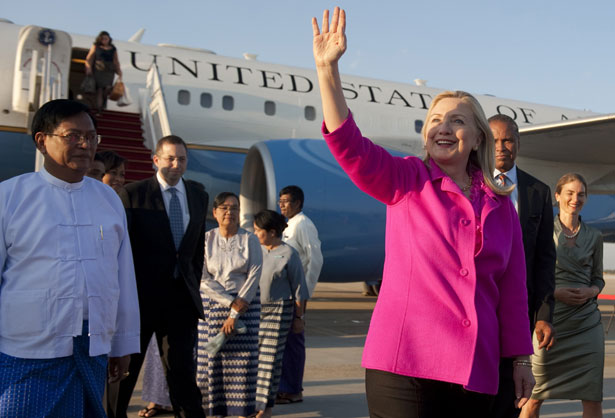
Secretary of State Hillary Clinton visits Burma in 2011. (Reuters/Saul Loeb/Pool.)
Let us happily bid a not-so-fond farewell—is good riddance too strong a term?—to Hillary Clinton, who for the past four years has represented the hawkish end of the Obama administration.
Latest evidence: The New York Times post-Clinton evaluation of her tenure that reveals, for the first time, that Clinton joined former CIA Director David Petraeus is a proposal to get the United States directly involved in arming and training the Syrian rebels.
Thankfully, Clinton-Petraeus were overruled by the White House.
In fact, since 2009, foreign policy has been made in the White House, not the State Department.
But the Times reports that Clinton was a warmonger:
Last summer, as the fighting in Syria raged and questions about the United States’ inaction grew, Secretary of State Hillary Rodham Clinton conferred privately with David H. Petraeus, the director of the CIA. The two officials were joining forces on a plan to arm the Syrian resistance.
The idea was to vet the rebel groups and train fighters, who would be supplied with weapons. The plan had risks, but it also offered the potential reward of creating Syrian allies with whom the United States could work, both during the conflict and after President Bashar al-Assad’s eventual removal.
Mrs. Clinton and Mr. Petraeus presented the proposal to the White House, according to administration officials. But with the White House worried about the risks, and with President Obama in the midst of a re-election bid, they were rebuffed.
Clinton, as revealed by Bob Woodward in Obama’s Wars, was a hawk on Afghanistan, too. And, of course, she and Susan Rice, the ambassador to the United Nations, were the leading advocates for the US-NATO bombing of Libya last year.
The anti-Assad rebellion in Syria is a disastrous one, and it’s led by a ragtag bunch of gangsters, militia-men wannabes, Islamist extremists and who knows who else. Finding “moderates” in that constellation would have been difficult, if not impossible, and ensuring that the arms that they might receive don’t filter into the hands of extremists would be hopeless.
The latest glimpse into the ranks of the Syrian rebels is in today’s New York Times, in an op-ed by Ramzy Mardini, who writes:
[The] 71-member coalition, which includes many S.N.C. members, isn’t willing to negotiate with the Syrian government, nor is it remotely prepared to assume power. It is facing the prospect of defections and, worse, disintegration. Narrow interests are taking precedence; Islamists are overpowering secularists; exiles are eclipsing insiders; and very few members seem to have credibility on the ground back home.
The coalition, he notes, includes tons of Islamist extremists, few women and few of Syria’s minorities. Despite diplomatic efforts by its chief to explore the idea of negotiations with President Assad’s government—an idea supported by Russia and by Lakhdar Brahimi, the UN mediator—the idea is anathema to many of the hard-core anti-Assad gang, Mardini notes.
He concludes, and I couldn’t agree more strongly:
The best hope for Syria’s future is a political settlement, not armed victory. But without a truly representative opposition, that hope will remain elusive.
Petraeus, thankfully, is gone. And Hillary Clinton, Obama’s hawk, is gone, too.
Let’s hope that Secretary of State John Kerry won’t be that stupid.
In other cabinet news, secretary of defense nominee Chuck Hagel backtracked on a range of issues during a stilted confirmation hearing.

