War in Iran, News in America
On this episode of Start Making Sense, Tom Stevenson analyzes the war in Iran, and Tara McGowan explains the new media landscape for young and news-avoidant voters.

The Nation Podcasts
Here's where to find podcasts from The Nation. Political talk without the boring parts, featuring the writers, activists and artists who shape the news, from a progressive perspective.
War in Iran, News in America / Start Making Sense
Tom Stevenson analyzes the latest news and long-term prospects of Trump's Iran war, for both Iran and the US. Tom is a contributing editor for the London Review of Books, where he writes about, among other things, politics in the Mideast.
Also: what news are people getting these days, and where are they getting it? Especially the people we call “news avoidant” & “low information” voters–the ones we want to vote for Democrats in November: what are the big stories for them? Tara McGowan explains– she’s founder and CEO of Courier Newsroom, a digital media company that operates a network of local news outlets.
Advertising Inquiries: https://redcircle.com/brands
Privacy & Opt-Out: https://redcircle.com/privacy
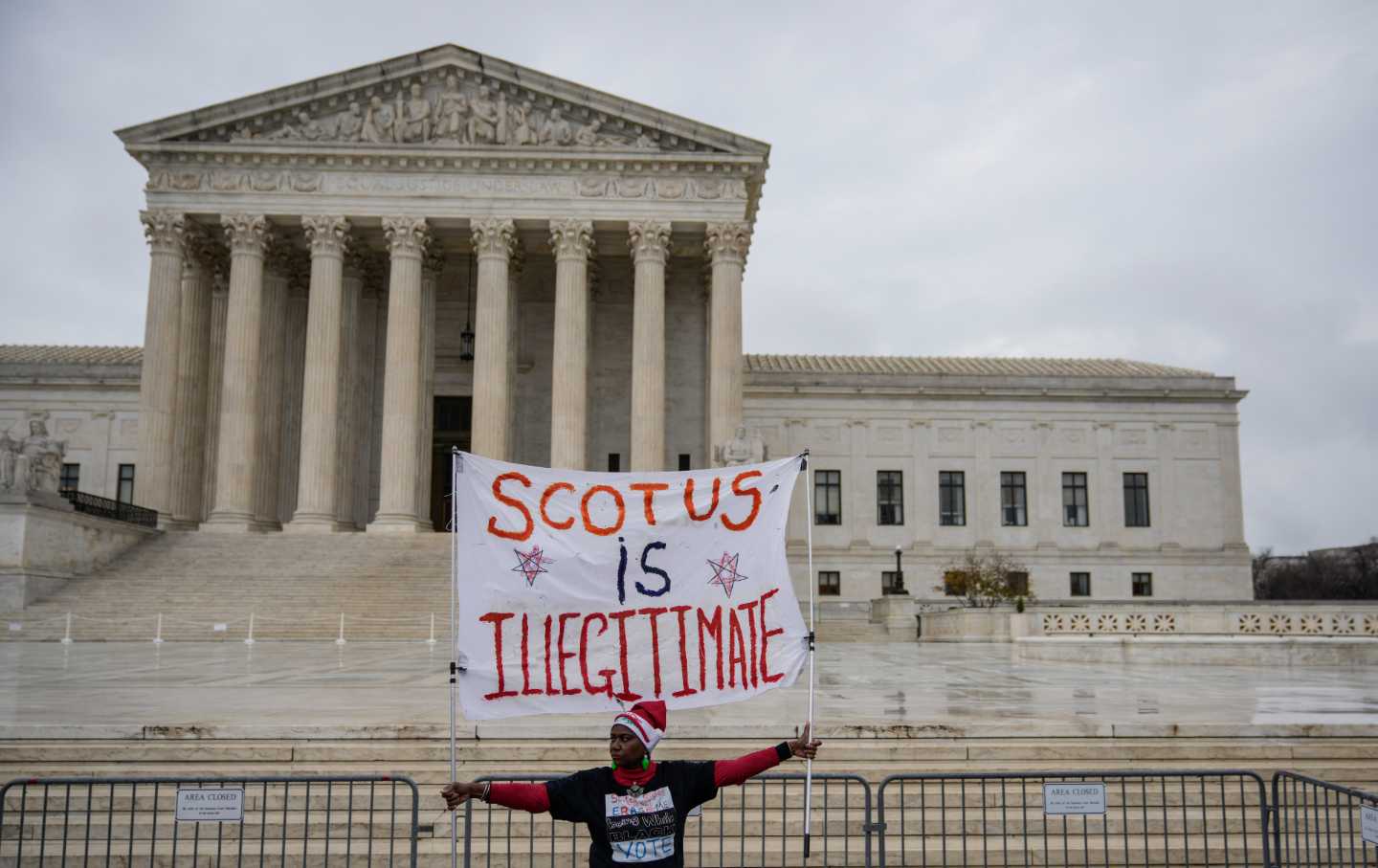
Newspapers for sale the day after US and Israel launched airstrikes on Iran, killing Ayatollah Ali Khamenei, the supreme leader of Iran, at a newsstand in Terminal 4 at John F. Kennedy International Airport.
(Michael Nagle/Bloomberg via Getty Images)Tom Stevenson analyzes the latest news and long-term prospects for Trump’s Iran War, in both that country and the US. Tom is a contributing editor of the London Review of Books, where he writes about, among other things, politics in the Middle East.
Also: what news are people getting these days, and where are they getting it? Especially the people we call “news avoidant” & “low information” voters–the ones we want to vote for Democrats in November: what are the big stories for them? Tara McGowan explains–she’s founder and CEO of Courier Newsroom, a digital media company that operates a network of local news outlets.
Subscribe to The Nation to support all of our podcasts: thenation.com/podcastsubscribe.
The Nation Podcasts
Here's where to find podcasts from The Nation. Political talk without the boring parts, featuring the writers, activists and artists who shape the news, from a progressive perspective.
Norm Eisen on the Paramount-Warners Merger, plus Trump and TV News / Start Making Sense
The primary force behind the settlement that will allow Trump’s allies at Paramount to take over Warners-Discovery and CNN was Gavin Newsom, who pressured California Attorney General Rob Bonta to end the anti-trust fight defending media independence. Norm Eisen explains – he’s co-founder and executive chair of the Democracy Defenders Fund and Democracy Defenders Action, and, the New York Times reported, “the leader of a coalition of entertainment and news industry professionals who opposed the deal.”
Also: After Trump banned CNN, MS NOW and Politico from the White House newsroom, the TV networks united in refusing coverage of his events – including Fox News. John Nichols has our analysis.
Advertising Inquiries: https://redcircle.com/brands
Privacy & Opt-Out: https://redcircle.com/privacy
Search Results placeholder
Jon Wiener: From The Nation magazine, this is Start Making Sense. I’m Jon Wiener. Later in the hour: what news are people getting these days, and where are they getting it? Especially the people we call “news avoidant” and “low information” voters–the ones we want to vote for Democrats in November: what are the big stories for them? Tara McGowan will comment–she’s founder and CEO of Courier Newsroom, a digital media company that operates a network of local news outlets. But first: The Iran war this week – Tom Stevenson of the LRB will comment – in a minute.
[BREAK]
First up: The war in Iran this week. For that we turn to Tom Stevenson. He’s a contributing editor at The London Review of Books, where his piece, “Iran Week One,” was published recently. His collection of essays titled Someone Else’s Empire: British Illusions and American Hegemony was published in 2023. We reached him today in London. Tom Stevenson, welcome to the program.
Tom Stevenson: Thank you very much.
JW: First things first: it seems like Trump didn’t try to explain to the American people why a war in Iran would be a good thing because he really didn’t think there was going to be a war. It would just be a fast, hard strike that would enable the United States to put a new Iranian leader in place. The model here of course was Venezuela. This was no secret in the first days of the war. Trump described “what we did in Venezuela” is his ideal scenario for Iran. You think that’s right. He wasn’t planning on a long war at all.
TS: It’s very difficult to say with Trump exactly on what he’s planning or whether even planning is precisely the right way to sort of conceptualize it. I mean, I think that there’s a good chance that Trump believed or was convinced that a show of force or an immediate use of force might produce a dramatic cracking of the Iranian regime or some kind of spectacular subordination, and that would be some huge political win for him, but I think that we also should grant that they may well have considered that this could well go for longer than that. I mean the war, it’s an obvious case of really criminal international aggression. But then on the side of that, speaking to this, how did they think of it or how does Trump think of it? I think there’s also this almost exuberant, somewhat obscene character to it, both in the prosecution and in the presentation, which sort of defies rationalizing about what the precise planning was.
JW: Yeah. Going back to the beginning, Trump of course has said many different things about why the United States did this and what he wants to happen next. He has said pretty consistently, we must stop Iran from developing a nuclear weapon. Big theme of the Israelis, big theme of the Israelis as well. How close was Iran to developing a nuclear weapon in your understanding in the view of American intelligence agencies?
TS: Well, this has been one of the long-lasting psychodramas of US policy towards Iran. The fixation on the nuclear program stands out for a number of reasons. The most important being that for decades, literally for more than two decades now, the firm assessment of the US intelligence community has been that Iran does not have an active nuclear weapons program.
JW: Let me just emphasize, does NOT have an active nuclear weapons program
TS: Does NOT have. That’s right. Contrary to the vast majority, 90% plus of what one hears on the subject, the assessment of the US and of Israel for more than two decades has been that Iran does NOT have an active nuclear weapons program. This was reiterated incidentally in the most recent declassified report of the office of the Director of National Intelligence, which said very clearly, “we continue to assess that Iran is not building a nuclear weapon,” and the Defense Intelligence agency reports exactly the same thing. In fact, in even clearer language, if I remember correctly, they don’t say that Iran is –to perhaps provide some quick background, Iran obviously does have a domestic civil nuclear program. It has enrichment facilities, it has research reactors, and it has insisted also on enriching beyond levels, which are traditionally therefore civilian reactors, which has given pause to the international regulatory authorities and so on.
But they say that they’ve insisted on that because they need it for medical research or as a matter of national sovereignty or whatever else, and on the other hand, they are entitled to domestic enrichment under the details of the nuclear non-proliferation proliferation treaty. They have every right to domestic enrichment had they wanted it. So, what is this? Well, I mean Iran basically in practice, aside from both sides, propaganda about it has wanted to have breakout status, and that is, it wants to have the technical ability to be able to pursue nuclear weapons should it change its policy in the future. But the fact is that until he was killed a few days ago, Ali Khamenei had formally dismantled Iran’s weapons program in 2003, which was a very short-lived reaction to developments in neighboring Iraq.
The intelligence agencies instantly do not say that Iran is not a threat because of this. In the same assessment, the ODNI spelled out what the threat from Iran was. They said that Iran has expanded its relationships with other key US adversaries, and it works with countries in the global south to mitigate US efforts to isolate the regime and blunt the impact of Western sanctions. So, insubordination essentially. I know that the thing is, I think what we have to conclude from this is that the entire drama of Iran and the nuclear weapons program is an effort at misdirection, and it’s quite a poor one given that the US intelligence and Israel’s intelligence incidentally assessed that it simply is not an active threat.
JW: Trump said that when the war was launched, the United States had identified what he called “potential new leaders” who he wanted to succeed to power in Iran, but he said, “most of the people we have in mind are dead” following the strikes. That is we accidentally killed the people that we wanted to take over the government. Therefore, he said, “we’re going to have to find new ones.” But then the Iranians this week named a new supreme leader, the son of the Ayatollah who was killed by the Americans. Trump said that was “not acceptable.” How did that go over among Iranians?
TS: Well, I mean the assassination of Khamenei on the first day appears thus far to succeeded in moving one generation down the Khamenei family, which I mean certainly to the extent we can talk about plans in advance, that wouldn’t have been the plan in advance for anyone in the US government, I wouldn’t have thought. But also, within Iran, I think, I mean my assessment at least for what it’s worth is that before the war, Mojtaba Khamenei was really very unlikely to succeed his father, he’s less capable, probably more self-interested, he has a big house in London held under a shell company. And there was already a lot of anger in Iran about nepotism, as there are is in many places in the world, and then Iran system was supposed to be organized against this sort of thing. There’s a general dislike, common in many countries, of nepotistic privilege. But then also there’s this second religious and historical sense of caution about, in Arabic, in religion, Arabic, the phrase will be a Riva Sota, which is inheritance of power of oral authority. And then it must be also remembered that Iran’s revolution in 1979 was a Republican revolution founded on a rejection of monarchic practices, so both on Republican and religious juris credential grounds.
It’s a very sensitive matter, and yet the signs thus far are that both, especially within the elite but also in the popular realm, Mojtaba’s succession has been largely welcomed. So a lot of the war basically has blown a lot of things out of the water and with what is perceived as Ali Khamenei’s martyrdom, this idea of his son succeeding has become much more attractive. Still, I think what this shows is that there’s no sign, or at least no detectable sign of a schism within the ruling elite, which is I think in part what Trump, or the Department of War wanted to induce.
JW: There has been a Democratic opposition inside Iran for a long time, mostly in prison for a long time. What do we know about their view of the attacks by Trump and by Israel?
TS: Well, Jon, that’s a fascinating question and I think that first it’s fascinating because there has been for years and especially now, a great flattening of the internal domestic political scene within Iran. Basically, a caricature vision where you have the regime, which is essentially a bandit leadership, a small number of people who are somehow ruling over millions of people who all despise them, and that system is just maintained purely by violence, and now one wouldn’t completely dismiss that picture. It’s obvious that it contains some amount of truth to it, but nonetheless, I think it is not an accurate description of the internal politics of Iran. There’s a much greater range of political currents. I mean, off the top of one’s head, one can think of I think at least four or five major tendencies. You’ve got Reformists, you’ve got secular monarchists, very well represented internationally as well, there’s secular Republicans as well who opposed to both Iran’s monarchical history and to Reza Pahlavi and the idea of bringing back monarchy in Iran.
But then you’ve got ethnic minority nationalists, people who are critical of the government in minor respects, and then very importantly government supporters who whatever percentage you think they represent do remain a powerful political force, it’s undeniable. And then within all those political tendencies, you’ve got a lot of internal divergence.
So I mean, I think the only thing you can say is that the internal political system is complex. It’s split in sort of a number of different vectors, and I think to sort of flatten all that out into either just as this tyrannical regime which the people as a collective oppose or not, has proved a dangerous over simplification.
JW: The American intelligence service concluded just on the eve of the war that the most likely successor government in Iran, given this broad array of different interest, political interests, the most likely successor government, the CIA thought would be run by the Islamic Revolutionary Guard Corps. Remind us what they are and whether you agree that they’re likely to be the most dominant force.
TS: Well, the IRGC is one of the legacies of the Islamic Revolution in 1979, or at least the dispensation, which followed from it, and it is a powerful political force. It’s a paramilitary and military force which runs alongside various other formal state institutions. It has its own navy in addition to the IRIS, which is the Iranian Navy, the Syrian armed forces, in addition to the Iranian National Armed Forces, but then you also have sort of various quasi policing intelligence functions. In fact, Iran system is quite devolved in a number of ways. It has quite a distributed network effect, which is quite intricate and very interesting, and then it’s also extremely politically powerful, but no question about that and has been for many years, perhaps even gaining in power. It’s very interesting that all the signs are that the US intelligence assessment, that it was quite likely that an external military intervention would in fact increase its political influence, but I have to say that’s an idea that was also floating around in the opposition. I remember that we had a very astute Iranian political analyst who I won’t name at the moment, who came to our offices at the London Review of Books and was discussing what this was a few months ago, what possible route the political situation might take, and as someone who very much opposed to the regime said that it was perhaps the most likely or perhaps the most positive result one could wish for among bad options was an internal coup within the IRGC.
JW: “The most positive” — Let me just go back to that: “the most positive,” you were told. Please explain why that would be the most positive.
TS: Well, that’s simply as an assessment of how pessimistic the overall situation is, but looking at all of the tendencies, certainly a brutal, brutal crackdown of the day, protests in January, which the protest began in December, but the crackdown in January and taking into account the dynamic between the external opposition, the US, pushing in various ways, the sanctions, and that was obviously a pessimistic scenario, but they’re now looking at the war. We can see that something fairly cataclysmic has in fact come to pass. I mean, how it shakes out, impossible to say. I mean, the important point is that thus far would do not really see internal regime fracture.
JW: I live in Los Angeles, the part of Los Angeles often called Tehrangeles because it has the largest number of Iranian exiles, I think, anywhere in the world. In my neighborhood, West LA, south of the UCLA campus, there have been huge demonstrations of the exile community. There’s a federal building here that’s had thousands and thousands of Persians protesting there before the war began, carrying portraits, mostly of the son of the Shah. If you live in LA, you might think this is the American favorite to succeed if Trump got to pick the leader the way he wants to. But if you don’t live in Los Angeles, how significant are these exile movements supporting the son of the Shah?
TS: There is a tendency, of course, for political movements, especially ones which have, for various reasons, a diaspora, to diverge to some extent from the political scene within the home country, which of course was exactly what one would expect.
For many years, the Iranian diaspora did have something of a bad reputation on this question, as being particularly open to the idea of external military intervention, in contrast to the domestic Iranian opposition, which of course, exists under very tight controls, often under house arrest, under various forms of repression, having to keep its head down and so on, very difficult conditions undeniably. And I think until very recently, the flirtation with monarchism, which was really quite prominent in the Iranian diaspora, especially in the United States, was something of an anomaly and looked on with some suspicion within the country, not by everybody, but with most. It must be admitted that there has been every sign suggesting there has been an increase in interest in the sort of Pahlavi movement within Iran in the last year or so leading up to this.
That said, I mean, for what it’s worth, my assessment would be that Pahlavi’s chances remain relatively slim. He’s obviously hoped there’s somewhat of a distant echo with the Venezuelan situation here, with Maria Machado that he’s been hoping and pushing as much as possible being that he is and has been for many years a fervent supporter of American military action in Iran, that that would stand him in good stead as a future ruler, and I think he probably believes it, but as it stands, it remains quite implausible, I think, that he would sort of ride in as Hamid Karzai did into Afghanistan from Pakistan — very unlikely in this case.
JW: Given that Trump says something different and contradictory almost every day, it doesn’t make a whole lot of sense to follow his pronouncements as definitive of what’s going to happen. What will you be looking at in the coming week or two as the most significant factors?
TS: Yeah, I mean, I think that one can really get danced in a circle if one pays too close attention to the precise wording of the statements. I think the main thing will be whether there’s an effort to try and declare victory or not.
At this point, and again, going back to optimism among pessimistic scenarios, the idea of the United States, from my perspective, deciding that it can declare victory on the basis of something, and then start winding this down or withdrawing, that’s going to be difficult to do because the enemy has a vote. In this case, Iran also has an obvious vote with this targeting on whether or not this war continues and in what form. But I think a positive sign would be look for any sort of practical indication of the air war decreasing in intensity, fewer cruise missile launches, that sort of thing.
That’s not what we see at the moment. Incidentally, I mean, it’s been quite striking the bombing campaign, it must be stressed, the air campaign in Iran has, if anything been picking up in pace, there was heavy bombing of Tehran over the last couple of days. Oil storage facilities have been hit; desalination plants have been hit. The Iranian Red Crescent reported that more than 3000 residential buildings have been impacted in one way or another. Not necessarily directly targeted but impacted, which is remarkable. There seems to be a degree of resilience within Iranian society about this, but who knows how long that could last. I think what we should really look for is any sign that either General Caine or Cooper orders a lessening of the intensity of the air campaign, which thus far has not obtained.
JW: For Americans this is obviously a historic event — war with Iran. What does it tell us about the larger trajectory of America in the world today?
TS: It’s obviously very worrying. I mean, there’s no doubt, I think, that this is an argument that the United States status as a unipolar superpower retains many of its characteristics, at least many of its more dangerous characteristics. What we see right now is an American power in the world that is unchecked. There may also be a risk that this crisis precipitates a sort of a more general global crisis, and what seems to be holding that back at the moment is the relative weakness of American competitors. Europe is of course subordinated for the most part to American desires. Russia is tied up in a brutal regional war. China remains for now, quiet and regionally contained and hasn’t weighed in too much on this. And on top of that, this general sense of the United States lashing out as it were. The chaotic element in the campaigning is I think very concerning, and it points to a sense that the US is willing to risk a lot, to gamble, to push out the boat. What held back, I think, a past generation of American planners, even bellicose American planners, from taking military action in Iran was a sense of competence, really, right. They had the foresight to see that the dramatic options were also perilous, and it’s not obvious that the current administration does have that level of competence — having sort of cleaned house and got rid of a lot of the people who might have, whatever their faults in other respects, might’ve been able to foresee the dangers.
JW: Tom Stevenson — he wrote about the Iran War for the LRB. Thank you, Tom.
TS: Thank you very much. It’s a pleasure.
[BREAK]
Jon Wiener: What news are people getting these days, and where are they getting it? Especially the people we call news avoidant and low information voters, the ones we want to vote for Democrats in November. What are the big stories for them? For that, we turn to Tara McGowan. She’s founder and CEO of Courier Newsroom, a digital media company that operates a network of local news outlets. She also is host of the podcast, Gloves Off. Tara, welcome to the program.
Tara McGowan: Thanks for having me, Jon.
JW: I asked two different AI assistants whether the biggest news story in America today was the war in Iran or the Epstein files. Microsoft Co-pilot said, “The Iran War story is drawing a vastly larger audience right now.” But Google Gemini said, “Rather than competing for attention, the Epstein files in the war with Iran are currently fueling each other’s visibility. For a large portion of the audience, the two stories have become a single polarized narrative about transparency, accountability, and the motivations of the current administration.” Google Gemini.
You are a media professional. What do you think?
TM: That is fascinating. I love that prompt in that you gave it to the two different AI. I very much agree with the latter one, and I’m very delighted to hear that an AI agent also is identifying that trend. The two are deeply, deeply integrated. And I believe that the president and his administration in large part have been launching these rather spontaneous, deathly, deeply dangerous, and deeply unconstitutional military interventions over the past few months to distract the American public and the global public from the Epstein files and the crimes and perpetrators of those crimes inherent in them, which very likely include the president. And so, I imagine that he and the administration would be very upset that the public is not dumb and that understands that these two stories are actually in fact interrelated and that they both do shed a big light on the lawlessness and corruption inherent in the Trump administration. So I’m surprised and delighted that the Google AI has identified that.
JW: What proportion of Americans know something about the Epstein files?
TM: I don’t have data in front of me, but I’ve got to imagine that the vast majority, well over 80%, I think was one thing that I saw recently, had heard of it in some way. I bet that’s even a conservative estimate at this point. Sort of the speed at which the Epstein files went from somewhat of a fringe conspiracy theory topic into the mainstream conversation with the calls for the release of the files. And then of course the passage of the bill and the signing of that bill into law by the president for the Department of Justice to release those files was, I mean, faster than I would’ve even imagined. But I think it’s so important. And obviously in this massive coverup being orchestrated by the Trump administration, the Department of Justice, the FBI, the CIA, they’re all involved. Their strategy to both drip releases of the files in small proportions and then have the drip of the files that be released be a disaster in terms of accessibility, searchability and not following their own – the law related to the redaction policy, I think has had a backlash effect than what they maybe hoped.
They think that they can just control the release in a way that would distract folks from it or that would make it too difficult for it to stay a story so it would just go away. And in fact, it’s done the opposite. The story is not going away. It’s never going away. Even when every single file is released, which is not the case today, it’s not going away until there’s accountability and justice and they seem not to understand that equation.
JW: Polls that I’ve seen show 70% of Americans say the Epstein files show that wealthy and powerful people in the United States are rarely held accountable for their actions. And 75% of Americans believe Trump is intentionally hiding information specifically regarding Epstein’s clients. Our fellow citizens, as you say, are not stupid.
TM: This is the thing about the Epstein Files and this scandal and this coverup is that it really is this perfect storm that reinforces all of the deep-seated beliefs and concerns of the American people when it comes to feeling rightfully so, that there are a different set of rules for the most elite, wealthy, and powerful individuals of this country that is very different than the rules for all of us. And that is also being reinforced by the cruel and lethal actions of ICE under this administration that are also illegal and unconstitutional. So just across the board, it’s no longer sufficient to just talk about the threat of authoritarianism or fascism with the Trump administration. They are ignoring the law, disregarding the rule of law all over the place. And so this deep-seated belief that Americans have always felt, again, that they were treated differently than the elites and the powerful, that is so much more explicit on the surface and unapologetic right now by this administration in a way that is really shocking.
And yet at the same time, folks are like, “Well, I’m not really surprised, but I am furious about it.” But this is another reason why it’s not going to go away, right? They think that they can just distract the public domestically and globally away from the biggest coverup story in our history. It’s just not going to happen.
JW: Of course, the idea that the wealthy and powerful are rarely held accountable for their actions was a central theme of the MAGA base and the reason they voted for Trump. What do we know about MAGA voters leaving Trump because of the coverup and the revelations we’ve gotten so far?
TM: Yeah. I mean, everything that I have seen both anecdotally and in terms of polling, et cetera, shows that the Epstein story is the most powerful wedge issue that is peeling longtime Trump supporters and even three-time Trump voters away from Trump. It’s going to be increasingly hard for us to distinguish one reason or issue or story that is peeling them apart from others now, because now, of course, we are in an unconstitutional war that has already left seven and counting American service members have lost their lives to this war. And this was also a president who not only campaigned on releasing the files and quote unquote draining the swamp of corruption and the protection of pedophiles, he also ran very explicitly and consistently as someone who was not going to be an interventionist, who was not going to start senseless wars, especially in the Middle East, that have cost our country lives and economic collapses and you name it.
And so these are two really powerful wedges where the hypocrisy is on the surface, the bait and switch of this administration and this president are on the surface. So I think every single day he is losing more support and that’s why it’s going to be very hard for us to measure. But we are seeing it in things like elections and special elections in primaries like we just saw in Texas where we are seeing massive, massive migration from consistent Republican and Trump voters to actually voting for Democrats, including in the Democratic primary in Texas as a referendum against this administration. So they are scared. They are obviously very scared. They see the same numbers we do, the same election results we do, and they know, and this is why there’s so much conversation right now about election interference and rigging and the president saying ridiculous claims like we should nationalize elections, which he cannot do, he has no authority to do because they know that if the midterms this November are free and fair, Republicans don’t stand a shot at protecting their very, very thin majority in Congress.
JW: Second big topic I want to talk about: Where are people getting their news about the Epstein Files and the war in Iran? I’ve heard that The New York Times, although it is still our national newspaper of record, is not read by a lot of people.
TM: No, that’s right. And most legacy media today, both publications like The New York Times that have, I think, tried more than most to not cow to this administration, they still do in certain ways. We’ve identified that at Courier, but they’re better than others. The bar is low, and also including the ones that have capitulated to this administration like Washington Post under Jeff Bezos, CBS, obviously now run CBS News by Barry Weiss and the Ellisons who own it now. They are not going to lead on these stories. I think they often feel a responsibility once parts of these stories are broken by independent media, by creators, et cetera, to pile on. So you’re right, they don’t have the reach that they once had. The vast majority of Americans today are learning about these stories on social media in their inboxes from independent media outlets like ours and yours, from independent creators and independent journalists who are working on their own.
And then they gain a lot of traction. And then we see legacy news outlets like NPR and New York Times contribute to that reporting. And so they don’t have the numbers, but they still play a really pivotal role because their audience is elite, right? So they still play a role in shaping the conversation. And certainly, when it comes to getting the attention and the pressure placed on elected officials and members of this administration, I think that those outlets still matter, which is why it’s so critical they don’t cow to the administration and that the audiences they do hold are able to trust them, that they’re being fair and accurate in their reporting, which is not always the case. These stories are gaining a lot of traction, including the ICE executions and the violence of ICE because of independent outlets and creators. And that’s why independent reporting is so important today.
JW: We’re especially interested in Courier Media, your organization. On Instagram, I looked this morning, you have one million followers. On TikTok, 3.5 million followers, 586 million likes. That’s half a billion likes for The Courier page at TikTok. What is Courier and how did you do this?
TM: And those are just our national accounts, Jon. So Courier is a network of independent newsrooms across the country, including our national bureau. I started it about seven years ago. Really, I started Courier, I was a journalist at the beginning of my career at 60 Minutes, Frontline and CBS News. I went into politics for about a dozen years running some of the largest digital media communications campaigns on the left for folks like President Obama at the time during his reelection, progressive organizations, super PACs that stood against Donald Trump in many elections. And I started career because I wanted to marry quality factual reporting, but with values driven, transparency, and a lot of what I learned in politics of being much more surgical, figuring out how to get in front of audiences in this new, very decentralized, very algorithm-run media ecosystem we live in. And so that’s what Courier is. It focuses not on elite audiences, but on actually reaching the Americans who don’t pay for news products, who are not proactively looking for news, but are consuming a ton of it for free every day by scrolling, Facebook, Instagram, TikTok, et cetera.
JW: I have to interrupt at this point because you said the word free. The New York Times costs a lot of money to be a subscriber. How can Courier be free?
TM: That’s right. So this is a big reason I started it, right? So there was a recent study out of Pew that showed 83% of Americans today do not pay for one single news product.
JW: Wait a minute, say that again.
TM: 83% of Americans do not pay for one single news product.
JW: Wow.
TM: That means they don’t pay for a paywall like New York Times or many state newspapers online. They don’t pay for a Substack membership or a podcast membership. They do not donate to things like NPR. This is where I often talk about the information chasm in America, the haves and the have nots. The people who have good, trusted, factual reporting and information are the wealthiest, most educated Americans. That is the minority of Americans. The vast majority do not pay for news. That’s why we started Courier. And so it was core for our model from day one that we would never charge for our news. It’s also why we have on good faith our free five-day a week newsletters across all of our local newsrooms have over a 50% open rate. People love it because they do not have access to free local journalism. The way that we make that possible is that we are a public benefit corporation that relies and always will rely in part on philanthropic contributions from large foundations down to grassroots small dollar donations of which we bring in over a million dollars a year from donations that average $20 or less from folks who love our news products, as well as underwriting support.
So individuals, organizations that want to support the ability for us to cover more beats, more issues without putting their thumb on the scale of that reporting. And then of course, traditional revenue, sponsored content that advertisers can purchase. Events are an increasing part of our strategy. So I believe all news organizations today need to have a diversified revenue model. There is never going to be another silver bullet revenue strategy such as there was with traditional advertising in the past. And we need philanthropy to play an increasing role to make sure that good information persists in this country. So that’s how we’ve been able to build and scale is a combination of really mission-aligned individuals and organizations.
JW: Well, there’s really two parts of Courier. There’s these massive national social media platforms. And then there’s the local online publications, which in some ways are the most fascinating to me. Explain Dogwood.
TM: Sure. So Dogwood is our Virginia newsroom. It was our very first newsroom we launched back in 2019. We did not actually launch Courier’s national accounts or products until about two years ago. I built Courier to be a local news organization first. That’s where I really feel there’s a direct correlation between access to good local journalism and civic participation. We are a civic mission-minded organization. We want people to be informed and to vote and to participate in their communities. We are explicit about that. And so The Dogwood is, like all of our state newsrooms, has a team of reporters on the ground who live in the communities they serve. We are a remote organization, which allows us to hire folks in rural communities across the states, as well as urban areas. Every newsroom, including Dogwood, has a political correspondent who lives within the Capitol, who reports on the State House what’s happening there that drives local, relevant, human-centered political coverage of what’s happening in Washington and in their state Houses.
They have a flagship newsletter that goes out five days a week. Again, that is free run by a community newsletter editor. That includes a combination of local lifestyle, cultural, and political reporting. And what we do both in our states and at national is we don’t only produce an enormous amount of really quality and awarding-winning original reporting. We also aggregate a lot of news from other trusted sources and package them in a way on social media and through our newsletters that our audiences will consume because they won’t get access to it elsewhere. So everything from cable news and local broadcast to legacy publications at the state and national level, we make sure that we’re actually putting the most relevant information in front of them and always citing it and sourcing it appropriately. But our audiences don’t read long articles. And so we need to make sure that we get them the headlines and the facts and the data points that are most relevant and that we break through the noise with that, and I think that’s our superpower.
JW: Well, in Virginia right now, early voting has begun on a statewide referendum to reapportion the congressional seats in response to Trump’s initiatives to gerrymanders congressional seats in other states. So Virginia is in the middle of a crucial political campaign right now. And of course, that is the latest headline at Dogwood. Early Voting Begins on Virginia Redistricting Referendum. Where are the other local news websites for Courier?
TM: Yeah. So we have reporters on the ground and newsrooms currently in 11 states. We just announced a few weeks ago. We’re expanding to 20 by the end of this year. So we’re going to have reporters on the ground and newsrooms set up in 20 states by the end of this year. We’re already in 11. Those 11 are Arizona, Iowa, Florida, Michigan, Nevada, New Hampshire, North Carolina, Pennsylvania, Texas, Virginia, Wisconsin.
JW: These are the states – it just happens to be that we would really like to win more congressional and statewide offices in November.
TM: That’s right. Our expansion states include Georgia, Minnesota, Kentucky, Colorado. I mean, you name it. I mean, we built a scalable model. My goal was always to be in 50 states and in US territories. We are on our way there. So it doesn’t matter what the political makeup is of the states. It comes down to us having the resources to get there. And that can often be defined by donors or underwriters who have a particular interest in a state, but we are unbiased. We would like our model to be everywhere and think it could be really effective at filling that vacuum left by a lot of local news closing down over the past number of years.
JW: So far, listeners want to see what Courier is up to. I recommend going to vadogwood.com just for a starter on what a wonderful local news publication looks like. Or you can go to their TikTok page if you’re young and know how to do that.
TM: I was going to say the best way to actually see how our audiences do the reporting is to sign up for the newsletters or go to the social media pages. And courierlocal.com is a good kind of hub site where you can find all the states and all their social channels as well.
JW: Tara McGowan is founder and CEO of Courier Newsroom, a digital media company that operates a network of local news outlets. Tara, thanks for all your work and thanks for talking with us today.TM: Thank you, Jon. I am a longtime, longtime reader and fan of The Nation. So, very humbled to be on the pod with you. Thanks for having me.
Subscribe to The Nation to Support all of our podcasts
Become a Sustaining Donor This September
Between the reemergence of right-wing red-baiting and Donald Trump’s use of the chilling National Security Presidential Memorandum–7 to criminalize left political organizing, we’re seeing McCarthyism reborn before our eyes.
This assault on democracy cannot be ignored or wished away. Resisting it requires bravery in the face of threats and repression, a steadfast commitment to the truth, and the unwavering belief that we can—and will—overcome this darkness.
We must have an independent media that sets the record straight, unearths corruption and abuses of power, and advances a politics of justice and dignity for all if we’re to win this fight.
That’s why I’m writing to you today. This September, The Nation needs to add 100 monthly donors to sustain our progressive journalism. Your contribution makes the next investigative report, the next truth-speaking column, and the next pathbreaking essay all possible.
I hope you’ll support our work with a recurring donation today. If you donate $10 or more a month, we’ll send you a brand new “Hands Off the Free Press!” sticker to recognise your commitment to our cause. Please, donate today.
Onward,
Katrina vanden Heuvel
Editor and Publisher, The Nation