CUNY’s Repression of Pro-Palestine Students Continues in Front of Congress
By placating House Republicans during a hearing on antisemitism, CUNY’s Chancellor left students and faculty to fend for themselves.
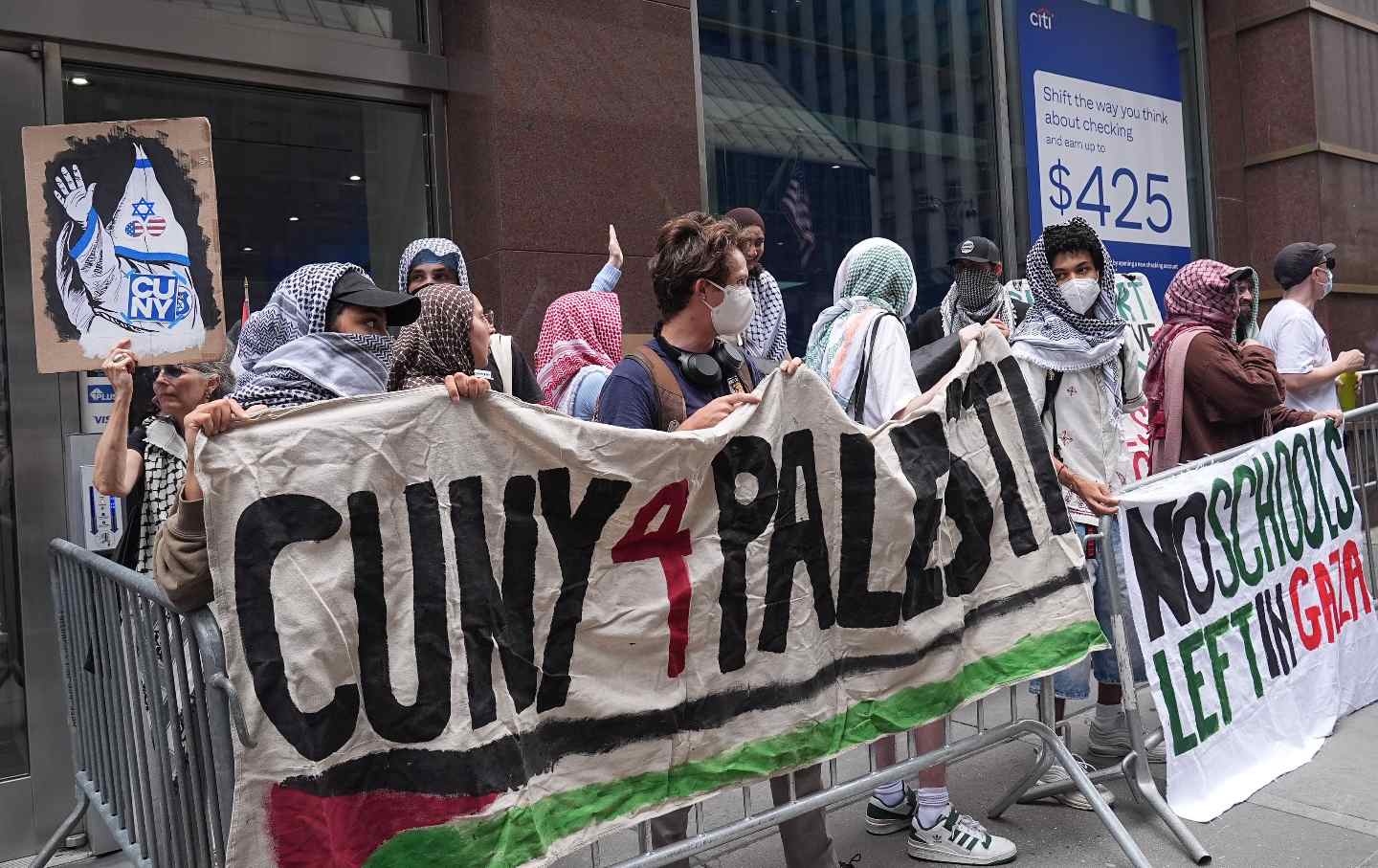
“We now have a zero tolerance policy against encampments,” said CUNY chancellor Felix Matos-Rodriguez. “We have also hired more than 150 full-time security employees and contracted with an additional 250 security personnel. Our approach has shown results.”
On July 15, Matos-Rodriguez was one of three university presidents, along with the heads of the University of California and Georgetown, to face questioning before the House Committee on Workforce and Education about a supposed unchecked crisis of antisemitism.
The Professional Staff Congress—CUNY’s staff and faculty union—and many from the greater CUNY community are saying the hearing by House Republicans was really meant to silence CUNY’s advocates for Palestinian human rights. Matos-Rodriguez, they argue, failed to defend those community members, as well as the tenets of free speech and robust, open conversation that are critical components of a thriving academic institution. “It was an egregious abdication of his responsibility as an academic and his responsibility as a leader of an academic institution,” said Heba Gowayed, an associate professor of sociology at Hunter College.
Among the legislators at the hearing was Elise Stefanik, the Republican representative from New York whose interrogation of elite university presidents in 2024 precipitated the resignations of the presidents of Harvard and Columbia. The committee suggested the PSC has an “antisemitism problem” for having passed resolutions in favor of boycotting Israel in the past. One CUNY administration official was singled out for having previously worked at the Council on American-Islamic Relations, as was Ramzi Kassem, a CUNY professor and the founding director of CLEAR, a legal aid clinic based out of the CUNY School of Law.
The organization helped spearhead the legal defense of Palestinian dissident Mahmoud Khalil. “This is the chief pro-Hamas agitator that led to the antisemitic encampments at Colombia,” Stefanik said of Khalil. “Is this acceptable that the legal defense fund for Mahmoud Khalil is the head of CUNY CLEAR? That’s acceptable under your watch?” Stefanik asked. In June, a federal judge agreed with Khalil’s legal team that Khalil’s confinement in a Louisiana detention center was unlawful, and that the Trump administration’s pretense for attempting to deport him was unjust.
But Matos-Rodriguez did not defend the work of Kassem, CLEAR, or the faculty’s union. “Anybody that breaks our rules and our policies, there will be an investigation. We’ll investigate it. And if there’s any disciplinary action to be taken, we’ll take it,” Matos-Rodriguez said in response to Stefanik, who asked for Kassem to be fired. “The PSC does not speak for the City University of New York. We’ve been clear on our commitment against BDS and against antisemitism.”
PSC president James Davis immediately fired back. “We do not accept the false premise that underlies today’s hearing that any campus activism in support of the Palestinian people is antisemitic, if not criminal,” he said. “All of CUNY should be proud that faculty working at our university are a part of the legal team defending our constitutional rights and the rights of Mahmoud Khalil, who was abducted for his political speech.”
Prior to the hearing, members from CUNY’s Faculty and Staff for Justice in Palestine chapter joined with faculty from the University of California and Georgetown University to pen a letter urging their institutional leaders to “break the pattern” that others in previous hearings had set by “proving unable or unwilling to stand up effectively to the patently false, hypocritical, and deeply anti-intellectual haranguing by members of the committee.” But Matos-Rodriguez “utterly failed to defend students from false charges of antisemitism,” the members said in a statement to The Nation. “It was heartbreaking and infuriating to see him do the Trump administration’s bidding.”
Matos-Rodriguez’s comments come on the heels of the one year suspension of Hadeeqa Arzoo Malik, a City College student and a core organizer of the encampment, as well as the apparent firing of four adjunct faculty at Brooklyn College for their pro-Palestinian advocacy.
As the administration digs in its heels to repress pro-Palestinian activism, there has been a sea change in American public opinion in favor of Palestinians as a result of Israel’s genocide in Gaza. “The tides are turning,” Arzoo Malik told The Nation. “The people of NYC support Palestine overwhelmingly. Especially on our [CUNY] campuses, as they are public schools of working-class students and workers who understand that our struggles are interconnected.”
More than just being out of touch with mainstream political opinion, Matos-Rodriguez’s failure to defend CUNY against the House Republicans reflected a leader far afield “even from the realm of settled law,” said Gowayed. “The case of Mahmoud Khalil, for instance, is a case where due process has decided on that situation. Chancellor Matos-Rodriguez could not even hold up the American legal system in his response.”
His comments on the student encampments were similarly worrisome, she said. ”To say we have a no-encampment policy, that is very much speaking against the students’ right for civil disobedience. What does that mean in an academic space where we have a responsibility towards our students to nurture them and instead we are playing this role of being an arm of the state?”
“CUNY’s recent firing of the adjunct professors and suspension of Hadeeqa Arzoo Malik are deeply alarming and part of a national, escalating pattern of punishing advocacy for Palestinian lives and freedom. Punishing Palestine advocacy not only violates the Constitution but reflects anti-Palestinian racism that violates anti-discrimination obligations under federal civil rights laws,” Sadaf Hasan, a staff attorney at the legal advocacy group Muslim Advocates, told The Nation. “As a public institution, CUNY is legally bound to uphold the First Amendment, not suppress it.”
Time is running out to have your gift matched
In this time of unrelenting, often unprecedented cruelty and lawlessness, I’m grateful for Nation readers like you.
So many of you have taken to the streets, organized in your neighborhood and with your union, and showed up at the ballot box to vote for progressive candidates. You’re proving that it is possible—to paraphrase the legendary Patti Smith—to redeem the work of the fools running our government.
And as we head into 2026, I promise that The Nation will fight like never before for justice, humanity, and dignity in these United States.
At a time when most news organizations are either cutting budgets or cozying up to Trump by bringing in right-wing propagandists, The Nation’s writers, editors, copy editors, fact-checkers, and illustrators confront head-on the administration’s deadly abuses of power, blatant corruption, and deconstruction of both government and civil society.
We couldn’t do this crucial work without you.
Through the end of the year, a generous donor is matching all donations to The Nation’s independent journalism up to $75,000. But the end of the year is now only days away.
Time is running out to have your gift doubled. Don’t wait—donate now to ensure that our newsroom has the full $150,000 to start the new year.
Another world really is possible. Together, we can and will win it!
Love and Solidarity,
John Nichols
Executive Editor, The Nation
More from The Nation

Christmas Wish Christmas Wish
The toll is staggering: In 2024, gun violence in the US resulted in 40,886 deaths and 31,652 injuries.

Islamophobic Elites Lied to Destroy the Life of a Palestinian Brown Student Islamophobic Elites Lied to Destroy the Life of a Palestinian Brown Student
Plutocrats, pundits, and government officials joined together in a racist smear campaign against a queer Palestinian student at Brown University.
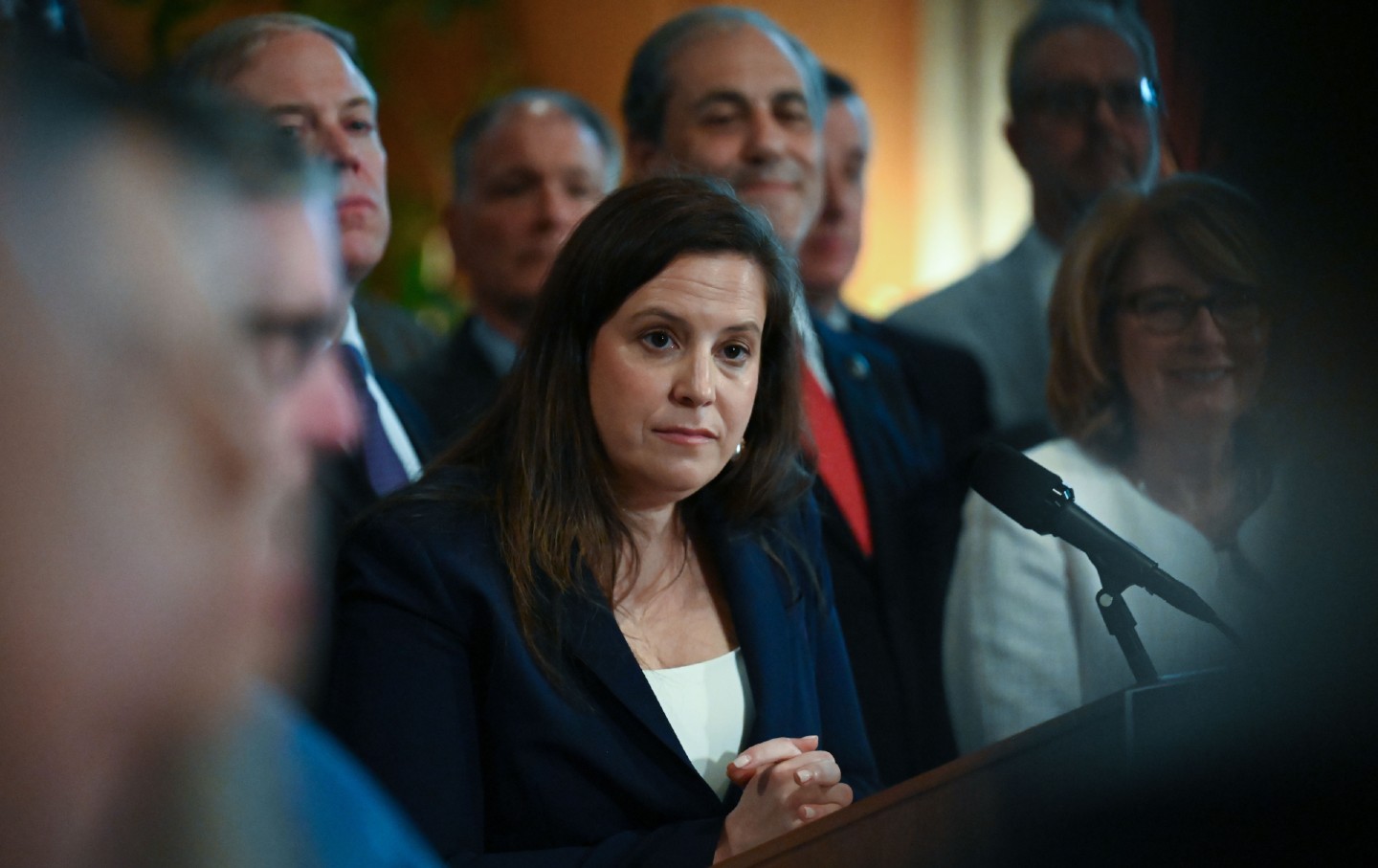
Recent Democratic Victories Have Republicans Running Scared Recent Democratic Victories Have Republicans Running Scared
Elise Stefanik is just the latest top Republican deciding against running in the 2026 midterms.

Pirate Trump Pirate Trump
Donald Trump escalates Caribbean tensions with vessel attacks near Venezuela.

Trump’s “Warrior Dividend” Might Be His Scariest Idea Yet Trump’s “Warrior Dividend” Might Be His Scariest Idea Yet
This week’s “Elie v. US” explores the authoritarian threat beneath Trump’s bonuses for military families. Plus, a case for getting rid of the Second Amendment.

