The First Amendment vs. the Wannabe King
What are the climate implications of Donald Trump punishing the Associated Press?
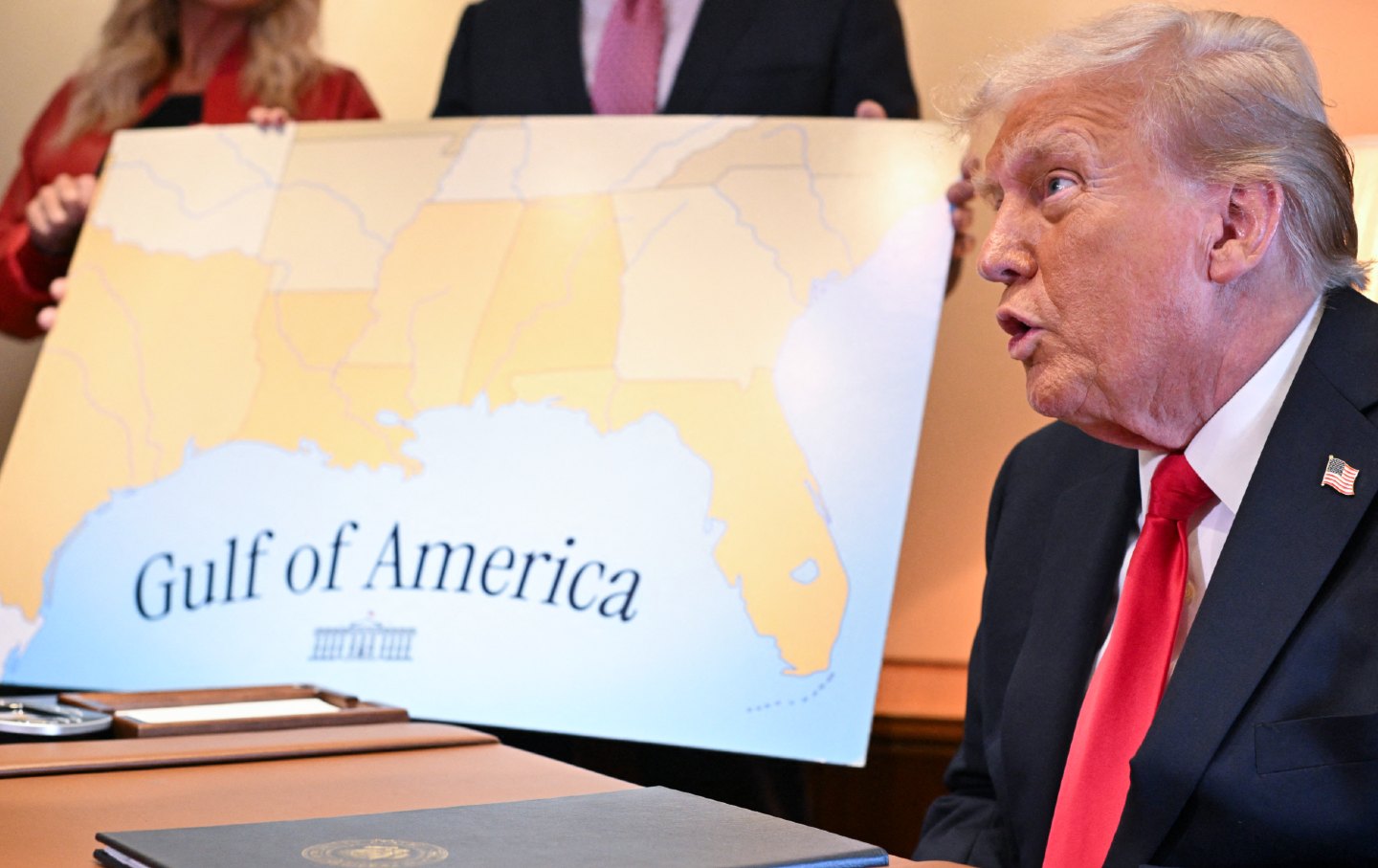
President Donald Trump speaks to the press after signing a proclamation renaming the Gulf of Mexico as the Gulf of America aboard Air Force One, as it flies over the Gulf en route to New Orleans on February 9, 2025.
(Roberto Schmidt / AFP via Getty Images)
As President Donald Trump continues to bar the Associated Press from the Oval Office and Air Force One for not adopting his new name for the Gulf of Mexico, the press faces a defining challenge. Will news organizations defend the AP’s clear First Amendment right to report the news free of government interference, or not? If so, what form will such solidarity take?
The Reuters and Agence France-Presse news agencies, the AP’s two chief competitors, have issued public statements of support, as has The New York Times. An additional 40 news organizations—including The Wall Street Journal, The Washington Post, Los Angeles Times, The Guardian, the major US television networks, and even Trump boosters Fox News and Newsmax—have reportedly signed a letter from the White House Correspondents Association, urging that AP’s access be restored.
Jim Acosta, the former White House correspondent for CNN, has suggested a more aggressive approach. Interviewed on The MeidasTouch Podcast—which this month overtook The Joe Rogan Experience as the most popular podcast in the United States—Acosta said the press corps should consider boycotting White House press opportunities. Trump “cares about having those cameras on him more than almost anything else in the world,” Acosta said. “If the press were to take those cameras away for a day or two, I think he’d quickly reconsider this idea of kicking the Associated Press out.”
Trump’s insistence that he has the unilateral right to rename the Gulf of Mexico is part of a larger effort to dictate what is and is not reality. “This is about the government telling the public and press what words to use and retaliating if they do not follow government orders,” AP spokesperson Lauren Easton said. In climate terms, a rough equivalent would be demanding that news reports stop saying that burning oil, gas, and coal is dangerously overheating Earth.
Trump went a big step further on Wednesday. Saying the “quiet part out loud,” as The Daily Beast put it, he hailed himself as “The King” in a post about New York City’s traffic congestion pricing program. “The White House’s official X account reposted Trump’s announcement with a mock Time Magazine cover depicting the president wearing a crown” above the title, “Long Live The King,” the Beast reported.
Journalists stand at an unprecedented moment in the climate story. From the time climate change irreversibly entered the public agenda in the late 1980s, the United States has been history’s biggest climate polluter. Today, its total historical emissions still exceed China’s. Meanwhile, the US’s political, economic, and military power has given it unmatched influence over what the world can do about climate change. US diplomats could decisively strengthen or weaken what got decided at UN climate summits, for example.
Throughout these 30-plus years, the US has had Republican presidents and Democratic presidents. But there has never been a president remotely like Trump, in either his approach to the climate issue or to public discourse.
How journalism should cover Trump and climate change was the subject of a Talking Shop webinar CCNow hosted this week. The questions tackled by journalists Jael Holzman, Lagipoiva Cherelle Jackson, and Bill McKibben included:
- How should journalism, whose very DNA includes respect for verifiable facts, report on a president who either doesn’t know or doesn’t care what the facts are, and whose discourse is therefore littered with dangerously false statements (e.g., climate change “is a hoax”)?
- How does journalism deal with the fact that Trump is brazenly violating the law—most plainly, by refusing to release funds that Congress has ordered spent?
- Faced with Trump’s long-time strategy of relentlessly “flooding the zone” with outlandish remarks, how can journalists stay focused on our civic responsibility to inform the public and hold government to account?
CCNow encourages journalists everywhere to think and talk about these challenges, both among ourselves and with the public—the people we report to and for. There are no easy answers. But it seems clear that, in retaliating against the AP, Trump is acting, as he often does, like a bully. And not standing up to a bully only invites further abuse.
Become a Sustaining Donor This September
Between the reemergence of right-wing red-baiting and Donald Trump’s use of the chilling National Security Presidential Memorandum–7 to criminalize left political organizing, we’re seeing McCarthyism reborn before our eyes.
This assault on democracy cannot be ignored or wished away. Resisting it requires bravery in the face of threats and repression, a steadfast commitment to the truth, and the unwavering belief that we can—and will—overcome this darkness.
We must have an independent media that sets the record straight, unearths corruption and abuses of power, and advances a politics of justice and dignity for all if we’re to win this fight.
That’s why I’m writing to you today. This September, The Nation needs to add 100 monthly donors to sustain our progressive journalism. Your contribution makes the next investigative report, the next truth-speaking column, and the next pathbreaking essay all possible.
I hope you’ll support our work with a recurring donation today. If you donate $10 or more a month, we’ll send you a brand new “Hands Off the Free Press!” sticker to recognise your commitment to our cause. Please, donate today.
Onward,
Katrina vanden Heuvel
Editor and Publisher, The Nation