
 Reuters Photos
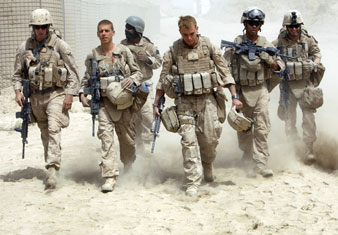
US Marines walk inside their base before patrolling near town of Khan Neshin in Rig district of Helmand province
Robert Scheer is the editor of Truthdig, where this article originally appeared. His latest book is The Pornography of Power: How Defense Hawks Hijacked 9/11 and Weakened America (Twelve).
Every once in a while, a statistic just jumps out at you in a way that makes everything else you hear on a subject seem beside the point, if not downright absurd. That was my reaction to the recent statement of the president’s national security adviser, former Marine Gen. James Jones, concerning the size of the terrorist threat from Afghanistan:
“The Al Qaeda presence is very diminished. The maximum estimate is less than 100 operating in the country, no bases, no ability to launch attacks on either us or our allies.”
Less than 100! And he is basing his conservative estimate on the best intelligence data available to our government. That means that Al Qaeda, for all practical purposes, does not exist in Afghanistan–so why are we having a big debate about sending even more troops to fight an enemy that has relocated elsewhere? Because of the blind belief, in the minds of those like John McCain, determined to “win” in Afghanistan, that if we don’t escalate, Al Qaeda will inevitably come back.
Why? It’s not like Al Qaeda is an evil weed indigenous to Afghanistan and dependent on its climate and soil for survival. Its members were foreign imports in the first place, recruited by our CIA to fight the Soviets because there were evidently not enough locals to do the job. After all, US officials first forged the alliance between the foreign fighters and the Afghan mujahedeen, who morphed into the Taliban, and we should not be surprised that that tenuous alliance ended. The Taliban and other insurgents are preoccupied with the future of Afghanistan, while the Arab fighters couldn’t care less and have moved on to more hospitable climes.
There is no indication that any of the contending forces in Afghanistan, including the Taliban, are interested in bringing Al Qaeda back. On the contrary, all the available evidence indicates that the Arab fighters are unwelcome and that it is their isolation from their former patrons that has led to their demise.
As such, while one wishes that the Afghan people would put their houses in order, these are not, even after eight long years of occupation, our houses. Sure, there are all sorts of angry people in Afghanistan, eager to pick fights with each other and most of all any foreigners who seem to be threatening their way of life, but why should that any longer have anything to do with us?
Even in neighboring Pakistan, the remnants of Al Qaeda are barely hanging on. As the Wall Street Journal reported Tuesday, “Hunted by US drones, beset by money problems and finding it tougher to lure young Arabs to the bleak mountains of Pakistan, Al Qaeda is seeing its role shrink there and in Afghanistan, according to intelligence reports and Pakistan and US officials….. For Arab youths who are al Qaeda’s primary recruits, ‘it’s not romantic to be cold and hungry and hiding,’ said a senior US official in South Asia.”
It’s time to declare victory and begin to get out rather than descend deeper into an intractable civil war that we neither comprehend nor in the end will care much about. Terrorists of various stripes will still exist as they have throughout history, but the ones we are most concerned about have proved mighty capable of relocating to less hostile environments, including sunny San Diego and southern Florida, where the 9/11 hijackers had no trouble fitting in.
There is a continued need for effective international police work to thwart the efforts of a widely dispersed Al Qaeda network, but putting resources into that effort does not satisfy the need of the military establishment for a conventional field of battle. That is the significance of Gen. Stanley McChrystal’s leaked report calling for a massive counterinsurgency campaign to make everything right about life in Afghanistan, down to the governance of the most forlorn village. The general’s report aims not at eliminating Al Qaeda, which he concedes is barely existent in the country, but rather at creating an Afghan society that is more to his own liking.
It is a prescription, as the Russians and others before them learned, for war without end. That might satisfy the marketing needs of the defense industry and the career hopes of select military and political aspirants, but it has nothing to do with fighting terrorism. In the end, it would seem that some of our leaders need the Afghanistan battleground more than the terrorists do.

