
Have you ever wished there was a set of standards by which budgets could be assessed that didn’t have to do with deficit hawks and stimulus sparrows pecking each other’s eyes out in the constricted ring of corporate opinion?
A noble little park opened in New York City last month: Four Freedoms Park. In the coverage of the Louis Kahn structure (which seems to rise like a ship out of Manhattan’s East River), remarkably little was made of the title. From Franklin Delano Roosevelt’s address to Congress in 1941, “the Four Freedoms” are core requirements for humane political and economic existence:
“For there is nothing mysterious about the foundations of a healthy and strong democracy,” said Roosevelt. “The basic things expected by our people of their political and economic systems are simple. They are: Equality of opportunity for youth and for others. Jobs for those who can work. Security for those who need it. The ending of special privilege for the few. The preservation of civil liberties for all. The enjoyment of the fruits of scientific progress in a wider and constantly rising standard of living.”
The “four freedoms” FDR named (which would eventually be incorporated into what became the Universal Declaration of Human Rights), were freedom of speech and expression, freedom of worship, freedom from want and freedom from fear. The last of those FDR defined as “a world-wide reduction of armaments to such a point and in such a thorough fashion that no nation will be in a position to commit an act of physical aggression against any neighbor—anywhere in the world.”
Watching the carnage in the Middle East and anticipating the arms-bonanza that is sure to follow it’s hard not to wince. CNN’s coverage alone, with its feverish fascination with Israel’s purported missile-defense prowess, is sure to result in yet a new boom for the death merchants in that country and ours.
But human rights standards aren’t only for international actors, says economist Radhika Balakrishnan. We could do with some good human rights lawyers in the budget debate in Washington. Balakrishnan is the director of the Center for Women’s Global Leadership at Rutgers University. She is also co-editor of Economic Policy and Human Rights: Holding Governments to Account.
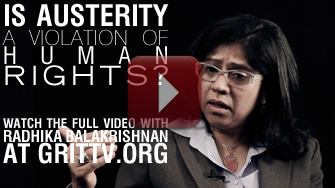 “Looking at the election we have just been through, if we had been looking at this from a human rights lens, every candidate would have to have spoken about poverty,” Balakrishnan explained, because governments have obligations to the most vulnerable in the society. The United States hasn’t ratified many international human rights accords, but it has signed some. Under those, humans have rights and governments have duties, among those the duty to use the “maximum available resources” to realize the basic human rights of its people.
“All of these discussions that are taking place as ‘you’re for the rich or you’re for the poor’ can be addressed in a very different way,” reflects Balakrishnan.
Austerity as a human rights violation? It certainly puts a different spin on things. We spoke as the Center was about to kick off its 16 Days Campaign, a concentrated season of activism on violence against women.
Click here to learn more about the center. To watch my conversation with Professor Balakrishnan in full and to find out why the Federal Reserve needs human rights observers, watch this.
Luckily, a few in Congress are heeding the human rights approach by championing a budget that protects social services. Check out Katrina vanden Heuvel on “The Budget Deal We Deserve.”

