POLL-AXED
Fort Lauderdale, Fla.
Anna Greenberg was directly on point with her thoughtful piece, "Why the Polls Were Wrong" [Jan. 1]. As someone who lives in the heart of the south Florida battleground, in Democratic-vote-rich Broward County, I would also provide an addendum. Just as the major polls were wrong for the reasons cited by Greenberg, let's also credit the election night Voter News Service with being accurate. While Republicans like James Baker decry the networks' "erroneous" initial call for Gore, all one has to do--besides debate recounts, chads and hanging chads--is to factor in the 22,400 intended Gore votes in Palm Beach County, apportioned between overvotes for President and erroneously cast votes for Pat Buchanan. These people, whose votes did not ultimately count, were certainly factored into projected totals favoring Gore on election night. As Greenberg asserted, it was the second call, which went to Bush early Wednesday morning, that was in error. Of course, Baker and the Republican high command touted that projection as accurate.
WILIAM HARE
New York City
It was not the polls that got it wrong this election. It was Anna Greenberg. The national pre-election polls reported by the media had their best polling performance since 1976. All ten traditional polls were within the margin of error. These polls had an average error on the winner of 1.1 percent. In the election Bush and Gore were almost dead even. Two polls had Gore ahead slightly, six had Bush ahead slightly, one was off by an average of 2.5 points each on Bush and on Gore and the Harris poll had the race even. There was one other poll that was significantly off. It used experimental interviewing methods and was not reported widely by the media. Rasmussen conducted it and issued an apology after the election.
Contrary to Greenberg's assertion, only two polls "'weighted up' the GOP share" to match the parties' usual share of the vote. Greenberg complimented one of those polls for its fine performance. None of the polls got the voter turnout wrong. All used the same methods they have used for years to assess likely voters.
Linking the pre-election polls to the networks' mistaken call of Bush as the winner in Florida on election night is just plain silly. None of the pollsters involved in the pre-election polls had any connection to the election night projections. The Bush projection was made from the 97 percent of the vote that had been counted by Florida voting officials.
One assertion Greenberg makes is disingenuous. The "internal Gore polling" she uses as a benchmark for what the public polls should have shown (a) was not available to the public, and therefore not subject to peer scrutiny; (b) was not constant over the last two weeks as she asserts; and (c) was partially the work of her father. The Nation should not be citing private partisan political polling as a standard against which to measure the public polls. The public polls disclose their methods, data and results. The partisan polls do none of these things.
WARREN MITOFSKY
HUMPHREY TAYLOR
HARRY O'NEILL
Polling Review Board
National Council on Public Polls
GREENBERG REPLIES
Cambridge, Mass.
I thank William Hare for his letter. Mitofsky, Taylor and O'Neill correctly note, as I did in my editorial, that many of the national poll results released on or close to Election Day fell within the margin of error. First of all, using the margin of error as the measure of accuracy is rather narrow, given the great volatility of the tracking polls and the wide variation among the polls during this election season. Second, the margin of error is somewhat tangential to the larger point that most of the national public polls favored Bush and that this perception of Bush's ascendancy influenced press coverage of the race prior to and after the election. Finally, while there were no official ties between these national public polls and the exit polls conducted by Voter News Service (a link I did not make in my editorial), to argue that the collective weight of these surveys did not influence press coverage of the election is also a bit silly.
The most perplexing aspect of the Mitofsky, Taylor and O'Neill letter is the notion that all the public polls release their "methods, data and results," making them subject to scrutiny and presumably greater accuracy than polls conducted for candidates. In fact, most national surveys commissioned by the media or released publicly for the purpose of public relations do not reveal either their likely voter screen or their weighting scheme. For instance, Harris Interactive Inc., headed by Humphrey Taylor, will not release the "propensity weighting" model it uses to weight its online political polls, despite the great interest of scholars and pollsters. If this election demonstrates anything, it is the need for even greater disclosure and scrutiny of the national public polls that so profoundly affect press coverage.
It should be said that it is rather gratuitous to suggest that my lineage prevents me from commenting on these matters. My observations stem from my training as a survey researcher, my scholarship as faculty at Harvard and my experience as a consultant to the Gore polling project. It is troubling that the representatives of the National Council on Public Polls feel they need to challenge criticism of the national polls in such a manner after an election season of widely acknowledged volatility and variation among the polls and the disastrous miscalls on election night.
ANNA GREENBERG
HEIL TO THE THIEF
Visalia, Calif.
Thank you for your editorial proposing electoral disobedience ["Wanted: Three Electors," Dec. 25]. It is horrifying to observe the country calmly accepting the hijacked "selection"--not election--of George W. Bush as President. He should be called the President-select, not -elect.
GAIL JENSEN SANFORD
ACCENTUATE THE POSITIVE
Milwaukee
Thanks for Gore Vidal's "Democratic Vistas" [Jan. 8/15]. There are only two things that help me sleep through the night since that Black Day of American History, December 12, 2000:
(1) At least Twig got my lousy governor out of my great state of Wisconsin.
(2) Bring on the gridlock!
MONICA VAN LIESHOUT
Chicago
"Welcome to Asunción." Not a bad line for Gore Vidal to end an editorial with. But my question is: So what are we going to do about it? Not about the simian shrub: He's the properly buttressed puppet his daddy wanted when he invited GOP pols down to Austin over the past few years to look him over--nice specimen, amenable, gets along with people, not a challenger. Hey boys, time to turn in your chits on my boy's (repeatedly) failed oil ventures (they'd already taken the tax write-offs), and let's make some hay! So they did. And they will own him because he owes them. Big time. Lotta chits.
But something concrete can come out of this if a movement coalesces to update voting technology around the country. Simian shrub enters the big house with the biggest surplus in history. Any reason why, prior to a budget-blowing tax cut for the rich, we can't dole out some to the 3,000+ counties for techie updating? Not to fight the simian shrub--he's in, and we don't care for the spectacle of civil war, thank you. Been there, done that, great for local pageantry, not for a national agenda.
What if, as a result of this fiasco that saw underfunded counties throw away thousands of votes for god-only-knows-who, everybody said, You know, it doesn't have to be that inane next time. We can do something about this. The fiasco, including the Supreme Court's choosing the President, may be great fodder for journalists and their magazines, but it doesn't do much to inspire faith in the system that's supposed to have fairness as its social glue. Not much glue left. But we can fix squeaky voting methods. We may not be able to stop Plan Colombia or shut down the war machine. There will be plenty of rhetoric to ignore. Simians shriek in the jungle, and so will these. But we can modernize the voting booth.
Anybody want to get concrete, start talking about such a stodgy, nonideological point? Anybody want to get practical? I thought so. Asunción is so much more romantic.
ANN P. WHITE
TWO. TWO. TWO VOTES IN ONE!
Scarsdale, N.Y.
I had only one vote to give to George W. Bush, but Chief Justice Rehnquist apparently had two. (Though I favored Bush, I was shocked by the decision of the Supreme Court cutting off Gore from a recount.) It might interest your readers to know how Rehnquist came to have two.
It is probable that Rehnquist obtained his confirmation as Associate Justice in 1971, and later as Chief Justice in 1986, by making false statements before the Senate Judiciary Committee concerning his writing in 1952, when he was clerk to Justice Robert Jackson, of a legal memorandum in support of segregation when Brown v. Board of Education was before the Court. Jackson died in 1954.
In 1971, when Rehnquist, a Nixon nominee, appeared before the Senate Judiciary Committee, he was confronted with his 1952 memo. He stated that the memo was written, at Jackson's request, for use at a conference of the Justices as a statement of Jackson's views concerning the constitutionality of segregation. Rehnquist restated his claim before the committee in 1986 when nominated for Chief Justice. If, as it appears, Rehnquist lied, he committed the despicable act of putting into the mouth of the dead Jackson a racist position that Jackson would have denounced from his grave, if that had been possible.
After Rehnquist's confirmation as Chief Justice, an examination of the papers of Justice Jackson at the Library of Congress disclosed Jackson's draft of his unissued concurrence in Brown, a document unequivocally declaring segregation unconstitutional, and wholly "inconsistent with Rehnquist's assertion that his memo was intended to state Jackson's rather than Rehnquist's view on the constitutionality of segregation." Thus, the pointed judgment of one of the great scholars of our constitutional law, Bernard Schwartz in A History of the Supreme Court, and Richard Kluger in his monumental work, Simple Justice: The History of Brown v. Board of Education and Black America's Struggle for Equality.
Had Jackson's draft of his unissued concurrence in Brown been known to the Senate when it voted on Rehnquist's nomination in 1971, it undoubtedly would have deprived Rehnquist of a seat on the Supreme Court, to say nothing of the Chief Justiceship. Chief Justice Warren, however, had rightly persuaded the court in Brown to speak in one, unanimous opinion.
Had Jackson issued his concurring opinion in Brown, Rehnquist would not be on the Court and would have had, like me, only one vote to give to Bush.
HAROLD REYNOLDS
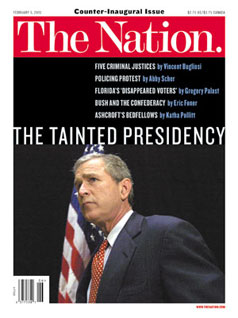
George Walker Bush has barely warmed his Oval Office chair, but the national media already seem eager to forget the rancor he incited on his way there, all but ignoring the shouts of the thousands
At the corner of Connecticut and K streets in downtown Washington, three blocks from the White House, a young African-American artist does a flourishing business selling his flavorful anti-Bush posters. "Shame on the Bushes and the rest of their kind!" he hollers occasionally to stir up customers. "Hail to the thief!" We hope he'll continue to stand his ground during the inaugural events and that police don't tamper with his First Amendment rights. He is expressing an important message that official Washington seems anxious to forget: the popular rage at the blatant injustices of Election 2000 and the illegitimate presidency that is assuming power. Our soundings tell us that this anger is widely shared around the country. George W. Bush's inaugural has not eclipsed the subtext of illegitimacy but actually aggravated and enlarged it.
Bush's elevation cannot be undone, but neither can its irregular foundations--including the conduct of Florida's election and the US Supreme Court's ruling--be brushed aside (see Gregory Palast, page 20, and Vincent Bugliosi, page 11). Some commentators sweetly suggest that Bush could help himself by squarely responding to these continuing doubts and protests. Instead, Bush opaquely responds, "They counted the votes, and I won. Next question." His presumptuousness is reflected in his opening moves and extreme appointments, which, in the case of John Ashcroft and Gale Norton, pour more salt on racial wounds. The fact that both nominees have earnestly invoked the "lost cause" of the Confederacy in their paeans to the archaic notion of "state sovereignty" (see Eric Foner, page 4) provides a chilling glimpse of a reactionary mindset. Bush aims to govern as if he were elected in a landslide--a latter-day Reagan who believes his agenda is now fully ratified by a popular mandate and so he can proceed to reward the right wing and various other of his constituencies. But the new President, remember, got votes from about 24 percent of adult Americans, slightly less than his opponent.
Whatever Bush may believe from his conversations with opposition leaders in Congress, the country is not on board for this presidency. Nor did it vote to build a costly missile defense system that reignites the nuclear arms race or to pass out more tax-cut boodle for the wealthiest among us. We call on the Democratic Party to stand against these and other outrages. The minority party, by responding hesitantly to the popular anger, seems not to understand that its own legitimacy is at risk, too. This troubled presidential outcome requires principled resistance in the political arena, not business-as-usual compromises and cheap deal-making among old colleagues. Ashcroft and Norton can be stopped if Democrats stand together. The sooner Democrats learn to speak resolutely for a true Democratic agenda, including healthcare for all, fairness for workers and a tax system aimed at reducing, not increasing, inequality, the better their own future prospects--as well as the prospects for restoring confidence in the system.
We call on the Democrats not only to resist but to lead. Dozens of plans have been put forth to insure that another Florida never happens, many of which are scheduled to be discussed by members of the Progressive Caucus and others at a meeting set for the day before the inauguration. Changes must include stronger enforcement of the Voting Rights Act and improvements in the way we conduct elections, ranging from campaign finance reform to the uniform introduction of modern technology. Restoring democracy is the top priority, but Democrats must rediscover their progressive voice on many other issues of substance before people will begin to believe in them again.
For this new President, who called himself "a uniter, not a divider," his beginning is dangerously provocative. We hope and expect that if Democrats prove to be weak-kneed and undependable, the people will organize to keep the pressure on.
Once again, the Civil War has sparked a contemporary political controversy. Two of President Bush's Cabinet nominees--Attorney General-designate John Ashcroft and the prospective Secretary of the Interior, Gale Norton--are being asked to explain their praise of the Confederacy.
In a 1996 speech to a conservative group, Norton likened her struggle to preserve states' rights to the Confederate rebellion, saying, "We lost too much" when the Union triumphed. Ashcroft, in a 1998 interview, lauded the magazine Southern Partisan for defending "patriots" like Robert E. Lee and Jefferson Davis and called on "traditionalists" to vindicate the Confederate cause against charges that it represented a "perverted agenda."
What is it about the Confederacy that appeals to so many modern-day conservatives from the party of Lincoln? Neither Ashcroft nor Norton appears to have family roots below the Mason-Dixon line. Ashcroft was born in Chicago, raised in Missouri and educated at Yale. Norton grew up in Colorado. But what is interesting is how conservatives who feel themselves heritage-deficient gravitate to a romanticized memory of the Old South--a usable past that conveniently omits slavery and Jim Crow.
During the 1950s, many conservatives responded favorably to Southern white resistance to desegregation. Moral conservatives saw the white South as a last bastion of traditional Christian civilization in a nation pervaded by individualism and secularism. Many libertarians insisted that federal action to secure civil rights threatened local autonomy, displaying an amazing indifference to the historic denial of blacks' rights by state and local authorities. Then in 1964, Barry Goldwater, who opposed that year's Civil Rights Act, carried five Deep South states, demonstrating that Republicans could strike electoral gold by appealing to white voters' resentment over black gains. Since then, white Southerners have become the backbone of the party's electoral strength.
Over the past two decades, Southern Partisan has carried articles defending apartheid, denying that slavery is contrary to Christian values, calling Lincoln a greater tyrant than George III, insisting that "Negroes, Asians, and Orientals...Hispanics, Latins, and Eastern Europeans have no temperament for democracy" and lamenting that immigration is undermining the "genetic racial pool" of the United States. Yet Ashcroft is hardly the only conservative to identify with the magazine. The advisers and contributing editors listed on its masthead have included Russell Kirk, a founding father of modern conservatism, and Republican politicians like Pat Buchanan and North Carolina Congressman David Funderburk.
Most Republicans appeal more subtly to white Southern voters. Ronald Reagan opened his 1984 campaign in Philadelphia, Mississippi, where three civil rights workers were slain; George W. Bush sent a message by speaking at Bob Jones University. Lauding the Confederacy is part of this symbolic politics.
No one claims that Ashcroft or Norton wants to restore slavery. But at the very least, their statements reflect a remarkable tone-deafness to how praise of the Confederacy is likely to be received outside conservative ranks. They tell us something about the restricted boundaries of the world of modern conservatism.
When it comes to the Civil War, Bush's Cabinet is a house divided. Ashcroft and Norton could benefit from a conversation--perhaps on Lincoln's Birthday--with Secretary of State Colin Powell. To Ashcroft and Norton, the South equals the white South, which equals the Confederacy. Blacks are not real Southerners, the region's white Unionists did not exist and slavery--the "cornerstone" of the Confederacy according to its vice president, Alexander Stephens--had nothing to do with the Civil War. Norton describes slavery as a "bad fact," legal parlance for an irrelevancy that inconveniently muddies the judicial waters, like smog on a day when a corporate polluter is defending itself in court.
Powell, on the other hand, has lectured eloquently about the contribution of black soldiers (nearly all of them Southern-born) to Union victory and the centrality of emancipation to that era's history. He could teach his colleagues something about the complexity of Southern history and the real meaning of the Civil War. Not that he is likely to be asked by the members of Bush's new Cabinet.
Media events have a life of their own. Consider the launch of the so-called Tiananmen Papers. On January 7, Mike Wallace interviewed on CBS's 60 Minutes an anonymous person in disguise who claimed, at some undisclosed time and place, to have hand-copied a massive number of Chinese secret documents that included transcripts of meetings, telephone conversations and other communications that the top leaders of China had with one another at the time of the Tiananmen Square massacre in 1989. He said he smuggled out transcriptions of a portion of this data on computer disks. He has assumed a disguise so he would have the option of returning to Beijing. A portion of this material has been published in a book, The Tiananmen Papers: The Chinese Leadership's Decision to Use Force Against Their Own People (Public Affairs), edited by Andrew Nathan, professor of political science at Columbia University, and Perry Link, professor of Chinese language and literature at Princeton University, with an afterword by Orville Schell, an author and former consultant to 60 Minutes. The material also appeared in Foreign Affairs with an introduction by Nathan. Completing the circle, CBS Evening News quoted the 60 Minutes statement that the documents had been "authenticated" by experts.
Authentication is a defined procedure in which a questioned document, or a part of it, is compared with the original or to an authenticated copy of it. In this case, however, the experts cited by CBS had no opportunity for matching documents with the originals. They did not even possess the questioned hand-copied documents, only the putative transcriptions of parts of them downloaded from a computer disk. And they acknowledged that they did not have proof that the originals existed.
The editors were able to verify bits of information contained in questioned documents from other sources. Much of the chronology of meetings, for example, could be found in Nicholas Kristof's authoritative November 12, 1989, article "How the Hard-Liners Won" in The New York Times Magazine. But such verification does not demonstrate that the documents are authentic. Bogus documents may contain accurate information (for example, facts in Clifford Irving's bogus Howard Hughes autobiography were verified by both Time-Life and McGraw-Hill, and information in the bogus "Hitler Diaries" was verified by the eminent Oxford historian Hugh Trevor-Roper). Indeed, invented documents frequently involve peppering the text with verifiable information.
The credibility of documents therefore rests on their provenance--the traceable chain of custody. By what means did these classified documents get from the files of the Chinese Politburo and Chinese security services into the hands of the media in America? How were they copied without detection, transcribed onto tape and transported to this country? Hand-copying such massive files from secret archives, which would constitute espionage of the highest order, would involve care and time to evade security. According to the Wall Street Journal and Associated Press, some 15,000 pages were copied and, from them, a small fraction was selected for the book. This would be a tall order. If the copier managed to transcribe one page an hour, and worked (in addition to his regular job) six hours a day, five days a week, it would take him ten years to copy 15,000 pages (not counting the time to enter them into a computer). Whoever copied such documents would have to have had access to classified material in different secure areas. So, to establish a provenance, it would be necessary to determine the copier's position, rank, level of access to classified documents and tenure in office.
Those connected with the book did not provide this provenance. Orville Schell told me that he "is not at liberty to say from whom, or how, the documents were obtained." James Hoge Jr., the editor of Foreign Affairs, wrote regarding the problem of the time needed to transcribe these files, "The work was done by a number of persons at the behest of high level reformers." He explained further that the anonymous person who appeared on 60 Minutes and whom the experts debriefed was merely their designated deliverer. If so, a deliveryman might himself not know who provided the documents to the group of transcribers. So, what remains missing is the chain of custody between the putative copier(s) and the deliverer.
Tiananmen Papers co-editor Nathan says the computer disk he printed out contained 516 pages of Chinese text. He suggested that reports in the Wall Street Journal and Associated Press that it was drawn from 15,000 pages of purloined documents were in error. He reasoned that the stories "didn't come from me or Perry [Link], the only authoritative sources on this question," and were therefore inaccurate. For his part, he says he cannot reveal the size of the underlying archive the transcribers had access to because it would endanger their safety.
Maybe so. But by asserting that he and his co-editor are the only "authoritative sources," he is excluding all the others--including the deliverer (who gave his own press interviews), the group of transcribers who boiled down the documents to 516 pages and the members of the faction that purportedly directed them and who copied the documents. Certainly, if such a treasure trove of documents exists, there would be a great number of people in a position to know its approximate size. Moreover, Nathan himself does not claim to have firsthand knowledge of those involved, other than the deliveryman. At best, from his work editing them, he has, as he puts it, "my views about the identities of the persons involved." He may be intuitively right--or wrong--but views do not make a provenance.
Finally, there is the question of motive. Schell said in the Wall Street Journal that he was convinced that the work was legitimate, both because of the deliverer's apparent knowledge of the inner workings of the Chinese government and the clarity of his motive in releasing documents. His motive, Schell explains, was to help reformers gain power in the Communist Party in Beijing. But the same clarity of motive, a desire for power, might also lead a group to arrange to publish bogus documents.
The authors have, of course, every right to publish a book they intuitively believe is truthful. But we do not know who, if anyone, took and copied these documents--or how many documents there are in the archive. We do not know why they were transcribed or who transcribed them. We do not know who directed this process--or why--and who selected, or wrote, the 516 pages delivered for publication. All we know for sure is that some anonymous person from China delivered for publication in America a computer file that cannot be authenticated.
As busy as he is these days, George W. Bush should take time out to see Traffic, Steven Soderbergh's new movie about the war on drugs. For, in coming days, Bush must name a new drug czar, and seeing this movie could--and should--affect his choice. Traffic contains the usual disclaimer about its characters bearing no resemblance to real individuals, living or dead, but it is in fact a thinly veiled attack on the drug policy of the Clinton Administration and its outgoing drug czar, Barry McCaffrey. (As he prepares to leave office, Bill Clinton has suddenly become a drug reformer, calling for the decriminalization of marijuana and the overhaul of federal sentencing guidelines for nonviolent drug offenders. Where was he when we needed him?) In the movie, the drug czar, like McCaffrey, is a military man, and as in Washington, the Office of National Drug Control Policy has been taken over by the military and law enforcement. And as in real life, the White House is preoccupied with stopping the flow of drugs from Latin America into the United States.
In Traffic, Soderbergh dramatizes the real-life futility of that undertaking. Having written about the drug issue for years, I expected the movie to take many Hollywood-driven liberties with the facts. At points, the movie does lapse into melodrama; overall, though, it depicts US counternarcotics efforts with dead-on accuracy. In making the film, Soderbergh gained the cooperation of the US Customs Service and the Drug Enforcement Administration. When a Customs official complained about aspects of the script, Soderbergh let him rewrite part of it. The DEA felt so comfortable with the director that it allowed him to shoot a scene inside the El Paso Intelligence Center in Texas--the first time a film crew was ever allowed inside the surveillance complex.
Often, access leads to co-optation, but not in Soderbergh's case. On the contrary, the input from law enforcement, by increasing the movie's verisimilitude, has added to the force of its indictment. One drug agent in the movie acknowledges that the traffickers have access to telecommunications devices far more sophisticated than anything the DEA has. A Customs officer concedes that for every drug shipment that gets seized, several others get through. A trafficker in a witness-protection program chides a DEA agent about the hopelessness of his effort to bring down a smuggling ring--even if he succeeds, others will quickly fill the gap.
Soderbergh's main vehicle for getting his message across is Robert Wakefield, a tough-on-crime state Supreme Court judge in Cincinnati (played by Michael Douglas). After being selected to become the next drug czar, Wakefield prepares for the job by going out into the field. At every stop, he is confronted by evidence of the drug war's failure. On a plane ride back from the border, the judge--surrounded by military officers--asks for new ideas in fighting the war. He is met by total silence.
What finally pushes Wakefield over the edge is his own 16-year-old daughter's descent into cocaine addiction--a subplot that's one of the movie's main weaknesses. Within a matter of days, the teenager goes from perky straight-A student to freebasing zombie who sells her body for drugs. Shades of Reefer Madness. Furthermore, the movie strongly implies that it is suburban whites like Wakefield's daughter who make up the heart of the nation's drug problem--indeed, every drug user depicted in Traffic is white and well-off. Of course, many privileged whites do abuse drugs, but so do plenty of poor African-Americans and Latinos. It's as if Soderbergh can't trust us to sympathize with drug-using minorities. This distorts the nature of the challenge facing drug policy-makers: The movie's addicts are all so well-heeled that they can pay for rehab out of pocket, but if treatment is a superior way to deal with drug abuse, as Traffic suggests, then the government will have to do much more in the way of providing it.
When Wakefield finally tracks his daughter down to a squalid flophouse in inner-city Cincinnati, he realizes that drug abuse is a deeply rooted social problem that cannot be fought with helicopters, guns or wiretaps. At the press conference to announce his appointment, the judge interrupts his prepared, cliché-ridden speech to ask, "How do you wage war on your own family?"
More and more Americans are asking the same question. Almost every time a drug reform measure has been put up for a vote, it has passed. In November, voters in California--tired of paying for ever more prisons--approved a referendum to treat, rather than incarcerate, nonviolent drug offenders. In Manhattan, increasing numbers of prospective jurors are being dismissed after expressing their reluctance to serve on cases involving low-level drug offenders. In early January, New York Governor George Pataki announced his intention to "dramatically reform" the notorious Rockefeller drug laws. The crowds lining up to see Traffic offer further evidence of the changing public mood.
How will Bush respond? On the one hand, he has repeatedly voiced sympathy for people dependent on drugs and alcohol. He has spoken frankly about his own drinking problem and how he managed to overcome it by religious faith. On the other, as governor of Texas, he presided over the nation's largest prison system, and he has seemingly never encountered a drug law he didn't like. Moreover, by invoking only the faith-based form of treatment, he leaves the impression that all addicts need to get well is to open their hearts to Jesus. Most troubling of all is Bush's nominee for Attorney General. Whenever he's had the chance, John Ashcroft has pushed for an intensification of the drug war. He belongs to a group of hard-core Congressional Republicans who have helped stymie all efforts at reform.
At a screening of Traffic in Washington last fall, Bill Olson, the staff director for Republican Senator Charles Grassley's drug caucus, walked out after Michael Douglas's bailout speech. "Shame on you!" he scolded Soderbergh--testimony to the strong emotions the movie is stirring and the stiff resistance its message is facing in Washington.
Only yesterday pundits assured us that George W. Bush, who lost the popular election by half a million votes, would tread softly and govern meekly. "He has no mandate to do anything except Be Nice," Molly Ivins wrote in the December Progressive. But who needs a mandate, with the mainstream media resolutely ignoring the still-unfolding scandal of the Florida election? Bush is making hay while the sun shines--paying off his debt to business with the nominations of Elaine Chao, late of the Heritage Foundation, for Labor; Gale Norton, lead-paint champion, for Interior; and Christie Whitman, governor of the state with the second-worst air pollution in the country (Texas is first), for EPA. Over at HHS, anti-choicers get Tommy Thompson--whose devotion to welfare reform provides a note of continuity with the worst aspects of the outgoing Clinton Administration. Most ominous, the Christian and loony right gets its reward for keeping quiet during the campaign: the nomination of John Ashcroft for Attorney General.
How far to the right is Ashcroft? As I write, the Democrats on the Judiciary Committee are doing their best to help him obscure his ghastly twenty-five-year record on abortion, guns, women's rights, gay rights, the separation of church and state. A rare exception was Ted Kennedy, who closely questioned the nominee on his crusade as Missouri's Attorney General against voluntary school desegregation. But so far the only senator who has publicly said she will vote no is Barbara Boxer, never a Nation favorite, while "progressive" stalwarts like Paul Wellstone and Russell Feingold (who was particularly fawning and vacuous in his questioning), not to mention Tom Daschle and Joe Biden, have all said they were inclined to vote yes (Wellstone and Biden later backpedaled after an outcry). You'd think the Democrats had lost the popular election! Unless Ashcroft is discovered to be sleeping with Barney Frank, his confirmation looks assured. Who in the Senate can be expected to care that as governor of Missouri, Ashcroft twice vetoed bills that would have equalized voter-registration procedures in mostly black and mostly white counties, given that not one senator would sponsor the Congressional Black Caucus's January 6 protest of the Electoral College vote? As the Last Marxist says, the Republicans really are reactionaries, but the Democrats are only pretending to be liberals.
If Ashcroft is not too far out to be confirmed, who is? Accepting an honorary degree at Bob Jones University in 1999, Ashcroft proclaimed that in America, "We have no king but Jesus." (Why aren't Jews up in arms about that?) This is a man who, on the eve of his swearing-in as a Missouri senator, anointed himself with Crisco, supposedly after the manner of the Hebrew kings. Can it be that Barbara Boxer is the only senator discomfited by the thought of an Attorney General who thinks the Bible instructs him to put salad oil on his head?
John Ashcroft is not just a conservative: He stands at the place where Christian fanatics, anti-choicers, militiamen, gun nuts and white supremacists come together. As Chip Berlet reports, he has acknowledged meeting with the head of the St. Louis chapter of the racist Council of Conservative Citizens to discuss the case of a member jailed on federal charges of conspiring to murder an FBI agent. He defended the leaders of the Confederacy in Southern Partisan, the neo-Confederate magazine that has done a brisk business in T-shirts celebrating the assassination of Abraham Lincoln (Timothy McVeigh was wearing one when arrested). If Southern Partisan rings a bell, by the way, it's because when editor Richard Quinn was discovered to be managing John McCain's South Carolina campaign, a Bush spokesperson criticized McCain for associating with him.
Among Ashcroft's many connections on the far side is Larry Pratt, who, as head of Gunowners of America, functions as a kind of liaison between the militia movement and Capitol Hill. A handwritten note from Ashcroft is posted on Pratt's website (www.gunowners.org). According to the Manchester Guardian, "the two men know each other from a secretive but highly influential rightwing religious group called the Council for National Policy, of which Mr Pratt is a member and whose meetings Mr Ashcroft has attended." Tom DeLay and Trent Lott also belong.
In a glowing profile in CounterPunch (July 1/15, 1999), Alexander Cockburn uncritically paraphrases the position for which Pratt is best known--that the surest proof against Columbine-type school shootings is to arm teachers to shoot students "just like they do in South Africa, where one instructor recently gunned down a bellicose student." South Africa is one of the world's most violent countries, with a long history of serious corporal punishment--with whips--in its dismal black schools, so it's not immediately obvious why the United States should follow its lead even if Pratt's tale is true. But the South African Consul says there is no such policy and knows of no such incident having occurred, nor did a media search turn one up. Need one point out as well that millions of pistol-packing teachers present something of a danger to defenseless schoolchildren? On the other hand, since Pratt also believes in guns for kids (Ashcroft's note was to thank Pratt for enlightening him about the antigun provisions in the juvenile justice bill), the students could just shoot back.
Pratt's website is a grab bag of nuttiness ("What the Bible Says About Gun Control"; "Guns Save Health Care Costs"). But it would be wrong to see him as a marginal, if colorful, figure. CounterPunch doesn't mention it, but Pratt has been a leader of the hard-core Christian right for many years: He led the walkout of religious conservatives at the White House Conference on Families in 1980; he has fundraised for Operation Rescue. In 1996, he was co-chairman of Pat Buchanan's presidential campaign until he was forced to resign when his links to Christian Identity and white-supremacist groups became public. Today Pratt pals around with Lott, DeLay and Ashcroft--whom Bush Senior reportedly considered for the Attorney General post but rejected as too extreme to be confirmed.
That was then, this is now.
"The heart will be the favorite organ of the Bush administration," says Marshall Wittmann of the conservative Hudson Institute. "That's to distinguish it from the favorite organ of the Clinton administration." Wittmann, formerly of the Christian Coalition, helpfully explained that among religious conservatives the term "heart" has become a friendly synonym for the more controversial "soul," and that this explains President Bush's frequent recourse to it--as in "Jesus changed my heart" or, more controversially, "The senators, if they are objective, they'll take a look at Senator Ashcroft's heart and his record and they'll confirm him." Don't be fooled. The giveaway is in the comparison between the two throbbing items in the original excerpt and the strong subliminal connection between them.
(A newly unearthed gospel song credited to John Ashcroft)
As I told the Bob Jones students,
Seated white and black apart,
This nation is unique, not like the rest.
As I faced those godly youngsters,
I told them from the heart
Just why this land will always be the best:
The only king we have is Jesus.
And I feel blessed to bring that news.
The only king we have is Jesus.
I can't explain why we've got Jews.
So because our king is Jesus,
I'm often heard to say,
Our kids should pray to Him each day in class.
If some kids just stay silent,
That's perfectly OK.
But they'll all be given Jesus tests to pass.
The only king we have is Jesus.
That's the truth we all perceive.
The only king we have is Jesus
So Hindus may just have to leave.
Now Jesus hates abortion,
'Cause Jesus loves all life.
They call it choice; it's murder all the same.
The killers must be punished--
The doctor, man and wife.
We'll execute them all in Jesus' name.
The only king we have is Jesus.
It's Jesus who can keep us pure.
The only king we have is Jesus.
And He's Republican for sure.
The homosexual lifestyle
Could make our Jesus weep.
He loathed their jokes about which cheek to turn.
Yes, Jesus came to teach us
With whom we're supposed to sleep.
Ignore that and you'll go to Hell to burn.
(Final chorus sung in tongues:)
Tron smleck gha dreednus hoke b'loofnok
Frak fag narst fag madoondah greeb.
Tron smleck gha dreednus hoke b'loofnok
Dar popish, flarge dyur darky, hebe.
What will be remembered about the Administration of William
Jefferson Clinton is not the sniping attacks of his critics, but rather
his eight years of considerable achievement. The center held, the economy
flourished and those bent on a cultural civil war were kept at bay. If
George W. Bush does half as well, the Republicans will hail him as a
savior.
The two previous Republican administrations created more red ink than
all previous administrations combined, but the GOP still will not credit
Clinton with putting the federal budget dramatically in the black.
Nor can they, even now, admit that Newt Gingrich's reckless road map
known as the "contract with America" was a divisive prescription for
disaster. By stopping Gingrich in his tracks, Clinton at least
temporarily stalled the right-wing lurch that the new Bush Administration
seems hellbent on reviving.
Clinton leaves office with unprecedented high approval ratings because
he demonstrated that it's possible to have a progressive federal
government that cares for the needs of the people while bolstering,
rather than bankrupting, the economy.
He gained the allegiance of poor and minority voters because--despite
an ill-conceived welfare reform--his centrist policies contained
reassuring support for affirmative action, earned-income tax credits,
college scholarships, family leave for workers and other measures to
insure that their lives are not totally ruled by the anarchy of the
market and a legacy of societal inequality.
He had the support of a clear majority of those on the cutting edge of
economic change on both coasts because they shared his alarm at the
forces of intolerance, be they inspired by misguided references to
religion, family, patriotism or sexism.
He supported immigrants, who are the lifeblood of our prosperity, and
dared to suggest that homosexuals should be treated the same as any other
productive and law-abiding segment of our population.
In foreign affairs, Clinton left his mark as a peacemaker willing to
deal boldly with the seemingly intractable problems of Northern Ireland,
the Balkans and the Mideast, while easing trade and other barriers among
nations.
True, the jackals nipping at Clinton's heels from the days he
announced for the presidency got their pound of flesh. But it's Clinton
who triumphed. When Jackal-in-Chief Kenneth Starr popped up on one of
last Sunday's talk shows to judge the Clinton years an "unfortunate era,"
he must have been referring to his own miserable performance and not the
well-being of the nation.
At no time in our modern history has a president been subject to more
abuse for claimed offenses that primarily concerned his activities before
attaining office. A minor investment, in which he lost money, was blown
out of proportion by the most respectable quarters of the media.
Think of the public outrage now if that same effort were put into
digging up the dirt on the new President's past business dealings, let
alone the excesses of his previous personal life. Imagine if the Los
Angeles Times were to conduct in-depth interviews with disgruntled Texas
Rangers, as the newspaper did with Arkansas troopers who had guarded
Clinton as governor. Or if the New York Times were to launch a four-year
investigation of the claims of one of Bush's less happy former business
partners. Would CBS' 60 Minutes consider a show based on what Larry
Flynt's investigators unearthed concerning allegations about Bush's
personal behavior in the years before he was president?
Nope, because the media has a double standard. Intimidated by the
right-wing's absurd claim of a liberal bias, journalists tend to be hard
on Democrats while granting Republicans a free pass. When will one of
those pompous media moralizers admit that his or her personal life is as
messy as that of the President they spent eight years denigrating? And,
face it, those rich media superstars lust for Republican tax breaks for
the rich as much as anyone.
We now know more than we need to know about the personal lives of our
leaders. It's doubtful that any of our past heroes could have better
withstood the merciless scrutiny extended to Clinton. He was flawed in a
way that all too many of us are, but the love and success of his wife and
his daughter suggest that some basic family values were intact. Yes, he
was a product of the sixties, and thank God for his not being
self-righteously square.
Clinton's historical reputation will more than surmount the petty
complaints of contemporary critics and leave him remembered as one of the
hardest working, most competent, fundamentally decent and smartest men to
ever serve in the office. He was an excellent President.
Thousands of citizens can't register or have been wrongly thrown off the rolls.
Five Supreme Court Justices are criminals in the truest sense of the word.
The company that the Florida secretary of state contracted with in 1998 to help purge the state rolls of ineligible voters is well connected to GOP circles. The chairman of the board of Database Technologies, now the DBT Online unit of ChoicePoint Inc. of Atlanta, was former astronaut and prominent Republican Frank Borman.
Also on the board were billionaire Ken Langone, who was co-chairman of the fundraising committee for New York City Mayor Rudolph Giuliani's aborted US Senate race; and big GOP funder Bernie Marcus, co-founder of Home Depot. Howard Safir, former New York City police commissioner under Giuliani, is a consultant to the company, and Vin Weber, best known as Newt Gingrich's legislative enforcer when the pair controlled the House of Representatives, is the company's lobbyist. The company says that it favors no party.
A report that Secretary of State Katherine Harris had ordered the removal from voting lists of 8,000 Florida citizens, every one of them wrongly identified by DBT as felons from Texas, first appeared in Britain's Observer, where I work as an investigative reporter. Harris and ChoicePoint claimed at that time to have corrected their erroneous ways, but the Observer, with the help of a team from Salon, reported in December that, extrapolating from known figures, at least 15 percent of the 58,000 felons named on the new scrub lists had also been wrongly identified as felons.
A ChoicePoint spokesman termed the British reports a "vile, lying, inaccurate pack of nonsense." A more upbeat spokesman noted with pride that "fifteen percent wrong [is] eighty-five percent right!" In a later statement the company said the scrub list contained the names of potential felons only, and that "Florida law prevents names from being removed from the voting roll unless the information is confirmed by local officials--not by us."
One county (Leon, which includes Tallahassee) allocated resources to verify independently the criminal records of those on the list who lived in that county. According to officials there, it could confirm only thirty-four of 694 names, indicating that the error rate could be as high as 95 percent, not 15 percent.
Police are up to old tricks: disrupting and spying on legal political activities.
About halfway through the installation of Sol LeWitt's art on the fourth floor of New York's Whitney Museum of American Art, a small alcove gallery is given over entirely to Autobiography, a work from 1980. Autobiography consists, by my calculation, of 1,071 simple black-and-white photographs, arranged in 3x3 square grids. The pictures are of an almost striking banality, with a degree of photographic distinction near zero, and they show, for the most part, the most ordinary of objects: tools, balls of twine, shoes and articles of clothing, kitchen utensils, snapshots, books, houseplants. Except for the flat-files and drafting instruments--triangles, T-squares, templates, protractors, rulers and the like--their counterparts would have been found in most households of the Western world at the time. The inventory defines domestic normality for persons of a certain class--not too wealthy, not too poor. More metaphysically, the objects participate in what Heidegger designates as Zuhandenheit--the "Ready-to-Hand"--the kinds of things one notices only when they are not ready to hand, their absence impeding the smooth flow of daily life. Their inventoried presence accordingly testifies to the orderliness of this household, in which everything is present and accounted for, and to the organizational disposition of Sol LeWitt, whose household it was.
The personality itself, of course, is not a further item in the inventory. We know from external sources that LeWitt was about to vacate his living space in 1980 and move to Spoleto, Italy; and that he wanted to photograph each object with which he lived. In a video interview, Sol LeWitt: Four Decades, on continuous view outside the lobby gallery, the artist tells the exhibition's curator, Gary Garrels, that a far better picture of him can be gotten from the photographs of all the things he lived with than from an ordinary portrait. The question has been raised as to why he did not then title the work Self-Portrait. My sense is that it is because "autobiography" implies the concept of a life, and a life is something lived. The ordinariness of the objects inventoried further implies that there is nothing out of the ordinary in LeWitt's life, that it could be the autobiography of Whoever, Wherever. It may be remarked that there is no photograph in Autobiography of Autobiography itself--though it would be philosophically daring to have included the representation of the life as a further item in the life represented. I cannot forbear observing the philosophical significance of the fact that Autobiography fails to include a photograph of LeWitt himself. "When I enter most intimately into what I call myself," the philosopher David Hume once wrote, "I always stumble on some particular perception or other.... I never can catch myself at any time without a perception, and never can observe anything but the perception." There is no experience of the self, Hume concludes, and so the term is without meaning.
Still, not everyone would photograph each of his possessions, as if for a yard sale, and organize them into a set of 3x3 grids. Nor can the work be rid of one's own subjectivity by organizing its components meticulously. If anything, character and disposition are revealed through the order or absence of order in one's life. In a way, the LeWitt exhibition could itself be titled Autobiography. It is difficult to believe that someone who took and arranged the photographs as compulsively as LeWitt appears to have done would leave the content and organization of a life's worth of his art to another. "If you require a monument," Sir Christopher Wren inscribed in St. Paul's Cathedral in London, "look around you."
The relevance of this to LeWitt's oeuvre, in whole and in part, lies in the philosophy he articulated in a crucial text, "Paragraphs on Conceptual Art," first published in Artforum in 1967. In the late 1960s there would have been relatively little to appreciate in the work other than the way it exemplified the theory. In its own right it was what the Italian critic Achille Bonito Oliva recently called "minimalial," even if it was not Minimalist in the strict ideological meaning of the term. It is true, however, that as LeWitt's art has evolved it has become decreasingly important to know much about that philosophy in order to respond to the work. Stand near the elevators at the Whitney and observe the expressions of sudden pleasure when the doors open and visitors see the marvelous wall painting Loopy Doopy behind the airy wooden structures in front of it. Few of those stepping out can be veterans of the theoretical debates to which "Paragraphs" belonged or know much of the subsequent history of Conceptualism as an artistic movement. For all its genesis in theory, LeWitt's work affords such instantaneous pleasure that it must appeal to an innate aesthetic sensibility that really does belong to Whoever, Wherever. This, together with the fecundity of his invention, is part of LeWitt's greatness as an artist. But even if the philosophy enters less and less into the content of what we experience, it belongs to the historical explanation of even the most recent, least apparently theoretical work.
"When an artist uses a conceptual form of art," LeWitt wrote, "it means that all of the planning and decisions are made beforehand and the execution is a perfunctory affair."
The implication is that the work of art is the transcription of an idea, in the medium its idea specifies. In 1967 it would have been LeWitt's practice to transcribe his own ideas; but later, when he began to do the wall drawings that were to become the genre most distinctive of his work, he more and more left the transcription of his ideas to what he terms "draftsmen." In a text from 1971 he wrote, "The artist conceives and plans the wall drawing. It is realized by draftsmen. (The artist can act as his own draftsman.) The plan, written, spoken or a drawing, is interpreted by the draftsman." It is fairly clear that between "artist" and "draftsman" there is a functional distinction involving different skills, and that it is in no sense necessary that a single individual incorporate both functions.
An example of a work for which the plan can be spoken is Wall Drawing #51: All Architectural Points Connected by Straight Lines. Blue snap lines. A "snap line" is a length of chalked cord, tautly stretched along a flat surface. It is plucked, like a violin string, leaving a straight line, the color of the chalk. The number of vectored lines will be a function of the number of "architectural points" the lines connect. Wall Drawing #51 was done in 1970 and "installed" that year in the Museo di Torino in Turin, Italy. Its latest installation, done in 2000, can be seen on the extreme north section of the east wall of the fourth-floor gallery, where the viewer will initially register it as a network of pale blue straight lines connecting corners with corners. It may have been done at other times, on different walls, and one hopes it will go on being installed, transcribed by different draftsmen, when we are all long gone. The installations themselves can be painted over or destroyed in other ways, but the plan itself has only the reality of a concept. And it need never have existed in the form of a drawing. It would have been enough for it to be a plan, scribbled down as an instruction to the draftsman or communicated by phone or on a tape, and so need no more resemble the set of its embodiments than a set of scrubbed floors need resemble the injunction "Scrub the floors!" Neither must the transcriptions resemble one another, as long as they comply with the plan. The distribution of "architectural points" will differ from actual wall to actual wall. I find it delicious that there are lines that connect the corners of the room with the corners of the alarm systems that happen to be placed in the wall chosen for the present installation of #51--and perhaps chosen to illustrate the point. In the catalogue illustration of the same work, the lines densely converge on the electrical outlets near the floor. It looks like the maps of airline routes one sees on in-flight magazines, shown radiating out from hubs.
There is an unmistakable skill in using snap lines to make nice, clean vectors on the wall, and there is no reason to suppose that LeWitt himself has such skills. The aesthetic of #51 is really inconsistent with casual, smudged marks, and part of the pleasure of the work derives from the impeccability of its execution. Compare it, though, with a 1972 work that shows a page from a publication about art, and indeed the art of certain of LeWitt's contemporaries--Marcel Duchamp, Robert Rauschenberg, Robert Morris, Jasper Johns and several others. It addresses the topic of "human control," which of course plays a central role in LeWitt's philosophy. I don't know who the author is. In any case, the plan of the work is in effect its title: From the Word "Art": Blue Lines to Four Corners, Green Lines to Four Sides, and Red Lines Between the Words "Art" on the Printed Page. My hunch is that the draftsman of this work was LeWitt himself, using colored ink and pencil, and perhaps one of the straightedges we see in Autobiography. But anyone possessing the minimal skills required to execute diagrams in high school geometry class could do this work. Who but LeWitt, however, could or would have formed the concept of connecting the word "art," as an isomorphic set of physical entities composed of ink molecules, with the perimeters of the physical surface on which they are deposited, as well as with one another? The work is witty, slyly deflationist of the concept of art as well as some of its theories, and exceedingly arch in the way it refers, as work, to the content of the text it unites with its page. The pleasures here, as with #51, are only marginally sensuous. They are largely conceptual pleasures, and perhaps best appreciated by those who belonged in the same intellectual atmosphere to which the works themselves belong. (I have to say that I love these works!)
But let us return to LeWitt's credo, and to the polemical atmosphere in which it was composed. What is actually implied by the severe disjunction between conception and draftsmanly enactment? First, it implies that art is a form of mental thought. "Mental thought" may seem redundant, but in the era in which "Paragraphs" was written, there was an overall philosophical tendency to deconstruct the idea that thinking is something that takes place exclusively in the mind. It was argued that painters, for example, or pianists, think with and through their hands and fingers--that a carpenter thinks with the saw and hammer, a dancer with his or her body, and that it is through the body that these people express themselves. Certainly, it might have been said, dancing does not transcribe through movements a terpsichorean plan in the dancer's mind! Certainly the clarinetist riffs in public space, and does not mechanically perform a privately inscribed score! Indeed, when this position was being argued in such philosophical texts as Gilbert Ryle's magisterial The Concept of Mind (1949), artists, especially those of the New York School, were expressing themselves in sweeping gestural movements on canvases laid on the floor or pinned to the wall of their studios. Painting was something that happened out there--not something that takes place in here. One begins with a mark, another mark, a third mark--a splash, a smudge, a drip--until the whole work energetically completes itself and the artist can then see what has been achieved. It was not something in which "all of the planning and decisions are made beforehand" with "the execution a perfunctory affair"! How could Pollock's Autumn Light have been planned? Or de Kooning's Woman I! In Abstract Expressionism, hand and eye were everything, and for those who can remember that era, the intellect could hardly have been more suspect. The painter's studio and the philosophy seminar room were at one in repudiating the "ghost in the machine."
LeWitt, by contrast, was an unabashed mentalist. "It is the objective of the artist who is concerned with conceptual art to make his work mentally interesting to the spectator." And, on a note that must have been infuriating to those who saw it as the aim of painting to express and arouse feelings of the most visceral order, LeWitt adds that conceptual artists would "usually want [the art] to become emotionally dry." It need not be boring--"It is only the expectation of an emotional kick, to which one conditioned to expressionist art is accustomed, that would deter the viewer from perceiving this art." Wall Drawing #1, first installed in the Paula Cooper Gallery in 1968, is not in the Whitney show, but you can see the plan for it in the catalogue. It is a composition made up of four rectangular areas, overlaid by a network of vertical and horizontal lines, drawn with graphite sticks, which would have had the visual exhilaration of window screens were it not for the superimposed diagonal lines, drawn at 45-degree angles, forming an overlay of nested diamonds. Wall Drawing #1: Drawing Series II 18 (A&B)--to give it its full name--is, one might say, almost aggressively dry. But it would have had great contextual excitement in 1968. It is often said in retrospect that Abstract Expressionism as a movement was finished in 1962. But it still tended to define what one expected to experience in galleries in the later sixties. Pop Art used the brash, lurid colors of commercial logos clamoring for the attention of consumers. So it would have been astonishing to enter an avant-garde space like Paula Cooper's and see something that is "perceived first as a light tonal mass...and then as a collection of lines." From the perspective of its historical moment, Wall Drawing #1 has to have been seen as provocative--a feeling that has faded with the evolution of the art to which LeWitt has so greatly contributed: We are living in a conceptual art world. On the evidence of Autobiography, meanwhile, one cannot but feel that there is an aspect of LeWitt's personality present in the neatly drawn, evenly spaced, repeated uninflected lines. It is a disposition transformed into an aesthetic, to be found throughout his work--though it is by no means the whole of the LeWittian aesthetic, which has become increasingly sensuous (as in the marvelously interlaced red and purple of Loopy Doopy) and hardly calculated to give pleasure to those with what the great logician W.V.O. Quine--who died on Christmas Day at age 92--once spoke of as a "taste for desert landscapes."
One cannot imagine Loopy Doopy as having been done by LeWitt in 1968. He has penetratingly observed that "the difference between the sixties and now is that those years were a time of very strong ideology, politically, aesthetically, and every other way. In order to break with the past and make new things, you had to begin with some kind of ideological framework." The work, one might say, has become decreasingly ideologized, and though the same distinction between plan and execution remains in place, there would be little inclination to consider the execution "perfunctory." LeWitt rarely serves as his own draftsman any longer, but he closely monitors those who carry out his plans.
Consider in this light LeWitt's sculptural--or, as he would say, "structural"--works. His 1964 Standing Open Structure Black is one of the defining sculptural works of the twentieth century: a simple wooden structure, painted black, with nearly square cross-sections, ninety-six inches tall. It is like a three-dimensional diagram of a geometrical figure, since it consists only of edges and corners. It could have been selected as a furnishing for the house that Ludwig Wittgenstein built and designed for his sister in Vienna. Typically, LeWitt's structures are variations on cubes used as modules, painted black or white, and looking, I suppose, like skeletal models for pieces of architecture or perhaps for molecules. They do not always stand on the floor--sometimes they are hung from walls or even suspended from ceilings. They all give the sense of being reductions of complex objects to their elementary constituents. Speaking again of the sixties, LeWitt observes, "I could never have made a colored sculpture. It was something I just couldn't do.... But now I say, so what? If it seems to promise some kind of interesting result, why not do it?"
Perhaps he is referring to such works as Non-Geometric Form #8--more engagingly titled Splotch (color). It is a gaily painted, irregularly curved object, like a cartoon mountain range, which is in a side lobby on the ground floor at the Whitney, the walls of which are no less gaily decorated with bands and arcs. It is an example of what LeWitt's friend Lucy Lippard called Eccentric Abstraction, the greatest exponent of which was LeWitt's protégée, Eva Hesse, the young sculptor who died in 1970. For all the tragedy of Hesse's life, her work was full of mirth, and it is very much as though, in relinquishing ideology, LeWitt took her as his model. Splotch, Splat and Blob are names that LeWitt uses. They belong to the lexicon of comic strips, in one of which Loopy Doopy could be the name of a character. This is a joyful show, full of fun and beauty, a gift to the world. The Whitney looks as if it had been expressly designed with LeWitt's ideological work in mind. The later work will brighten the dour interior until February 25.
Perhaps Edward Bellamy anticipated the retrospective examinations that would mark our country's culture in this bi-millennial year. Bellamy, long famous for his utopian novel Looking Backward 2000-1887, regarded the year 2000, traditionally enough, as "the closing year of the twentieth century," the ending of the millennium--not, like current political leaders, as the first year of the twenty-first century and the new millennium. In most other respects, however, this nineteenth-century social critic was far more innovative in making his predictions of the twentieth century's material and moral advances. He placed the dateline "Historical Section, Shawmut College, Boston, December 26, 2000" on his novel in 1887, and with the passage of the actual date, we can appraise the accuracy of the vision with which Bellamy himself putatively "looked backward" on it--much as the arrival of 1984 marked the occasion for numerous assessments of George Orwell's anti-utopian novel.
The hero of Bellamy's utopian novel, Julian West, awakes in the Boston of 2000 from a Rip Van Winkle-like sleep of 113 years. He gazes out upon an urban landscape and can scarcely recognize it as the same city in which he went to sleep, when he sees the new Boston's size and grandeur:
At my feet lay a great city. Miles of broad streets, shaded by trees and lined with fine buildings, for the most part not in continuous blocks but set in larger or smaller enclosures...along which statues glistened and fountains flashed in the late-afternoon sun. Public buildings of a colossal size and architectural grandeur unparalleled in my day raised their stately piles on every side. Surely I had never seen this city nor one comparable to it before.... [Then] I looked east--Boston harbor stretched before me within its headlands, not one of its green islets missing.
Even harder for the awakened West to grasp is the changed social order of 2000. West, who had been among the privileged, prosperous few in his city, finds rather that there is universal--and equal--prosperity for all. Each American annually receives a "credit card," and everyone is entitled to receive the identical amount of credit, against which he or she can draw in charging chosen purchases of commodities or services. Bellamy's so-called credit card functioned much as a bank debit card would today, if each year began with the direct deposit by the US Treasury of an identical (and generous) sum into each cardholder's account. Nor did the citizens of 2000 brook any gender discrimination: Bellamy foresaw the entry of women fully into the work force of the twentieth century, and his utopia provided equal pay (or rather equal credit) for equal work. The payment of these annual credits into each account was funded by "the nation," which in turn owned all the means of production and distribution, and so received the fruits of everyone's paid labor.
But no Marxian revolution had brought about that state of equality and common ownership. Rather, it had resulted from the ultimate, logical development of corporate America, arising from a growth pattern much like that of the continuing takeovers, mergers and aggregations of today. As Bellamy described it, writing in "2000":
Early in the last century the evolution was completed by the final consolidation of the entire capital of the nation. The industry and commerce of the country, ceasing to be conducted by a set of irresponsible corporations and syndicates of private persons at their caprice and for their profit, were entrusted to a single syndicate representing the people, to be conducted in the common interest for the common profit. The nation, that is to say, organized as the one great business corporation in which all other corporations were absorbed; it became the one capitalist in the place of all other capitalists, the sole employer, the final monopoly in which all previous and lesser monopolies were swallowed up, a monopoly in the profits and economies of which all citizens shared. The epoch of trusts had ended in The Great Trust.
The culminating political action was taken through election of the "national party," comprising a coalition of all classes.
In a word, the people of the United States concluded to assume the conduct of their own business, just as one hundred-odd years before they had assumed the conduct of their own government, organizing now for industrial purposes on precisely the same grounds that they had then organized for political purposes. At last, strangely late in the world's history, the obvious fact was perceived that no business is so essentially the public business as the industry and commerce on which the people's livelihood depends, and that to entrust it to private persons to be managed for private profit is a folly similar in kind, though vastly greater in magnitude, to that of surrendering the functions of political government to kings and nobles to be conducted for their personal glorification.
The shocking thing to Bellamy, were he to awake in 2000, would be the inexplicable increase in economic inequality that has in fact accompanied those very gains in productivity that he believed would result from steadily increasing industrial concentration. Bellamy would be surprised not by the technological progress he would see today but by the want of accompanying moral progress. To him, cooperation was the human ideal, and the unbridled economic competition of the nineteenth century was its antithesis. Probably the book's most famous passage, and imagery, is his comparison of nineteenth-century society to a towed coach:
By way of attempting to give the reader some general impression of the way people lived together in those days, and especially of the relations of the rich and poor to one another, perhaps I cannot do better than to compare society as it then was to a prodigious coach which the masses of humanity were harnessed to and dragged toilsomely along a very hilly and sandy road. The driver was hunger, and permitted no lagging, though the pace was necessarily very slow. Despite the difficulty of drawing the coach at all along so hard a road, the top was covered with passengers who never got down, even at the steepest ascents. These seats on top were very breezy and comfortable.... Naturally such places were in great demand and the competition for them was keen.... By the rule of the coach a man could leave his seat to whom he wished, but on the other hand there were so many accidents by which it might at any time be wholly lost. For all that they were so easy, the seats were very insecure, and at every sudden jolt of the coach persons were slipping out of them and falling to the ground, where they were instantly compelled to take hold of the rope and help to drag the coach on which they had before ridden so pleasantly.
Yet nineteenth-century gentility was not always hardhearted:
Commiseration was frequently expressed by those who rode for those who had to pull the coach, especially when the vehicle came to a bad place in the road, as it was constantly doing, or to a particularly steep hill. At such times, the desperate straining of the team, their agonized leaping and plunging under the pitiless lashing of hunger, the many who fainted at the rope and were trampled in the mire, made a very distressing spectacle, which often called forth highly creditable displays of feeling on the top of the coach. At such times the passengers would call down encouragingly to the toilers of the rope, exhorting them to patience, and holding out hopes of possible compensation in another world for the hardness of their lot, while others contributed to buy salves and liniments for the crippled and injured....
If the passengers could only have felt assured that neither they nor their friends would ever fall from the top, it is probable that, beyond contributing to the funds for liniments and bandages, they would have troubled themselves extremely little about those who dragged the coach.
Bellamy perhaps would view today's socioeconomic conditions as utopia delayed but not yet denied. We now have the technology available for Bellamy's projected "credit card" society, and are approaching a cashless economy, in which women and men have at least made progress toward equality of political power and economic opportunity. We have placed a safety net on the coach, to prevent people from falling all the way down and off. One emerging twentieth-century economic trend would have been most encouraging to Bellamy: that toward the increase in ownership of corporate equities by workers' retirement funds, whether these are invested in the market through the Social Security system, as Clinton has proposed, or in the individual retirement accounts favored by Bush, or through company pension funds. Each mega-merger of giant corporations may also bring about a mega-merger of their respective pension funds. When and if the growing public and private pension funds, plus equities owned through the Social Security system, attain majority ownership and control of corporate America, some form of Bellamy's utopia might still arrive. The "Great Trust" foreseen by Bellamy may come to be owned ultimately by its workers and retirees.
I first read Looking Backward in about 1947, upon the recommendation of my high school history teacher, close to the sixtieth anniversary of the book's publication. I expect that new readers are less frequent now, half a century later. Yet Looking Backward was a leading bestseller in the generation that witnessed its first publication. In a 1935 survey commissioned by Columbia University, Looking Backward was ranked, both by educational philosopher John Dewey and by leading US historian Charles Beard, as the most influential American book of the previous half-century. (On an international scale, Dewey and Beard ranked its influence second only to that of Marx's Das Kapital.) Julian West's story richly deserves reading or critical rereading--perhaps in an edition that can be purchased with the credit cards of the twenty-first century.
After a hard rain, a sudden clearing.
Puddles shine on the gravel path
Winding down to the meadow where smoky wisps
Rise from the warm ground, low earth clouds
That thin and vanish; and now
The birds start up again, and the crickets.
What if a happy life is only a long succession
Of happy moments; if they come unbidden
And the virtue that serves us best is simple readiness,
Mere openness to the occasion, if the sycamore
Swaying whenever the wind moves by
Serves as our great exemplar, sage, and prophet?
I hope not. I hope the efforts I've made
To claim my life as my own and give it meaning
Lead in the end to a happiness more alive
And lasting than any that fortune offers
Whenever she pleases, the random bounty
Impossible to anticipate or encourage.
My efforts, my patching of roofs and windows,
The writing of invitations, the widening of my guest list,
The mastery of guitar chords, the library work
On the history of landscape in water color and oils,
What exactly they add to the world of hills and valleys
That the hills and valleys should be grateful for.
And then this hard rain and sudden clearing,
This low sun, these rosy clouds that I interpret
As proof I'm included in the lucky flow of gifts
Circling the earth, offering me a welcome
Hard to resist, without conditions or reservations,
With nothing expected of me, nothing to be earned.