Danny Goldberg is the President of Gold Village Entertainment and author of the books "Bumping Into Geniuses" and "How The Left Lost Teen Spirit."
Hollywood didn’t do itself proud with the anti-piracy bills. But in their fervor to defeat them, the self-proclaimed defenders of Internet freedom got a lot of things wrong.
24 comments
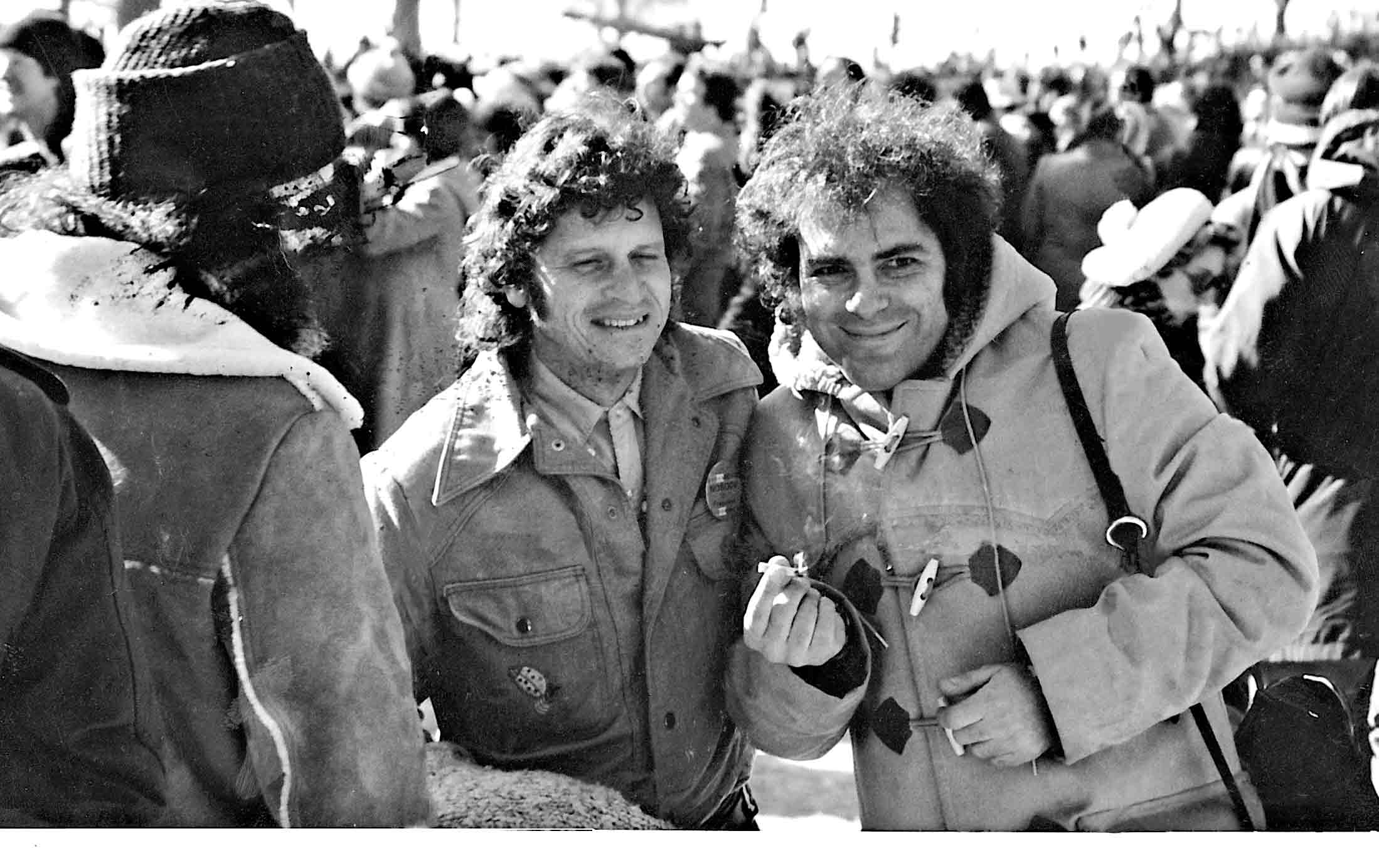
For half a century, Bill Zimmerman has labored for progressive causes as an organizer and political consultant. In a new memoir, he looks back on his career with an unwavering commitment to his beliefs.
Unless and until progressives change the mind sets of the tens of millions of people who believe right-wing mythology, future elections will have disappointing results for progressives regardless of who is in the White House.
In Paul Krassner's new book, what's obscene is not sex but anything greedy, dishonest or cruel.
The sullen attitude of most Democratic politicians toward young people
is reflected in Hillary Clinton's memoir, Living History, in
which she laments that people between the ages of 18 a
As the chairman of Artemis Records, the company that released Cornel West's CD, Sketches of My Culture, I considered criticizing Cornel for his association with Lawrence Summers, president of Harvard. Without ever listening to it, Summers attacked West merely for having released a CD, dismissing the entire universe of recorded music as being "unworthy of a Harvard professor." But like most record executives, I'm more tolerant of unorthodox associations than Summers, so I'll continue to judge West by his work and the inspiration it provides.
Among the flurry of press reports sparked by the controversy--most of which alluded to the alleged "rap CD"--quite a few couldn't get the facts straight. The New Republic claimed that West "has spent more time recording a rap CD and stumping for Al Sharpton than doing academic work." In fact, West has canceled only one class in twenty-six years of teaching, and that was several years ago, to deliver a lecture in Ethiopia. West recorded the CD during a leave--a long-established privilege in academia. (Summers himself took a leave from a professorship at Harvard to work for the World Bank.)
A Summers aide has said that the confrontation with West was a "terrible misunderstanding," but it's possible that Summers knew exactly what he was doing, using West the way Bill Clinton used Sister Souljah: to placate conservative elements of his constituency. Not only did Summers harshly criticize West's published work, he acknowledged that he had not read any of it or listened to the CD. Moreover, it's obvious that what disturbs Summers is not the notion of a Harvard professor engaging in political activity but West's particular beliefs: He criticized West's involvement with Bill Bradley, Ralph Nader and Al Sharpton, but Summers himself supported Al Gore (as did West's friend and supporter Henry Louis Gates Jr., head of the Afro-American studies department). Summers has been silent as his supporters have misrepresented West's record and called him names. Two examples: The National Review's Rod Dreher referred to West as a "clownish minstrel" and the New York Daily News's Zev Chafetz called him "a self-promoting lightweight with a militant head of hair."
West's decision to record a CD is in keeping with a commitment to spread his ideals and ideas as far and wide as possible. His book Race Matters has sold more than 350,000 copies and is one of the most influential books on race of the past couple of decades. His other works are used as texts in college classes around the world. There is no other public figure who is welcome in academia, in the media, in both conventional and activist politics and in the religious world.
By the way, Sketches of My Culture is not a "rap" CD. West, like most contemporary music critics, acknowledges that hip-hop is a vital cultural language. But Sketches itself is a concept album that is predominantly spoken word surrounded by r&b music, a montage that includes limited and focused uses of hip-hop language. Like any work of art, it's open to legitimate criticism, but it is clearly a serious attempt to use a modern art form to grapple with the themes that have animated West's career: black history, spirituality and political morality. There is not a word of profanity on it.
The indefatigable West has reached out to poor communities, moderating the crucial final panel at a recent "Rap Summit" and appearing on urban radio shows that had never been graced by the presence of an academic. I have seen the faces of young people inspired by West's linking of their own aspirations to the civil rights struggle and to the great philosophical and religious traditions. He urges them to live up to those examples. It has said something to the broader American community about Harvard that Cornel West is a professor there, and it will say something about Harvard if he is not.
Two of the most
famous figures in the Democratic Party, Senators Joseph Lieberman and
Hillary Clinton, have introduced the Media Marketing Accountability
Act of 2001, which, among other things, would make it illegal to
market or promote adult-rated rap and rock-and-roll albums to kids
under 17 and would empower the Federal Trade Commission to decide
which R-rated films may be marketed to minors.
In April,
Senator Clinton said, "If you label something as inappropriate for
children and then go out and target it to children, you are engaging
in false and deceptive advertising." And this summer Democrats,
occasionally joined by some Republicans, have browbeaten
entertainment-industry leaders at Congressional hearings, accusing
them of evading the rating system and selling salacious material to
young people. But the R rating on films doesn't mean kids under 17
shouldn't see them; it means they shouldn't see them without an
adult. Many parents want their kids to see such R-rated films as
Billy Elliot and Erin Brockovich. As for records, the
"parental advisory" sticker informs the buyer that the record
contains profanity, but it does not have an age
recommendation.
Lieberman disingenuously says, "We're not
asking the FTC to regulate content in any way, or even to make
judgments about what products are appropriate for children." But
that's precisely what his radical bill does. It empowers the FTC to
"establish the criteria" for new ratings for records and films, and
would legally require record companies and film studios to create and
implement "an age-based rating or labeling system." Marketing would
be deemed to be targeting minors if "the Commission determines that
the advertising or marketing is otherwise directed or targeted to
minors." With the FTC defining marketing to minors on the basis of
FTC-mandated ratings criteria, backed by the crippling financial
penalties for "unfair or deceptive acts or practices," it would be
able to decide which music and movies could be mass-marketed and
thus, by and large, which ones would be released.
Lieberman and Clinton apparently believe that federal
bureaucrats are the ideal arbiters of the appropriateness of
entertainment for teenagers. Lieberman told Inside.com, "We
know the difference between Schindler's List and Saving
Private Ryan and some of the slasher flicks that are aimed at
teenage boys. That's a decision best left to the administrative
agency."
Two days before the legislation was introduced,
the FTC issued a surreal report that criticized record companies for
advertising stickered albums on the World Wrestling Federation TV
show SmackDown! because 36 percent of its audience is under
18. So according to the FTC it's OK for younger teens to watch guys
knocking the living daylights out of each other, but it's not OK to
sell rap music to those same kids! Not surprisingly, more than 70
percent of the albums the FTC monitored were by African-American
artists. (The FTC also included the rock band Rage Against the
Machine, whose lyrics are frequently political, on the list.) At the
Hip-Hop Summit in June, attended by African-American leaders
including Cornel West, Martin Luther King III, Louis Farrakhan and
several black members of Congress, even those who criticized the
content of certain albums agreed that this legislation is dangerous
and unfair.
While the FTC investigation was conducted in
response to the Columbine murders, Lieberman is a one-man slippery
slope who makes no bones about his desire to regulate nonviolent
dirty words, complaining that "the leading music companies...have
been doing little if anything to respond to the FTC report and curb
the marketing of obscenity-laced records to kids."
Although
the Washington elite focuses its rhetoric on corporations, young
people view these outbursts as attacks on youth culture. Just as baby
boomers didn't view Bob Dylan and the Beatles as "products" of CBS
and EMI, today's young people view rap and rock music as their own
culture, which appears to be precisely what middle-aged pundits hate
about it. George Will, for example, castigated rap lyrics last
September on ABC's This Week. Six months later, Will lavished
praise on Sopranos executive producer David Chase for his
creation. Both Eminem's Slim Shady and Chase's Tony Soprano are
violent, bigoted characters whose humanity and contradictions are
nonetheless illuminated by their creators. The primary difference is
that rap is the cultural language of young people.
Obviously, people of good will disagree about culture, and
there is nothing wrong with fierce criticism of any genre. But
Lieberman et al. want to go far beyond criticism. They want
government to have veto power over the marketing, and thus the
economic viability, of entertainment.
By supporting this
legislation Democrats may pick up a few "swing voters" who like the
symbolism of entertainment-bashing, but in doing so they risk
alienating young voters, fans of pop culture of all ages and civil
libertarians. It is hard to imagine the young people who still turn
out in the thousands to hear Ralph Nader speak at campuses being
attracted by Lieberman's approach. Voter turnout among young people
is at an all-time low, around 28 percent; and according to Voter News
Service, while Clinton had a 12-percentage-point margin over Bush
among 18-29 year olds in 1992 and a 19-percentage-point margin in
1996, Gore-Lieberman won this demographic by a mere 2 percent in
2000. None of the published postelection analyses by Democrats have
focused on restoring turnout or Democratic margins among young
voters.
Condescending to, alienating and demeaning young
people is bad morally and bad politically. No progressive movement
has ever succeeded without young people. Continued culture-bashing by
Democrats opens the door for more erosion of their natural base to
culture-savvy libertarians like Jesse Ventura.