
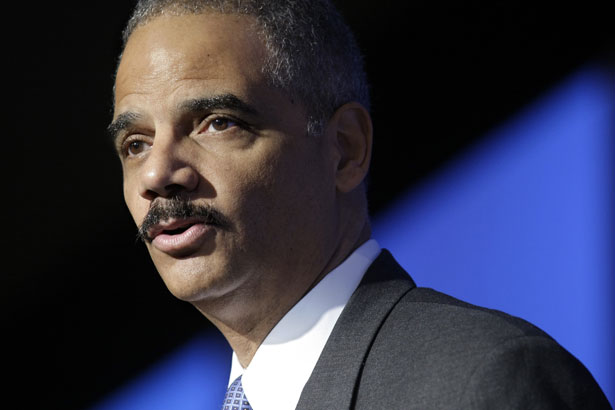
Attorney General Eric Holder (AP Photo/J. Scott Applewhite)
At the March on Washington fifty years ago, Dr. Martin Luther King inspired a generation of Americans “to make justice ring out for all of God’s children.” That day in 1963, Dr. King told us he had come to our capital “to remind America of the fierce urgency of now.” At the time, America heeded his words: within two years, President Johnson signed both the Civil Rights Act and the Voting Rights Act into law.
Sadly, over five decades, that fierce urgency appears to have faded. Justice seems further away for too many, particularly for the thousands—disproportionately low-income people of color—whose liberty has been taken from them through unequally applied sentences for low-level drug offenses. President Obama should do more to deliver them justice, and he can by commuting their sentences.
This month, Attorney General Eric Holder took an important step by announcing federal prosecutors would overhaul draconian prosecution policies that result in excessively long mandatory minimum sentences for nonviolent drug offenders and seek smarter, more just approaches that reduce the racial disparities of our current system. America’s views on drug policy are rapidly changing, but countless prisoners remain locked up, serving sentences that no longer align with our national values. In 2010, President Obama signed the Fair Sentencing Act into law and ensured that those arrested with crack—mostly young, African-American men—are no longer subject to a 100-to-1 sentencing disparity compared to those arrested with essentially the same drug in powder form, who are more likely to be Caucasian.
The Fair Sentencing Act was a rare time in history when Congress reduced sentences, thereby enunciating a sharp turn in public policy, yet those sentenced prior to 2010 remain in prison, serving sentences that have now been repudiated by Congress. And so, as important as Attorney General Holder’s recently announced new policies were, they did nothing to help those who are currently serving unjust, lengthy sentences.
If, as Dr. King wrote, “justice too long delayed is justice denied,” then every day they continue to sit in prison serving sentences that policymakers—and the American people—believe no longer fit their crime is another day that justice is denied. I continue to call on President Obama to use his commutation power to correct these injustices today.
And there is more he can do. According to a recent poll, 52 percent of Americans now support legalization of marijuana. And a recent ACLU report revealed that despite using marijuana at the same rate as Caucasians, African-Americans were arrested for marijuana at a rate four times higher than whites. With opposition to the failed policies of criminalization and prohibition growing every day, Congress should immediately act to catch up with the American people. In the interim, the president should not let anyone suffer one more day for the mistakes of outdated policy. He should be guided by the fierce urgency of now.
But this is not merely a matter of justice. Reducing prison overcrowding by commuting excessively long sentences is the fiscally prudent path, especially in the face of sequestration. It costs an estimated $30,000 per year to house an inmate in federal prison. Keeping Americans locked up when they would not be under current law is, put simply, a foolish waste of money.
That $30,000 per prisoner could undoubtedly be better spent. The National Institutes of Health, our nation’s true Department of Defense, faces cuts of $1.6 billion that will stop research into potentially life-saving cures. Meanwhile, 57,000 fewer children will be enrolled in Head Start programs this year, reducing their chances of success.
But today, our increasingly limited resources are spent incarcerating people—in some cases now elderly and incapacitated people—who no longer pose a danger to society and have already served long sentences. That’s both unjust and unwise—and the fierce urgency of now is most relevant.
Commutation of nonviolent offenders is a significant step the president can take immediately, but he has so far used this power—one of the few he has that cannot be obstructed by the Tea Party—far less than his predecessors.
Drug policy reform has not always been politically popular. At many points in past decades, I have found it a lonely pursuit, but today it is an issue that unites the left and the right.
Americans of all political persuasions now recognize how our policies prop up injustice and waste our dwindling resources. It’s time for the president to take the next step and right these wrongs. He should use his commutation power to the fullest extent and complete the important work that Attorney General Holder began earlier this month.
The people serving unjust sentences know all too well the fierce urgency of now. I hope the president will heed Dr. King’s reminder and act on their behalf as soon as possible—right now.
Why do Americans misremember the ‘I Have a Dream’ speech?

