From the Strait of Hormuz to the Streets of Minneapolis—Plus, Mamdani and the Midterms
On this episode of Start Making Sense, John Nichols analyzes the politics of the Iran war, and Maurice Mitchell talks about political movements and voting.

The Nation Podcasts
Here's where to find podcasts from The Nation. Political talk without the boring parts, featuring the writers, activists and artists who shape the news, from a progressive perspective.
From the Straits of Hormuz to the Streets of Minneapolis, plus Mamdani and the Midterms / Start Making Sense
Trump’s war in Iran is bringing economic chaos and suffering to much of the world, but for American voters, the biggest effect is the soaring price of gasoline – and the political implications for Republicans in the midterms are clear to everyone. Meanwhile Minneapolis has shown how Americans can resist unjust and illegitimate power. John Nichols comments.
Also: The Working Families Party is organizing voters not just to win a Democratic majority in Congress but for a movement election, a historic expansion of the electorate that includes a demand for significant change. Maurice Mitchell, the party’s National Director, explains.
Advertising Inquiries: https://redcircle.com/brands
Privacy & Opt-Out: https://redcircle.com/privacy
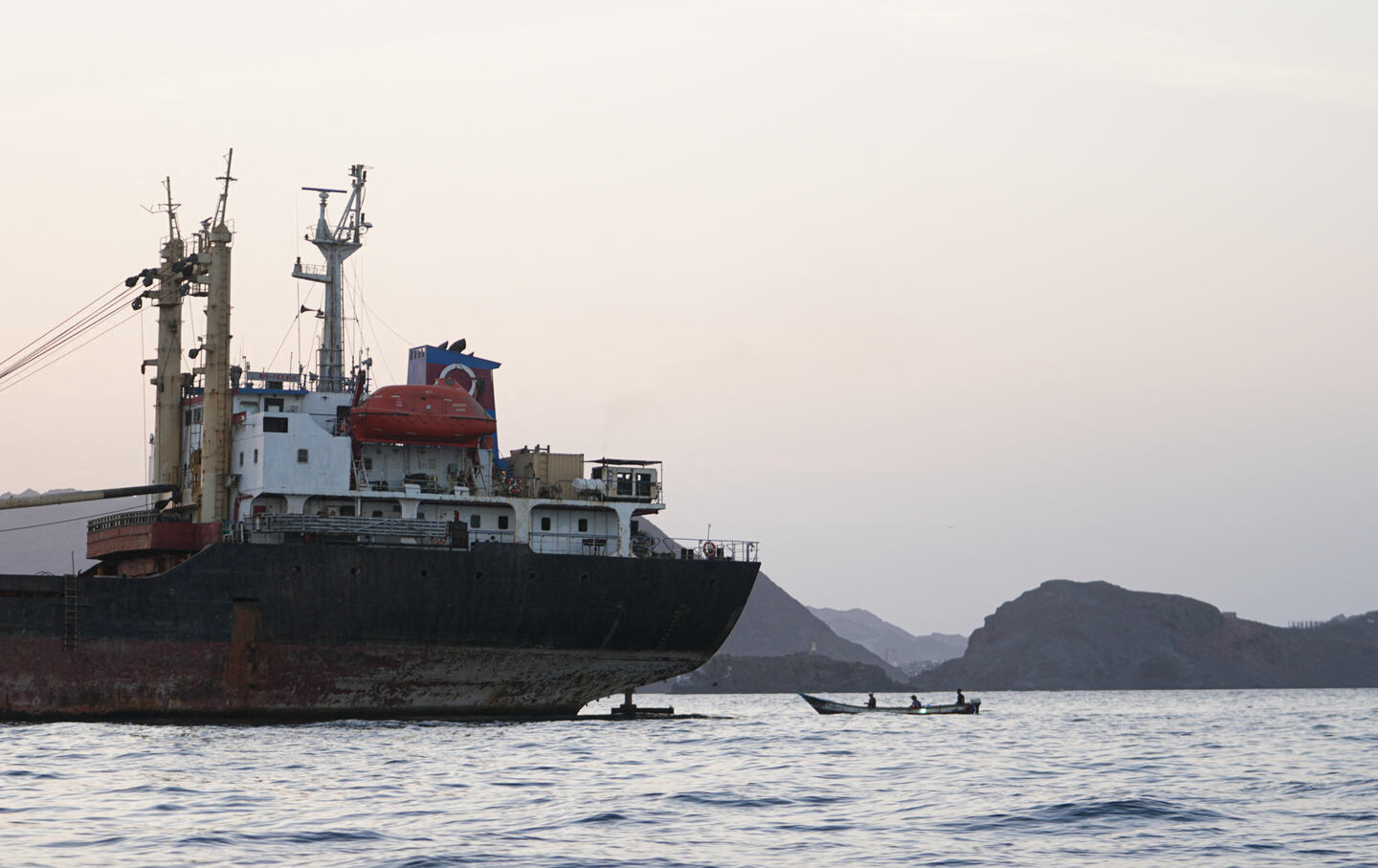
Commercial vessels are pictured offshore in Dubai on March 11, 2026.
(AFP via Getty Images)On this episode of Start Making Sense, John Nichols analyzes the politics of the Iran war, and Maurice Mitchell talks about political movements and voting.
Trump’s war in Iran is bringing economic chaos and suffering to much of the world, but for American voters the biggest effect is the soaring price of gasoline—and the political implications for Republicans in the midterms are clear to everyone. Meanwhile, Minneapolis has shown how Americans can resist unjust and illegitimate power.
Also: The Working Families Party is organizing voters not just to win for a Democratic majority in Congress but for a movement election, a historic expansion of the electorate that includes a demand for significant change. Maurice Mitchell, the party’s national director, explains.
Subscribe to The Nation to support all of our podcasts: thenation.com/podcastsubscribe.
The Nation Podcasts
Here's where to find podcasts from The Nation. Political talk without the boring parts, featuring the writers, activists and artists who shape the news, from a progressive perspective.
Norm Eisen on the Paramount-Warners Merger, plus Trump and TV News / Start Making Sense
The primary force behind the settlement that will allow Trump’s allies at Paramount to take over Warners-Discovery and CNN was Gavin Newsom, who pressured California Attorney General Rob Bonta to end the anti-trust fight defending media independence. Norm Eisen explains – he’s co-founder and executive chair of the Democracy Defenders Fund and Democracy Defenders Action, and, the New York Times reported, “the leader of a coalition of entertainment and news industry professionals who opposed the deal.”
Also: After Trump banned CNN, MS NOW and Politico from the White House newsroom, the TV networks united in refusing coverage of his events – including Fox News. John Nichols has our analysis.
Advertising Inquiries: https://redcircle.com/brands
Privacy & Opt-Out: https://redcircle.com/privacy
Search Results placeholder
Subscribe to The Nation to Support all of our podcasts
Jon Wiener: From The Nation magazine, this is Start Making Sense. I’m Jon Wiener. Later in the hour: The Working Families Party is organizing voters not just to win a Democratic majority in Congress but for a movement election, a historic expansion of the electorate that includes a demand for significant change. Maurice Mitchell, the party’s National Director, will comment. But first: From the Straits of Hormuz to the Streets of Minneapolis: John Nichols will explain – in a minute.
[BREAK]
It’s week three of Trump’s war with Iran, and things are not going well for him – or for a lot of the world. For comment and analysis, we turn to John Nichols. Of course, he’s executive editor of The Nation. John, welcome back.
John Nichols: It’s an honor to be with you, Jon.
JW: What are Trump’s goals in this war, and how close is he to achieving them? Some would say that’s a trick question.
JN: That is a trick question, Jon, because the goalpost keeps moving. As best we can tell, and I’ve actually listened to the president, sometimes for hours, as he tries to explain what he’s up to. And it appears that his goal is something along the lines of regime change within the regime. And that is to have a different leadership coming out of some track that he thinks the United States can work with. With the United States being in a very dominant role as regards Iran, and particularly as regards its oil. I know that’s a bit of a loose interpretation, but it’s basically a lot of what we’ve heard. Beyond that, I think, to be honest, because it’s become so chaotic, the goal is probably just to have something that could be declared successful and step away at some point because it’s become a mess that now creates new goals to deal with the problems that have developed since the goalless initial struggle began.
JW: Yeah. There was a point at which he might have declared victory, announced we defeated the enemy and called it quits, but it seems like it’s too late for that now–with Iran closing the Strait of Hormuz, a fifth of the world’s oil is not being shipped. The price of oil is soaring. It’s the largest oil supply disruption in history. Seems like the price is going to stay up for a while. And apparently it could take four to six months after the war ends to clear the mines and reopen the straight to shipping. I guess Trump hadn’t thought of that possibility when he started the war.
JN: Yeah. I mean, there are some geophysical realities that probably ought to be reviewed in the early stages of planning for a war, even before you plan it. And one of those is that there’s a relatively narrow space there on the map. And to move oil through that is a big deal. And Iran, frankly, I mean, like them or dislike them, feel however you want to feel about the Iranians, they at least understand that spot matters. You have countries in Europe as an example. They’re now looking at where they get their natural gas, oil resources from. I think some of them are looking at Russia, some of them are looking at US, at to the extent Norway, places like that. Then you’ve got another factor with China, which relies on an immense amount of Middle East oil. You’ve got Japan, which could go into a huge crisis because of what’s going on.
And so the end result is that if you were sitting in the White House right now, you’re getting these signals coming in as regards an immediate war. And then all these other countries around the world that are giving you messages of, ‘we need these resources or our economies are going to go into crisis. And secondly, we’re not very excited about helping you with this mess to be created.’
JW: Trump, in contrast, said, “maybe we should not even be trying to secure the strait of Hormuz for oil shipping because the United States produces so much oil. “We don’t need it,” he said about Mid-East oil. “We have a lot of oil. We’re the number one producer anywhere in the world.” Is there something here he does not understand?
JN: Well, I think maybe at the fundamental level is that the world consumes a lot of oil and you create a global economic crisis. Oil becomes too expensive. Economies cannot function. Many of the still significantly industrialized economies, Germany, Japan, obviously China. This is the kind of thing that creates a global chaos. If you read The Financial Times every day, which by the way, The Financial Times, British global paper, they have crossed the top headline every day. They are treating this as one of the most monumental moments in global history. I don’t think that Americans quite recognize, and maybe this goes even up to the White House, how many things have been thrown into chaos by this. But this is a very big deal that could reshape the world for a very long time.
JW: The global chaos does bring death and destruction on an immense scale to lots of people in the world. But here in the United States, the big thing is the price of gasoline. Ever since he took the oath of office in January, Trump has been talking about how great it is that he has kept the price of gasoline low. And that’s because voters get pretty grumpy pretty quickly when gas prices go up. And guess what? Gas prices are going up in the United States, even though we produce lots of oil. They’re going way up. Where I live in LA, the price of gas before the war was about $4.30. Right now, it’s about $5.60. That’s a 30% increase over three weeks. And this is something that everybody knows about because that price is posted on every gas station, on every big intersection in the United States. So it’s no secret. And that’s one reason why gas price increases tend to be politically the most damaging kind of inflation there can be.
Now, voters in the past haven’t blamed the president consistently for an increase in the price of gas, I understand. They usually blame the oil companies, but that’s not what’s happening now because everybody knows why the price of gas is going up. There’s a Morning Consult poll that asked Americans who was responsible for the increase in the price of gas. 48% said Trump, and the next highest group was 16%, who blamed the oil and gas companies; 13% blamed ‘global market forces.’ The oil price increase means everything else goes up, but that is the key thing for American politics. And the amazing thing is this is what Trump talked about as one of his great achievements, and now he has sort of stabbed himself in the back by his own actions.
JN: You’ve laid it out well, my friend. Let’s triage for a moment here and recognize that this is a war circumstance. There are civilians, there are innocents on the ground in the Middle East who are being killed. There is massive dislocation occurring in several countries, and including in Lebanon, which is a whole additional story and a place that often when chaos occurs there, that has all sorts of global significance. And so, we begin with that human side. But once we have established that that is a fundamental concern, that’s a beginning point of how we all should react politically to this, is you don’t want the chaos of the region, the death, the dislocation of that to continue. You want to find ways to ease that pain. Then you come to the domestic politics. Now, I only say that upfront because there’s a lot of politicians that don’t always think that way, but they should. Once you do understand that death and destruction in one part of the world can often blow back on you and you want to address that, then you get to the domestic political concerns, which are very real.
JW: And let me mention one other thing. The farmers getting ready for spring planting have learned that the price of fertilizer is going way up at a time when farm economics are already in crisis.
JN: Messed up by tariffs, et cetera. And these are people who voted very strongly for Donald Trump. And so, I do think that it’s not surprising that there’s a potential political reality here and that it has, I believe, Republicans and Congress terrified.
JW: Yeah.
JN: Because they are looking at a reality that they have to go out and defend all of Trump’s and some days lunacy, as well as economic pain. Now, it is true that in 2024, Donald Trump was able to make the economy his issue, and that benefited him tremendously as well as his party. I don’t think there’s any way that he can do that in 2026. What that means is that this feeds into a number of other factors that make the circumstance for the Republicans going into these midterm elections really tough. We’ve already seen all sorts of special election results, down belt races and off-year races that have been a very bad pattern for the Republicans, very good pattern for the Democrats. When you overlay that with an economic crisis and one that where you start with the high gas prices, that then feeds into high food prices because of what you’re talking about with farmers, it feeds into a situation that could be inflationary, at which point the Fed will feel under pressure to step in and raise interest rates. If that happens, then we could — and I know they try to avoid this, but you could end up in a recession. And if you end up in a serious recession, I’ve got news for you, Jon: You look back at the history of American politics, which I do a lot: in 1974, recessionary moment, 1980, 1982, recessionary moments. Boy, you start to look at these things and then you look at the election results, you see great big swings against the party in power, sometimes transformational swings against the party in power.
JW: And the starting point politically here was that the Iran war on the first day of the Iran war was the most unpopular war already in modern American history. The New York Times put a little chart together: the Afghan war in the first week had 92% approval. The Persian Gulf War in 2001 had 82%. The Iraq War, 2003, 76%. Kosovo in 1999 had 58% approval. Invading Grenada in 1983 had 53% approval. The Iran war is the only war to start with less than 52%. It had 41% support at the end of the first week of the Iran war, and that is before any of this gasoline price shock really hit before people understood the implications of closing the Strait of Hormuz. So the starting point already was politically disastrous for Republicans.
JN: I think that’s exactly right. And look, if you go back and look at wars, somewhere start quietly, Vietnam War around the time of the Gulf of Tonkin Resolution, Congress is debating some things. And I’ve talked to senators who were in Congress at that time, and they said “the administration told me it wasn’t all that big a deal. I voted for it. Boy, was I wrong.”
And I will add, just because this is a Nation podcast, that the two votes cast against the Gulf of Tonkin Resolution back in 1964 were cast by Ernest Gruening, the former editor of The Nation, and by Wayne Morse, Senator from Oregon, who was a favorite of The Nation. And so, we believe we tend to end up on the right side of history.
But in this circumstance, there was already a lot of opposition among the American people. There’s also, frankly, a substantial amount of opposition in Congress, far more than you usually see at the start of the war. That opposition is primarily from Democrats, but you even have Republicans on the predictable Republicans like Rand Paul and Thomas Massie, but other Republicans who are starting to say, “What are we doing here? How is this working?” And so you started with an unpopular war. It has turned into a chaotic and unfocused war, but then confused by Donald Trump’s attempts to talk about it, which sometimes are incredibly hard to follow, his mixed signals, his mixed messages.
I do think we’re in a situation where it is very likely that this all piles up. I don’t necessarily think that voters sit down and say, “Well, I really want to enforce some of the basic premises of the US Constitution as regard to separation of powers.” But at a certain point, whether the exact words are used or not, there’s a desire to check and balance the White House, to say, “Okay, these guys do not know what they’re doing. Is there a way to address this?” Democrats have not been very good at that. They don’t always message as well as they could or should, but in this case, they may not have to because the unpopularity of this war as well as the actual economic pain that may be associated with it could make this a defining factor in the 2026 elections. That is why I think there is a very real possibility at certain point that Donald Trump does do, and Pete Hegseth and all these people, do end up doing what Senator George Aiken from Vermont suggested midway into the Vietnam War, which is declare victory and leave.
JW: One last thing: Katrina vanden Heuvel, our editor and publisher, sent me an article over the weekend with the headline, “Why Minnesota Matters More Than Iran for America’s Future.” The author argued that what happened in Minneapolis in response to ICE was, “Something I’d never seen in 50 years, a spontaneous uprising of civic activism propelled by a single idea. I am my neighbor’s keeper, whoever he or she is and however he or she got here.” The author called it “one of the most courageous battles ever fought by American men and women not in uniform.” Now, that article was not in The Nation. Where was it – and who wrote it?
JN: In The New York Times, written by Thomas Friedman – who’s a guy who we often differ with. But Friedman has roots in Minnesota, went there to tell a story. Frankly, he reported it very thoroughly and came away with the same impression that I had when I went to Minnesota. And I think the same impression you had watching it as a son of Minnesota. And that was that something very essential had happened there. At The Nation, we decided it was worthy of a Nobel Peace Prize nomination, and we may have to submit Thomas Friedman’s article as an addendum to the nomination, if that’s appropriate.
But I do think that what he is saying there is important. Is it more important than Iran? I don’t know, because I don’t know where this Iran thing is going to play out. But is it incredibly important for America at this point to say that it is possible to resist? It is possible to object. There have been many, many, many times when Americans have risen up to resist something that their government is doing, and they’ve done so in nonviolent and incredibly, often very beautiful ways.
What happened in Minneapolis and in Minnesota has captured the imaginations of people in the US and around the world, and it comes at a time when there’s a great deal of angst and concern about the direction of the country. And who knows, maybe Thomas Friedman will notice the No Kings demonstrations at the end of the month when I suspect you may well pass that 10 million mark of people coming out.
Bottom line is this is an amazing country, for all of its flaws, all of its weaknesses. It’s 250 years old, and we have not always lived up to our expectations, but that First Amendment of our Constitution, which gives us the right to dissent and the right to object, and the right to assemble and to petition for the redress of grievances. The people of Minneapolis decided that those rights are real, and in doing so, they reminded all of us that they are real and that they’re fundamental, and that they may well be our saving grace.
JW: John Nichols – he’s executive editor of The Nation; read him at thenation.com. Thank you, John.
JN: Thank you very much, Jon.
[BREAK]
JW: Now it’s time to talk with Maurice Mitchell. He’s a longtime community organizer and movement strategist, and he’s National Director of the Working Families Party, a multiracial working-class movement that played a leading role in electing Mamdani mayor of New York City. Last time he was here in July, we talked about how Mamdani won the Democratic primary. Maurice Mitchell, welcome back.
Maurice Mitchell: It’s good to be with you.
JW: I heard you give a talk last week in LA where you said your biggest political worry was not the midterms in November. Now most of our friends are worrying about all the things Trump is likely to do to prevent Democrats from voting in November: banning voting by mail, requiring proof of citizenship, sending ICE to blue polling places on election day, maybe even starting another war to serve as a justification for repressing opponents. But you seem confident Democrats will have a big victory on election day in November, and Republicans will have a big defeat.
MM: The more they’re aware that they might lose, the more desperate they’ll be. And so I think we’re likely to see a lot of volatility and a lot of chaos because of that desperation, but also a lot of missteps and overreach because of it. So I’m less confident that we will have free and fair elections, but I believe there’ll be many opportunities, even in the event of their attempt to steal the elections, for us to be able to put up a good defense and a good offense to prevent that from happening.
I have a lot of confidence that there might be a wave election. I’m interested in something bigger than a wave: a movement election, a sort of shellacking that is historic and an opportunity to bring a lot of people into the electorate that normally aren’t in the electorate. And that’s what we’re working on at the Working Families Party: not just defeating the Republicans but bringing a lot of people into that defeat and owning that defeat.
JW: You’ve also argued that Democrats are too focused on winning elections and not focused enough on preparing to govern when they do win. And that’s why you’ve said your biggest concern is what happens on January 20th, 2029. This is the day that Trump departs from the White House forever, when the Democratic president takes the oath of office, with a Democratic Senate and a Democratic House. Right now, that sounds like heaven – but you’re not so sure about that.
MM: Well, the path to Hell is paved with a lot of good pro-Democratic intentions. And so the thing that I’m concerned with is – it’s back to this: Democrats relying on negative partisanship, relying on people’s disdain, disgust, aversion to Trump and Trumpism, to his fascism, in order to build electoral majorities. Those electoral majorities are not sustained, because once the Trump threat has been eliminated, then the reason for that electoral coalition is moot.
And so, what might keep that coalition together? It’s the positive agenda. It’s the governing agenda. It’s people’s experience after you’ve defeated Trump; what governing is like. And if that experience is not transformative, if that experience doesn’t deal with some of the things that I think most people — if you call them, they would say it, Do you want small change, or big change? “Big change.” Do you agree with the status quo, or do you want something different? “Well, I want something different.”
If those Democrats think that their job is restoration, to rebuild rule of law, to rebuild these institutions that Trump destroyed, when the working class coalition that brought them to governance are asking for something much more bolder and transformative, well, to me, that disconnect might lead to all those folks that got into office based on aversion to Trump will be voted out in the next election, in the next midterm, because they will be the party in power.
And like I said before, the party in power faces those electoral headwinds, whether they’re Republican or Democrat. And if the party in power doesn’t have a very convincing argument about what they did when they had governing power, then I fear once those Democrats, in the best-case scenario, the Democrats win the midterms and they win the presidency, those Democrats will be making the best, most pristine argument for right-wing populism.
JW: Let’s talk about Mamdani. I understand you had something to do with the Mamdani campaign.
MM: Well, yeah, just we’re very, very proud of the mayor and we’re very, very proud of his campaign. And I like to remind people that the Working Families Party started in New York. The Working Families Party was part of the coalition that created the public funding of elections program that allowed Zohran Mamdani to raise $1 million, but to spend $8 million, which was a critical piece of the puzzle. The Working Families Party built the progressive caucus in New York City, defeated the IDC, which were the breakaway “Democrats’ in the state legislature, helped elected Zohran Mamdani to be an assembly person in Queens, built the strategy, the slate strategy where all these progressives who were working families, party progressives who were running against Andrew Cuomo and Mayor Adams, they basically ran a solidarity, multiracial solidarity slate against Mayor Adams and Andrew Cuomo, and Zoran was a part of that, created the conditions for Zohran, Mamdani and Brad Lander to cross-endorse each other and built a pretty broad labor and community coalition that ultimately rendered a historic victory that included Zohran’s incredible mastery of communications, a campaign that was a serious organizing effort that led to more than a hundred thousand individual volunteers being part of that campaign.
JW: Let me just underline that. How many volunteers?
MM: More than 100,000 individual volunteers in one campaign in one city. And the Working Families Party had a ballot line where more people voted on the Working Families Party line for Zohran Mamdani than all the people that voted for his Republican opponent, Curtis Silwa. And Zoran also pretty famously voted for himself on his party, the Working Family Parties ballot line. And so, we’re very, very proud of his victory, but also we’re even more proud, we’re doubly proud of how Zohran and his administration is governing.
JW: Let us pause here because you have argued that it isn’t just winning elections, it’s governing that’s the key to political success.
MM: Correct, correct. And he pretty famously said, “Expectations will be high, and we’ll meet them.” Really trying to govern in a new way where we actually are engaging in an aspirational politics. And of course, it’s not just him, the individual, he’s putting together a team that’s really impressive. I was just sitting down with Afua Atta-Mensah, who is in charge of the Office of Racial Justice and Equity, and they’re going to be really leaning into demonstrating what an economic populist vision that sees race in a city that is majority of people of color looks like. A few weeks ago, he was able to make a deal with Kathy Hochul on childcare. The childcare, the universal childcare that he campaigned on, that’s going to be a reality.
JW: I want to pause right here because this is the kind of detail of governing that a lot of people don’t understand. But this week’s news is that Mamdani is going to Staten Island to announce that New York City will add a thousand free preschool seats for three-year-olds, including on Staten Island. Now, if you don’t live in New York City, this is just gibberish to you, but it’s a very important part of Mamdani governing. Please explain.
MM: Sure. So, the power of Zohran Mamdani going to Staten Island is, look, he could have announced that anywhere. He could have announced that in what some people jokingly call the Commie corridor, which is this strip of communities where a lot of people who align with very, very progressive ideals and their representatives live and govern and everything else. He went to Staten Island, which is one of the few places where people actually elect Republicans in the city. What Zohran said in his victory speech and what he’s demonstrating is that he is governing all of New York, all of New Yorkers, this very, very diverse place. And he’s going to ensure that everybody gets to experience what it’s like when progressives govern. So he’s not just governing for progressives. Progressive governance is for everyone. From the residents of Staten Island to the folks in Brooklyn that I was just in Black Brooklyn, I was just with yesterday to the folks in Queens. Queens is one of the most diverse communities where more than a hundred languages are spoken. The South Asian aunties and uncles that, when he was campaigning, I got to visit with, who were so excited and so proud of his candidacy. He’s governing for everybody. And I think showing up at Staten Island that way is a way to demonstrate that. When he was campaigning in Staten Island, he was getting heckled, and he just embraced it. He was like, “This is New York.” And so I’m really excited with the momentum that he’s building. It’s a sense of permanent campaigning almost that’s taking place through how he’s governing.
JW: And there’s one other bit of news that I personally found very moving. Mamdani hosted Mahmoud Khalil at Gracie Mansion to break the Ramadan fast. Now, we talked about Mahmoud Khalil on this show quite a bit when he was in the news last year. Remind us of who he is and why this was such a powerful and moving event.
MM: Because Mahmoud Khalil was persecuted and imprisoned by our government.
JW: A leader at Columbia University.
MM: Yes. So, a leader in a Columbia University, an academic that was imprisoned by our government for speech, for speech that our government didn’t like in support of the Palestinian people. As far as anybody could see, his only crime was advocacy for Palestinian people during what many people, including human rights organizations in Israel, agree is a genocide. That was his only “crime.” And so there’s something very, very powerful, especially considering the direction that his predecessor chose to make in regards to pro-Palestinian organizing and advocacy, Mayor Adams joined basically the policy of policing speech, pro-Palestinian speech, and basically set the NYPD against many of these students and many of the academics that were very critical of the policies of the United States and Israel in their war of retribution against the Palestinian people. So, this is really powerful to see somebody who was imprisoned and was in proceedings to be deported by the Trump administration, now embraced by a leading official, Zohran Mamdani in the city of New York, like a significant reversal of fortune and a signal that the state of New York is under new management.
JW: And because of things like this, people say terrible things about Mamdani. Just recently, this guy, Jake Lang, had a protest called “Stop the Islamic Takeover of New York City” where Mamdani was called a “Muslim terrorist” and a “jihadist.” What does the Working Families Party do to respond? Do you have a rapid response media team that has the facts to prove that Mamdani is not a terrorist?
MM: It’s funny, I was on CSPAN, I remember one of the first questions somebody asked me was whether or not the Working Families Party supports Hamas. Such an odd question.
I think people like Jake Lang, their actions, and the type of public theater they engage with speaks for itself. And I don’t think it makes sense for us to directly respond to some of those accusations. And one of the things that I’m really proud of in how Zohran campaigned and how he’s governing is he’s focused like a laser on the issues of working people, not on these wild, really unhinged Islamophobic and racist accusations. He’s focused on universal childcare. He’s focused on a rent freeze and lowering the cost of housing. He’s focused on the day-to-day needs of working people, not going back and forth with an unhinged white supremacist. And so that’s been our policy in the press.
We’re not going to go back and forth and, in some ways, elevate the rantings of an unhinged white supremacist. We’re going to focus on the thing that they’re trying to distract us from, which is organizing working people of all races into a populist movement that fights for them against the oligarchs that many of them are getting paid by.
JW: And actually you have one other argument: you’re counting on people’s – they don’t need to be told about this. They have enough common sense to say, if somebody says, “Mamdani is a Muslim terrorist,” most people in New York would say, “That just doesn’t sound right to me. “
MM: The other thing is that so much of their unhinged attacks have backfired because people in New York are able to register, for lack of a better word, bullshit. And whether folks agree with Zohran on everything, they believe him. And because they believe him, random white supremacists, outsiders picking a fight with him, I think only ingratiates him with the people of New York, ultimately. None of those accusations track with people’s experience of the mayor.
Look, I have three siblings. We don’t always get along, but if anybody outside of our family picks a fight, well, we are thick as thieves. And I think when some of these unhinged white supremacists and some of these corporate lobbyists spend all this money in order to cast Zohran as whatever they want to cast them, I think that just brings him closer to the people and the people closer to him.
JW: Maurice Mitchell is national director of the Working Families Party. He’s one of our heroes. Mo, thanks for talking with us today.
MM: It’s been a pleasure.
Become a Sustaining Donor This September
Between the reemergence of right-wing red-baiting and Donald Trump’s use of the chilling National Security Presidential Memorandum–7 to criminalize left political organizing, we’re seeing McCarthyism reborn before our eyes.
This assault on democracy cannot be ignored or wished away. Resisting it requires bravery in the face of threats and repression, a steadfast commitment to the truth, and the unwavering belief that we can—and will—overcome this darkness.
We must have an independent media that sets the record straight, unearths corruption and abuses of power, and advances a politics of justice and dignity for all if we’re to win this fight.
That’s why I’m writing to you today. This September, The Nation needs to add 100 monthly donors to sustain our progressive journalism. Your contribution makes the next investigative report, the next truth-speaking column, and the next pathbreaking essay all possible.
I hope you’ll support our work with a recurring donation today. If you donate $10 or more a month, we’ll send you a brand new “Hands Off the Free Press!” sticker to recognise your commitment to our cause. Please, donate today.
Onward,
Katrina vanden Heuvel
Editor and Publisher, The Nation