Protest After No Kings—Plus, Abortion After Dobbs
Protest After No Kings—Plus, Abortion After “Dobbs”
John Nichols analyzes the post–No Kings political landscape, and Amy Littlefield explains why there are more abortions now despite the restrictions.

The Nation Podcasts
Here's where to find podcasts from The Nation. Political talk without the boring parts, featuring the writers, activists and artists who shape the news, from a progressive perspective.
Protest after No Kings, plus Abortion after Dobbs / Start Making Sense
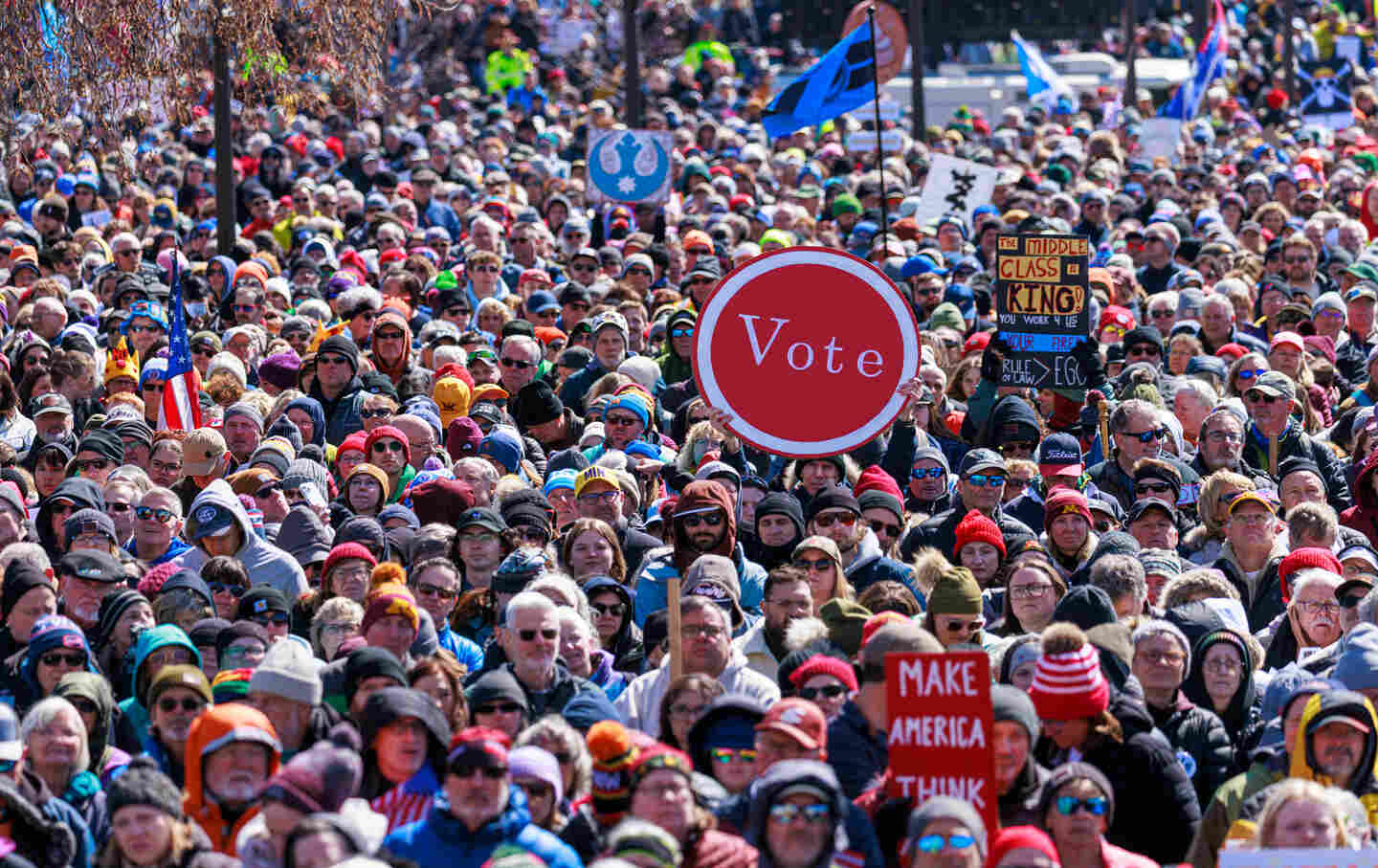
We’re still thinking about No Kings 3 day on Saturday: 8 million people. 3,300 events. ‘No Kings’ protests in almost every city and town in the country. 100 towns in Texas alone had No Kings protests! It was the largest single-day nonviolent protest in American history. John Nichols analyzes the possibilities for what comes next.
Also: No one expected that revoking the constitutional right to abortion would wind up expanding access to it. But ever since the Supreme Court's Dobbs decision in 2022 allowed more than a dozen states to ban abortion outright, the number of abortions in this country has actually risen every year. How did that happen? Amy Littlefield explains; her new book is Killers of Roe: My investigation into the mysterious death of abortion rights.
Advertising Inquiries: https://redcircle.com/brands
Privacy & Opt-Out: https://redcircle.com/privacy
LAPD officers arrest a protester dressed as Lady Liberty in chains following clashes near the Metropolitan Detention Center during the “No Kings” national day of protest in Los Angeles on March 28, 2026.
(Etienne Laurent / AFP via Getty Images)On this episode of Start Making Sense, John Nichols analyzes the post–No Kings political landscape, and Amy Littlefield explains why there are more abortions now despite the restrictions.
We’re still thinking about No Kings 3 on Saturday: 8 million people. 3,300 events. No Kings protests in almost every city and town in the country. One hundred towns in Texas alone had No Kings events! It was the largest single-day nonviolent protest in American history. John Nichols analyzes the possibilities for what comes next.
Also: No one expected that revoking the constitutional right to abortion would wind up expanding access to it. But ever since the Supreme Court’s Dobbs decision in 2022 allowed more than a dozen states to ban abortion outright, the number of abortions in this country has actually risen every year. How did that happen? Amy Littlefield explains; her new book is Killers of Roe: My Investigation into the Mysterious Death of Abortion Rights
Subscribe to The Nation to support all of our podcasts: thenation.com/podcastsubscribe.
The Nation Podcasts
Here's where to find podcasts from The Nation. Political talk without the boring parts, featuring the writers, activists and artists who shape the news, from a progressive perspective.
The Plan for No Kings-Vote Early Day, plus The Supremes and Trump’s voter list purge / Start Making Sense
Leah Greenberg, co-executive director of Indivisible, answers the question, “What’s the Plan — for the next No Kings Nationwide Day of Action?” This one shifts from mass protest in the streets to organizing for early voting – and preparing for whatever Trump does to disrupt or undermine the vote, the count, and the certification.
Also: The Supreme Court last Friday issued an order allowing states to use Trump’s SAVE database to purge their voter rolls of people the DHS considers ineligible – but it’s too late to apply to the midterms. Rick Hasen explains – he teaches law at UCLA and he’s Director of the Safeguarding Democracy Project and editor of the Election Law Blog.
Advertising Inquiries: https://redcircle.com/brands
Privacy & Opt-Out: https://redcircle.com/privacy
Search Results placeholder
Jon Wiener: The largest single day of protest in American history–that was last Saturday’s No Kings Day. From The Nation magazine, this is Start Making Sense. I’m Jon Wiener. Later in the hour: Ever since the Supreme Court decided in 2022 to allow more than a dozen states to ban abortion outright, the number of abortions in this country has actually risen every year. How did that happen? Amy Littlefield will explain; her new book is Killers of Roe. But first: What we can learn from No Kings Day. John Nichols will comment – in a minute.
[BREAK]
We’re still thinking about No Kings Day on Saturday. 8 million people, 3300 events, including some deep in Trump country. In Texas alone, a hundred towns had No Kings protests. It was the largest single day of protest in American history. For comment and analysis, we turn to John Nichols. Of course, he’s executive editor of The Nation. John, welcome back.
John Nichols: Great to be with you.
JW: Now it’s time for Your Minnesota Moment – news from my hometown of Saint Paul that you won’t get from Sean Hannity. The No Kings flagship event on Saturday was in Saint Paul. 200,000 people came. If you had that many people in Washington DC, it would be one of the biggest demonstrations of the decade. This was an event where Ilhan Omar introduced Jane Fonda. That was one of the highlights for me. What were the highlights for you?
JN: There were so many. It was a remarkable event, Jon, and some of the highlights were local folks that they brought up. The genius of the No Kings structure is that they will often have prominent national speakers, but they never sideline the local folks. So, there were really just fabulously compelling speeches, especially from folks who were involved in the struggle with ICE in Minneapolis. And they spoke about different aspects of it, tracking the flights from the airport in Minneapolis to Texas, about helping folks who had been picked up by ICE and then put back on the streets, but without their cell phones or without good winter clothing, in January and February.
Among the more prominent folks that spoke, I think that Bernie Sanders gave one of the more significant speeches he’s done in a long time. It focused not just on the kind of standard No Kings messages of defending democracy, but also a substantial portion on the war in Iran. And it was notable that he wasn’t alone in that a number of the speakers focused on the war and some of the loudest and most passionate responses were to those aspects of those speeches. Finally, I have to tell you, Joan Baez, and she just nailed it. And as long as we’re talking about music, I guess we have to mention Bruce Springsteen, who turned in a remarkable performance. And I will note that he closed the song by raising his guitar above his head and shouting to the crowd, No Kings, No War. And that again, that anti-war message really resonated with folks.
JW: What’s especially significant to me about the No Kings events on Saturday was not only the total number of participants, a million more than the last one, which was five months ago. It’s especially significant that we had more than 600 more individual events than we had five months ago. That means new organizers in hundreds of places that had not had protests before. And these included we now know every congressional district, including rural and Republican areas in Trump country. These are places where there’s a lot of pressure. There’s a lot of expectation of silence. And seeing neighbors stand up in those places is really impressive. Wisconsin is a purple state with a lot of Republican voters and a lot of Democratic voters, I understand. There were 100 No King’s events in Wisconsin, which means a lot of small towns and some very small towns.
JN: That’s exactly right. And obviously I’m a Wisconsinite, so proud of my state. And there were huge demonstrations in Milwaukee and Madison and other cities. I mean, tens of thousands of people out at these. But there were also demonstrations and marches, pickets, kind of signs along the road events, even in some of the smallest towns in the state. One of them, I would highlight, was in Dodgeville, Wisconsin, and Dodgeville is oh, about 50, 60 miles west of Madison. It’s definitely in farm country in a place called Iowa County. It happens that a lot of my relatives came from that county on both sides of my family, and Dodgeville is a town of about 4 to 5,000 people, and they had the better part of a thousand people are out marching.
JW: Wow.
JN: Now, just, you want to understand that in perspective, if that was New York City, you’d be talking in the range of a couple million. I wasn’t at this one because I was up in Saint Paul, but I was at the previous one in Dodgeville and it’s very high spirited, very unapologetic. It happens that Dodgeville is representing the state legislature by a Republican. And yet I think what happens in places like that and what happens in a lot of other places around a state like Wisconsin when a thousand people march in a town of, say, 4,000 folks, the people who aren’t marching notice it. Yes, it’s political, but it’s also an event. It’s something, it’s a parade if you will. Some of them will still be in opposition, but others will feel freed to respond to their own disappointment, their own frustration, their own anger. What’s happening? And I think that’s why these demonstrations, these protests matter because it isn’t just for the people who participate. It’s also for what is communicated to the people who are, curious, who are interested, who want to know what’s going on and who maybe are getting a sense that they too, can be a part of the opposition to this administration.
JW: Yeah. What Indivisible has learned is that once people go to their first protest, that’s not the end. That’s the beginning. They go on to do more. And the Indivisible national leadership is not leaving that to chance. Right now, they’re calling on all the organizers of local protests to hold what they are calling what’s next events for the people who came to their protests in the next couple of weeks. They say, think of this as both a welcoming orientation for newly activated community members and a strategic discussion about what’s to come. And they point out protests aren’t an end unto themselves. They are a tactic. We are not here to fill the streets. We’re here to stop Trump’s authoritarian power grab. And we want to hold every last member of his regime accountable. We want to build a stronger democracy. So there’s a lot of work ahead. And we want all the people who went to protest on last Saturday to come to these what’s next events. I’m impressed that the Indivisible leadership really has the big picture in mind here.
JN: Yeah, I think they heard some criticism along the way. And I think they’ve always been, looking for the best ways in which to build a movement. And that has historically in the United States involved mass demonstrations, mass protests. The challenge is that the Trump administration doesn’t seem to be particularly interested in what the people of the United States are marching about or speaking about. And so, yeah, I think this movement has to find all of its ways to communicate, all of its ways to connect and to build out and that will involve more demonstrations, which are vital, and they are a part of our Constitution, right? This is our petition for the redress of grievances. It’s also, though, a steppingstone, a point where we begin processes, many of which will lead toward Election Day, many of which will lead toward immediate demands. One of the things that that folks who are involved in organizing No Kings are talking about is a national day of boycott.
JW: And they say that they got the idea for a day of no work, no shopping, no business as usual from the Minneapolis Day of Action, where they had a one-day strike, we called it. And there was a lot of skepticism about how are they going to pull that off when it’s five below zero? Turned out it was a fantastic event. And the national leaders think we should do it for everybody now.
JN: Yeah. I think one thing, and I know that not everybody who’s listening in is familiar with what it feels like when it’s five degrees in Minneapolis. But it’s not that hard to get people to stay home on such a day. Although in fairness to the organizers there, people didn’t actually stay home. Tremendous numbers of them came out and marched in the streets. And so that’s the combination that I think folks are looking to hear it is to do something on a weekday, not a weekend, not a Saturday, and aim toward delivering a message that people are willing to give up a day of work, shut their businesses, gather to say something’s got to change now. Will they ever get through to Donald Trump? But can they get through perhaps to some Republican members of Congress and to some of those Democrats who’ve been a little too spineless along the way? I mean, there’s a lot of steps to this process. And what I was struck by when I was up in Saint Paul was the level of movement building, the sense that people really were conscious that this has to be more than just demonstrations, but the demonstrations are a vital part of it. They do give people energy; they they do give visibility. And this is a message that Bernie Sanders brought in a big way to the Saint Paul demonstration and the events surrounding it. And he went through a whole list of victories along the way throughout our history, putting it in that 250th anniversary of the United States perspective. And when you think of it in that way, I think the whole No Kings effort becomes much more epic but also much more consequential. This isn’t just protest. This is an effort to achieve change.
JW: It reminds me of Timothy Snyder’s post on Sunday. He wrote, “I was at a No Kings rally yesterday, and rather than writing another essay about why this matters, I will just say that it is pure joy to meet the people who want to stand up, the people who are doing the work. Thank you.” It’s true. It’s not only strategically a crucial step; iIt is a joy to be part of something really important and really big.
JN: You should have seen it, Jon. I know that you know Saint Paul. And I’ve been there quite a bit in my life as well. In fact, I’ve been on the steps of that state capitol there, which is on something of a hill. And then there’s a long lawn that goes down, you know. And when I say lawn that underestimates the fullness of it. It’s an expanse that goes deep into the city, right? And so you get on those steps and you see all of Saint Paul behind you, but you see a lot of green space in between. That space was entirely filled as far as your eyes could see. And what was powerful about it was the extent to which people were engaged. The rally was very well organized. They had screens, if you were farther away, to see things, the sound system actually worked. And that’s not always the case at rallies.
JW: That was very impressive.
JN: But beyond that, there was a sense of engagement. People got there early, they stayed late. And I can give you an example of Rob Weissman from Public Citizen. He gave a very short but very compelling speech which did bring in a lot of elements of the long term No Kings message: a special tribute to the folks in Minneapolis and Saint Paul, but then that anti-war message, and he said at a certain point, “No Kings, no ICE, no war.” And without prompting, the crowd started chanting, “No Kings, no ICE, no war,” again and again, to the point where he had to just go silent for a little bit and let the crowd speak its truth, if you will. And a similar thing happened when Bernie Sanders spoke. And at some point he said something along the lines of, “we’ve got to end this war immediately.” And the crowd started chanting very loudly: “End this war! End this war!” And so you get the drift of it, Jon. This was the sort of event where when you said something, the people responded.
JW: There is impressive public opinion polling this week that shows that support for Trump and the war is at its lowest point ever. This week there’s an Economist-YouGov poll, 35% of voters approve of the president’s job performance. It’s dropped just five points in the past seven days in that poll. It’s at the lowest level of his second term. Only 28% of Americans approve the war. A quarter of Republicans are now against the war. So, this is by far the most unpopular war in history, and so close to its beginning is really unusual. Of course, we have no idea whether Trump is paying any attention at all, since he’s surrounded by yes men and kind of lives in his own world. But there’s no question that the public doesn’t like this war and wants it to end.
JN: I don’t think there is any question. You really saw it at the demonstrations over the weekend, which drew new people, right? And I think you ask, why do more people come? It’s not as if folks are suddenly realizing that the Trump administration isn’t perfect. I think what you’ve got going on is folks who are seeing something that for them is even more urgent, something that is even more compelling, and that is the need to address this war.
You mentioned the notion that,we don’t know if Trump will pay attention to this because he’s surrounded by so many yes men. I do think that this is one where he has little choice but to pay attention, and that is because the domestic impacts of those rising gas prices, that clear sense that the American people don’t know why we’re doing this. That does come back to the president. He can’t help but look at those very, very weak polls, this deep, deep opposition to the war. And I do think that this is one of those moments where when people mobilize, when they march, when they protest, when they tell a pollster they don’t like something, but also when they tell their Republican members of Congress, “this is something we really object to. And, it might affect how we vote in November.” I think that comes back to the White House.
And I do think that’s one of the reasons why you’re seeing really mixed messages about the war from President Trump, even sometimes in the same day, suggesting that, yeah, we may end this thing pretty soon, or we may go all in and do even more. And it’s that chaos of it, I think is a reflection of the fact that the Trump administration knows that they’ve gotten themselves into something that is not going well in this midterm election year.
JW: John Nichols – read him at thenation.com. John, thanks for talking with us today.
JN: Honored to be with you as always, Jon.
[BREAK]
Jon Wiener: No one expected that revoking the constitutional right to abortion would wind up expanding access to it. But ever since the Supreme Court’s Dobbs decision in 2022 allowed more than a dozen states to ban abortion outright, the number of abortions in this country has actually risen every year. How did that happen? For that story, we turn to Amy Littlefield. She’s the abortion access correspondent for The Nation. She also writes for The New York Review and The New York Times opinion section. And her new book has just been published: Killers of Roe: My Investigation into the Mysterious Death of Abortion Rights. Amy Littlefield, welcome back.
Amy Littlefield: Thank you so much for having me back on, Jon. It’s such a pleasure to talk with you again.
JW: There’s been a revolution in abortion access since the Dobbs decision. The reason why the number of abortions has been rising can be summed up in one word: telemedicine. As a result, you say never in modern history have wealth and location been less decisive in whether someone can get an abortion in the United States, so that is great news. That is a historic achievement. How did it happen? How did telemedicine get to be so successful?
AL: The big picture answer, Jon, is that the abortion rights movement, in the wake of the Dobbs decision that reversed the almost 50-year-old constitutional right to abortion, found its bold side. We saw segments of the abortion rights movement that were outside of the sort of more mainstream groups that tended to make political decisions within the movement, coming up with these interesting, risky, legal, experimental strategies, namely shield laws. These are laws where clinicians in blue states like New York and in Massachusetts are protected by their state officials if they mail medication abortion into states like Texas and Alabama. Now, this is a legal experiment happening in real time because these laws have not been presented to the Supreme Court yet. But in the meantime, we have these brave providers who are, you know, risking their liberty to provide these services. And as a result, we’re seeing abortion reaching places in this country where it was inaccessible even while Roe v. Wade was the law of the land.
JW: So, it’s never been easier for poor women to get an abortion. And yet you have a big “but” here: it’s never been easier, but — but what?
AL: But we also know that women are dying. We also know that it’s not reaching everybody. So the data that we have from Johns Hopkins is that since the Dobbs decision, there’s been an additional 22,000 additional births in states with abortion bans. There’s been 59 additional pregnancy related deaths and close to 500 additional infant deaths. Now, this is likely because people are being forced to continue pregnancies even though there’s a catastrophic fetal anomaly. And then the baby is dying shortly after birth. And we’ve heard many of these stories in the news, right? We’ve seen from ProPublica’s reporting these horrific stories that have stayed with me. Portia Gomes, whose child, youngest son, chased after women with hair that looked like hers on the street saying “that’s mommy” after his own mother died a preventable death.
States like Texas and Georgia, where children are now growing up without their moms because their moms were having miscarriages or were having completely treatable, rare complications for medication abortions, and the hospital was afraid to intervene. Just as I covered for a long time for The Nation how abortion access was always defined by contradiction. You had people in blue states for whom it could be quite easy and accessible — for whom? Medicaid covered abortion, for example. And so it was free. And then you had folks in red states who were having to pay hundreds or even thousands of dollars out of pocket, or who are having to travel long distances even while Roe v. Wade was in place.
Now those distances have gotten longer. Those barriers have gotten even higher for people who need in-person care. And folks later in pregnancy do often still need in-person care. And so these methods aren’t reaching everybody. But it is an astonishing fact that today, somebody in rural Mississippi who before would have had to drive many hours to the nearest clinic, would have had to contend with all manner of state laws making it harder, putting time and distance between her and the care she needed, can now get abortion pills shipped to her door for free from one of these telemedicine services.
Now, there’s also another caveat, which is that it can be legally risky, right? We do see cases on the news where prosecutors are weaponizing laws like abuse of a corpse laws, or sometimes even homicide or murder laws to go after people they suspect of taking abortion pills. We know that there’s a long history in this country of women being criminalized for suspected drug use in pregnancy, and that continues after the Dobbs decision as well.
And so, it doesn’t just require information, but a certain tolerance for legal risk and uncertainty and sometimes isolation, because many of these laws make people afraid to seek help lest the people they’re getting help from be targeted for lawsuits or criminalization as well.
JW: How do people in red states find out about this? Where do they get the phone number or the website? This is a pretty interesting story in itself.
AL: And what’s interesting is that a lot of the activists I talked to about this said that basically right now, information equals access, right? If you can find the information, you can get access to these pills. But so, the information is coming via websites like Abortion Finder. I need an A and plan C pills. And these websites are sort of clearinghouses for information about where you can order medication, abortion or where you can find a clinic. Plan C pills told me they had circulated more close to 5 million, I think, stickers.
JW: 5 million stickers. Yeah, that made a big impression on me. And where did these stickers go?
AL: I mean, I have to say, I have seen them out in the wild, right? People stick them on bathroom stalls, they stick them on lampposts in the cities. They stick them like bulletin boards on college campuses, like they stick them. I mean, it’s, it’s this incredible grassroots distribution network of trying to get the word out. And one of the founders of Plan C pills told me she’s proud of the fact that it took a few years. But now Plan C is kind of a household name, right? People are becoming so much more aware that these options exist. And that’s really irreversible. Even though we might see legal attempts to roll back this access, the fact that people are now aware of methods, some of which are happening inside the law and some of which are happening outside the legal system, right? It’s, it’s hard to put that genie back in the bottle once people are aware of these medications and where to find them.
JW: So, does that mean that pretty much everyone who wants an abortion, who needs an abortion can get one?
AL: No, unfortunately, Jon, it does not. You know, we talked about people later in pregnancy. You know, folks who are later in pregnancy tend to be disproportionately young, disproportionately low income, disproportionately people of color. I’ve covered that for The Nation before: during my visit to one of the few third trimester abortion clinics in the country. those folks who still need to be seen in person–it’s not reaching people who don’t have access to that information, who think that the only option available to them is a clinic. And we’ve seen sometimes, you know, mainstream healthcare organizations be hesitant to refer to these shield law providers because of fear of legal risks.
And so, the information is not reaching everybody that it needs to reach. And of course, it’s also not available to people who are in abusive relationships, people who don’t have a safe place to take medication, abortion. So, you know, those folks may still need to find a clinic. And of course, that’s become harder than, much harder than before with more than a dozen states that have banned abortion outright.
JW: And what do we know about Evangelical women from politically conservative households? Do any of them get abortions?
AL: You know, this was one of my favorite anecdotes from the story that I reported recently for The New York Review of Books on this and that is that the doctors who are offering shield law abortions, who are mailing medication, abortion for free or for $5 or whatever someone can pay told me that they’ve seen an increase in women from these rural, conservative evangelical communities who seem to be accessing abortion now, through these telehealth methods, even though they could never access them before. Probably because they couldn’t tell people in their community, and they couldn’t travel without telling people. And so now that they’re able to get a discreet box sent to their door, or to a friend’s door, this is one of the corners of the country that abortion access is reaching where it never had before. And so people who have a very large number of kids are now accessing abortion for the first time when they couldn’t. A similar phenomenon I reported for my book played out in Illinois after they passed a law allowing Medicaid coverage of abortion. There were there’s a doctor at a clinic there who told me all of a sudden she was seeing women come in who had like seven or more children. And she was like, “why are you suddenly coming in for an abortion?” And they were like, “well, now I finally can get an abortion because my Medicaid will cover it.” So we can see how financial barriers kept abortion inaccessible even when Roe v. Wade was in place.
JW: I’d like to talk just for a minute about the clinics that perform abortions for the people who require medical abortion in Wyoming. For example, there’s a famous one, Wellspring Health Access in Casper. It’s the only clinic in the state of Wyoming. It’s actually the only clinic for several states around there. Run by Julie Burkhart, who’s one of our heroes. It is open now because the Wyoming Supreme Court ruled that in the state of Wyoming, abortion is health care. So these are incredibly brave, courageous people, and we need them.
AL: Absolutely. And, you know, recent news, of course: Wyoming, despite this court ruling, passed a six week ban. And so every abortion rights victory is of course, followed by an attempt by the anti-abortion movement to roll back that victory. We’re seeing that in some of these states that have passed ballot initiatives such as Missouri as well, right? We’re seeing Republican attempts to interfere with the legal status of abortion. And so I think clinics are having a really hard time right now. They’re having a hard time staying in business because of the vast array of anti-abortion laws that make it harder for them to operate, but they’re also facing serious financial hurdles. And one of the tensions within the abortion rights movement right now is that these telehealth options, which are vastly affordable to patients and have expanded access into places where it’s never reached before are a threat to the bottom line of clinics. And privately, some of my sources told me, they think that’s the reason why some mainstream reproductive health groups were quite hesitant to embrace the idea of shield laws early on, because it could pose an existential threat to clinics, which are already closing at a really alarming rate.
JW: I got the impression from some news stories that self-managing an abortion is a criminal offense in some of the anti-abortion states, but is that actually true?
AL: No. In fact, there’s only one state where self-managing an abortion is actually illegal, and that’s Nevada, and it’s only illegal after 24 weeks. And so, despite widespread fear among people who may choose these options, it’s not illegal. Now, that doesn’t mean that there aren’t legal risks, because what we’ve seen are anti-abortion state officials using existing laws from murder legislation — For example, we saw recently in Georgia a woman being charged with murder after she was accused of taking abortion inducing medication. So these types of stories, I think, have a chilling effect.
And so one of the barriers to abortion access right now, even as it’s become financially quite accessible and logistically quite accessible because it will arrive at your door for free, is that you have to be willing to sort of tolerate the legal risk and the feeling of uncertainty. And “can I go to the emergency room, or are they going to call the police?” Frequently when people are criminalized, it’s because a health care worker contacted law enforcement. And so, of course, if you’re a person of color, if you’re someone in a domestic violence situation where your partner might try to alert officials or bring a lawsuit against you, these are all factors that can make it terrifying or can make it so that you choose not to seek access, even though logistically it would be possible. And so some of these things are sort of less tangible than the dollars and cents that might have defined abortion more so before.
JW: Well, we’ve gone almost 15 minutes without mentioning Donald Trump. But I do want to mention that Trump does not seem to be doing much on the anti-abortion front. That Heritage Foundation’s famous Project 2025 proposed a way to ban sending abortion medications through the mail. Has Trump actually tried to do that?
AL: Why no, Jon, He absolutely has not — And boy, are anti-abortion activists very angry about it. And it’s pretty remarkable that, under this Republican administration, indeed, abortion pills are readily accessible by mail. Trump has not invoked the 1873 Comstock Act, and the Justice Department has not invoked that, as Project 2025 hoped he would do. His FDA has not, you know, reimposed the in-person dispensing requirements for mifepristone. Now, that could still happen. And the common wisdom seems to be that the FDA is indeed just waiting until after the midterm elections in order to, you know, release its supposed review of the of this medication and, and perhaps interfere with medication abortion by mail and bring the sort of above ground aspect of this whole infrastructure grinding to a halt. And it’s pretty telling to me that they are waiting until after the election to do that. I think that tells you why they haven’t done it so far.
JW: Yeah. And where do we stand now on the legal battle over the shield laws? I know that the Texas attorney general, the right-wing madman Ken Paxton, has been suing abortion medication doctors in California and New York under a Texas law. Actually, it’s pretty far reaching, House Bill 7 allows private citizens to sue anyone who mails, transports, delivers or provides abortion medication to a person in Texas. There’s a $100,000 Fine if you are found guilty of violating this. And Paxton has also argued that providing prescriptions to Texas residents by out-of-state doctors is violating the requirement that they have to have a medical license to practice in Texas. So he is suing doctors in California, New York, and elsewhere. Where do we stand on the on this legal battle?
AL: Remember when the Supreme Court sent abortion back to the States and everyone thought, you know, that was going to be everyone who wasn’t paying attention? That they thought that would be the end of it. I mean, this is what happens when you send abortion back to the states, right? Is that you have anti-abortion zealots like Ken Paxton, who are doing everything they can to try to stop the unstoppable. And then you have blue states that were sort of awakened by the Dobbs decision into protecting providers, and finally moving rapidly to make abortion more accessible. And so this showdown is inevitably going to end up before the Supreme Court at some point, right? And there are complicated legal questions and also much simpler ideological questions. When you look at the conservative makeup of the Supreme Court, that will determine how the Supreme Court responds to these laws.
And of course, there are many legal challenges wending their way through the courts, attempting to stop abortion pills by mail. One recent hearing happened in a case in Louisiana: a federal judge hearing arguments in an interesting showdown between Republican state officials and then the Trump administration, which is saying, “can you please wait until we conduct our purported safety review of mifepristone?” Many people would read that to mean until after the 2026 midterms. And then Louisiana saying, “hey, please immediately reinstate this in-person requirement.” What was so interesting to me is the judge in that case sort of threw up his hands and was like, the drug war has been raging for years, and you think we’ve actually stopped drugs? There’s this acknowledgment. And we haven’t talked about community support networks the activists who, completely outside of the public spotlight, completely outside of the legal system, are circulating these pills, which at this point are cheap and easy to obtain and freely available. And so Plan C pills has lists of these community providers who will not be affected by whatever the Supreme Court does. So people may lose their ability to get these medications from a clinician or a telehealth service like The Map [Massachusetts Medication Abortion Access Project] or some of these other sort of more formal telemedicine operations. But community activists are circulating these pills in huge numbers that are not even being counted by anyone.
JW: Finally, in your book Killers of Roe, you call the anti-abortion movement the most successful social movement of our time. Now, I have to say, as a more optimistic glass half full, often called a Pollyanna person, I have to challenge this. Yes, they did win a 50-year battle to triumph at the Supreme Court with the Dobbs decision. But doesn’t the fact that we opened with contradict that, that there are more abortions now than before? Before Dobbs? And aren’t they unsuccessful in one other crucial way? They’ve lost virtually every referendum that’s ever been on the ballot. A majority of people in America want to keep abortion legal, even in the reddest states. Even in the states where no Democrats have been elected to anything for decades. Efforts to ban abortion by referendum have virtually all failed. So this suggests to me that the abortion rights movement has not been at least totally successful.
AL: You know what, I absolutely agree with you on many of those points. I think it depends on your measurement of success. It’s hard for me to think of a social movement that has achieved something as monumental as reversing Roe v. Wade, and it’s all the more remarkable because of how popular that ruling was, right? I actually think that’s pretty damning for the abortion rights movement, that they managed to do this, even though they represent a minority point of view. And if you look at that measure alone, boy, have they been astoundingly successful. It’s really hard for me to think of someone on the good, good guys side who’s done something that huge. On the other hand, you’re absolutely right that if you measure it by the number of abortions, they are worse off in some ways than they were before. Plus, women are dying as a direct result of policies that they’ve brought into effect, and they’re dealing with the public relations nightmare for them — and the tragedy, frankly, for the rest of us — of moms dying preventable deaths and leaving behind their children in these red states. And so, I like your take on that. I’m not going to push back too hard on that.
JW: But then there’s a kind of a but to that, which is even if they’re not the most successful or even if they’re not as successful as they want it to be, they still had massive success at organizing for a long time and winning some huge results. And that – you raised the question; what can we learn from the successes they’ve had at organizing? If we regard them as offering what you call a masterclass in political organization?
AL: They were they built a stunningly successful grassroots operation. That is the bare fact. And it’s not hard for me to admit. And I think it’s not hard for – I mean, I think it’s quite hard for the abortion rights movement to acknowledge they outorganized the pro-choice side. And one of the most damning statistics I found in my research, I read this book called abortion and The Politics of Motherhood, a seminal work on abortion rights by the sociologist Kristin Luker, came out in 1984. She did a survey that found most anti-abortion activists she was reporting on volunteered between 30 and 40 hours a week.
JW: Wow.
AL: Their pro-choice counterparts reported such low levels of involvement, at least from 1977 to 1980, during this study that researchers actually had to lower the bar for the number of hours that qualified someone as an activist in order to even be able to count them. So, what she concluded is that, you know, while pro-choice activists were reporting similar hours in the 1960s when they were trying to overturn the status quo, by the late 1970s, they had to define the minimum involvement as five hours a week in order to even find a sample of activists who they could study. Now, Reagan’s election, you know, changed that equation somewhat when people started to perceive they were on the losing side. Perhaps that gave them some sort of motivation to get out and volunteer more. But I think that was a real challenge for the abortion rights movement, they were they were running defense. They were playing, you know, a defensive strategy, relying on the courts to shore up Roe v. Wade instead of building a ground game instead of fighting in state legislatures. They were really focused on Washington, D.C., and on a litigation-based strategy.
I’m an eternal practitioner of hope, just like you are, Jon, and so I think the hopeful tone that I hope my book strikes is that, in the wake of the Dobbs decision, we are seeing the abortion rights side channeling that energy and momentum that used to belong to their enemy, and developing these unconventional legal strategies like the shield laws, circulating abortion pills person to person in quiet ways. And if you’re not hearing about it, that means it’s working, right? And we’re seeing, you know, city councils, state legislatures passing never before seen measures to expand abortion rights. And so I think that balance of energy and momentum is starting to shift. And my argument overall with this is that justice and the services that people need tangibly to survive, they don’t necessarily come from on high. We shouldn’t necessarily be waiting for the Supreme Court to hand them down to us. In fact, what we’re seeing is people on the ground making a more just world for themselves. And that is where I find the hope.
JW: People on the ground making a more just world for all of us – Amy Littlefield: her new book is Killers of Roe: My Investigation into the Mysterious Death of Abortion Rights. Amy, thank you for all your work, and thanks for talking with us today.
AL: Thank you Jon. I really appreciate it.