Rebecca Solnit on Long-Term Strategy—Plus, Resisting ICE in Small-Town America
On this episode of Start Making Sense, Rebecca Solnit argues for understanding change over more than the last few years, and Emma Janssen reports on the resistance in rural Minnesota.

The Nation Podcasts
Here's where to find podcasts from The Nation. Political talk without the boring parts, featuring the writers, activists and artists who shape the news, from a progressive perspective.
Rebecca Solnit on Long Term Strategy, plus Resisting ICE in Small Town America / Start Making Sense
It’s been only a couple of weeks since the No Kings 3 protests, but we can see now how protest and resistance are changing in America: that one it wasn't just bigger than the previous No Kings. It was different: Deeper and more connected. Rebecca Solnit argues that to understand resistance and change today, we need a much longer perspective than a couple of years. Her new book is The Beginning Comes After the End.
Also: Minneapolis made history with its mobilization against ICE. But what about the rest of the state, where the immigrant population has been growing for a couple of decades? What kind of resistance has developed there? Emma Janssen went to small town Minnesota to find out. She’s a writing fellow at The American Prospect.
Advertising Inquiries: https://redcircle.com/brands
Privacy & Opt-Out: https://redcircle.com/privacy
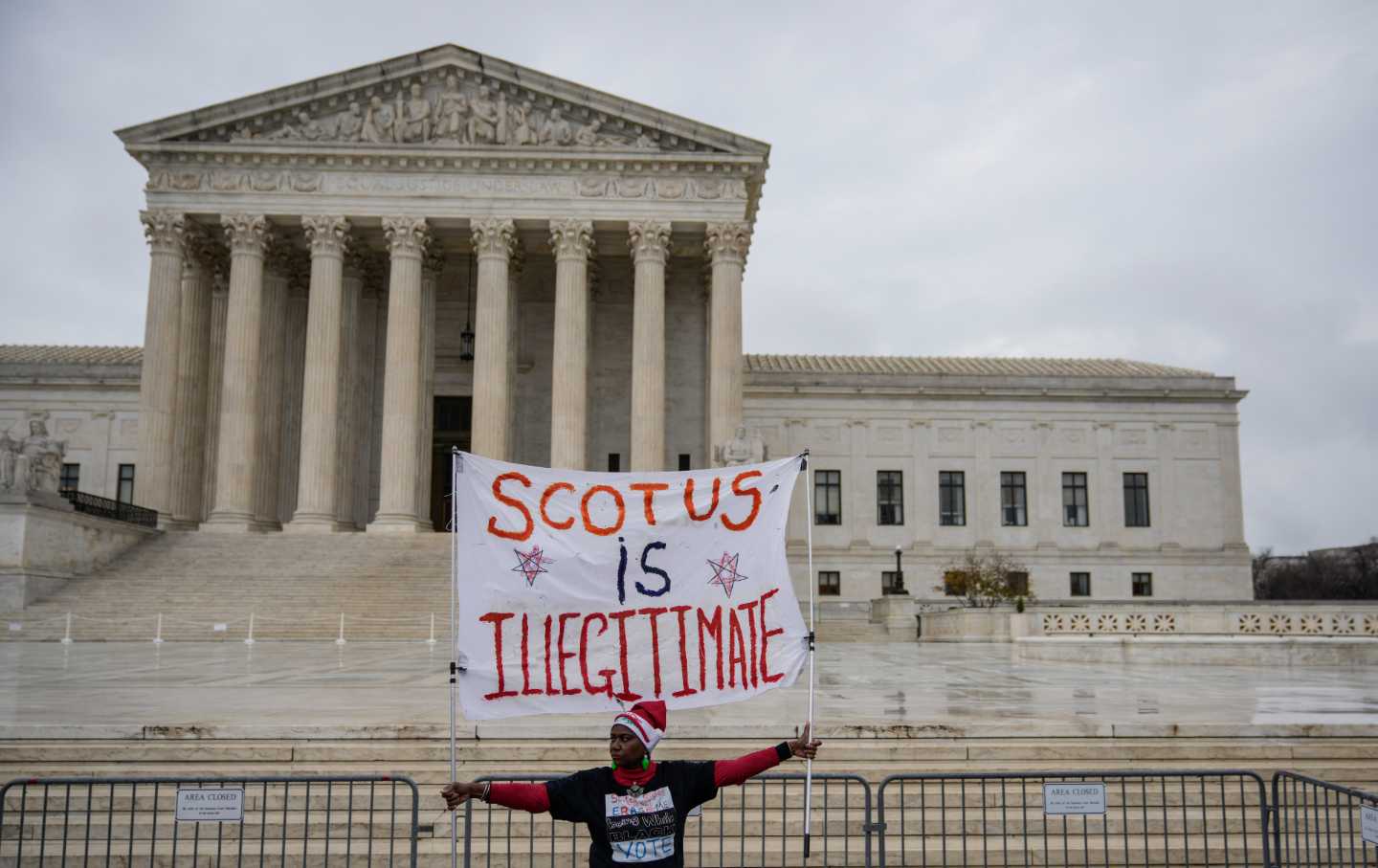
Protesters hold a “No Kings” flag as they gather in Southeast Area and take part in rally and march on March 28, 2026 in Washington, DC.
(Tasos Katopodis / Getty Images)It’s been only a couple of weeks since the No Kings 3 protests, but we can see now how protest and resistance are changing in America: That one wasn’t just bigger than the previous No Kings. It was different: deeper and more connected. Rebecca Solnit argues that to understand resistance and change today, we need a much longer perspective than a couple of years. Her new book is The Beginning Comes After the End.
Also: Minneapolis made history with its mobilization against ICE. But what about the rest of the state, where the immigrant population has been growing for a couple of decades? What kind of resistance has developed there? Emma Janssen went to small-town Minnesota.
Subscribe to The Nation to support all of our podcasts: thenation.com/podcastsubscribe.
The Nation Podcasts
Here's where to find podcasts from The Nation. Political talk without the boring parts, featuring the writers, activists and artists who shape the news, from a progressive perspective.
Norm Eisen on the Paramount-Warners Merger, plus Trump and TV News / Start Making Sense
The primary force behind the settlement that will allow Trump’s allies at Paramount to take over Warners-Discovery and CNN was Gavin Newsom, who pressured California Attorney General Rob Bonta to end the anti-trust fight defending media independence. Norm Eisen explains – he’s co-founder and executive chair of the Democracy Defenders Fund and Democracy Defenders Action, and, the New York Times reported, “the leader of a coalition of entertainment and news industry professionals who opposed the deal.”
Also: After Trump banned CNN, MS NOW and Politico from the White House newsroom, the TV networks united in refusing coverage of his events – including Fox News. John Nichols has our analysis.
Advertising Inquiries: https://redcircle.com/brands
Privacy & Opt-Out: https://redcircle.com/privacy
Search Results placeholder
Jon Wiener: From The Nation magazine, this is “Start Making Sense,” I’m Jon Wiener. Later in the show: Minneapolis made history with its mobilization against ICE–But What about small town Minnesota, where the immigrant population has been growing for a couple of decades? What kind of resistance has developed there? Emma Janssen went to small town Minnesota to find out. She’s a writing fellow at The American Prospect. But first: It’s been only a couple of weeks since the No Kings 3 protests, but we can see now how protest and resistance are changing in America: that one it wasn’t just bigger than the previous No Kings. It was different. Deeper. More connected. Rebecca Solnit will explain- in a minute.
[BREAK]
Now it’s time to talk with Rebecca Solnit. She’s a writer and activist who’s authored more than 25 books, including Men Explain Things to Me, Orwell’s Roses and Hope in the Dark. She’s a columnist for The Guardian U.S. edition, she writes for The Nation, and you can read her regularly at meditationsinanemergency.com. And she’s featured right now in the three-part Thoreau documentary on PBS. Her new book is The Beginning Comes After the End: Notes on a World of Change. Rebecca, welcome back.
Rebecca Solnit: Hello, Jon.
JW: I’ve read several obituaries about the death of feminism lately, but what did you make of the First Lady of the United States, Trump’s wife, Melania, appearing to throw him under the bus? Just when he was hoping his war with Iran was distracting people from the Epstein files, last week, she held her own news conference at the White House to announce that she never had a relationship with Jeffrey Epstein. What is going on here?
RS: I just think it’s hilarious how she’s learned from her husband how to act guilty as hell. And she’s rendering it perfectly. You don’t have a press conference like that saying, “I have nothing to hide” unless you have something to hide. And I think everyone on earth except her seems to fully understand that.
JW: And yet she wants to create distance between herself and her husband, who apparently, she implies pretty directly, does have something to hide.
RS: Well, I’ve got a shocker for you, Jon. I don’t think she likes the guy.
JW: So, what does this say about the “feminism is dead” obituaries?
RS: You know, a lot of times when people proclaim the death of feminism, they’re pointing to some sucky thing that recently happened to women: the overturning of Roe vs. Wade, et cetera. And of course, with Roe vs. Wade, American women are not all women on earth. And 70% of American women still live in states where abortion access exists.
But the larger thing is, not only is there a death wish in a lot of those funeral orations, but there’s a refusal to understand the whole trajectory. Second wave feminism and what came after, over the last 60 years, in my lifetime, has changed the status of women far more profoundly than almost anyone reckons with. Sure, there are setbacks. Sure, there’s the manosphere and the haters, etc. But women were so unfree, unequal, so excluded, degraded and disempowered through both culture and law in the world. I was born into that.
The extent to which feminism has changed everything, including men, is really pretty astonishing. Again, despite those setbacks and bad things that happen, and some of them, like this recent New York Times piece, are just really dumb, where it’s like the Epstein files do not prove that Me Too failed. The Epstein files were only seized as a result of the arresting of Jeffrey Epstein, which was the result of Julie K. Brown’s incredible reporting at the Miami Herald, which was almost certainly a result, I should go ask her, of the other stories that launched Me Too, which was not a freestanding, spontaneous eruption, but, you know, a consequence of the several years of feminism before. So without Me Too, there would be no Epstein files. And the fact that, you know, Prince Andrew, okay, the Andrew formerly known as Prince, and the various other men who have fallen, it’s really kind of shifted the conversation in a lot of ways. That’s not the sound of feminism failing.
JW: And the fact that the First Lady is holding a press conference at the White House to say “this has nothing to do with me” itself is testimony to the fact that feminism is not dead.
RS: Such beautiful nervousness. We love to see it.
JW: Well, it’s been two weeks since the No Kings 3 protests on March 28th. That one was famous mostly for being bigger than the previous No Kings one. But it wasn’t just bigger, it was different. Please explain.
RS: Yeah, I had a bunch of studies noticed that first, there were No Kings protests in every single congressional district in the country. Secondly, they were more than ever before in rural, small town and suburban America and red state America. And so it felt like it’s going deeper into the country as a whole, deeper into places that weren’t previously involved, deeper into places where lots of people, including Democratic leaders, would love to tell us that all they care about is kitchen table issues, or they’re “moderates,” or all these other things that belie the fact that people are getting pretty whatever the opposite of a moderate is about what’s going on. Do we call it radical?
JW: It’s okay with me. And one other thing about the bigger No Kings demonstration, 700 more demonstrations in places they were not before: That means lots more people learning how to organize their friends, their neighbors, how to deal with officials, how to get the permits, how to find out if they need permits, how to get the training in de-escalation. It’s a lot more organizers, and I’ve heard that once you learn this stuff, you don’t forget it.
RS: Yeah. And there was a sudden wave of disparagement just before this third No Kings that really felt pretty Astroturf to me, including claiming things like “Oh, what does a demonstration do?” But a lot of people showing up are organizing. A lot of them are getting recruited.
And something beautiful and magical often happens in these moments, that I’ve seen over and over again, in more or less a lifetime of going to protests and demonstrations: people feel they stop feeling alone, which really happens for I think a lot of people, when the right feels like it’s in power. Now it’s ‘we’re kind of sort of in power.’ You know, people feel a sense of strength and membership and belonging. And I think those things are really important. They’re important to movements. They’re important to democracy. To see so many people, including in these little towns, in red counties, standing up for what they believe in, I think is just beautiful, powerful. And of course, so much of my work has been about all the things that matter, even if we can’t quantify them so readily, even if their impact is indirect or immeasurable or slow. But, you know, I think it was huge, and I think it’s pretty upsetting to the right, which is often a good measure of what we’re doing.
JW: I’d love to talk about what happened in Minnesota. We ran a segment on this show last week headlined “Minnesota Changed Everything” with Deepak Bhargava, long time organizer, now runs a big foundation. He argued that people in Minneapolis accomplished what initially seemed impossible: They ended the ICE surge in the state. They actually changed how leaders think about immigration policy. Greg Bovino lost his job, Kristi Noem lost her job. And there were some big moves in popular culture, starting with Bruce Springsteen and Bad Bunny.
How did this happen? Well, he said it happened because of years of organizing by community groups and unions and faith organizations and what seemed like spontaneous organization by ordinary people in their neighborhoods, organizing those rapid response groups, the ones with the whistles and the cameras. You’ve noticed the same thing.
RS: Yeah. The thing that blows me away the most about Minnesota is, I think, behind the Trump administration’s assumptions about how the ICE attack on immigrants and brown and Black people would play is, as is often the case with conservatives, an assumption about human nature. They assumed that we are basically selfish and basically cowardly. We might protect ourselves, but are we going to protect our neighbors who are a different color, ethnicity, religion than us?
They gambled on selfishness, and they lost. And that’s so beautiful. I think the moral beauty of the way people showed up for each other and stuck up for each other, was such a profound lesson in who we can be, who we sometimes are. And a lesson about human nature in times of crisis that I’ve looked at in my book, A Paradise Built in Hell. And that really matters for us because we are in a very different kind of disaster than the earthquakes and things I wrote about, but nevertheless, we are in a disaster, or catastrophe, which I think is a little bigger.
JW: Yeah. In your new book, The Beginning Comes After the End, towards the end, you quote Mike Davis saying, “I’ve seen social miracles in my life, ones that have stunned me, the courageousness of ordinary people in a struggle.” Minnesota’s a good example of that.
RS: Oh my God, it is so good. And I don’t want to forget Chicago and LA and New Orleans and Charlotte and these other towns in North Carolina. People have been showing up all over the country. But boy, Minnesota really riveted the world with what went on in Saint Paul and Minneapolis in that bitter cold weather. Even after people died, other people would keep showing up in public, but also doing the private work of bringing food to people afraid to leave their houses, driving kids to school, protecting the kids at school and daycare centers, and other things. And it was just extraordinary. I hope people are making a documentary. I hope people are writing books about it. I hope it’s being really well documented because I think it’s just such an extraordinary, profound thing that happened. And there aren’t that many moments in American history quite like this. You know, it really, to me, stretches back to the St. Louis Commune of 1877, the abolitionist movement and the Underground Railroad. Forward to some of the strongest moments in the civil rights movement of the late, late 50s, early 60s. And it is just one of the great moments in American history in my life.
JW: My favorite story here is one that appeared in, of all places, our national newspaper of record, The New York Times. There was this interview with a woman, Lindsay Gruttadaurio, 62-year-old insurance claims adjuster, called herself a centrist Democrat, who said she grew up in a military family and often disagrees with progressives. She said watching the ICE raids on the news motivated her. So, on one of those super cold days at the end of January, she bundled up and went to her first protest, and told The New York Times, “I immediately felt comfortable. It’s like a Lutheran potluck. Just go and you’ll be fine. In fact, it was thrilling. There was a lot of cussing. It was fantastic, actually.”
RS: [LAUGHTER] You know something that’s been really big since January 20th, 2025, is first-time protesters. I went to a lot of Tesla Takedown protests last, you know, particularly when they started up the spring of 2025 or late winter of 2025. And I talked to people there a lot, and there were a lot of first-time people there, and that’s exciting, too. It means that we’re building a movement. And also, as that quote illustrates, it means that people who are usually considered moderate, and often portrayed as timid, low participation level are really gearing up to show up like we are in a different country than we were a year ago. And I’m just fascinated by how the Trump administration is constantly doing things and assuming that they’re the only actor in the field. The backlash, whether it’s Iran or Minneapolis, or anything else, always seems to come as a surprise to them. May the surprises continue to rain down.
JW: You’ve said recently that in some circles you are called “the hope lady.” I’ve often said that your book Hope in the Dark really changed my thinking about politics and about life. Let’s say it again: hope is not the same thing as optimism. Optimism is the belief that you know what’s going to happen, and if you know what’s going to happen, you don’t have to do anything to help make it happen. Hope is the opposite. It’s based on the idea that you don’t know what’s going to happen, and therefore you need to take action — because maybe it’ll have an effect. But for a year or more, you’ve been saying you want to “go light on the word ‘hope.’” And lately you’ve written about the case for defiance. How come this shift?
RS: Really since they started talking about hope in 2003, when a lot of people fell into despair. When the war on Iraq, George W. Bush’s war began, I found that people conflate hope with optimism. Or they think it means that you have to feel good, which it clearly does not, or that it’s an emotion. And I think it’s really an ethical commitment and attitude, a lot of things, but not an emotion. You can be heartbroken and hopeful in the sense of continuing to show up. And I think at the essence, what we’re talking about is not surrendering, for those of us who are in relatively safe conditions.
And what’s interesting about the people who want hopelessness, the abandonment of engagement, of effort to seem suave and sophisticated is that it’s basically surrender. If you say there’s nothing we can do, and a lot of people say that loudly, you’re not only asserting that we have no power to impact what happens, you’re also impacting what happens negatively by discouraging participation. You know, it’s really kind of a drag on people’s motivation to participate and understanding that we can participate because the outcome has not been determined. People talk about the future like it’s some country out there, or a place we’re going to go visit, like the way you drive to the shopping mall, or it doesn’t exist. It’s something we’re making in the present by how we show up or fail to show up. And there are parameters, and sometimes we lose, but we always lose when we don’t show up. So I really want people to just keep showing up. And I think because this is going out on the radio, I need to leave out the F-word. But I responded to a wonderful climate journalist who felt a little encouraged by something I said — that “if the word ‘hope’ doesn’t work for you, try ‘never bleeping surrender.’” Because that’s really the divide. Are we going to surrender and just let all this stuff happen? How can we? It’s breaking solidarity with the people most under attack.
And right now, we’re in this interesting, weird moment where clearly Trump is on the downhill slope mentally, physically and politically. Their power is pretty finite. It backfires on them and all the ways they misestimate and misuse it. And they are, one way or another, on the decline. We don’t know what that means exactly, but maybe we define what it means by how we help them decline.
JW: We’ve been talking about things that have happened in the last couple of months. Your new book, The Beginning Comes After the End, suggests we should take a much longer view of what is going on in our lives. And you open your new book, not with millions of people taking to the streets in No Kings, but with three dozen people at a Land Back ceremony where 500 acres north of San Francisco was returned to the indigenous people who, in your words, were, “its original stewards.” Why did you make that your starting point?
RS: It’s such a remarkable thing. And in a way, 400-something acres seems like, what’s the big deal? But if you look in the long-time scale, if you have a baseline for how white people thought and mostly didn’t think about indigenous people of the Americas only a few decades ago, you see that we had to move heaven and earth, we had to completely redefine the history of this hemisphere, our understanding of nature — I’m speaking for all the settler colonialists — we had to really adopt a radically, almost revolutionarily, different worldview to see this land was always occupied. There was no such thing as virgin nature. Its original inhabitants never disappeared, and their rights were never terminated, that what happened to native people wasn’t a bad thing in the 19th century. It’s an ongoing process whose chapters are still being written.
And it’s interesting, when I go back and look at all those books, like Bury My Heart at Wounded Knee, which even when they seem to be trying to ally themselves with the story of native people, they’re always stories of ending, of decline, of defeat. But what we’ve seen in the last 30-something years with a real turning point, a big watershed in the early 1990s, is a lot of reclaiming of land language, culture, ceremony, but also reclaiming, you know, arguably their rightful place in the public imagination and public life and a huge amount of leadership for climate and environmental issues.
And I think even beyond that, something that I think is so important and that I couldn’t find anybody writing about, so I just went out on a limb and did it on my own. I think this indigenous presence has really changed the way the rest of us think profoundly. If it’s a completely different history of the continent than the one we were brought up with. But also, if you acknowledge that the indigenous presence for 10,000 years and more in this hemisphere, you stop being able to think of nature and culture as these separate nonintersecting spheres. And you also stop thinking of human nature the way — like all the environmentalists, I was around when I was young in the 80s, used to think of it: human beings are inherently destructive. We can only protect nature by putting a fence around it and keeping people out of it. And it’s like, well, people were in these places. You know, for thousands of years and they looked great. So human beings are not inherently at odds with nature. There are a lot of ways to be human. You think about everything differently because these are such foundational concepts for what we do in the present.
So all that had to change nationally and beyond because this is happening in Canada and Latin America too, New Zealand, Australia, etc. something colossal had to happen internationally for this one thing to happen, specifically on the Marin Sonoma border in California. And I wanted to kind of like take this very specific event and look at how much had to change for this to happen, the same way that for same sex marriage to happen in 2015, we had to radically rethink what marriage was and what queerness is and what equality means, and I feel like a lot of people can’t see change because they don’t have time frames that go beyond, you know, last week, last month, last year.
And it’s really over this – if the arc of justice is long, but it bends in any direction at all, you better equip yourself to see long arcs, and that means thinking in years and decades and sometimes centuries, to see. We are not who we used to be 50 or 60 or 70 years ago. So many of our fundamental assumptions about nature, gender, sexuality, equality, justice, race, and everything else have changed profoundly and but so incrementally, most people don’t really have those baselines. I wanted to give them back.
JW: Last thing: you say toward the end of your new book, that the turmoil and chaos we’re experiencing now is “the chaos of the end of something.” What is at the end of?
RS: I think if you look carefully at what the right-wing project is in Russia and Hungary, in Argentina and Chile, in the United States, it’s essentially backlash. It’s telling us: “all you environmentalists and feminists and anti-racist and indigenous rights activists and climate people have changed the world profoundly. We want to change it back.”
Because it’s completely regressive. In a way, they’re announcing that their time is over. They see their white colonial patriarchal project coming to an end, and they’re very unhappy about it. I, on the other hand, am quite happy about it. But if you listen to them carefully, they’re the ones who are telling us that we’ve changed the world profoundly, that we have a lot of power, that all this different stuff we, the progressives have done over the last 70 years is connected. They think we’re winning. And that’s actually kind of exciting. And you see that the majority of people hold views that are really different than they were not so long ago. And that also these far-right entities are powerful, partly because they have the backing of a lot of billionaires, including Silicon Valley and media billionaires behind them, the fossil fuel industry. But they are minority movements because they’re bad for the majority. If you’re not a straight, white Christian man and you want to have rights and equality and participation, etc., they’re your enemy. And most of us are not all those things. And even plenty of straight white Christian men — I can think of my friend Bill McKibben, for example — have much better values and want a more egalitarian world, a more rights oriented world, including the rights of nature.
So they themselves are the ones telling us that they’re losing and that they see their world going away, and that they have this fantasy. And I always think here of ,like old men in the 80s, that they can hit rewind on the VCR of history. And, you know as a historian, there is no rewind.
JW: Rebecca Solnit — her new book is The Beginning Comes After the End: Notes on a World of Change. Rebecca, thanks for everything you do — and thanks for talking with us today.
RS: Always a pleasure, Jon. Thank you.
[BREAK]
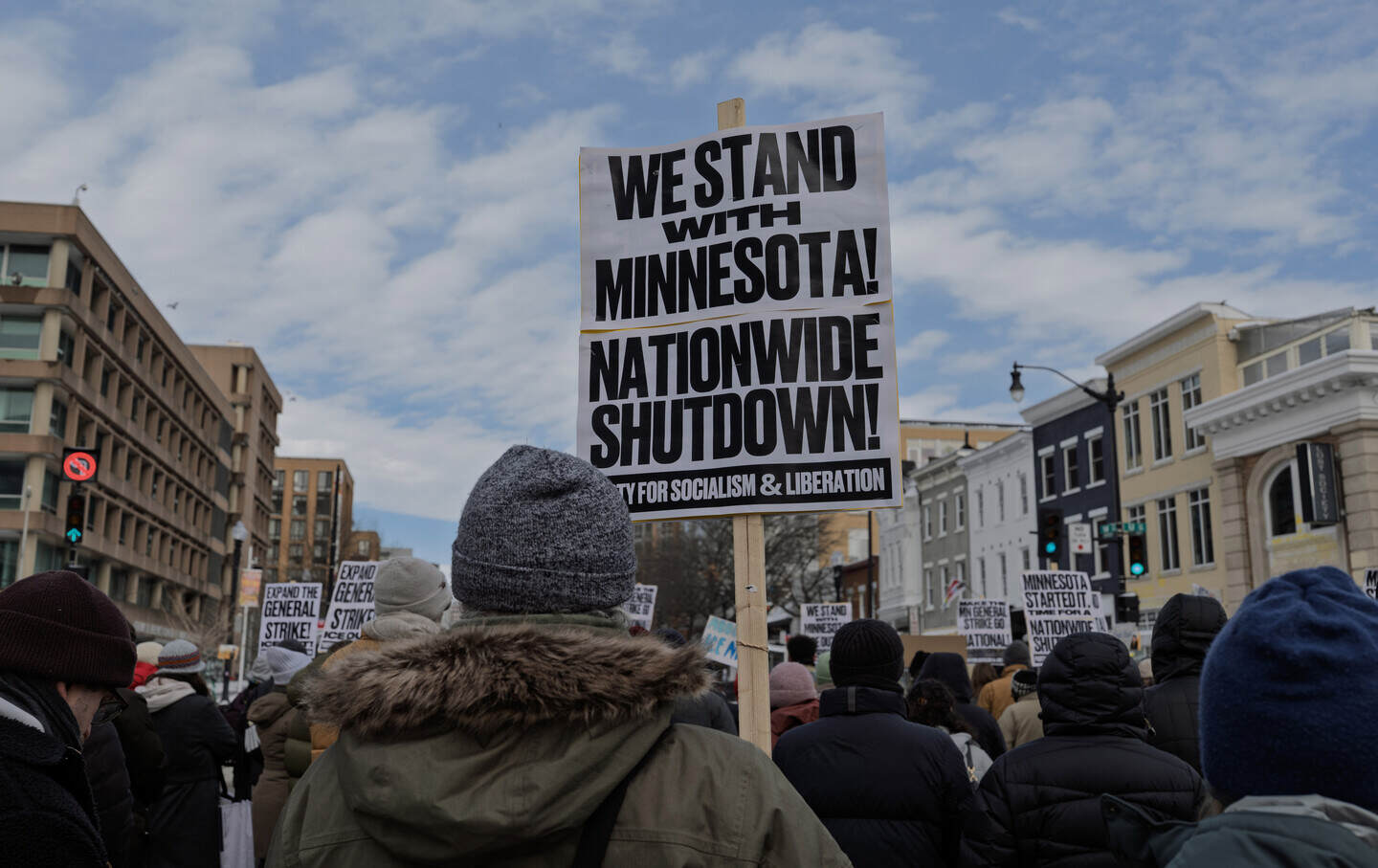
Jon Wiener: At the peak of the ICE surge in Minneapolis, that one day general strike in January brought 50,000 or maybe even 100,000 people into the streets. Meanwhile, every day for a month in Minneapolis, more than 100 hyper local rapid response groups stood ready with those whistles and cameras in case ICE showed up on their blocks. That’s the mass mobilization that drove ICE out of Minneapolis at the beginning of February. But what about ICE outside the Twin Cities? What about smalltown Minnesota, where the immigrant population has been growing for a couple of decades? What kind of resistance has developed there? Emma Janssen went to small town Minnesota to find out. She’s a writing fellow at The American Prospect. Before joining The Prospect, she was a student at the University of Chicago studying political philosophy, editing The Chicago Maroon and freelancing for The Hyde Park Herald. We reached her today in Chicago. Emma Janssen, welcome to the program.
Emma Janssen: Thank you so much for having me. I’m so glad to be here.
JW: You went to southern Minnesota, where many towns have significant immigrant populations. These are immigrants from where? And why are they in these towns?
EJ: Like in the Twin Cities in greater Minnesota, you definitely also have a large population of immigrants from Somalia. One of the towns that I spent a lot of time in, Willmar, is one such town. But throughout Minnesota, you also have immigrants who are coming from Latin America. And you also have, in parts of the state, a pretty robust Karen population. That is a group of immigrants from Myanmar. Those were the three main groups that I encountered.
JW: And the Karen are Christian. Is that right?
EJ: Yeah. That’s correct.
JW: How active has ICE been in these towns? There’s only one that’s gotten into the news in Willmar, where a group of ICE agents stopped at the Mexican restaurant downtown for lunch, and at the end of the day, those agents came back and arrested the people at the restaurant who had served them lunch. What happened to them?
EJ: The female owner of the restaurant was deported, and the father, the male owner of the restaurant, he was returned to Willmar eventually, a few days later.
JW: And there’s one footnote here. Willmar had actually been in the news a few years earlier — in The New York Times.
EJ: Yeah. So, it was 2019, Tom Friedman, and I believe one of the headlines that I saw was something like, “Mr. President, Come to Willmar.” And basically the thesis of the piece is that Willmar had managed to create a community where Somali immigrants, Karen immigrants, Hispanic immigrants, and longtime white residents of the town lived in some sort of harmony. The day that I was there, it just looked completely closed down. Businesses were shuttered, it was cold, it was quiet. And I had heard these horrifying stories about ICE’s impact on the town. So that to me was just a really poetic and sad moment to read that.
JW: You also went to Albert Lea, Minnesota. It has a place in the labor history of the Reagan era, not a happy place in that history.
EJ: The most famous strike in Albert Lea was in 1985 at the Hormel plant. And Hormel, by the way, is still the biggest company in that area. They’re headquartered in the nearby town of Austin, which I also visited. But this strike actually was the subject of a documentary film called American Dream, which won the Academy Award for Best Documentary Feature that year. The Hormel Strike was defeated. So that history of labor just continues to kind of haunt the residents and the workers in both Albert Lee and in Austin.
JW: Looking at where the resistance is found in these places — In Minneapolis, the resistance was led by, among others, what we call the faith community. In Minnesota, the largest religion is Lutheran. 23% of everybody in Minnesota is Lutheran. Minneapolis has the largest Lutheran congregation in the world, 13,000 members Mount Olivet Lutheran Church. Google is great at things like this. And Lutheran pastors were leaders of the resistance in Minneapolis, they led civil disobedience famously at the airport. How are the Lutheran ministers doing in small town southern Minnesota?
EJ: It’s very much a similar story. And actually, one of the pastors that I spoke to in Northfield, which is one of the towns I visited, it’s only about 45 minutes outside of the Twin Cities, she had actually participated in that airport prayer sit-in that you mentioned. So it’s a very similar environment where these faith leaders are coming together, leading such large congregations and have connections with other folks in their town—whether other folks there are members of the congregation or not.
In a lot of these towns, everyone knows the big church, you know, so these churches have become focus points for every form of resistance that you can imagine — whether the church is the place where you can bring in groceries that you picked up, and then later they’ll be distributed to immigrant families who are staying home, or the churches are where you can come and talk to folks who are maybe more involved in these resistance efforts and ask what they need from you. Or maybe the church is the place where, in the case of one church that I visited in Northfield, one group was doing ICE watch patrols, another group who was doing mutual aid of the form of groceries, another, rides to school for immigrant children, etc.. The church is where those groups come together on a weekly basis to just check in and see what the successes, the failures, the concerns of that week were. And the faith leaders have really built this sense of what they call “neighbor-ism” and “neighborliness”, and using that as kind of the guiding principle and philosophy of how they are resisting ICE.
JW: And which of these towns have Muslim populations and mosques?
EJ: Of the three towns that I visited, Willmar certainly has the largest Muslim population of those three. That’s in some part because the main industry in Willmar is based around the Jennie-O Turkey processing plant, and Muslim workers will work at the turkey processing plant, but they won’t work downstate in Albert Lea or Austin, where the meat being processed is pork — because it’s haram, forbidden, to deal with pork. So that means that Willmar is really a major, major place for the Somali community. And there’s a great Islamic center there where I went to an iftar dinner during Ramadan and got to speak to some community members who were able to speak to the specific impact that this immigration crackdown was having for them during the holiest month in Islam.
JW: The part of your report that I found most disheartening was about the white kids in middle school, where you talked to some parents about what was going on.
EJ: In Albert Lea, I spoke to two mothers. Both mothers are Mexican American, and so their kids are facing racism at school: white kids saying things like, “all the Mexican kids line up” or “I hope you have your bags packed. I hope you’re ready, because Trump’s coming for you” and things like that.
And then in Austin, I spoke to a teacher who had witnessed some of this as well on his school’s campus, and he also wanted to highlight that many kids were trying their best. In Austin, there had been some school walkouts, including kids as young as late elementary school and early middle school, who were walking out in support of their peers and neighbors who had been targeted by ICE. So, it’s not all bad, but there were these really harrowing stories of just casual, everyday racism on the schoolyard.
JW: We’ve been talking about these towns as if they’re all pretty much the same, but in fact, you found significant differences between Northfield, which is a college town, and Willmar, which is a kind of a farming industrial town. The biggest difference was the county sheriff in Willmar.
EJ: Willmar is one of four towns in Minnesota where the local jail has an agreement with ICE to house immigrants who have been detained by ICE or CBP. In Willmar, the folks I spoke to said that they really do feel like the sheriff is working with ICE and the federal government. It’s a real source of profit for the county and for Willmar because they receive money from the federal government to serve as a detention facility for them — to the point where the jail has actually moved local detainees who are not there for immigration purposes further afield, just to free up space for folks who are detained due to immigration status.
JW: On the other hand, you found a lot of what you call bright spots of solidarity, which are really the most significant parts of your report. The most remarkable to me was you found a motorcycle club for cops and ex-military. Tell us about them.
EJ: I was sitting down in a different Mexican restaurant in Willmar, and in walks Willie, who was one of the people that I spoke with in Willmar. And he walks in and he’s wearing this like, real tough-guy-like leather motorcycle jacket with this kind of robin’s egg blue colored lettering, and it has some Bible quotes on it. And it, it’s just like this kind of cool jacket, and I have no idea what’s going on. Willie tells me that he is a member of this motorcycle club where it’s a group of veterans, former police officers, former firefighters, EMTs, paramedics, that kind of like law enforcement-adjacent crowd. And that’s their jacket. And so Willie is a member of the group. And from what he told me, it’s a big part of his social life and the group is pretty tight knit. As you can imagine, it’s a pretty conservative bunch, a law enforcement motorcycle club. You know, it kind of makes sense.
JW: Got it.
EJ: Yep. And so Willie is the owner of a local restaurant right on one of the main streets in Willmar. He was hosting a fundraiser around the holidays in late December, and he was really concerned that there would be some sort of disruption due to ICE. He’s Mexican American, some of his customers are as well, and it was just a lot of fear brewing under the surface. So the conservative tough guys in his motorcycle club said, “we’ve got your back. You run the fundraiser. Don’t worry about ICE.” They literally formed a perimeter outside of Willie’s restaurant. And as he told it, the fundraiser went off completely without a hitch. And it was just a really heartening moment of some of these otherwise super conservative guys just using their presence to say, “don’t mess with our friend and don’t mess with his business and what he’s trying to do.”
JW: No Kings Day, March 28th was after you finished your reporting there. I noticed that Willmar did have a No Kings Day protest on March 28th. The local news reports there said 650 people went to a No Kings protest at the middle school parking lot on that Saturday. There is a Indivisible Kandiyohi County that organized this.
Albert Lea had a No Kings rally on that Saturday, March 28th, 300 people at New Denmark Park. It was described as the town’s largest protest in its history.
And of course, the college town of Northfield had a big No Kings protest. This is, you know, Carleton College and Saint Olaf College. They had two or three thousand people in Ames Park. And then they had busses going to the rally, the flagship rally in Saint Paul. So all of these places had No Kings Day protests. And the one in Northfield was really big.
I wonder what your concluding thoughts are about resistance to ICE in rural Minnesota. I was struck by that term “neighbor-ism.”
EJ: It doesn’t surprise me that so many people showed out in all of these towns, including in the more conservative and smaller towns like Willmar and Albert Lea. When I was there I spoke to some older, longtime white residents of the town who could be forgiven for assuming something about their politics, potentially assuming that they are more conservative or have some nostalgia for when their towns were all white, working class and everyone had a job.
I met so many people who would fit that description, who were actually some of the most radical organizers out there. And people are really galvanized by this. They see what’s been happening to their own neighbors, and they’re determined to do something about it. And for some people, that means getting in their car at 5 a.m. and following ICE vehicles around. And for others, it means going to the first protest they’ve ever been to in their lives and just kind of bravely standing on a street corner with a hand-drawn sign.
There’s a lot of that happening in these small towns, and it doesn’t mean that everyone in Willmar is suddenly going to become a leftist, card-carrying DSA member, Bernie voter. But it does mean that, I think, there’s a level of empathy and care that is often a bit quieter and a bit harder to see, but it’s there and I think it’s really growing as well.
JW: Emma Janssen – you can read her report “When ICE Blows Through Rural America” @prospect.org. Emma, thanks for talking with us today.
EJ: Thank you so much.
Subscribe to The Nation to Support all of our podcasts
Become a Sustaining Donor This September
Between the reemergence of right-wing red-baiting and Donald Trump’s use of the chilling National Security Presidential Memorandum–7 to criminalize left political organizing, we’re seeing McCarthyism reborn before our eyes.
This assault on democracy cannot be ignored or wished away. Resisting it requires bravery in the face of threats and repression, a steadfast commitment to the truth, and the unwavering belief that we can—and will—overcome this darkness.
We must have an independent media that sets the record straight, unearths corruption and abuses of power, and advances a politics of justice and dignity for all if we’re to win this fight.
That’s why I’m writing to you today. This September, The Nation needs to add 100 monthly donors to sustain our progressive journalism. Your contribution makes the next investigative report, the next truth-speaking column, and the next pathbreaking essay all possible.
I hope you’ll support our work with a recurring donation today. If you donate $10 or more a month, we’ll send you a brand new “Hands Off the Free Press!” sticker to recognise your commitment to our cause. Please, donate today.
Onward,
Katrina vanden Heuvel
Editor and Publisher, The Nation