
In Fact… In Fact…
KATHY BOUDIN AND PAROLE DENIAL Noted with dismay: New York prison officials' recent decision to deny parole to former Weather Underground fugitive Kathy Boudin. This magazine can spare no sympathy for the 1981 Brink's robbery in which Boudin drove the getaway truck while former members of the Black Liberation Army killed two police officers and a security guard. But Boudin was an accessory, not a principal, in that robbery and had surrendered before the officers were killed. In twenty years behind bars, she has embodied the ideal of a prisoner remaking her life: earning a graduate degree and teaching other inmates at Bedford Hills. Even though the victims of the Brink's robbery and their families were divided over Boudin, Governor George Pataki chose to heed a vocal campaign by Rockland County police officials to keep her locked up. That denial is part of a national pattern in which governors, in the name of fighting crime, have made it almost impossible for prisoners to earn parole. In some states 80 percent of all applications are denied. The denial of parole is a hidden engine of the nationwide prison crisis that's breaking states' treasuries--and at the same time is leaving large numbers of nonviolent offenders with no incentive to rebuild their lives. The point of parole is precisely for officials and offenders alike to step back from the acts that got inmates locked up in the first place and look at the whole life. No possible purpose is served by keeping Boudin incarcerated. ON THE WEB: THIS [email protected] From the UN World Conference Against Racism in Durban Mark Gevisser writes that South African President Thabo Mbeki proclaimed that the divide between North and South "also coincides with the divide between white and black, broadly defined." Meanwhile, the Congress of South African Trade Unions struck to protest his government's "neoliberal" economic policy. Re the US-Israel walkout: Charles Tanzer reports that while the United States emphasized concern over the language about Israel in the final document, it "spent its time challenging nearly every word of the text, objecting to language that might actually require it to take steps to combat racism or acknowledge that slavery was a crime against humanity" (see www.thenation.com). CAREY McWILLIAMS AWARD Victor Navasky is co-winner of the American Political Science Association's Carey McWilliams Award. Named after The Nation's great editor, the award honors "a major journalistic contribution to our understanding of politics." The other winner is William Kristol, editor of the conservative Weekly Standard. Asked how the association justified giving the award to the proprietors of two such different magazines, a spokesman said that they had in common a willingness to alienate their own constituencies. We congratulate Navasky and commend to Kristol the writings of Carey McWilliams.
Sep 6, 2001 / The Editors
More Democracy–Now! More Democracy–Now!
In a recent interview with the Washington Post, Pacifica Radio executive director Bessie Wash said that the Pacifica management's goal "is to increase listenership." In the name...
Aug 23, 2001 / The Editors
Nothing Could Be Finer in North Carolina Nothing Could Be Finer in North Carolina
William Kristol claims that Senator Jesse Helms's departure at the end of his term represents "the end of an era." We can only hope. Helms has championed an odious brand of cons...
Aug 23, 2001 / The Editors
‘Nation’ Notes ‘Nation’ Notes
We regret the loss of two valued contributors. Richard Cloward, for forty-seven years a professor at the Columbia University School of Social Work, was author of such influentia...
Aug 23, 2001 / The Editors
Let’s Get Organized Let’s Get Organized
When The Red Queen boasts in Through the Looking-Glass that in her country, "it takes all the running you can do, to keep in the same place," she could have been talking about tod...
Aug 23, 2001 / The Editors
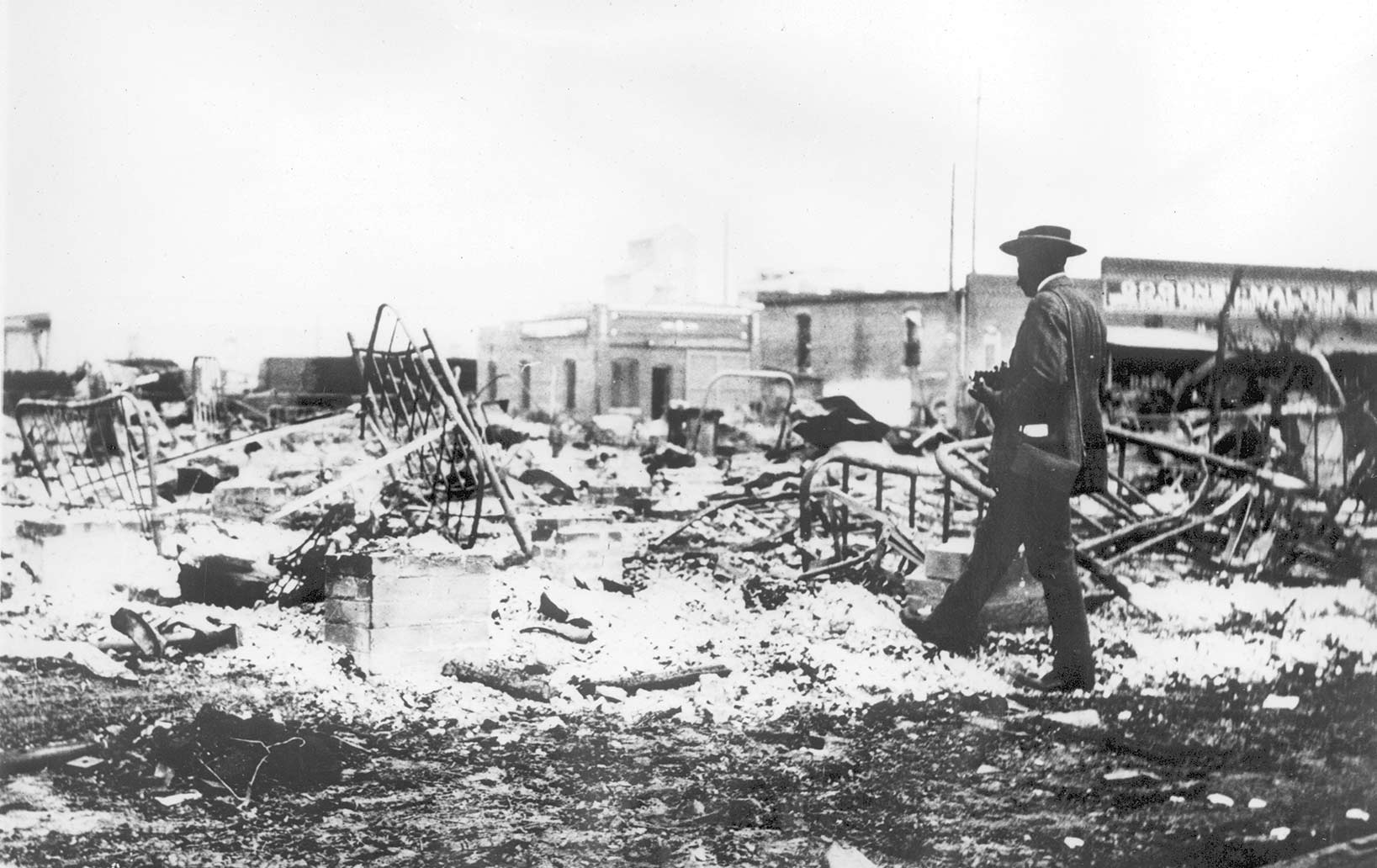
Tulsa, 1921 Tulsa, 1921
On the 100th anniversary of the riot in that city, we commemorate the report written for this magazine by a remarkable journalist.
Aug 23, 2001 / Feature / The Editors and Walter F. White
Nation Notes Nation Notes
We welcome to The Nation's editorial board Tom Hayden and Lani Guinier. From his days as a seminal figure of the 1960s--an author of the Port Huron Statement, president of SDS, one of the Chicago 7 convicted (later acquitted) for inciting a riot at the 1968 Democratic Convention--Hayden has been an effective progressive voice. From 1982 to 2000 he served in the California legislature as a conscience on the left and a productive legislator. Term-limited out of the State Senate, he ran for LA City Council in the recent election, losing by 369 votes. A contributor to this magazine and author of ten books, Hayden edited the forthcoming The Zapatista Reader for Nation Books. Lani Guinier had an unwanted fifteen minutes of fame in 1993 when Bill Clinton withdrew her nomination as Assistant Attorney General for Civil Rights after she was vilified for her scholarly writings on voting. In 1998 she became the first black woman to be named a tenured professor at Harvard Law School. She is the author, most recently, of Lifting Every Voice: Turning a Civil Rights Setback Into a New Vision of Social Justice (Simon & Schuster). FOLLOW-UP : Richard Pollak writes: There was much justified rejoicing in the environmental community in early August after the Bush EPA sided with its Clinton predecessors and ordered General Electric to dredge thousands of pounds of lethal PCBs from the Hudson River north of Albany, New York. The decision is undeniably a setback for GE, which had spent millions fighting the proposal with dubious scientific reports and a monthslong propaganda blitz in the media (see Richard Pollak, "Is GE Mightier Than the Hudson?" May 28). But dredging is at best many months, if not years, away, and any notion that it is a done deal is premature. Several other federal agencies and New York State are still assessing the draft order, which would set in motion the largest such environmental cleanup in the nation's history, at a cost to GE of some half-billion dollars. Already there's talk of scaling back the project if dredging technologies prove too disruptive to towns along the river. These are, for the most part, hard-core Republican communities with a deep distrust of the government; many residents welcomed GE's antidredging public relations campaign and now promise to put up a strong local fight against the EPA solution. This despite the fact that many of their neighbors, and wildlife, continue to suffer from a variety of disorders caused by the polychlorinated biphenyls that GE dumped into the river over three decades.
Aug 9, 2001 / The Editors
Mark Green for Mayor Mark Green for Mayor
He is the most promising candidate progressives can look to for leadership.
Aug 9, 2001 / The Editors
The Hijacking of Social Security The Hijacking of Social Security
We've gathered some worthy articles on this subject so the reader can explore the important points to be considered.
Aug 9, 2001 / The Editors