
Puzzle No. 1623 Puzzle No. 1623
This puzzle originally appeared in the March 13, 1976, issue. Next week we'll have five new ones, by the finalists in the competition to replace Frank W. Lewis.
Mar 3, 2011 / Frank W. Lewis
Letters Letters
Scrap the Constitution? New York City; Austin, Tex. In “Stealing the Constitution” [Feb. 7], his fervid attack on right-wing constitutionalism, Garrett Epps writes that the Constitution has grown “more democratic and egalitarian” over time. Not quite. Enormous strides have been made in the direction of racial and sexual equality, but other trends have been in the opposite direction. Where it took five states representing as little as 15 percent of the population to veto a constitutional amendment in 1789, for instance, it takes thirteen states representing as little as 4.4 percent of the total to do the same today. By the year 2030, according to Census projections, it will take just 4 percent. When it comes to the people’s basic right to alter their mode of government, the United States is growing less democratic. Similarly, forty-one senators representing as little as 11.5 percent of the population can veto any bill, a figure that is expected to drop over the next three decades to 10.1 percent. Today a voter in Wyoming, which has a nonwhite population of 14 percent, has seventy-three times as much clout in Senate elections as a voter in California, the first “minority majority” state. By 2030, he or she will have eighty-nine times as much clout. Wyoming voters also have three times as much power in presidential elections, which means they have at least that much extra leverage when it comes to judicial appointments. If the federal judiciary leans more and more heavily to the right these days, this clearly has something to do with it. Thanks to the rule by which an amendment requires the concurrence of two-thirds of each house plus three-fourths of the states, the US Constitution is the hardest such document to change on the face of the globe. Thanks to the principle of equal state suffrage—which Article V says cannot be modified without the unanimous agreement of all fifty states—the Senate is the most unrepresentative legislative chamber in the putative democratic world. Yet that is equally unchangeable. As we saw with Bush v. Gore, the Electoral College allows a determined minority to steal the White House, and it, too, remains as unyielding as the Rock of Gibraltar. What the Constitution giveth in terms of the occasional progressive judicial opinion, it more than taketh away by augmenting the power of Wyoming, the Dakotas and other rural white bastions. The result is a pitiless dictatorship of the past over the present that grows more constrictive with each decade. Constitutional intractability of this sort is a powerful sop to the right, which explains the growing potency of the ultraconservative movement. Perhaps the Tea Partiers understand the Constitution better than Epps realizes. DANIEL LAZARE SANFORD LEVINSON Ashland, Mass. If the left spends its time trying to “take back the Constitution,” as Garrett Epps recommends, then it is in a very bad place. The right’s claims about the Constitution are indeed absurd, but is refuting them the best the left can do? Instead, progressive lawyers and legal scholars would be well advised to begin creating model constitutions and new amendments and laying the groundwork for a constitutional convention, with all the difficulties and perils that it would entail. A constitutional convention is in our future, and the left and “ordinary people” are completely unprepared. BERNARD GILMAN Epps Replies Washington, D.C. Daniel Lazare and Sanford Levinson take me to task because, they say, one part of the Constitution, the Senate, is not “more democratic and egalitarian” than it used to be, and is arguably less so. This would be a well-placed objection if I had said, “All parts of and institutions under the Constitution have become more democratic and egalitarian.” But I did not. I dislike the Senate gerrymander as much as Madison did in 1787, when he fought desperately against it. But I think it is mistaken to suggest that because the Senate gerrymander remains undemocratic, we cannot celebrate the major democratic strides represented by the Thirteenth, Fourteenth, Fifteenth, Sixteenth, Seventeenth, Nineteenth, Twenty-third, Twenty-fourth and Twenty-sixth Amendments. These are tremendously important changes. Far-right “constitutionalists” minimize or ignore them. For progressives to remain silent about them is to collude with those who wish to strip them of their value. To regard the ongoing existence of the Senate gerrymander as somehow negating all those accomplishments is wrong, and all the more so because this critique ignores the fact that in one important respect the Senate is more democratic and egalitarian than it was in 1789. Today, because of prolonged, disciplined popular agitation, senators are elected by the people. I would have thought Professors Lazare and Levinson might at least note that in passing. It strikes me as important. Bernard Gilman says that a constitutional convention is “in our future” and that instead of defending the progressive features of our current Constitution we should be preparing to rewrite the entire document. I suspect that he is wrong; indeed, considering what could happen at a constitutional convention in the present climate, I profoundly hope so. But I am confident that if we do not defend the proper interpretation of this Constitution, there will be no need for a convention; the far right will simply strip the current Constitution of its many valuable and progressive features. Senate or no, “model constitutions” or no, I am not willing to be silent while that act of theft takes place. GARRETT EPPS Print the FLAME-ing Ads! Columbia, Md. I have been reading the objections [“Letters,” Feb. 28] to the Nation’s printing of ads for FLAME (an acronym for “Facts and Logic About the Middle East”). I agree that the ads are disgusting, but still I think you should print them for the remuneration you get from them. I put this in the same category as the Christian Zionists giving money to the Israelis on the basis that it will be used to get rid of the Palestinians so that Israel can take over all of the Holy Land and thus enable the Second Coming of Christ. The hitch is that Jews will then either all be converted to Christianity or will be killed. If Jews took this seriously, they would not accept the donations, but they know it is silly, so why not take the money? I doubt that Nation readers will be influenced by the FLAME ads. Hopefully, they have learned enough from reading The Nation that they realize this is propaganda. DORIS RAUSCH
Mar 3, 2011 / Our Readers
Banksters Fighting Back With Higher Fees Banksters Fighting Back With Higher Fees
The banks are back! They’re paying out bonuses and raking in profits, we hear. But just how did they bounce back so fast? Let’s take Bank of America—they’re...
Mar 2, 2011 / Laura Flanders
The Story of ‘Citizens United’ vs. the FEC The Story of ‘Citizens United’ vs. the FEC
A guide to mitigating the damage done.
Mar 2, 2011 / Peter Rothberg
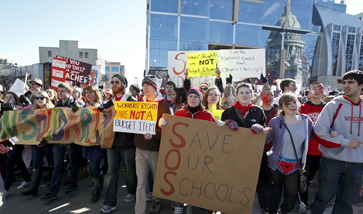
Wisconsin Teachers, Students Face Uncertain Future Wisconsin Teachers, Students Face Uncertain Future
Proposed budget cuts and threats to collective bargaining are already damaging public education in Wisconsin.
Mar 2, 2011 / Meredith Clark
Iran Intensifies Crackdown Against Greens Iran Intensifies Crackdown Against Greens
Mousavi, Karroubi reportedly taken to army prison, amid demands that they be executed.
Mar 2, 2011 / Bob Dreyfuss
Thom Hartmann: Corporations Are Fueling Our Peak Oil Crisis Thom Hartmann: Corporations Are Fueling Our Peak Oil Crisis
We have to to fight back against the corporate capture of government because the companies profiting off our addiction to oil are doing everything in their power to keep us on our...
Mar 2, 2011 / The Nation and On The Earth Productions
Boeing Boondoggle: Pork Can Fly Boeing Boondoggle: Pork Can Fly
“The gift that keeps on giving” should have been the headline on the Pentagon’s decision to award the Boeing Co. a $35 billion defense contract last week.
Mar 2, 2011 / Robert Scheer
Arab Uprisings and American Intervention Arab Uprisings and American Intervention
The young people protesting in Arab capitals right now want a meaningful break with the status quo and, in many ways, that means a break from American support.
Mar 2, 2011 / Laila Lalami
A Vote to Cut Grants to Low-Income Students Provokes a National Day of Action A Vote to Cut Grants to Low-Income Students Provokes a National Day of Action
The United States Student Association is organizing nationwide resistence to a House vote to cut the Pell Grant and TRIO programs.
Mar 2, 2011 / StudentNation / Sara Jerving