Fighting for Our Lives in Fossil Fuel Country—With John Beard Jr.
“This is about life. And this extractive industry is not a giver of life, it is a taker of life.”
The Valero refinery on May 5, 2026, in Corpus Christi, Texas.
(Brandon Bell / Getty Images)On March 23, 2026, a massive explosion tore through the Valero refinery in Port Arthur, Texas, shaking homes and sending a plume of smoke over a community that has lived with oil and petrochemical pollution for generations. In this episode of A People’s Climate, host Shilpi Chhotray talks with John Beard Jr., a former refinery worker who spent 38 years inside the industry, about what happens when global oil decisions become local realities.
From US policy toward Venezuelan oil to the expansion of petrochemical production and the world’s demand for plastics, Beard connects the decisions made far from Port Arthur to the people who pay the price close to home. They explore who benefits from the fossil fuel economy, who bears its risks, and what it would take to build a transition that doesn’t leave communities to pay for it with their health and their lives.
Key Topics
- Global oil, local consequences: How decisions about oil, foreign policy, and energy affect communities right here in the United States.
- The price of fossil fuels: Why communities like Port Arthur bear the pollution, health risks, and industrial disasters that make fossil fuel profits possible.
- The Valero explosion: What the March 2026 refinery explosion revealed about the risks fence-line communities live with every day.
- Oil & petrochemicals: How Gulf Coast communities became sacrifice zones for refining, plastics, and global fossil fuel demand.
- Who benefits?: The disconnect between the industry’s promise of jobs and prosperity and the economic realities facing Port Arthur residents.
- A just transition: What it means to move away from fossil fuels while repairing the damage already done and protecting workers and communities.
- Building power: Why communities need political power to challenge an industry whose reach extends from local government to global geopolitics.
Resources
- Port Arthur Community Action Network
- A People’s Climate Episode: An Unreasonable Woman with Diane Wilson—Another Texan’s historic win against the petrochemical industry
- US Gulf South Climate and Environmental Justice organizations:
- Better Brazoria: Clean Air & Water
- Cheek Texas Community Association
- Climate Conversation Brazoria County
- Concerned Citizens of St. John Parish
- For a Better Bayou
- Freeport Haven Project for Environmental Justice
- Houston Climate Movement
- Mossville Environmental Action Now (MEAN)
- Permian Gulf Coast Coalition
- RISE St. James
- S.A.F.E. Communities
- San Antonio Bay Estuarine Waterkeeper
- South End Charlton-Pollard Greater Historic Community Association
- Southern Sector Rising
- t.e.j.a.s. (Texas Environmental Justice Advocacy Services)
- The Vessel Project of Louisiana
Credits
Presented by Counterstream Media and The Nation
Powered by Wildseeds Fund
Host: Shilpi Chhotray
Executive Producer: Mindy Ramaker
Engineer: Ameeta Ganatra
Project Manager: Asia Simms
John Beard, Jr.
John Beard, Jr. is the Founder and CEO of the Port Arthur Community Action Network. After working in the oil industry for 38 years, Beard became a community advocate in his hometown of Port Arthur, Texas, dedicated to holding the industry accountable. He founded the Port Arthur Community Action Network to fight for health and safety protections in an area dense with refineries, export terminals, and petrochemical plants. Over the past year, Beard has emerged as a national and global environmental justice leader, serving as a civil society delegate to the U.N. Plastic Treaty negotiations, the Fossil Fuel Non-Proliferation Treaty, and the Conference of Parties negotiations on climate change.
Subscribe to The Nation to support all of our podcasts: thenation.com/subscribe.

The Nation Podcasts
Here's where to find podcasts from The Nation. Political talk without the boring parts, featuring the writers, activists and artists who shape the news, from a progressive perspective.
Why SCOTUS is Climate Action’s Biggest Threat w/ Elie Mystal / A People’s Climate
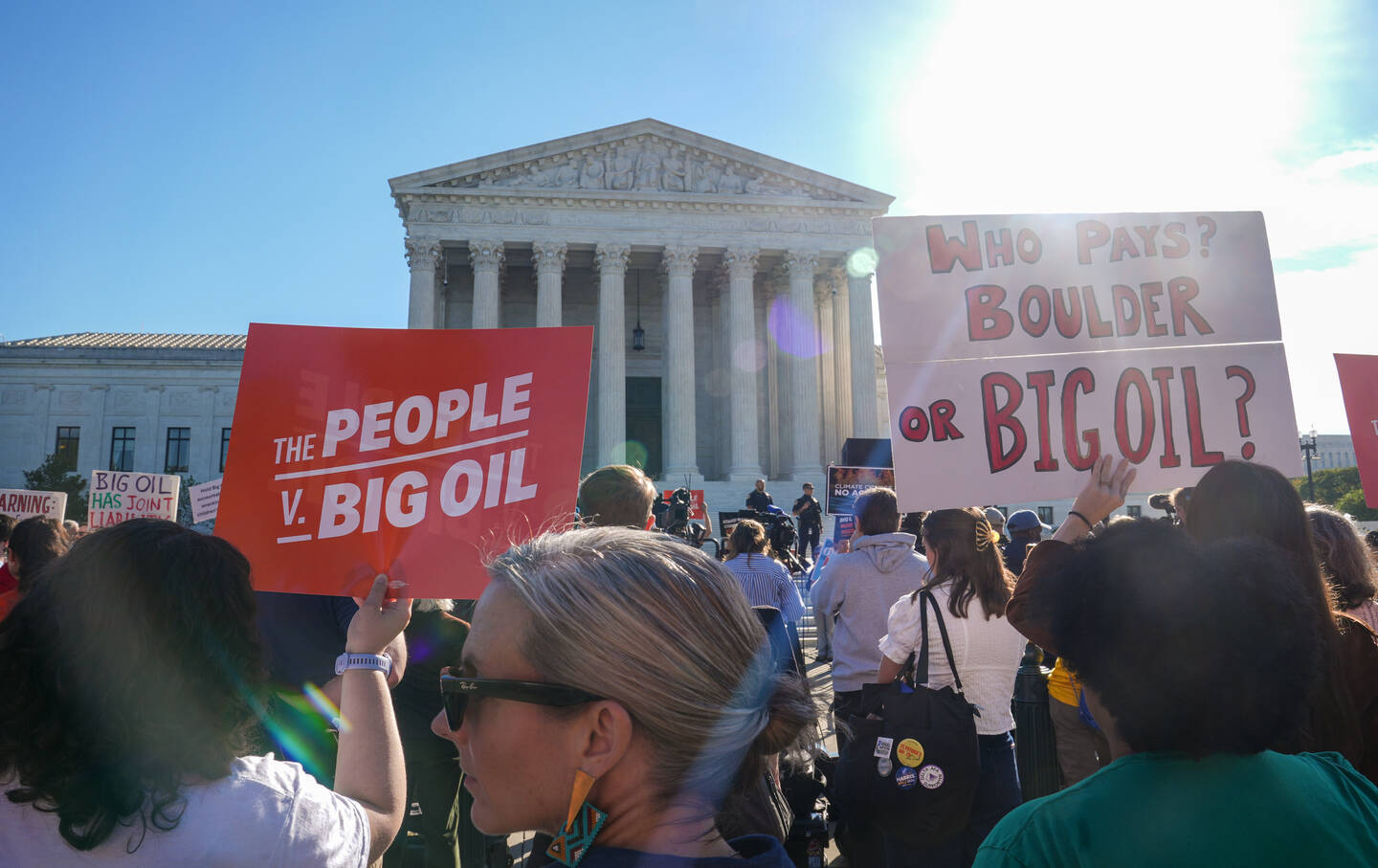
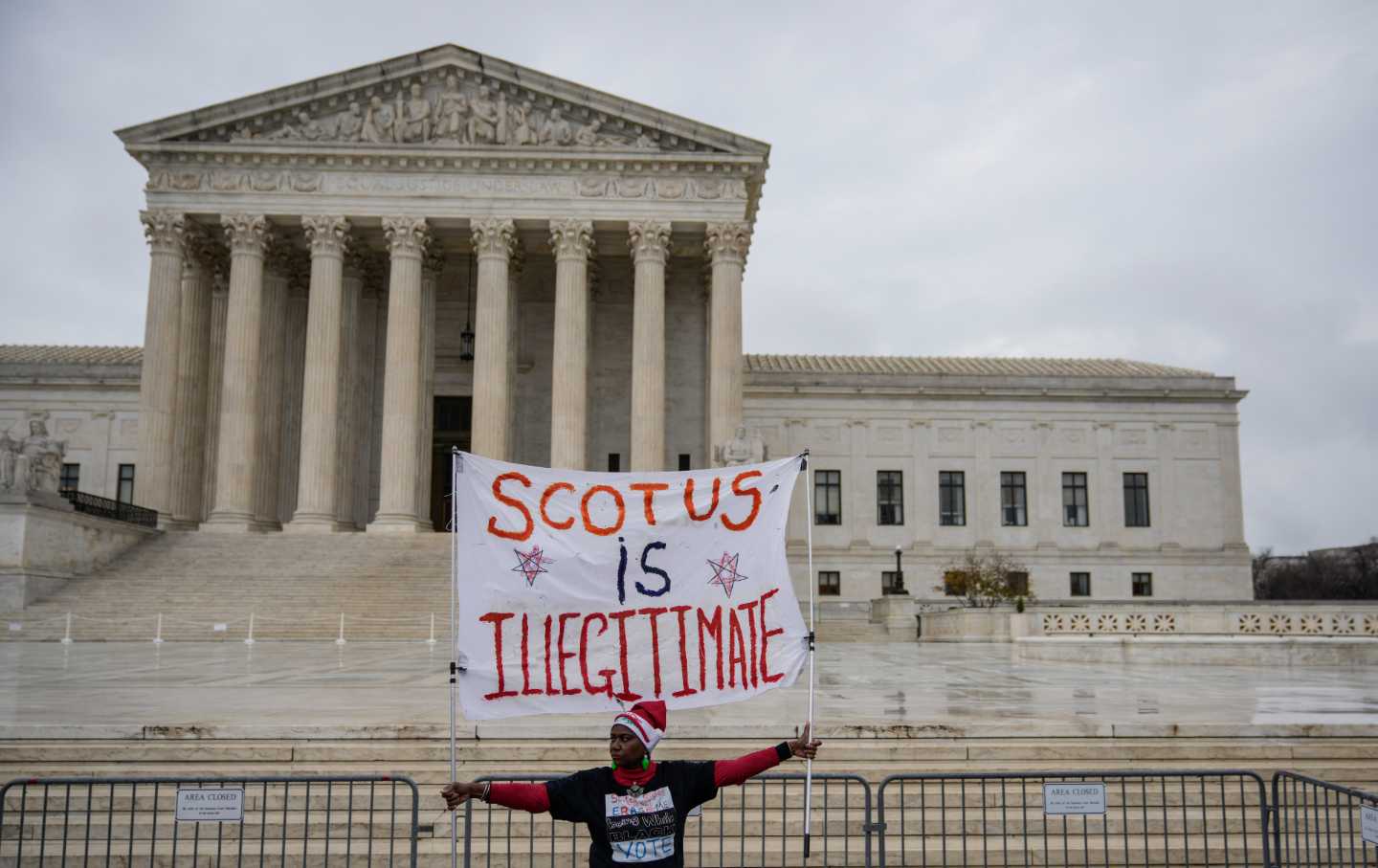
That’s why The Nation’s justice correspondent Elie Mystal thinks the Supreme Court should matter to everyone who cares about climate and environmental justice. The Court can block laws, limit the government’s ability to regulate polluters, and prevent communities from holding powerful companies accountable. In this episode of A People’s Climate, Shilpi Chhotray talks with Mystal about what happens when some of the biggest climate battles are being decided by a few unelected judges.
Mystal explains how the Supreme Court has changed, why its decisions have such far-reaching consequences for climate policy, and what recent cases like Loper Bright and Suncor Energy reveal about the stakes. He and Shilpi also discuss what can be done to change the Supreme Court, including stronger ethics rules, term limits, and expanding the number of justices.
Note: At the time of recording, Justice Samuel Alito had not recused himself from Suncor Energy v. Boulder County, which is discussed in this episode. On September 28, 2026, Alito recused himself from the case.
Key Topics
- The Supreme Court & climate: Why the Court has become such an important battleground over climate laws, environmental protections, and corporate accountability.
- The Shadow Docket: How the Supreme Court can block or change major climate policies through emergency rulings—without hearing full arguments or explanations.
- Loper Bright & the EPA: What overturning Chevron deference means for regulating polluters and protecting the environment.
- Fossil fuel accountability: What the Suncor Energy case could mean for efforts to hold oil and gas companies responsible for climate-related harms.
- Supreme Court ethics: Questions around conflicts of interest, financial ties, recusals, and the lack of a binding ethics code for the justices.
- Reforming the Court: What could be done to change the Supreme Court, including term limits, stronger ethics rules, and adding more justices.
- Climate & political power: Why understanding the courts is essential to understanding where climate policy gets made—and where it can be blocked.
Resources
- Bad Law: Ten Popular Laws That Are Ruining America by Elie Mystal
- Allow Me to Retort: A Black Guy's Guide to the Constitution by Elie Mystal
- Contempt of Court podcast hosted by Elie Mystal
- The Inside Story of Five Days That Remade the Supreme Court
Credits
Presented by Counterstream Media and The Nation
Powered by Wildseeds Fund
Host: Shilpi Chhotray
Executive Producer: Mindy Ramaker
Engineer: Dennis Maxwell
Project Manager: Asia Simms
Elie Mystal
Elie Mystal is The Nation's justice correspondent and a columnist; host of its legal podcast,Contempt of Court; and author of the weekly newsletter “Elie v. U.S.” He is also an Alfred Knobler Fellow at Type Media Center and the author of the New York Times best-sellers Allow Me to Retort: A Black Guy's Guide to the Constitution and Bad Law: 10 Popular Laws That Are Ruining America.
Advertising Inquiries: https://redcircle.com/brands
Privacy & Opt-Out: https://redcircle.com/privacy
Search Results placeholder
CLIP [00:00:03] A massive explosion at one of America’s largest oil refineries, the Valero refinery went up in flames in Port Arthur.
CLIP [00:00:10] It was scary for many with the fire raging into the wee hours of this morning. Roads closed and a shelter in place, keeping residents indoors wondering what was happening.
CLIP [00:00:24] The expansion of petrochemicals in Texas is putting the state’s most vulnerable neighborhoods at risk.
CLIP [00:00:31] This area in downtown Port Arthur used to be a place of hustle, bustle business and industry. Right there used to the Fair Store, the Harper’s Store, but all that’s gone now. But instead, we’re stuck. Stuck with this polluting, foul-smelling stench that’s here every single day of the year. Enough is enough.
Shilpi Chhotray [00:01:05] Today’s guest takes us into the belly of the beast. Joining us from Port Arthur, Texas is John Beard, Jr. He’s a former refinery worker turned organizer. And for decades, he’s worked inside the very industry that’s transformed his hometown into one of the nation’s largest hubs for oil refining and petrochemical production. John helps us understand what it’s like to live next to one of country’s largest sources of toxic emissions, and how the fight for climate justice starts at the fence line. Hi, John, welcome to A People’s Climate. I can’t think of a more timely conversation to be having than the one today. Thank you for being here.
John Beard Jr [00:01:48] Thank you, glad to be here, glad to be able to have this conversation. These are challenging times, but I’m of the belief that God gives his toughest battles to his strongest soldiers. So I ask us not to be fearful or cowled by what’s going on but to be smart, to be intelligent, follow your instincts and don’t back away from the fight.
Shilpi Chhotray [00:02:09] I love that. Well, let’s get into a moment where you’ve had to exercise a lot of these elements that you’re talking about. And that’s March 23rd of this year.
CLIP [00:02:18] Bright orange flames seen here raging at one of the largest oil refineries in the U.S.
CLIP [00:02:24] Huge explosion just happened in Valero. It just shook my whole truck.
CLIP [00:02:27] Thick black clouds of smoke filling the sky over Port Arthur, Texas. The thought that came to mind was someone may have dropped a bomb. That’s what it felt like as a massive inferno engulfed part of this Valero plant Monday night.
Shilpi Chhotray [00:02:41] This is the explosion at the Valero Energy Refinery in Port Arthur where you live. Describe what that explosion was like for you. I’d love to start there.
John Beard Jr [00:02:52] I hear this rumble, roar, and a boom, and my TV that’s on the flat screen that’s on the wall started dancing like it had legs. And I still recall the fact that looking at that wall, that wall shifted like a wave hit it. It was so strong, it shook the house and rumbled for so long that I got up, I could see both Valero and Motiva from that location, and I saw the fire and the plume going up in the air, so I grabbed my cell phone, grabbed my car keys, jumped in the car. Heck, I beat the emergency responders there because I live very, very close.
Shilpi Chhotray [00:03:28] So about 36,000 people, five schools, and over 20 churches are located within three miles of the Valero refinery. So a lot of people actually live very close to this. The official statement from Valero and the Texas Commission on Environmental Quality, also known as TCEQ, said there was no indicated threat to the surrounding community. But a state report found that this blast led to emissions, obviously. Above the state-permitted levels, including the release of more than 21,000 pounds of chemicals.
John Beard Jr [00:04:00] Their explanation from the information we’ve got doesn’t make sense. You know, the fire ended at nine hours later, started around 6:30 and ended around 3:30 that Wednesday morning. But elevated readings were coming from the facility and being measured by TCEQ itself over 200 hours later. That’s almost two weeks later. And then you’re going to have to restart, which is going to put more pollutants in air again. So you’ve got all of this to consider. It just wasn’t the explosion, fire. Oh, everything’s safe. All clear. Never works that way.
Shilpi Chhotray [00:04:34] A follow up question I have for you here is this explosion was framed as an accident.
John Beard Jr [00:04:39] These aren’t incidents or accidents. They don’t just happen. Oh, there was a fire. Oh, they had an explosion. How do you say accidents are what? Preventable. So if they’re preventable, there is a series of events that happened that led to that accident. But what we find is. Hazard analysis and mitigation is not something a lot of companies engage in unless they’re forced to. Now, when they got to pay several million dollars because they blew up a plant and killed four or five people, oh yeah, they’re going to make some changes. The government’s going to force them to in some cases.
Shilpi Chhotray [00:05:14] Mm-hmm
John Beard Jr [00:05:15] Now, right now, I don’t know with the current administration, but there have to be some changes because this is a repetitive pattern that endangers the lives and health of people. And you should not have to cause harm to someone in order to justify having your job or doing your business.
Shilpi Chhotray [00:05:34] I don’t want to understate your role here, John, because you are the number one expert out of Port Arthur. You were a refinery worker for 38 years. So you know the ins and outs of this industry. You know these chemicals like the back of your hand. I want to hear a little bit about your personal journey and what drew you into this work originally.
John Beard Jr [00:05:55] Well, I’m second generation petrochem worker. My dad worked, his first day’s work, as he always would point out to me, was just right across the way from where that fire and explosion happened. And he worked for the predecessor company of Valero Golf Wall for over 44 years and seven months. He knew it almost to the day and the hour. Born and raised looking at this, we lived about two and a half blocks from the fence line of Valerio, of what’s now the largest refinery in the country, which is Motiva. I grew up surrounded by this. That’s what Port Arthur is and is all about. And worked fortunate enough to get a job working in the plant for 38 years until 2017. But I always knew and understood what was happening. You have a white house and you might be outside enjoying the evening sea breeze and when it gets late decide to go in. You get up next morning and look at the side of your house where the prevailing wind came from and there’s this yellow stain or this line on it. Like something’s been released at night. You know, a lot of people say, well, how did you go from one thing to the other? Well, it’s real simple. When you know better, you do better. I learned a lot things about it, but then I began to see the discrepancy between what the companies said and what they did, not only in how they handled us as workers, but how they handle the public.
Shilpi Chhotray [00:07:11] Well, it’s really interesting that you’ve had this trajectory because your father- when you used to say, you know, talk about the foul smells – your father would say to you, ‘son, don’t turn up your nose at that smell, that’s the smell of money.’ I thought this quote was so fascinating. Do you agree with your dad in some ways?
John Beard Jr [00:07:30] I agree with him because when you look at where he came from and the type of work, you know, they were farmers and sharecroppers and worked in different areas that didn’t pay like this did. But these were jobs that they knew were going to stay, that would be there and they paid well. The companies did hire the locals back then, not that they do that today. So, you know, that’s why people came there. But today is your job should not interfere with someone else’s ability to live and breathe and be safe in their community.
Shilpi Chhotray [00:07:58] That’s right. And I want to paint a fuller picture for our listeners with some really important statistics out of Port Arthur. So the average Port Arthur resident makes about 29,000 a year compared to the average individual U.S. Income of around 50K. Nearly half of the people living in your neighborhood report living with poor health according to federal data. And this is the most startling to me is the risk for developing cancer caused by air pollution. Is essentially the highest in the country. This is one in every 53 residents. So it is pretty startling. The other piece I would like to share is the American Lung Association gave Jefferson County where Port Arthur is located an ‘F’ for ozone pollution in its 2025 State of the Air report card. I would to move to after your retirement, so the work you’ve been doing the last several years, what compelled you to go from working inside these facilities to organizing against them? Like, was there a light bulb moment?
John Beard Jr [00:08:59] I come from a family not of necessarily activists, but people who are involved in their community, but it never was one single thing. It was a series of numerous things over time, but I think it became more poignant to me when I got on city council and became active politically and it just began to seem like, for lack of a better way to say it, that something’s rocking in Denmark. That that, you know, as they say here in Southeast Texas, there’s a dead cat on the line. Something’s not right somewhere. ‘Oh, but don’t worry about it. Don’t worry. Look jobs. Oh, we got jobs.’ But we’re not getting the job, so where’s the benefit for us? But then you hear about all of the various petrochemical projects and expansions and all of this brought in and all of this and you’re giving up billions in tax abatement. We just recently had a study completed and it’s going to be startling when we release this to people to let them know what your elected officials and local government, city and county, are basically allowing industry to get away with not paying. In the billions. When you have a community that has so many needs and you talk about as the county judge here likes to say, over $80 billion in industrial expansion but you also have an area, Beaumont Port Arthur, that has some of the highest unemployment in the state. Now tell me how does that jive? How does that match? You know they tell, oh it’s jobs, oh they don’t have the training or they’re on drugs or people just don’t want to work. No, it’s no such thing as that. You know, and I think it’s just an extension based on it very closely parallels the 1954 desegregation decision case for the Supreme Court, Brown versus Topeka. That desegregated schools, now that was 1954.
Shilpi Chhotray [00:10:41] Sure.
John Beard Jr [00:10:42] Port Arthur school district did not come from under desegregation order, the consecutive order from the justice department until 2007.
Shilpi Chhotray [00:10:50] 2007, John? No!
John Beard Jr [00:10:53] Yes. I sat on the committee, the first task force that had to do a series of things in order to appeal to the court and say, ‘we don’t have these problems anymore, so take us from under this order.’ And they did. 1954 to 2007, they say the wheels of justice turn slow, but very fine. In Port Arthur’s case, they barely turn it off when you consider that sort of thing. Yeah, when we talk about change and stuff happening here, man, these timelines are extended way past what you think. You would think there would be immediate relief, but there’s not. Am I thinking there’s always a lot of foot dragging and stuff that goes on to maintain the status quo.
Shilpi Chhotray [00:11:39] Absolutely. Well, we’ve talked a lot about Port Arthur, and I want to talk about Texas more broadly speaking, because Texas accounts for 75% of the petrochemicals made in the United States. This is the feedstock for powering the world’s plastic addiction. It’s also responsible for more greenhouse gas emissions than Saudi Arabia or the entire global maritime industry. It is also the nation’s top emitter of the carcinogens benzene, ethylene oxide, and 1,3-butadiene, which are really really toxic chemicals. So despite all of this, despite all this information, over the next five years, 18 new facilities and 23 expansions are planned or already under construction. I’d be curious how many of these facilities are projected in your area in Port Arthur.
John Beard Jr [00:12:32] Well uh… You’re you’re exactly on point with that uh… 17 of them are in Port Arthur.
Shilpi Chhotray [00:12:39] No. Oof.
John Beard Jr [00:12:41] Of those 17, those 17 are also located within eight miles of my home. Eight miles. And so, yeah, there’s a high concentration there.
Shilpi Chhotray [00:12:53] Let’s name the players, right? Because I think it’s important to know that this continues to happen. It is happening, it’s scaling, but there are people and parties responsible. We know the chemical company, Valero, you know, these oil and gas facilities, but who are the politicians? Who are the government, both at the federal and regional level, that are responsible for this?
John Beard Jr [00:13:16] Well, you know, the governor does his part to try to do that. And now he’s trying to backtrack in some ways. But I tell people all the time, someone who has said Texas is open for business and my County commissioner, Jeff Brannick, who said that, you know, we’re going to be business friendly. As I told him that I hope you’re not going to be citizen adverse because being business friendly means you’re lining out the red carpet for them while holding us back saying, no, you stay back. Come on, business and industry. Y’all come. You know what what about us we live here you know he’s a he’s the same guy who’s home at ninety thousand dollars in damage from the TPC explosion in 2019 but yet when they asked him were they going to file any kind of charges against the company for what happened in all of that, ‘oh, no we’re not going to do that.’
Shilpi Chhotray [00:14:04] He’s drinking the Kool-Aid.
John Beard Jr [00:14:05] Yeah, so he is part and parcel of it and then you’ve got your local elected officials who simply don’t understand this. That they’re basically giving our money away and our communities are suffering. Port Arthur needs better streets and roads and infrastructure. Why would you give a company almost a billion dollars in tax abatement, which is money you should be getting almost to the tune of 100 million dollars a year that you just simply wrote off? And yet you had to go to the state and borrow 13 and a half million dollars just to fix water lines in your community.
Shilpi Chhotray [00:14:38] It’s staggering.
John Beard Jr [00:14:39] Tell me, when you need money, why are you giving away money?
Shilpi Chhotray [00:14:44] Absolutely. And I want to go back to Texas Commission on Environmental Quality, which we mentioned briefly before, because they have a lot to do with exactly what you’re talking about. So as their name suggests, they’re in practice supposed to regulate and limit pollution, but they have not denied a single permit for any new major source of air pollution in the last 25 years, not a single one. I’m like, why do you even exist? For me, it feels like they’re doing more harm than good. In fact, 90% of these new oil and gas projects in Texas are located in counties with higher concentrations of people of color.
John Beard Jr [00:15:21] They’re exactly right they’re an enabler they don’t build these places on Wall Street or in River Oaks in Houston or in Holland Park in communities of affluence and wealth. They build it in poor communities because as one of the captains of industry said it’s the path of least resistance
Shilpi Chhotray [00:15:38] How do these approvals of high-risk industrial expansion actually happen?
John Beard Jr [00:15:43] Well, because these guys always, just like on Capitol Hill and just like in Austin, they walk the halls and the lobbies. They call you up and say, hey, if you’re not busy, let’s go out and lunch and talk with you about a little project we’re thinking about. I’ve heard all of it. I’ve been approached by all of them, you know, in that way, on my time there. And you have to understand that they’re constantly looking at ways to make the process work for them. From suggesting the language in zoning rules, laws and ordinances to try to water those things down to even going and getting people basically paying them to change their vote. You have your same county judge who said that this was his last go round who decided, well, you know, I think about it now. I think I’m going to go for four more years. They know something’s coming that we don’t know. And that’s why they want to be around to be able to shepherd it through. But the fact is we have to stay more aware because when those kinds of changes happen, when people backtrack on what they said they’re going to do, but you have to ask yourself, hmm, why? Why and why now? And then when you hear about some project coming up, and how they’ve got their hands all in it, because they’re guiding the tax abatement and all of that. So the way to combat that has got to be a groundswell of support education from people and mobilizing the grassroots to stand up and make their voices heard and not only just say no, but hell no.
Shilpi Chhotray [00:17:28] We’ve done an amazing job of putting Port Arthur, not only on the national map, but global. And I want to get into the global piece here. We often think about foreign policy and global oil decisions as something that happens like over there, you know, in places like Venezuela or the Middle East. But in reality, those decisions have very real impacts on communities like yours. Of course, for our listeners, they know this well, but back in January the U.S. Military captured Venezuelan leader Nicolás Maduro in a surprise nighttime raid and vowed to tap all of these oil reserves. Can you explain as someone from Port Arthur how U.S. Policy towards Venezuelans oil ends up impacting health and daily life in your community?
John Beard Jr [00:18:18] Sure, it’s quite simple. The Venezuelan oil has a heavy, it’s a heavy oil. It has a high sulfur content. It’s sour. And Gulf Coast refineries are uniquely situated to handle that, especially Valero, because they have the necessary equipment to take or extract the sulfur from the oil, which makes it easier to process in their equipment. Basically, sulfur acts as a poison to the catalyst that is used to change the form of a fossil fuel from a low value product, such as crude oil, to a high value product such as gasoline, diesel fuel, jet fuel, and the like.
Shilpi Chhotray [00:18:57] And that’s where they do the conversion.
John Beard Jr [00:18:58] That’s right, and so by getting this oil, it’s so much cheaper.
Shilpi Chhotray [00:19:02] Well, it’s cheaper for the fossil fuel companies, but not for your community. You’re left dealing with the fallout from things like the Valero explosion while they just get richer.
John Beard Jr [00:19:11] Well the oil gas industry’s got a stranglehold on Congress and and even our local communities all the way from the city hall and the school board on with the State House to the White House. They’ve got a strangle hold. You have a president who’s taken away the tax breaks and incentives for renewables. So how you going to move forward? Yet renewables is taking a substantial part the energy is being produced in Texas to carry the load and the burden. When you want to incentivize something you want to grow, why would you cripple it by saying, well, let’s not do any at all? Because the oil and gas industry would exist without it, but not renewables. So it’s another way of trying to muddy the water and kill the potential to do that, because oil and gas wants to make as much money as they can, as fast as they can until they can’t any longer. And then meanwhile, we’ll be stuck.
Shilpi Chhotray [00:20:02] Right, and we’re already feeling the ramifications of that already.
John Beard Jr [00:20:06] Exactly.
Shilpi Chhotray [00:20:07] I think one thing I wanted to follow up with your points about the tax incentives and taking way those tax incentives, he’s actually doing much worse.
CLIP [00:20:18] In today’s Money Watch, the Trump administration is paying a French company $1 billion to walk away from two U.S. offshore wind leases. This is part of the White House’s campaign against renewable energy.
CLIP [00:20:32] And then last week, more than $900 million in additional payouts were made for two more projects, Blue Point Wind off of the coast of New York and New Jersey and Golden State Wind off the coast California. So between the last few months, there have been nearly $2 billion in these payments.
Shilpi Chhotray [00:20:50] So it’s a massive transfer of taxpayer dollars to private companies, which is just insane.
John Beard Jr [00:20:57] So it’s another form of corporate welfare, and it’s not corporate welfare that’s helpful to the everyday guy because it creates inflation. It’s inflationary. And it takes money away from projects and areas and things it can go into that can help strengthen and make our communities better and even make us more energy independent from oil and gas. So renewables are the way to go, but we’ve got to fight for that, whether it means regime change or just what. You know, I know of a lady who was paying over $400 a month in electrical bills she’s now paying just a little over $100 a month because she’s got solar panels and all of that renewables that she’s using.
Shilpi Chhotray [00:21:38] That’s substantial.
John Beard Jr [00:21:39] Yes it makes a difference because now you’re not dependent on that. You’re not dependent or what happens in the oil and gas markets pushing that cost up. You have that true freedom, but as I like to say there’s some people that don’t want you to be truly free. And that’s these oil and gas companies.
Shilpi Chhotray [00:21:55] It’s very true, and one of the things that I came across in my research on Texas politics right now that feels especially challenging is this Texas railroad commission race. But what I read was that both major candidates have deep ties to the oil and gas industry. For communities like yours that are already fighting pollution and just like entrenched corruption, it can feel like the political system is moving further away from accountability. So how do you keep people engaged when the choices on the ballot don’t seem to reflect their interests?
John Beard Jr [00:22:30] Well, you have to teach them how to keep their eye on the prize, because these culture wars and these things are merely distractions that use divisive politics in order to keep people not focused on the real issues. And some people are willing to make trade-offs because of those politics, but he’s against illegal immigration, so I’m going to support him because he’s talking my language. But he’s also talking the language of the very industry that’s oppressing you. With these high gas prices and causing inflation, making prices at the pump as well as at the supermarket higher for you. It’s increasing your cost of living while decreasing your quality of life. You’ve got to start developing and grooming and finding better candidates to run.
Shilpi Chhotray [00:23:15] Well, it kind of brings me to my next question, and then I just have one more after that, but what would it actually take to replace a system as massive as the extractive oil, gas, and petrochemicals sector, and in a way that protects workers and communities at the same time?
John Beard Jr [00:23:33] A just transition can happen, but in other countries, you can’t say we’re going to do it and just leave them stuck with the damage that came from it. You’ve got to have what I call restorative justice. If there’s going to be justice, it has to be restorative to restore them. And it comes, it’s a biblical thing. It comes from the Bible that if I damage or hurt or harm you, I have to pay back double to you what I’ve damaged. So we’ve got a find a way to have a just transition. But killing the beasts is not going to be easy but the beast is in his death thrones and that’s why I preach. The more we can accelerate that energy transition and make it more reliable it’ll happen.
Shilpi Chhotray [00:24:13] Yes.
John Beard Jr [00:24:14] When they started having uh… Are you say uh… Got rid of horses and buggies when they had that you know had the carriages then cars started coming but the guys who shoed horses became mechanics and work on cars and change tires. Then they began to have service stations which created the need for the oil and gas and lubricants and so forth. So there’s always some things that have to be done. So we’ve got to understand these things and make the transition, but what I caution people about always is that the geniuses that got us into this mess aren’t the same geniuses that can get you out.
Shilpi Chhotray [00:24:48] 100%.
John Beard Jr [00:24:49] I love what happened in Santa Marta. They said that the oil and gas industry did not have a seat at this table. And I think that’s right, because they’ve been nothing but obstructionists, having been to the plastics conference and been to all these conferences and all of that and these meetings. They have been truly obstructionists. That’s why we didn’t get a plastics treaty this past August. You’ve got to do it without them, because the same people that got you in this mess ain’t going to be the ones to get you out. If they were that smart, they never would have got us in the mess.
Shilpi Chhotray [00:25:19] It’s so true. It would literally be like inviting Marlboro execs to a health conference. Like, I don’t think people understand that. They don’t need a seat at the table.
John Beard Jr [00:25:28] No, it is it is truly as we say in the South and in Texas, putting the fox in charge of the hen house. Don’t be surprised if you don’t have eggs or chickens before sitting down.
Shilpi Chhotray [00:25:38] Or a hen house, they’ll burn that down too.
John Beard Jr [00:25:40] Yep, they sure will. They will definitely do that as opposed to losing it. They would rather burn it down So this is going to take a unified effort. It’s gonna take a groundswell from people and as I always like to say they may have billions of dollars, maybe even trillions of dollars, but there are eight point one billion of us. We have to push back because silence is consent. If you stay silent if you don’t speak who will? But your speaking out may encourage someone else to speak out, may encourage someone else to stand up and say no, and pretty soon everyone else does. But you have to take that step. Every one of us does. And we can’t allow our friends, there’s a saying too, friends don’t let friends not vote. We got to get better about that too. You got friends, and I know we don’t like to get involved and get argumentative, but man, too much is at stake right now.
Shilpi Chhotray [00:26:31] Agreed.
John Beard Jr [00:26:32] And there’s too much rhetoric out there that is absolutely crazy for us to sit back and say, ‘well, I’m just going to take care of me.’ You know, there may be other ways that you can do this, but you can’t sit on the sidelines. This is no time to do that
Shilpi Chhotray [00:26:48] One last question for you here is, what do you want people who have never been to Port Arthur to finally understand?
John Beard Jr [00:26:55] Well, what I’d like to say to the listeners is that Port Arthur is unique. It’s a wonderful and great place, but it has suffered from the indignity of over 125 years of petrochemical expansion and pollution. And that’s all up and down the Gulf Coast of Texas and Louisiana. And then when you look at the expansion to do more, you begin to wonder, what What are we doing all of this for, especially? The toll it’s taking on people that actually live there, people of color most largely.
Shilpi Chhotray [00:27:26] Exactly.
John Beard Jr [00:27:26] And so we’re unique, but at the same time we’re not unique. We share a lot with our friends in Freeport and Brazoria, in Taft and Corpus Christi, Texas, in Brownsville. Our friends in the bayou country of Louisiana and in the cancer alley corridor between Baton Rouge and New Orleans, St. James, St. John, and all of those parishes. Because why should we have to suffer and die for someone else to have a job and live or become rich and wealthy and be billionaires? I don’t think it’s worth it. I don’t think a man should be able to sleep at night knowing that what he’s doing, regardless of the benefit he think he’s giving to people with oil and gas or whatever, that you’re also killing people too. What are you going to do about that, sir, Mr. Billionaire? What are gonna do about it? So I want people to understand that. That this is what we’re fighting for. We’re not fighting the companies per se, or against other people, we’re fighting for our lives and your lives. That’s what you have to understand this is about life, and this extractive industry is not a giver of life, it is a take of life. It is the take of land and resources from beneath your own feet.
Shilpi Chhotray [00:28:39] That’s right.
John Beard Jr [00:28:40] And so we’re in a very challenging time but it’s a great time to be alive because now you got something to fight for. Now you’ve got something stand up for and to take a position on and we’re not going to stop until that battle is won. Until all of us can be free from the scourge of fossil fuel pollution and what it brings and this extractive industry that creates it all and this beast that is wrapped the whole world up in it.
Shilpi Chhotray [00:29:05] I mean, thank you so much for your courage and sharing the truth with us about what’s happening in Port Arthur and beyond, I mean with all these global interconnections, but for making sure that what your community is going through doesn’t stay invisible. I really, really appreciate your dedication to this fight.
John Beard Jr [00:29:22] Thank you all very much. Have a great day and an even better weekend. Weekend’s just around the corner.
Shilpi Chhotray [00:29:31] For generations, fence line communities have lived with the pollution that fuels our economy and our everyday lives. John’s powerful organizing demands a transition away from fossil fuels while also asking who gets protected and who gets left behind. To learn more about John’s work and the groups fighting for climate justice along the Texas Gulf Coast, check out our show notes. Thank you to Wildseeds Fund for making this podcast possible. This episode of A People’s Climate is executive produced by Mindy Ramaker, with engineering and sound design by Ameeta Ganatra, theme music by Khafre Jay, additional research by Asia Simms. Recorded at Studio 132 in Oakland, California. From Counterstream Media and The Nation, I’m your host, Shilpi Chhotray. Until next time.