Freezing ICE Funding in the Senate, plus Standing Together in Israel and Palestine
Leah Greenberg of Indivisible talks about how to rein in ICE, and Sally Abed explains how Palestinians and Israeli Jews are Standing Together for peace and equality.

The Nation Podcasts
Here's where to find podcasts from The Nation. Political talk without the boring parts, featuring the writers, activists and artists who shape the news, from a progressive perspective.
Freezing ICE Funding in the Senate, plus Standing Together in Israel and Palestine / Start Making Sense
We have the power to rein in ICE and protect our neighbors, Leah Greenberg argues – she’s co-founder and co-executive director of Indivisible, the group that organized No Kings 2 last October, the largest demonstration in American history. The key right now, she says, is for Senate Democrats to refuse to fund Homeland Security in this week’s budget vote, unless Republicans agree to put meaningful restrictions on that lawless agency.
Also: The group Standing Together says it is still possible for Israelis and Palestinians to live side by side with full equality and justice for everyone. The are the largest Jewish-Arab grassroots movement in Israel, working to create an alternative to the existing reality by building political power. Sally Abed explains — she’s a Palestinian citizen of Israel, a leader of Standing Together, and she was elected to the Haifa city council in February 2024,
Advertising Inquiries: https://redcircle.com/brands
Privacy & Opt-Out: https://redcircle.com/privacy
U.S. Customs and Border Protection (CBP) Commissioner Gregory Bovino with his security team while a group of citizens protested him.
(Photo by Lokman Vural Elibol/Anadolu via Getty Images)On this episode of Start Making Sense, Leah Greenberg of Indivisible talks about how to rein in ICE, and Sally Abed explains how Palestinians and Israeli Jews are Standing Together for peace and equality.
We have the power to rein in ICE and protect our neighbors, Leah Greenberg argues – she’s co-founder and co-executive director of Indivisible, the group that organized No Kings 2 last October, the largest demonstration in American history. The key right now, she says, is for Senate Democrats to refuse to fund Homeland Security in this week’s budget vote, unless Republicans agree to put meaningful restrictions on that lawless agency.
Also: The group Standing Together says it is still possible for Israelis and Palestinians to live side by side with full equality and justice for everyone. The are the largest Jewish-Arab grassroots movement in Israel, working to create an alternative to the existing reality by building political power. Sally Abed explains — she’s a Palestinian citizen of Israel, a leader of Standing Together, and she was elected to the Haifa city council in February 2024.
Subscribe to The Nation to support all of our podcasts: thenation.com/podcastsubscribe.
The Nation Podcasts
Here's where to find podcasts from The Nation. Political talk without the boring parts, featuring the writers, activists and artists who shape the news, from a progressive perspective.
The Amazing Movement Against Data Centers, plus How to be a Dissident / Start Making Sense
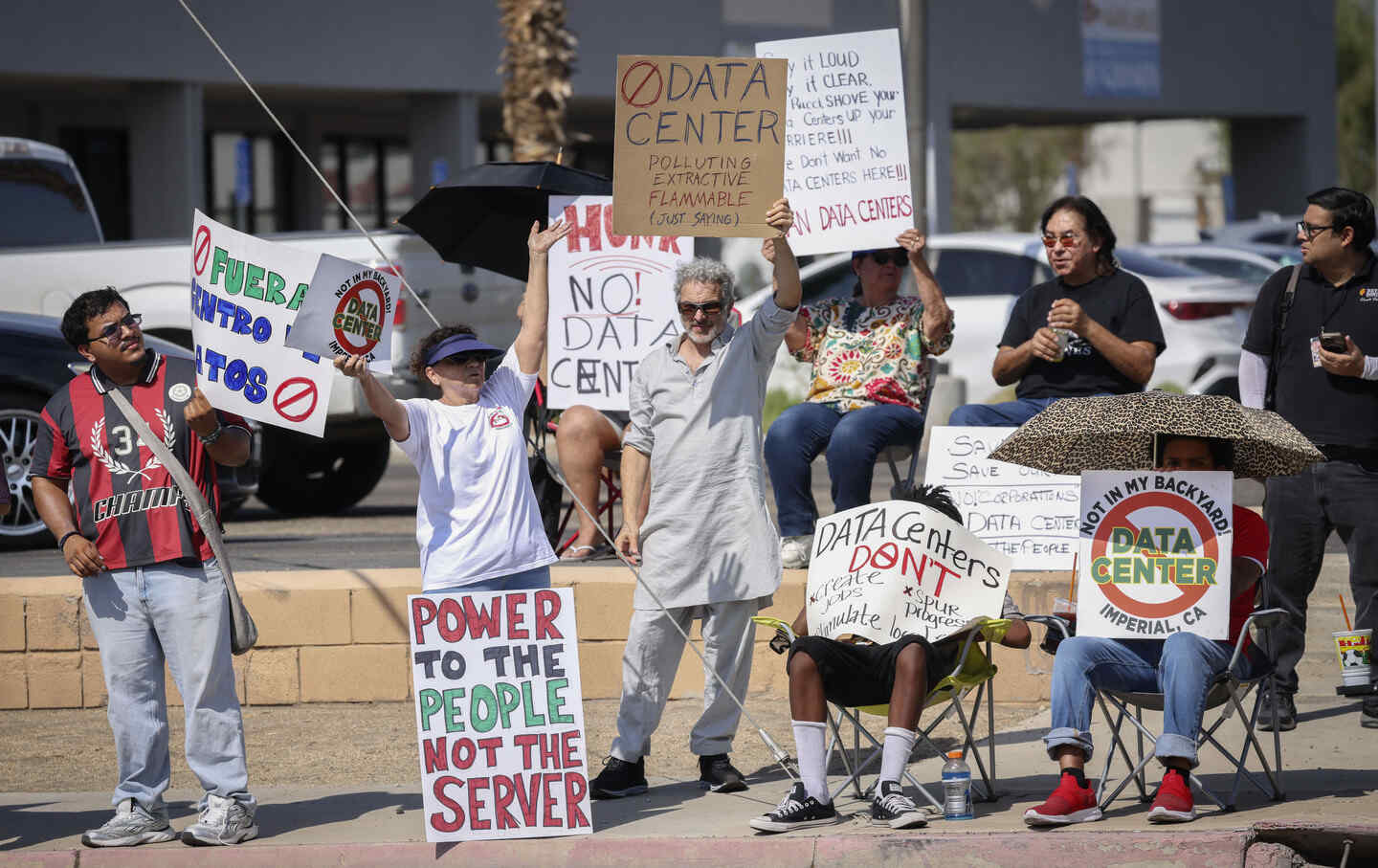
Is the resistance to data centers a new kind of mass politics? David Wallace-Wells explains why the answer is “yes.” He’s a writer for The New York Times Opinion pages and author of the unforgettable book “The Uninhabitable Earth.”
Also: How to be a dissident in an age of fear – Ami Fields-Meyer has thought a lot about that. For starters: don’t start from scratch; don’t try to do it alone. Ami is co-author of the new book “On Courage.”
Advertising Inquiries: https://redcircle.com/brands
Privacy & Opt-Out: https://redcircle.com/privacy
Search Results placeholder
Jon Wiener: From The Nation magazine, this is Start Making Sense. I’m Jon Wiener. Later in the hour: The group Standing Together says it is still possible for Israelis and Palestinians to live side by side with full equality and justice for everyone. They are the largest Jewish-Arab grassroots movement in Israel. Sally Abed has our analysis — she’s a Palestinian citizen of Israel and she was elected to the Haifa city council in February 2024. But first: We have the power to rein in ICE. Leah Greenberg of the group Indivisible will explain — in a minute.
[BREAK]
JW: ICE is killing people in the streets of Minneapolis, kidnapping children, and trampling our rights. What is to be done? For that, we turn to Leah Greenberg. She’s co-founder and co-executive director of the Indivisible Project, that grassroots movement of thousands of local Indivisible groups working to elect progressive leaders, rebuild our democracy and defeat the Trump agenda. Last time we talked here was right before the second No King’s Day in October. That was when 7 million people came out, maybe the biggest demonstration in American history, organized by Indivisible and its allies. And Leah is now co-host of a new weekly podcast, “What’s the Plan?” It’s about the actions we can take right now that have the most impact. The first episode goes live this Friday, January 30th, on all platforms. Leah Greenberg, welcome back.
Leah Greenberg: Great to be here. Thanks for having me.
JW: The Senate is voting this week on funding for Trump’s Department of Homeland Security, which includes ICE and the Border Patrol. Indivisible has been working overtime on getting the Democrats to act. What kind of leverage do the Democrats have at this point in passing a funding bill in the Senate — and what are you proposing they do with it?
LG: Well, look, the basic outline here is that the Senate is trying to finish off a full federal government funding package. This is one of several different bills that are under consideration. It’s the only one that there is a dispute or contention around. And so what we’re asking Senate Democrats to do is not provide votes to allow this to move forward to passage at either the actual formal vote stage or at the closure stage. Our basic asks are pretty simple and we’ve seen a variety of different ways that these are manifesting. But the simple answer is there’s absolutely no reason that Senate Democrats should be allowing ICE or CBP to get more money while they are invading an American city, while they are attacking people’s basic rights and freedoms and while they’re continuing their reign of terror.
Now there are more specific asks. We need an independent investigation into the killing of Renee Good and now the killing of Alex Pretti. We need to have CBP back to the border and ICE out of our cities. We need to have an end to warrantless actions. These asks I think are very important. But the big imperative right now for us is simply to keep the heat on Senate Democrats and make sure they understand that it is totally unacceptable to pass a funding package that moves more money to these folks while they’re out of control and harming people across the country.
JW: I want to underline that we are not alone. We’re actually part of the majority on this. If you look at the polling, despite the unrelenting propaganda and the incredible lies from the White House, remember they said the people ICE murdered in Minneapolis were “domestic terrorists.” The Trump regime has lost the argument with the American people. If you just look at the polls, they asked last week, “do you approve or disapprove of ICE?” Simple enough question. The New York Times poll — kind of the gold standard – found 63% disapprove, 36% approve. And that was before ICE shot and killed Alex Pretti, that nurse in the intensive care unit at the VA hospital in Minneapolis.
Even “Abolish ICE” is no longer a fringe position. A plurality of the public now supports abolishing ICE. It’s up 12 points with independents in the latest Economist/YouGov poll. And even among Republicans, 20% of Republicans favor abolishing ICE. This is not putting guardrails on their actions, not requiring more training. This is abolishing ICE.
So what Indivisible and its allies are fighting for this week in the Senate is pretty darn popular in America right now.
LG: That’s right, and I think it’s important to be clear that we’re fighting an uphill battle, not with American public opinion, which is with us, but with the received conventional wisdom of Democrats in Washington, all this time. It’s been incredibly challenging because there is this perception across a broad swath of Democratic leadership that immigration is a loser issue and you should just stay as far as you possibly can away from anything that’s associated with immigration. We saw this playing out earlier this year when the Trump administration sent a large number of innocent men to El Salvador. Chris Van Holland very courageously went there, and in doing so, really successfully elevated the issue in order to force the release of Kilmore Abrego Garcia. That was not a collectively popular position within the Democratic caucus because there’s a very large faction that no matter how the polling is shaking out, simply does not want to elevate anything on immigration because they have this perception that that’s going to be a problem for Democrats. So we’ve been pushing uphill, not because we don’t actually have lots of public support, but because we actually need elected officials to understand that the ground is changing underneath their feet incredibly fast.
JW: Another sign of how fast the ground is changing: The Wall Street Journal editorial page usually does not agree with us on many important issues. They declared on Saturday, “The Saturday shooting of Alex Pretti as he lay on the ground surrounded by ICE agent is the worst incident to date in what is becoming a moral and political debacle for the Trump presidency. The Trump administration spin on this simply is not believable.” — Wall Street Journal editorial.
LG: Yeah, a lot of Americans, even folks that we mostly think of as being within the Trump coalition, do not like extra-judicial murders in the streets. And I think it’s really important for us to also take this moment and make the connections to the overarching reign of terror that has been happening this entire time, because we have now seen twice in the last month ICE murder a white person who is a bystander in their campaign for mass deportations in Minneapolis. We also know that there are dozens and dozens of unaccounted for, unexplained deaths in ICE facilities, for lack of medical care, because of abuse. Some of those where we have more information, there have been determined homicides. We know that this is how they are behaving when they are on film in interacting with American citizens. And we also know that there’s an enormous amount of absolute horror and the ways that they’re behaving when the cameras are off, inside of their own facilities, towards people who are in their custody.
JW: The House voted to pass the DHS funding a couple of weeks ago, and there were seven Democrats who voted with Republicans. And I wondered what reason could any Democrat have for voting in favor of funding Homeland Security and ICE? One I’ve always been interested in is Marie Gluesenkamp Perez. She’s this member of Congress from Western Washington state, a Democrat who won in a kind of purple district. She was one who voted for funding ICE, and she issued a statement about why, and I like to get your response to her explanation:
“When fishermen in Pacific County, Washington get in trouble out on the water, the Coast Guard makes sure they’re safe. When there’s flooding or landslides in southwest Washington, FEMA helps our families get back on their feet. Both of these are part of the Department of Homeland Security, which is extremely important to my community. I could not in good conscience vote to shut it down. In a DHS shutdown. ICE would continue operating with limited oversight, thanks to funding in the One Big Beautiful bill, which I voted against. Meanwhile, agencies like the Coast Guard or FEMA would take the hit.” – Marie Gluesenkamp Perez. So the bill that you and I are arguing should be voted ‘no’ on, that bill won’t stop ICE, she says, but it will stop the Coast Guard and FEMA. What do we say to that?
LG: Well, I think we’ve got to be real that there’s some hard limits on what we can do to successfully rein in ICE in this immediate period with the powers we have. And that’s because of a combination of things. First, it is true that an enormous amount of money, just unfathomable sums, went to ICE and CBP during the one big beautiful bill or when the one big beautiful bill was passed. It’s also true that we’ve got a wildly lawless federal government that has regularly declined to be reined in by normal respect for the norms and rules of law. And so there is fighting for protections in the upcoming bill, and then there will ultimately certainly be the fight to force them to actually abide by those protections if we get them. So I want to be realistic about the fact that there is no one magical ‘push this button and ICE stops being a terror’ available to us right now.
And also I think we need to understand this moment as a broad referendum on “are we going to have a secret police that operates without accountability in this country at the behest of the Trump administration, or not? Is it okay to murder people in the streets or not?” That is fundamentally the question. And if your take is, “it is more important for me to avoid any kind of potential disruption than it is to take a stand and say we can’t have people murdered in broad daylight on American streets”–that is a stance that you can take, but I don’t think it’s one that history is going to look down on well.
And indeed we’re already seeing enormous pushback to the seven who took that vote. Tom Suozzi, who was one of the other seven, issued an apology earlier today noting that he didn’t understand how much it was going to be viewed as a referendum overall on the behavior of ICE. He is someone who has been enthusiastically on the record in as many forms as he possibly can over the last year and a half about how important it’s for Democrats to be “tough on immigration.” And so the fact that he’s out there recognizing that he needs to take a step back and apologize indicates the ground is changing very fast.
JW: And meanwhile, back in Minneapolis, the CEOs of 60 Minnesota corporations issued a joint statement. This includes the biggest” Target, 3M, UnitedHealth, Best Buy, US Bank Corp. Together they called for “an immediate deescalation of tensions” and for “state, local and federal officials to work together to find real solutions.” I wonder if you have any comment on working together with ICE?
LG: Yeah, I think this is part of an overarching theme that we’ve seen over the last year plus of the Trump administration in which corporate actors are profiles in cowardice. I think that there’s not another way to put this. This is a statement by people who understand that something has gone terribly wrong and are terrified of expending any of their own capital to actually name ICE or to call for any kind of solution that would actually make a difference. And so I think the fact that they put it out at all is a sign that they are quite freaked out. And also it is so far from an act of leadership, it is so far from what we should be able to expect from corporations who are major employers throughout Minneapolis, whose employees are themselves being abducted in some cases by ICE. They are very sincerely, they’re continuing the overarching theme that we’ve seen all year, of corporations being utterly complicit in Trump’s reign.
JW: It may be hard to imagine that Trump would throw in the towel in Minneapolis, but let’s not forget that in Los Angeles and in Chicago, eventually he pulled out the majority of the federal forces that were in those cities — because the resistance was so massive, so committed and so persistent. I can easily imagine that happening in Minnesota in the next week.
LG: I think we’re already seeing signs that Trump is panicking, flailing, and trying to recalibrate. I think it’s pretty clear they understand they’ve lost control of the story that they’re already moving to take some steps around redeploying. Tom Homan, who even nobody in this story is anything less than an absolutely vile human, but who is generally associated more with the career folks and less with the theatrics of the Noem and the Bovino faction within the administration. What I think is really important for us to do here is hold two things. If they do pull back in any way, hold two things. The first is that this is an extraordinary victory that is led and driven by regular people who came out and put themselves at enormous risk to protect their neighbors. It is a historic and powerful moment, and everyone who was part of it in Minneapolis should feel like they were part of history because they were.
This is an extraordinary tide-turning event and a demonstration of the power of mass defiance to say ‘no’ to fascism and to beat it back. That is true. The other is that what we’ve seen in other cities where there’s been a large scale incursion is that a lot of times they decide that the coverage is getting too hot, so they pull back on the theatrics, but they continue to maintain the basic capacity to do a reign-of-terror style operation within the city. And so I think it’s really important that even if we do see an announcement that says, oh, this is pulling out or this is happening, that we really be attuned to the conditions on the ground and to what folks are seeing, because most likely what they’re going to try and do is take the heat off while continuing to try to snatch people off the streets, out of their jobs, out of their workplaces, and maintain the incredibly terrifying conditions that they have been subjecting Minnesotans to over the last month.
JW: One last thing: Carleton College. You and your husband are graduates of Carleton College in Northfield, Minnesota. Carlton was locked down on Sunday because ICE came to the campus. Carlton does have a substantial international population, and the school’s lockdown process and their policy around this is clear. They’re very straightforward: ICE will not enter any campus building at Carleton. I know it’s been a while since you were there, but congratulations to Carleton.
LG: Look, I mean, congratulations to the state of Minnesota, having spent a few years there in college. I will say I am proud and I am not surprised at all because it’s a state with an extraordinary history of being deeply committed to welcoming refugees, to valuing diversity, to pushing for justice and to social democracy and to creating conditions in which people can collectively thrive. And so I think there was a extraordinarily cynical decision to go in there in order to further demonize the Somali community of Minnesota in order to try to fracture white people against people of color within Minnesota. And I think what you’ve seen is a pretty profound rejection of those politics, of divide and conquer, and a demonstration of what’s possible with mass solidarity.
JW: Last thing: what are the political tasks that we should all be carrying out this week?
LG: First and foremost, call your senators. The vote that we are expecting to happen here is going to be somewhere between Wednesday and Thursday on cloture. We need to make sure that the heat is on every Senator, Republican, or Democratic. But I want to underscore we can stop this if the Democratic caucus stays united. So far, Chuck Schumer has said Democrats will not provide the votes to move the DHS funding bill forward. We need to make sure that nobody gets wobbly on that commitment. We need to collectively keep their spines firmed up over the next few days because we know that as you get closer to a deadline like this, people start to get pretty nervous. They need to be more nervous about the waves of callers who are contacting them than they are about the other forms of pressure.
JW: Leah Greenberg, she’s one of our heroes, and there’s more information about what you can do @indivisible.org. Leah, thanks for talking with us today.
LG: Thank you. Pleasure.
JW: And we have one bit of news here: The Nation Magazine is nominating the people of Minneapolis for the Nobel Peace Prize. In our nomination, the editors write, “through countless acts of courage and solidarity, the people of Minneapolis have challenged the cultures of fear, hate, and brutality that has gripped the United States and too many other countries. That nonviolent resistance has captured the imagination of the nation and the world. The people of Minneapolis and their elected leaders have demonstrated an extraordinary and sustained commitment to human dignity and to the protection of vulnerable communities. They have exemplified the desire for democracy and equality and the celebration of difference. The moral leadership of the people in city of Minneapolis has set an example for those struggling against fascism everywhere on this troubled planet. And this, we believe, merits recognition through the award of the Nobel Peace Prize.” — Part of what The Nation’s editors wrote in nominating the city and people of Minneapolis for the Nobel Peace Prize.
[BREAK]
JW: Can anybody change Israel? Is it possible? Or is it too far gone? The group Standing Together says It is still possible for Israelis and Palestinians to live side by side, with full equality and justice for everyone. Standing Together is the largest Jewish Arab grassroots movement in Israel. It’s committed to creating an alternative to the existing reality by building political power. For an update on the work of Standing Together, we turn to Sally Abed. She’s one of the leaders. She’s a Palestinian citizen of Israel. She was elected to the Haifa City Council in February, 2024, the first Palestinian woman ever to lead a joint electoral slate in Israel. She also co-hosts the biweekly podcast, “The long answer.” Last time we spoke was in 2024. We reached her today in Haifa. Sally Abed, welcome back.
SA: Thank you for having me, Jon. Great to be back.
JW: The current sociopolitical reality in Israel and in Gaza is described by Standing Together as “unbearable.” But you also say, “we find cause for hope.” What gives you cause for hope?
SA: It’s a very interesting, perhaps important exercise to start with hope, because really hope means insisting on finding the political imagination, but also our belief in our collective ability to change our reality. And hope is never naive, it’s never free of a lot of pain and a lot of grief and a lot of fear about our future.
I did become a mother a year ago–
JW: Congratulations.
SA: Thank you. It is just easier for me to speak about hope from that small scope, which just became my entire world all of a sudden. But it’s just so much clearer to me that this place is my homeland. We deserve to live here, freely and in prosperity and safely. But what gives me even more hope is not just that we deserve, that every person deserves, that is what people desire, that people have the interest to live freely, safely, and in prosperity. When you know that people desire that, when you know that people actually seek that, then you understand that any collective that is not working towards that or is that is not demanding that in the way that you see it, it means that they just simply don’t have the option — because of the oppressive, systemic, oppressive systems of occupation, of apartheid, of discrimination, but also of a captivated collective.
I think of the Jewish Israeli collective that at the moment literally no one is telling them it’s an option, that peace is an option, that freedom for all is security for all. Equality for all is security for all and a future for all. Once you understand that the mission is to provide that option for the public, as a real, viable, attainable option, then people will choose it. And that’s what gives me hope.
JW: Standing Together had an incredible year. Last year, the most dramatic thing Standing Together organized were these mass rallies in the streets demanding an end to the killing and destruction in Gaza. How big were the big ones and what were they like?
SA: I mean, the biggest mobilizations were, if you really took cumulative numbers of people on the streets, every week, it would be hundreds of thousands, if not even millions at peak moments before the hostage deal and the so-called ceasefire, which unfortunately we know hasn’t been really ceased.
And the peak mobilizations weren’t the whole story. I think one of the largest unsung successes and achievements of the movement is being able to absorb so much of that energy into a more sustainable infrastructure. And today you don’t see those mass mobilizations in Israeli society, in Jewish Israeli society within the liberal camp.
However, you are seeing an amazing, incredible historic mobilization of Palestinians in Israel around organized crime and violence. Just last week, there was a nearly a hundred thousand people in Sakhnin calling out the police for under-policing, and it is really a very acute problem within Palestinian society. And the reason why I’m saying this is because we were able to be part of that, to lead that as Jewish Arab solidarity move into these, into and the south and Nazareth. Exactly, because we were able to effectively absorb sustainable structures of solidarity, of communities, of people who are, even when you don’t have these high mass mobilizations, we are still extremely reactive and extremely responsive to our reality on the ground.
JW: I want to underline the issue that you’re now working around, organized crime in Palestinian communities in Israel — The issue here is that that is tolerated, maybe even encouraged by the Israeli government. Why exactly is this an issue for Standing Together?
SA: One, as I said before, we do see it as yet another form of oppression against Palestinians. But also we believe this is not the problem only of the Palestinians in Israel. This is a problem of the Israeli society. Everyone has to take part of this. Everyone is impacted by this. The minute the police normalize losing sovereignty over violence in a certain sector, certain entire cities in Israel, hundreds of thousands of illegal arms and illegal money solicitation — and once you normalize that, you know that it’s going to go over to other places and it’s going to do much more harm in many other places. And it is an issue of Jewish solidarity, but also of a joint struggle for safety for all.
JW: Another area where Standing Together has been very active recently is providing what you call a “protective presence” in Palestinian communities, especially in the occupied West Bank. What exactly does that mean? How many people have been involved in this, and what exactly did they do?
SA: Protective presence in the West Bank, which is basically people — either Israelis, usually foreigners, for years, for decades — have been accompanying communities that are facing settler violence and ethnic cleansing in the West Bank. And I think what Standing Together has been attempting to do is, first of all, to give the issue of settler violence and settler terrorism more presence within social media, within mainstream media. We know that Standing Together today is one of the largest, more impactful platforms in that sense. And we felt the responsibility to really have an organized presence there that really attracts this kind of attention and brings this issue, this acute problem to the Israeli public and providing the opportunity for the average Jewish Israeli to make that simple choice: on whose side are you? And I think in politics, one of the most powerful stories in politics, the most important question is who’s ‘us’ and who’s ‘them’? Who are you part of? Who are you normalizing as part of your collective? And I think one of the most important missions for us is to allow and make it easier for the Israeli public to refuse settler terrorism as part of its collective.
JW: You’ve also said solidarity does not end with mass protest, does not end with the protective presence. It also means, you say, being “partners in grief.” Explain what you do around that issue.
SA: Oof. Sorry. I think that’s one of the most difficult missions that we have — because confronting the level of dehumanization for Palestinians, it makes it very difficult to grief together. I think that Israeli society, Jewish Israeli society in particular, has undergone, first of all a very, very real massive trauma after October 7th. And if you add to that, the decades of dehumanization, but especially in the last two, two and a half years, two and a four months, the level of dehumanization, normalization of the killing, the mass killing and starvation and deportation and ethnic cleansing of Palestinians, it’s very difficult to find spaces where you can acknowledge that human loss, let alone feel grief together. Experiencing a community or a culture of solidarity and a culture of partnerships so deep where you grief together is that one of the most radical experiences you can have in Israeli society as Palestinians and Jews. And it is radical because the minute you can truly grief together, it’s hard to understand how rare it is, unfortunately in Israeli society to find these spaces and how powerful it is when you are able to grieve together. And then it’s just so much, it’s so natural. It’s so easy to then imagine a future together.
JW: Let’s talk a little bit about Standing Together as an organization. Membership in Standing Together: I read there were three new local chapters established in 2025, and 2 new student chapters. You have 14 student chapters that have led the fight against the war in Gaza on campuses and stood up for students’ freedom of expression. Explain why the student movement is so important in Israel today.
SA: Well, we did grow substantially, which is, I think it would have been a miracle to just survive. So the fact that we have grown is a testimony of the kind of historic juncture that we are in at the moment. As you mentioned before, I live in Haifa. If you don’t take your kids to the bilingual school, you literally, even if you live in a mixed city, you don’t meet the other side. So college is really the first meet. And university campuses have been a victim, like most institutions and platforms and places that have been really very radicalized to the right. So I think one of the most important things that we were able to do is fight for that space. And it wasn’t easy. We were fought back a lot, but we were able to expand our presence on college campuses, especially in the periphery, because the periphery has a higher percentage of Palestinian students, but also higher percentage of Jewish students who are from the periphery who don’t come from a culture of peace and leftist background and all of that, but actually they have just very, very real shared interests.
JW: Just before we go, I wonder if you have any closing thoughts for Americans — and maybe what Americans don’t understand about what’s happening in Israel, Gaza and the West Bank, and what they need to know more about.
SA: I think many Americans know better than us what needs to happen. In many ways, we’re still too close to the events. But I think in the future we will look back and we will really see a shift in paradigm. We had the paradigm of the Oslo Accords, which was almost a unilateral peacemaking, and wasn’t successful. Since October, 2000 and the Intifada, the second Intifada, until today, we really had the paradigm of “managing the conflict” – because “there’s no partner” and “we will forever live by the sword.” And that was the paradigm.
And I do think that October 7th and the two years following that shifted us into a completely new paradigm. It’s not the same reality anymore. It wasn’t just another escalation. It wasn’t just another war. And the fascism, right? The settler right is already there in the new paradigm. They know that it’s a new paradigm. It’s not about “managing” anymore. We need to decide. it’s decision time.
We have to determine the fate of the two people on this land, and this is the new paradigm. And they are there and they’re talking about final solutions. They’re talking about ethnic cleansing, about deportation. They’re talking about creating a new kind of space, taking away citizenship from Palestinians in Israel or even Jews who don’t support them. And it’s a full-on apartheid, from the river to the sea. And that is their vision.
No one is competing against that idea — because if you really look at the liberal camp, they are talking about October 6th, “oh, let’s investigate what happened on October 7th. Let’s make it better. Let’s manage this better. Let’s make sure this doesn’t happen again, but in the meantime, let’s manage it.” And no one is really, even the ones who do believe in peace and who are against occupation.
I do think someone like Yair Golan, the head of the Democrats, which is the most on the edge of the liberal camp from the left, he is anti-occupation. He always talked against the occupation. He even talked about peace. But he never is talking about peace as an attainable, real option for Israelis. When the whole world talked about a Palestinian state, he said that “it is disastrous for the Israeli people.”
For Trump, what Trump is doing, what the Arab world is doing — it does impact us. It does affect us. However, if we are unable to create, to compete in terms of ideas, against fascism, compete for the Israeli public’s mind and opinion, then no one can save us. Literally, no one can save us. Even the most radical person that can come up and become the President of the United States. If the Israeli public doesn’t see peace and freedom and equality, full-on equality for all, for the 7 million Palestinians on this land, as a real viable option that is also good for them, then no one can help us and this will never be over.
I think what’s happening in the United States right now with the immigration laws, with ICE persecution, with authoritarianism, and everything that’s happening in the US, is something that needs to be attended, organized around that, mobilized around that. It does create a sustainable movement, sustainable movements that will help us eventually– because it helps you. And yes, we are in this together. I really see us as the same movement, fighting the same kind of patterns and the same kind of forces. But there are missions that are just on us, and you need to just let us do them.
JW: Sally Abed. You can learn more @standingtogether.org. Sally, thanks so much for all your work, and thanks for talking with us today.
SA: Thank you, Jon, and good luck to all of us. Solidarity.
Subscribe to The Nation to Support all of our podcasts
Become a Sustaining Donor This September
Between the reemergence of right-wing red-baiting and Donald Trump’s use of the chilling National Security Presidential Memorandum–7 to criminalize left political organizing, we’re seeing McCarthyism reborn before our eyes.
This assault on democracy cannot be ignored or wished away. Resisting it requires bravery in the face of threats and repression, a steadfast commitment to the truth, and the unwavering belief that we can—and will—overcome this darkness.
We must have an independent media that sets the record straight, unearths corruption and abuses of power, and advances a politics of justice and dignity for all if we’re to win this fight.
That’s why I’m writing to you today. This September, The Nation needs to add 100 monthly donors to sustain our progressive journalism. Your contribution makes the next investigative report, the next truth-speaking column, and the next pathbreaking essay all possible.
I hope you’ll support our work with a recurring donation today. If you donate $10 or more a month, we’ll send you a brand new “Hands Off the Free Press!” sticker to recognise your commitment to our cause. Please, donate today.
Onward,
Katrina vanden Heuvel
Editor and Publisher, The Nation