Ten Things? How About Twenty! Thirty!
Salem, Ore.
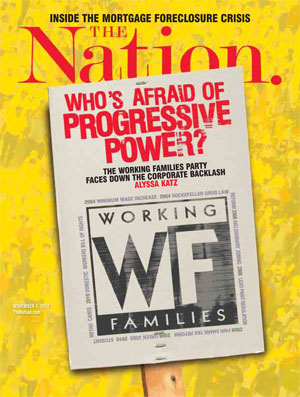
Re Thomas Geoghegan's "Ten Things Dems Could Do to Win" [Sept. 27], an eleventh aim: confronting that elephant in the room that feeds on Wall Street and banks too fat to fail—uncontrolled military spending on weapons we don't need, troops yet stationed in WWII venues and two US-provoked, unwinnable wars.
T.R. MELTON
Albuquerque
Here are my additions to the list:
11. Thank the progressive base—stop insulting us.
12. Lead, don't follow—that's what majorities are for.
13. Sell your agenda, explain why it's good for me, using ten words or less per item.
14. Stop using words like "resonate"—try "We care about you" or "The GOP lies."
15. Support public financing of elections.
NANCY WOODARD
St. Louis
I'd add to the list: make election day a national holiday. I bet the increase in the number of folks of little means who'd vote would be huge. They're part of our base.
DANNY KOHL
Warren, N.J.
First, we need to tame the military-industrial gorilla, since half our red ink flows to war. Second, suing corporate officers who loot their firms might knock out Citizens United far faster than the hard slog to a constitutional amendment, but employees who sue need financing and protection from retaliation. Finally, tell us how to end the filibuster.
JOHN RABY
Montpelier, Vt.
Thanks for explicitly advising us to "read, or reread, Marx for what is still the most thoroughgoing critique of capitalism." There is no ending the capitalist menace without Marxist analysis and strategy.
CARL MARTIN
KIPPsters—Way Kool
Houston
Pedro Noguera's "Schools vs. Slogans" [Sept. 27] mentions the relationship between KIPP (Knowledge Is Power Program), the organization I co-founded, and Teach for America (TFA). I have great respect for Professor Noguera, but I must clarify a point concerning the role of Teach for America teachers at KIPP.
Noguera states that KIPP "will hire Teach for America fellows only as assistants until they have proven their effectiveness in the classroom." In fact, TFA corps members are hired at KIPP as full-fledged lead teachers, not assistants. Here in Houston, where I am superintendent of eighteen KIPP schools, our TFA members are doing a fantastic job of helping us close the achievement gap.
For example, one of our teachers at KIPP Houston, Remington Wiley, is an alum of KIPP and TFA. After completing fifth through eighth grade at KIPP Academy, she went on to Deerfield Academy and Spelman College before joining TFA and coming back to KIPP. We gave her the same responsibilities as any teacher, and she is an incredibly valuable faculty member. Nationwide, the vast majority of KIPP schools have TFA teachers, and 60 percent of our school leaders got their start in TFA. These folks contribute greatly to helping all our KIPPsters climb the mountain to and through college.
MIKE FEINBERG
DNA=Do Not Apply
New York City
Re "Freshmen Specimen" [Sept. 27]: In presenting the risks involved in personalized genetic testing, Patricia Williams overlooks what may be the most troublesome recent development in the field: overregulation by public health authorities that prevents people from voluntarily analyzing their own DNA. What happened at Berkeley could not happen in New York, because the state health department has determined that direct-to-consumer marketing of DNA tests is medical intervention and requires prior authorization from a physician. The state has sent cease-and-desist letters to companies like 23andMe and Navigenics, essentially denying such services to many New Yorkers. Mandating medical counseling before you can learn whether you have an increased genetic predisposition to male-pattern baldness or gout may increase the power of doctors, such as myself, but the result is substantially increased cost and decreased access for the lay public.
Professor Williams is right to highlight the abuses engaged in by some direct-to-consumer genomics companies. An "above average risk" for breast cancer is obviously not the same thing as "the high risk of pretty much getting it." But the solution to these concerns is to prevent such abuse, not to shut down the industry. Many people have legitimate reasons for wanting to know the details of their genetic code—whether to inform their lifestyle choices or simply to contribute additional data to the collective pool of knowledge, so the direct-to-consumer tests become more accurate. Surely, if my genetic makeup is one of the most important aspects of my identity, as Williams writes, I have a right to know what my DNA says and to use that knowledge as I see fit.
JACOB M. APPEL, MD, JD
The Mount Sinai Hospital
Rigoberta Menchú Redux
Paris
Re Greg Grandin's "It Was Heaven That They Burned" [Sept. 27]: I rejected Grandin's preface for a new English-language edition of I, Rigoberta Menchú because he and the publisher, Verso, tried to impose it on me as a fait accompli. It was already in press when, by accident, the foreign-rights editor at Gallimard asked Verso to seek my approval. I have had too much experience with macho-Leninism to put up with this kind of behavior. I was also reacting to certain kinds of US academics who think they own the truth about Latin America and who play up a few aspects that suit their agenda, dismissing everything that does not fit. Unfortunately, imperial arrogance is not only a privilege of the right.
ELIZABETH BURGOS
Middlebury, Vt.
Greg Grandin claims to champion crucial details, but he blows past any detail that complicates his search for heroes and villains. What he describes as my "accusations" and "conjectures" are based on research that he has yet to refute. We can be sure that Rigoberta Menchú's father's land battle was with his K'iche' Maya in-laws because of their many warring petitions in government archives. Conceivably Vicente Menchú led a secret double life as a founder of the Committee for Campesino Unity. But after he died alongside five members of CUC at the Spanish Embassy, CUC's obituaries for its five martyrs did not include him.
Contrary to Grandin, two years later Rigoberta Menchú was agnostic on the source of the embassy fire because its sole survivor, the Spanish ambassador, attributed the fire to the protesters' Molotov cocktails. Grandin says Guatemalan guerrillas had no tradition of tactical suicide, but cyanide pills were standard on risky operations, as Daniel Wilkinson describes in his book Silence on the Mountain.
"Recent research has proved Stoll's thesis about Guatemala's revolution to be mostly wrong"—OK, where is it? As an ex-staffer of the Commission for Historical Clarification (CEH), Grandin is accustomed to quote 1999 CEH findings he apparently wrote himself while skipping CEH findings that echo my description of peasant neutralism.
Certainly there was social support for the guerrillas in some areas—you can read about it in my books—but little or none in others. It was anthropologist Carol Smith who documented that the 1970s were a period of modest material gains for many indigenous Guatemalans, not the deepening exploitation that a guerrilla narrative demands.
The guerrilla romance Grandin wishes to revive was in deep trouble, not just in Guatemala but all over Latin America, before I got into the act. I'm surprised Grandin considers me such an influential opponent because the book that he will have to refute is Utopia Unarmed by Jorge Castañeda.
DAVID STOLL
Grandin Replies
Brooklyn, N.Y.
Elizabeth Burgos accuses me of presuming to "own the truth" regarding Rigoberta Menchú's memoir. But she literally does: in August 1982, Burgos, acting in Menchú's name, signed a contract with Gallimard making her the sole legal author of the book, discharging the publisher "from rights due" Menchú. Until 1993 Burgos shared the book's revenues with Menchú but then instructed Gallimard, according to a company representative, to stop paying Menchú and remit all future royalties to herself. Around this time the book began to take off as an international bestseller, so the proceeds from then on were considerable. I have always thought defenses of Menchú based on her vulnerable position as an indigenous woman came up short. Yet Burgos's arrangement is perverse: Menchú, having barely escaped unimaginable terror, got the opprobrium while Burgos, nestled comfortably between the Seine and the Luxembourg Gardens, got the cash.
Neither Verso nor I tried to "impose" my preface on Burgos, because neither of us knew she had exclusive power to vet all editions, in all languages. To justify this injustice, Burgos tends to present herself as Menchú's primary interlocutor in the creation of the memoir. I suspect that what rankles Burgos is that my essay, though generous to her interviewing method, reveals that the book was a collective endeavor, with others, notably Guatemalan historian Arturo Taracena, involved in its interviews, transcriptions and editing.
David Stoll accuses me of writing the CEH report. He is wrong. I left the CEH before it moved from the research to the writing stage. Its full report can be read at http://shr.aaas.org/guatemala/ceh/mds/spanish. Readers can decide if it supports Stoll's interpretation of the causes of the Guatemalan genocide. The truth commission was largely staffed by UN and other human rights careerists who had no particular sympathy for left-wing politics, yet they had no problem understanding that racism and poverty were the cause of the genocide and not, as Stoll insists through his deconstruction of Menchú's memoir, tit-for-tat reprisals between the military and the guerrillas. As to the cyanide pills guerrillas supposedly kept, surely Stoll can distinguish between taking one's life to avoid torture and what he accuses Menchú's father of: participating in an act of mass murder to create revolutionary martyrs—not to mention that civilians who died in the Spanish Embassy were not guerrillas.
Stoll shouldn't be so modest. He is influential enough. I've taught students who call Menchú a liar, and they cite Stoll as evidence. Even writers of minor reputations can make names for themselves by tearing others down.
GREG GRANDIN Read More
Our Readers and Greg Grandin