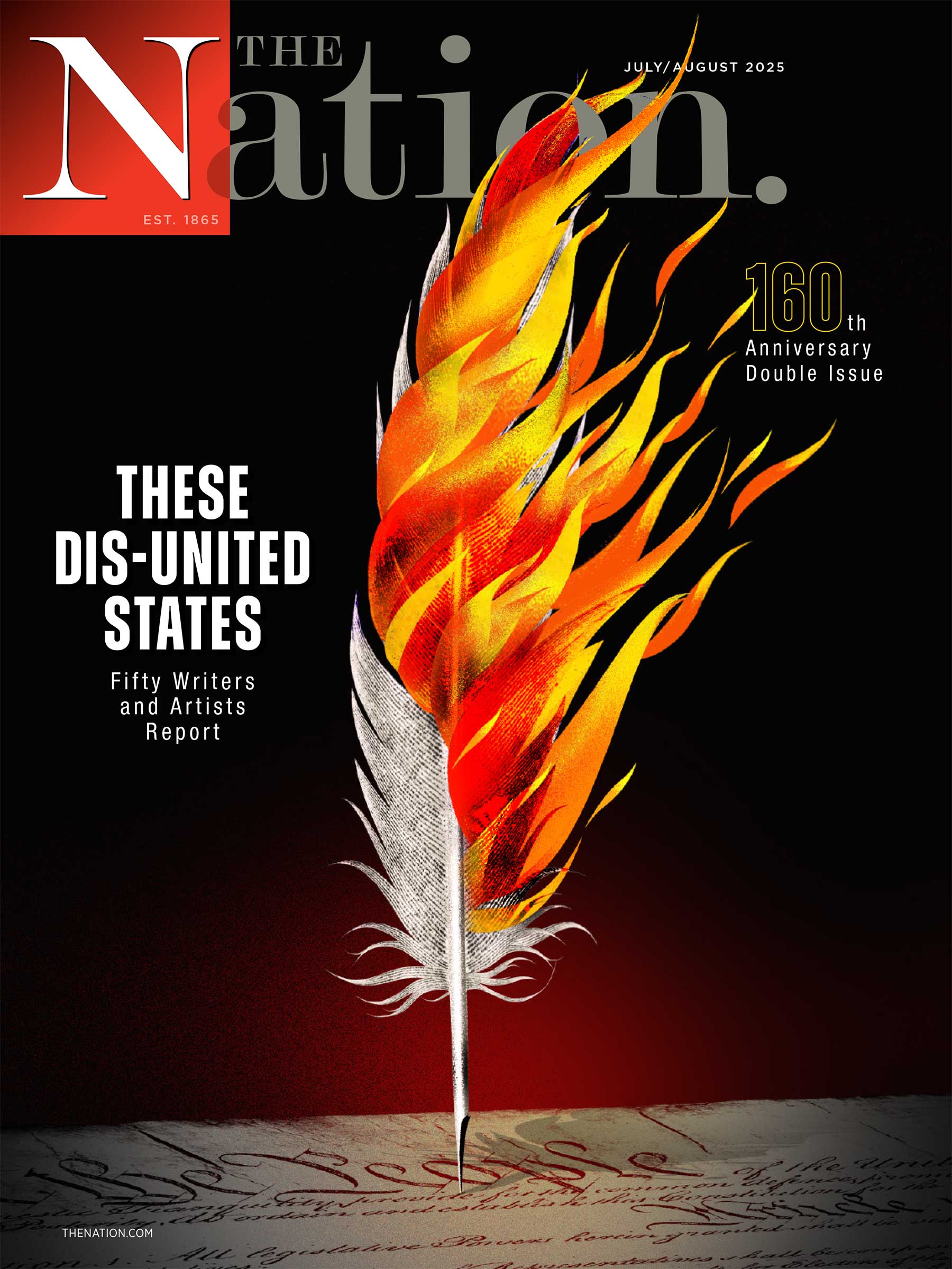
Gotcha Covered
Allentown, Pa. Keep the table of contents inside the magazine. The new covers are a jumbled mess. Please bring back Avenging Angels or a similarly edgy and creative agency. DENNIS MICHAEL FURST
Barton, Vt.
The new cover format—a touch of horizontal voyeurism?—displays the contents more clearly. It’s cleaner, and I like it.
MARTHA GORDON
Kept the Home Fires Burning
Prescott, Wis.
Ah, yes! Michelle Goldberg’s “When Fiction Becomes Fact” [Feb. 28]: in early 1942 the US military received a civilian report that one Ransaku Saito (a Japanese immigrant) had installed a searchlight in his chimney in Aberdeen, Washington, which helped direct Japanese aircraft to Aberdeen. Never mind that Saito had died in 1936. Indeed, history does repeat itself.
WILLIAM KRUBSACK
Jack the Gipper
Manchester, Md.
Alexander Cockburn’s acerbic and brilliant prose has never been used to better effect than in “Dishonoring Reagan” [“Beat the Devil,” Feb. 28]. “Malign vacuity” is an inspired description. I experience an involuntary shudder when I see footage of Reagan, much like what happens when I drive over a crushed animal on the road—minus the pity.
KRISTIN KOLARIK
Jacksonville Beach, Fla.
Bravo, Alexander Cockburn! I sometimes feel like I am living in someone else’s bad acid trip—until a writer like Cockburn rekindles the light of reason and clarity and reminds us of the true legacy of a man who did more to damage our political and socioeconomic landscape than anyone in the twentieth century.
PATRICK NOLAN
San Jose, Calif.
Thanks to Alexander Cockburn for doing the deed on poor, dumb Ronnie Reagan. I have had it up to here with PBS et al. trying to turn this sappy fascist into an elder statesman. This guy bought arms for terrorists. Isn’t that a criterion for treason?
TIM RYAN
Brandon, Iowa
Thanks to Alexander Cockburn for a burst of reality. Amid all the hoopla over the Reagan centenary, I had begun to suspect mass amnesia. Cockburn’s brief review of the sordid record of his presidency is a sorely needed reminder of what it was really like. We must admit that he did have an enormous impact on public attitudes and discourse: almost single-handedly, he made unabashed greed acceptable. The Great Prevaricator was able to convince the poor and the middle class that they deserved no better than what they had.
WILLIAM REEDY
An Apple for the Mentor
New Orleans
Re David L. Kirp’s “The Kids Are All Right” [Feb. 28]: it would be great if there were enough stable adults (and money) for every troubled child in America to have a mentor, but as Kirp points out, it’s impossible. Friends of Children provides something rapidly disappearing in the schools of poor communities (where the number of troubled children is disproportionately high): teachers who stick around. With the rise of programs like Teach for America, teaching has become less of a career and more of a two-year stint for fresh-faced college grads to use to beef up their résumés.
Growing up, I visited my second grade teacher after school all the way through high school. She was always in the same room with the same posters on the wall and the same sunny disposition I’d known when I was 7. That consistency meant the world to me when other parts of my life became unstable. Mentoring depends only on an adult’s willingness to stick around and to care.
SOPHIE LUCIDO JOHNSON
Who Are You Calling ‘Socialized’?
Portland, Ore.
Paul Goode states incorrectly [“Letters,” Feb. 21] that “single-payer is socialized medicine: the state owns and operates a healthcare system financed by taxes.” “Single-payer” refers only to how healthcare is financed, not how it is delivered. Medicare is a single-payer system. The Veterans Administration is socialized medicine; its doctors are on the federal payroll. Every state single-payer bill I know of, as well as the national legislation (HR 676), allows free choice of providers, whether public or private.
PETER SHAPIRO
Oregon Single Payer Campaign
Read It and Leap
Seattle
Charles Taylor, in “The Ballad of John and J.D.” [Feb. 14], seems to be arguing two things at once. One is that John Lennon and J.D. Salinger represent some sort of opposing poles in American culture. The second is that reading fiction can influence your behavior. This is a topic that I think goes back to Plato, who wanted only inspiring literature in his republic. It is the theme of Don Quixote. It is evidenced by Goethe, when thousands committed suicide after reading one of his early works. And it is explored in a similar way by Chekhov, who notes that some women end their lives after reading about Ophelia. Mark Twain makes fun of the notion but writes about it frequently. In the case Taylor is writing about, Mark David Chapman read Salinger intensely before killing Lennon. I would like Mr. Taylor to answer the following: Can fiction actually induce entirely new behavior? Or does the tendency to look to fiction as an unerring guide already exhibit a pathology?
MAHLON MEYER
Taylor Replies
Brooklyn, N.Y.
We tend to think of art’s influence in one of two naïve ways: either as a wholly benign force that can spread only understanding and enrichment, or as a force that has the power to unhinge the unstable, one that elites (the government, school boards, the MPAA ratings board) must vet for the lower orders. We have a hard time accepting that art is neither completely benign nor directly poisonous, that part of its power, and its horror, is that it can stir up all sorts of unpredictable feelings.
I sense the same either/or approach in Mahlon Meyer’s questions. My piece clearly answers his first question: I stated that J.D. Salinger did not inspire Mark David Chapman to murder John Lennon. But Meyer’s second question turns Salinger’s fiction into a powerless entity and thus misses my point. That The Catcher in the Rye didn’t direct Chapman’s behavior does not make it impossible for Chapman to have found in Salinger’s elitist moralism an echo of his belief that the corrupt and phony dirty the world, a belief he decided to act on with a gun.
CHARLES TAYLOR Read More
Our Readers and Charles Taylor