The Plan for November—and After
Ben Wikler lays out Democratic strategy, and John Nichols talks about progressive candidates for the Senate.

The Nation Podcasts
Here's where to find podcasts from The Nation. Political talk without the boring parts, featuring the writers, activists and artists who shape the news, from a progressive perspective.
The Plan for November—and After / Start Making Sense
How are we going to defeat Trump and the Republicans and win control of Congress in the midterms? How are we going to win the White House in two years? Ben Wikler has a plan – he’s published a book with the title This is the Plan. Ben was chair of the Democratic Party of Wisconsin for six years, ending in 2025, where he shaped what became the most powerful and effective state political party in the country.
Plus: John Nichols on the Senate Candidates in Maine and Nebraska, and the governor’s race in Wisconsin. John of course is executive editor of The Nation.
Advertising Inquiries: https://redcircle.com/brands
Privacy & Opt-Out: https://redcircle.com/privacy
US President Donald Trump addresses the nation from the East Room of the White House on July 16, 2026, in Washington, DC.
(Saul Loeb / Pool via Getty Images)How are we going to defeat Trump and the Republicans and win control of Congress in the midterms? How are we going to win the White House in two years? Ben Wikler has a plan—he’s published a book with the title This Is the Plan. Ben was chair of the Democratic Party of Wisconsin for six years, ending in 2025, where he shaped what became the most powerful and effective state political party in the country.
Plus: John Nichols on the Senate Candidates in Maine and Nebraska, and the governor’s race in Wisconsin. John of course is executive editor of The Nation.
Subscribe to The Nation to support all of our podcasts: thenation.com/subscribe.
The Nation Podcasts
Here's where to find podcasts from The Nation. Political talk without the boring parts, featuring the writers, activists and artists who shape the news, from a progressive perspective.
Massive GOP Spending Hasn’t Slowed the Coming Blue Wave; plus The Cornell Rape Case / Start Making Sense
Republicans are spending hundreds of millions on the midterms, but their money hasn’t been able to counter the crisis of affordability, the disgust with Trump’s corruption, and the quality of many of the Democratic candidates. Harold Meyerson comments – he’s editor at large of The American Prospect.
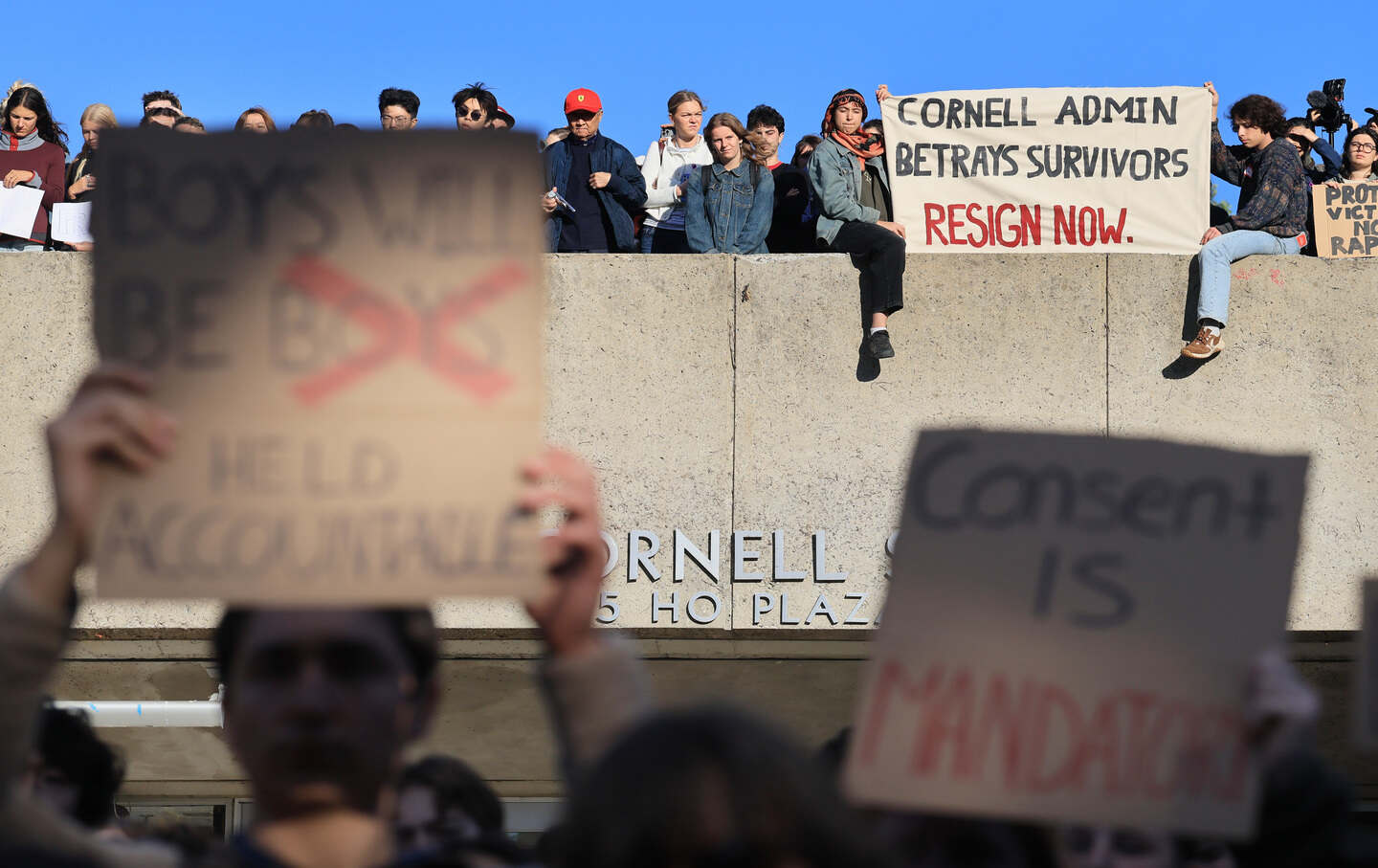
Also: Katha Pollit argues that the gang rape at a Cornell fraternity party could have been stopped–if someone had bothered to intervene. But no one did. “Where were the good guys?” She asks.
Advertising Inquiries: https://redcircle.com/brands
Privacy & Opt-Out: https://redcircle.com/privacy
Search Results placeholder
Jon Wiener: From The Nation magazine, this is Start Making Sense. I’m Jon Wiener. Later in the show: John Nichols on Progressive Senate candidates to challenge Republicans in Maine and Nebraska. One is a Democrat–and one isn’t. But first: How are we going to win the midterms? Ben Wikler will explain – in a minute.
[BREAK]
Everybody in politics wants to know: what is the plan? How are we going to defeat Trump and the Republicans? How are we going to win control of Congress in the midterms? How are we going to win the White House in two years? What is the plan? Well, Ben Wikler has just published a book with the title This is the Plan. Ben was chair of the Democratic Party of Wisconsin for six years, ending in 2025, where he shaped what became the most powerful and effective state political party in the country. Ben Wikler, welcome to the program.
Ben Wikler: Great to be with you, Jon. Great to be with you, listeners.
JW: You open your book with the first major election of the second Trump term, April 2025, the first test of whether Trump and MAGA would continue to dominate all of American politics, or whether regular people could fight back, would fight back. It was in Wisconsin. It was for the state Supreme Court, and it featured on one side, Elon Musk, the richest man in the world, and on the other side, a little-known Dane County Circuit Court judge named Susan Crawford. When you say that now, the whole thing seems highly unlikely. But in fact, the winner of that first test of the power of Trump and MAGA was not the richest man in the world. It was the little-known Dane County Circuit Court judge. Tell us how that happened.
BW: It was a fight, and I love starting here because I think it illustrates both how dark this moment is, how big the crisis of this moment is, and that it is realistic to hope if we roll up our sleeves. And as Nancy Pelosi loves quoting Flo Kennedy to say, “Don’t agonize, organize.” So here came Elon Musk. He had his own lawsuits moving through the Wisconsin court systems over Tesla dealerships. So, he wanted to buy the court for his own bottom line, but also, he wanted to demonstrate his power and lock in mega control of the state Supreme Court in the closest state in the country. He poured in more money into that race than anyone has ever donated to any judicial race in American history. And what Susan Crawford did across the state, she said, I never dreamed as a little girl growing up in Chippewa Falls, Wisconsin, I’d be up against the richest man in the world for democracy. But she energized this movement that had been building continuously a permanent campaign on the ground, in every small town, in every suburb, in every city in the state for years. This organizing machine, turnout machine, communications machine ensured that voters saw that this was a referendum, not just on Brad Schimel, the Elon Musk’s preferred candidate, and Susan Crawford, but on the question of whether Wisconsin could be bought, or whether it would still be a state that was governed by oven for the people.
The state party working with the campaign launched an effort called “The People versus Musk.” This is a judicial election, and Elon Musk was on trial, and we kicked his ass. He lost by ten percentage points. His money wound up boomeranging and backfiring on him. More people turned out in that election to support Susan Crawford against Elon Musk than have ever voted for a Republican candidate for governor in a November election.
Normally, Supreme Court races have a fraction of the turnout of what you’d see in a gubernatorial race in a midterm election. What we saw was both a great campaign and the culmination of years of work. And my argument in this book is that there are elections like that, ones that don’t get nearly as much attention, but like that one that have enormous consequences for the whole country that are taking place all the time, and what we need to do as a movement.
This is a book addressed to the person listening to this podcast right now, to the concerned American who’s maybe gone to a no Kings protest or chipped in on Act Blue once or twice, but is trying to figure out “what the hell do I do in this nightmare?”
If enough of us get together and pour ourselves into the races that no one’s paying attention to, but that actually determine who will run the American electoral system, then we have a chance to win power in the states in 2026 that can allow us to have a free and fair election in 2028, that can then allow us to pass fundamental reforms to change this country and make it a democracy that works for everyone in 2029. And that is the plan.
JW: Well, you and I and most of our listeners are political people. We think about politics every day, but that’s actually pretty unusual in America. Most people do not relate to politics the way we do. In the last presidential election, about 75 million people voted for each candidate. 90 million people did not vote at all. And even among the ones who did vote for most of them, politics is not part of everyday life. It’s sort of like the Olympics. It comes once every four years. You watch it on TV for a couple of days, you cheer for your team, and then you go back to real life. And real life for most people is paying the rent, paying the grocery bill, putting gas in your car. It’s not about saving democracy in defeating Trump. Now you can say, “this is bad. This is wrong.” But this is the political world that we live in. I think you know about this. And I think you had to deal with it in Wisconsin.
BW: Absolutely. If you ask the average swing voter or person who might or might not vote how they feel about Trump’s threat to federalize election administration, it doesn’t ring any bells whatsoever. Most people do not think about the fact that elections are run at the state level, not the federal level. Trump’s attacks on democracy are so remote from the concerns of people who maybe they’ll vote, I don’t know that if you’re really concerned about democracy, your job is to talk to voters who are on the fence, not about what you’re freaked out about, but about what they’re freaked out about. And the only way to do that is to actually ask them what they’re concerned about and listen to them. And this is my fundamental political advice for anyone who wants to make a difference. It’s to take the advice of Abraham Lincoln. In the 1840s, he wrote a letter to the Whig Party, and he said, “keep a constant watch on the most doubtful voters, and from time to time have them talked to by those in whom they have the most confidence,” which is to say, talking to people who trust you, listening to them, if they’re not already with you, that’s the most important group of people to talk to about what is concerning to them, and then meet them where they are about their concerns. And so much of the kind of coverage of politics is like this person said this in a speech, what is that going to do to the election? The voters who are on the fence did not hear that speech, that is so remote from their day-to-day concerns.
You need to bring the news, the information, the politics to the lives of the folks who are not thinking about it. In Wisconsin, we have elections constantly that come down to less than one percentage point, five of the last seven presidential races have done that. And the way that you win a race like that is by talking to people who the last thing they want to think about is what’s happening in the next presidential election, because everyone who’s already thinking about the election already knows who they’re voting for. So it means finding the people that are not thinking about this, having patience, having curiosity, meeting them on the issues that they’re concerned about, that they don’t even think about as issues necessarily, and then helping them see how the values and concerns that they have in common with you can lead them to vote for the person that you support. I map out how to do this, the groups that that can help to train and support you to be able to do this, how you can do this even if you live in a red or blue state to support the work in the places that have the closest elections. All of that is in the book. I call it your superpower. Another word for it is organizing. And in a democracy, it is the thing that we can do to save the country.
JW: We want to know what is the plan for defeating Trump and MAGA? But the first eight chapters of your book, the great majority of your book, is not about the battle for the presidency. Why not?
BW: The reality is the presidency is the final boss in a video game where you have to fight through every level. If you’ve ever played Super Mario Brothers, you know that you get to Bowser at the end, not at the beginning. Every part of the American political system is built like a pyramid. It’s stacked on top of other parts of it. Elections are run often at the municipal level. Local city governments set up the polling places. Maybe the county does the ballot design. It varies from state to state. They do it in laws set by the state government. Constitutionally, state governments oversee the elections and work with the local governments to administer them. Those are shaped by federal laws. But the reality is Trump is in the White House right now because of a whole bunch of decisions by state governments over the last several decades. And in Wisconsin, we see this very vividly because the Trumpian moment, this moment of crisis and nightmare really began in 2010 with the Tea Party Wave and Citizens United and the takeover of state governments across the battlegrounds and so much of the country, and then the systematic unraveling of democracy at the local level, not the national level that created the conditions that allowed Trump to be able to get into the White House. And as we learned in 2020, we beat biggest bad guy, and he came right back because all those other conditions remained unchanged. There’s so much more that we have to do. So, the good news is that a lot of those smaller levels of government are actually more susceptible to the work, to the to the donations that you and I can give to the hours of volunteering that you and I can make because so few people pay attention to them.
BW: The vast majority of Americans don’t know who their state representative is, which means that if you tell someone who the person is and tell them that they’re a crook, or tell them that they’re a champion, you can have a much bigger effect on their opinion about that person than you can on their opinion on Donald Trump, where everyone has an opinion already and is maybe ready to yell at you about it.
So, the work we have to do is basically trace the lines of power through state and local governments, through state judicial elections like Wisconsin state Supreme Court. But those kinds of races allow a group of friends to have an outsize impact on pushing over a domino that sets off a chain of dominoes that can really change the whole direction of the country. And that’s the path that we’ve gone in Wisconsin, which is to figure out exactly what set of races we had to win through everything we could into winning those races and systematically unravel the system of control and domination that Scott Walker or former Republican governor put in place. We’re on the verge of making Wisconsin a fully blue state now after years of work. I think the same kind of strategy of picking our fights, picking our battles, and then throwing everything we’ve got into them in ways that can change the system itself. That’s what we need to do as a nation.
JW: Well, let’s talk about the Democratic Party right now. People are feeling a lot better about the Democratic Party than they were two years ago. After all, consider the alternative. But there are a lot of things wrong with the Democratic Party that our friends are able to explain pretty, pretty clearly. You say we should all work hard on the project of making the Democratic Party powerful and good, and that’s part of the plan.
BW: If you ask the average person what they think of the Democratic Party, they will say a string of things that you can’t say on a family friendly podcast. And that’s true for Democrats. It’s true for Republicans. It’s true for independents, true for people who don’t pay attention to politics. And part of that comes from the sense that the party should be doing a million things, that it actually has no power to do. The party, the formal legal organization of the Democratic Party, doesn’t set the message. It doesn’t choose the candidates. It doesn’t run the ads. The party has much more limited scope than that. People use the phrase Democratic Party often to refer to the amorphous blob of everything associated with any Democrat anywhere, but the Democratic Party itself does have this possibility that we, I think we have demonstrated through the work that I and thousands of people have poured themselves into in my state of Wisconsin. And you can see in some other places, but not enough, which is that it can be a home for year-round local neighbor-to-neighbor, friend-to-friend organizing that builds itself into the fabric of communities. So that when people think “who are Democrats,” they don’t think they’re some “them” far away that “disagree with me, that I don’t like,” or that are failing to fight or meet the moment, whatever it is they think instead. “Oh, that’s my neighbor who I talked to, you know, yesterday at our block party who asked me to be involved in helping elect someone to the city council who’s going to do something about that pothole at the intersection.” And when you build from below, that way you can actually create the kind of trust that allows you to, to enlist many more people in getting involved. Wisconsin was the highest turnout state in 2024. And we were also the most evenly divided, the closest state in 2024. There are so many elections where Wisconsin has been to the right of the national popular vote. This time we were right on track and we’re moving towards being to the left of the country. That’s not because Republican turnout went down. It’s because Democratic turnout went up and the. The work builds on itself. So, when you have a presence in every neighborhood and every community, it means that in the elections, like the Supreme Court race, when Elon Musk comes and tries to buy everyone off, there are a whole lot of people who are grounded in what’s happening, where they live, who are ready to stand up and say, hell no, and fight back.
My argument is, whatever you feel about Democrats and the Democratic Party, you actually have the power to join your local party, get a few friends together, and turn it into the party that you want it to be. The door is wide open. It is. It is much easier than people realize to be able to build and organize within the Democratic Party itself. And the great thing about the Democratic Party as a vehicle to do this work is that it is everywhere. It is legally in every single state. There it is possible to create a local chapter that you’re not having to pass some set of litmus test box checks to be able to join the party. Anyone can join and get involved. And that means that if you think that we should have more fight in us, if you think we should be organizing more intensively, more locally, in more places, you can make that happen starting now.
JW: Well, let’s talk about Trump. The first time Trump won in November 2016 was, of course, a terrible shock. But if you tried, you could sort of understand why a lot of people might vote to give him a chance and see if he could actually make their lives better. And of course, he actually didn’t win that election. He lost the popular vote by 3 million votes. But in 2024, everybody knew what Trump was, and he got more votes than he had the last time. A lot more votes. He got more votes than the Democratic opponent got. So, 2024 was actually much, much worse for what it said about our fellow Americans, and of course, much more disastrous for the future of democracy. And yet, you say there’s a different way to think about Trump’s 2024 victory, one that offers some hope. Please. What is it?
BW: I want to say at the outset of this, that one tenth of 1% of all the votes cast in that election determined the winner. It was less than 115,000 votes spread across Wisconsin, Michigan and Pennsylvania. If those voters had voted for Harris instead of Trump, then Harris would be president right now.
JW: And this is because of the Electoral College.
BW: Which is it, an atrocity, a disaster. And I lay out a plan to defuse the Electoral College, which is a whole other conversation we could have. But it’s a lot closer to happening than people realize. But the big question of how this person, who was demonstrably a disaster as a president got back into the White House is actually, in my view, impossible to understand unless you pull the lens so far back that you look at the entire planet because something happened in 2024 that has never happened before in recorded modern history of democracies in every single country in the world that has a wealthy or middle class democracy, the ruling party in that country lost ground in 2024. It happened in Japan. It happened across Europe. Right wing governments lost ground. Left wing governments lost ground, male incumbents, female incumbents all across the world. Whoever was in charge took it on the chin. And again, that’s never happened before. And if you ask why that is, across the board, voters were hit with inflation, which was a global phenomenon. Higher prices drove everyone to distraction. And it’s the reason why people are furious about the economy right now as well, I might add. But if you look in 2024 and you ask who moved the most? Who was it that had voted for Biden, who then voted for Trump? Who was it who voted for Biden? Who then didn’t vote, who didn’t vote in 2020 and then moved over to vote for Trump in 2024. The biggest predictors were one that you said inflation had caused you great distress, that prices had affected you, and secondly, that you didn’t watch the news that politics was far from the center of your life, that you said you never sought out political news. If you read a newspaper, you were 70% likely to support Biden in the spring of 2024. If you said you never paid attention to political news, you’re much more likely to support Trump. And what’s so striking within the United States, the places where Harris campaigned the most and Trump campaign the most, Harris did better. In the places where neither of them ever showed up, it was the people who just experienced something in their own lives and voted for change, without a lot of attention to exactly who it was on the ballot and what that person was promising to do who made the difference for Donald Trump.
And the reason why that creates hope, in my view, is that, first of all, it does not mean that people wholesale adopted MAGA or even endorsed Trump’s policies. If someone was remembered what policies each candidate supported, they were much more likely to support Harris. Secondly, the country is not working for most people right now. And so, the big chunk of the electorate that essentially says, do I like how things are going? If not, vote for change. That part of the American electorate is saying they want change right now. And that is something that Democrats and in some states, independent candidates or even non MAGA Republicans were ready to join with Democrats and independents to build a pro-democracy pro-working people coalition. That means that all of those who are promising and fighting for change have the upper hand at this moment.
Our coalition cannot be about restoring a status quo that people already felt was broken. It has to be about delivering change to make things actually better for most people. And that means taking the keys out of the hands of the mega billionaires that are screwing everything up. There is not a pendulum swing that has gotten stuck on the right. Instead, there is this chance encounter between the economic cycle that Trump lucked himself into waltzing into after Covid, after the supply chains got gnarled and mangled and prices went up everywhere. And the fact that Trump, who does not believe in democracy and thinks that we should essentially belong to whatever billionaire pays him the most money, and often it’s him paying himself. Those two things intersected Trump, and this moment of high inflation. And Trump got back into power. But that is not a permanent condition. And in fact, he’s making inflation worse. Everyone who’s freaked out about democracy is against him now. And everyone who’s panicked about the economy is against him now. And that is a winning coalition that could allow us to create the change that people are crying out for.
JW: And you say there’s one more big secret. You call it the greatest secret of politics. It’s about what happens to you if you make the fight for a better country, a long-term part of your life.
BW: This is something that has transformed my life, and I’m delighted to share it with your listeners. Although it’s possible that that folks who are tuning into this podcast have discovered it for themselves too. It is actually a source of meaning and purpose and joy to get involved in something bigger than yourself. I fell in love with my wife while we were putting up posters for a protest together. And this has been a part of the fabric of our family and our circle of friends. We’re people who have discovered that when you’re part of something bigger and then you actually win and make a difference together, collective action helps create collective joy. Movements can be infectious. They can be sustaining. Political energy is a renewable resource.
And in a moment when we are pulled away from each other, doomscrolling spending time on our phones, getting panicked by notifications, driven by algorithms that know that humans are super alert to threats, but that make us terrible inside our bodies and in our souls. That in fact, the feeling that we can join hands and have more power and actually make things better. That’s something that makes everything feel better. The best answer to political anxiety is not to pop a pill. It is to take an action and then see the impact of that action on making your world better.
Anyone who helped elect Barack Obama in 2008 probably has that memory. How great that felt. And the thing is that when you don’t just do presidential campaigns, but you get involved in local elections as well, when you get involved in supporting a highly contested race for state legislature, half the country away. But then you see that it actually worked and you pulled off a victory by a few dozen votes. And you know that you and your friends were a part of that. It feels great.
This is not a fight that we’re going to win overnight. It’s going to take years to unravel all the damage and then to build something better than we’ve ever had, which is what we need as a country. But that does not have to be work. That can actually be something that helps to build a community in our nation, that can help reduce the partisan and polarizing temperature. Because if you want to persuade someone, you have to first see them as a human being. And that improves our own souls, as well as helping bring political opportunities to people who do not yet identify as our allies and partners. And by doing that, we can actually grow closer together and have the sense that we’re part of a country that actually has a common project. To me, this is the underlying source of hope, is that the process of fixing what’s broken in our politics and in our economy can also be a process that heals our civic souls and helps us to grow rather than shrinking as, as Trump wants us to do. And that that to me is, is the opportunity that underlies the political work is something that is deeply human.
JW: One last thing: You yourself. What’s your own plan for 2028, when Ron Johnson will be facing the voters in Wisconsin in a campaign for the Senate? A lot of our friends want you to run for the Senate in Wisconsin in 2028 and become part of the Democratic majority in the Senate. When we elect a Democrat to the White House, what can you tell us about your plans for 2028?
BW: I’m honored and flattered. I will tell you my overwhelming focus right now is on these next few months. What I want is for anyone, whether or not you buy the book, to roll up their sleeves and get involved, not just in the fight for the House and the Senate, but also for the state and local offices. The acid test is whether we have free and fair elections in 2028. And that will depend on who’s actually running them. And those people are elected in 2026. These next few months will determine whether Trump’s next coup attempt will succeed or not.
Lots of people are wondering about who will be the presidential nominee, who will run for every Senate race, all that stuff in ‘28. All that can wait right now. All of us have to zero in on the things that we can do in these next few months to ensure that democracy survives this moment of enormous peril. And if we come out the other side after 2026 with an electoral system run by people who actually believe in democracy, then the sky’s the limit for what we can achieve to make this country better for everyone.
JW: Ben Wikler – his book is This is the Plan. Ben, thank you for all your work, thanks for this terrific book, and thanks for talking with us today.
BW: Thanks so much, Jon.
[BREAK]
JW: For today’s political update, we turn to John Nichols. Of course, he’s executive editor of The Nation. John, welcome back.
John Nichols: Good to be with you, my friend.
JW: Just a reminder here that Democrats need to retake the Senate–that means holding two and flipping four. We have strong candidates in many places, but we have one open question: Maine. Who’s going to run in Maine, instead of Graham Plattner?
We have to defeat Susan Collins. Maine is the most Democratic state with a Republican senator facing reelection. Things got a lot clearer over the weekend. Several candidates dropped out, and the remaining one is Troy Jackson. He’s going to be officially nominated at the party convention this weekend. Who is Troy Jackson?
JN: Troy Jackson is a really interesting candidate. He is a former logger from northern Maine right up by the Canadian border. And he got his start in politics not as a candidate, but as a logger who was blocking the border during a dispute over how much loggers got paid and what was paid for wood and things like this — might get a little technical for some folks on the podcast. But the bottom line was he was in a very political struggle. And the sitting governor at the time said, “well, why don’t you folks who are blocking the border come down to Augusta, come down to the Capitol and meet with me?” And basically the logger said, “no, you come up and meet with us.”
And that’s where its backstory that sort of lets you understand where this guy comes from. He got into politics as somebody who was already pretty upset with the status quo. And then he became ultimately a state senator and a very powerful, very effective state senator. Rough and tumble in the Maine Legislature which has often been divided over the years, has divisions within the Democratic Party. But he rose to a pretty high place, and then he ran for governor this year in a multi-candidate primary where there were three progressives running: Hannah Pingree, who eventually won the nomination, as well as Shenna Bellows, who is the secretary of state of Maine.
And interestingly enough, Graham Platner endorsed all three of them. because they have ranked choice voting in Maine. But Jackson was pretty close to Platner politically. I mean, there’s an ideological parallel there on a lot of issues, pretty strongly pro-Medicare for all, in favor of taxing the rich, really aggressively in favor of taxing the rich. And so when Platner’s campaign collapsed or when Platner left the race there was a real sense that people didn’t know exactly where this thing was going to go. Where the mood was in Maine, where they go to somebody who’s more of a traditional politician, where they go with somebody. It’s kind of a centrist, something like that.
You got a real signal in the county caucuses that occurred last weekend, and Jackson swept them. He won everyplace. And one of the reasons for that, of course, is not just ideological. It’s long-term presence in politics. This is a guy who’s been in Maine politics for decades, and he’s been very well identified.
He was the leader of the Bernie Sanders campaigns in the state. He was somebody who’s kind of always been very out front, especially on labor and economic issues. But ultimately, having begun as a relatively more conservative fella, has become a really strong defender of a lot of social and racial justice issues. And so at the end of the day I think he had a lot of people who’d come to really like him and know him.
He will be the nominee and he will hit the ground running. He just spent the first half of the year campaigning all over the state for governor. Now he’s shifting over to a Senate race, but he’s been in every town. He’s, you know, knocked on the doors. He’s talked to the people. And so he doesn’t really start as somebody who is just building up, trying to get a campaign going.
The funny thing is that on his signs, which said “Troy Jackson for governor” and then in the corner said, “endorsed by Bernie Sanders.” The signs still say “Troy Jackson” and “endorsed by Bernie Sanders,” but they’ve been having fun just putting a white strip across it that says “for Senate.”
JW: Let’s talk about Susan Collins for a minute here. In 2020, the last time, of course, she ran for reelection, every major poll showed her behind. Some showed her behind by ten points or more. And in the end, she ended up winning by nine points. Huge victory, especially since Joe Biden carried the state by nine points.
The latest polls, taken just after Platner pulled out, show the candidates basically tied right now. How hard is it going to be for Troy Jackson to beat Susan Collins?
JN: Hard! Maine is a state that has, in the last decade or so, had a very right wing Republican governor. It’s had a Republican senator. The other senator is an independent. Maine is a battleground state. It is one that leans democratic. And in recent years, Democrats have done quite well there. Maybe that pattern is locking in. And maybe that would suggest that in the six years since Susan Collins was last on the ballot, that there really has been a mood shift. If so, it’ll be easier.
But I think you have to recognize this is a real race. Main also knows Susan Collins well, even if they don’t love her. They’re very familiar with her. She’s done a lot of constituent service. She shows up at the parades. She is an energetic and engaged candidate. So don’t fool yourself that this is going to be an easy thing. There’s a nationalization of this election. So at the end of the day, what Susan Collins will try to do is localize, make people not pay attention to the national. What Troy Jackson I think will do is also localize to some extent, because he’s really of the state. But he is going to, I think, deliver a very strong message that, if you want to push back against Trump and Trumpism, and frankly, if you want to get the Democratic Party to actually stand for something other than platitudes, that he might be the guy.
JW: Okay, Maine is the top flip opportunity. Farther down on the flip opportunity list is, surprisingly, Nebraska. Nebraska, a deep red state Trump carried Nebraska 60 to 40 in 2024. 20 point margin. And the incumbent Republican is running for the Senate for reelection there: Pete Ricketts.
Over the weekend, the Democratic Party candidate, Cindy Burbank, withdrew from the race, leaving the field open to an independent: Dan Osborne. Dan Osborne is a favorite of ours. Remind us, who is Dan Osborne, and can he defeat a Republican incumbent in a state Trump carried by 60 per cent?
JN: Dan Osborne is a fascinating fellow. When he became old enough to vote, he registered as an independent, just didn’t particularly love either party. And he came to prominence in Nebraska as the leader of a strike at a Kellogg’s plant in Omaha. And it was a bitter strike. It got a lot of national attention. He held out, you know, pretty strongly there and so got a lot of attention. He became relatively prominent figure. And the interesting thing is that, you know, he’s a machinist, I think a technician who was very good at talking about fixing cars, fixing tractors, things of that nature.
And so obviously folks talked him into running, and he ran two years ago and sort of shocked everyone because his campaign took off. It was a very Nebraska-centric, genuinely all about being independent, campaign, very critical of the Democratic Party, very critical of the Republican Party, an economics that was pretty populist, pretty close to Bernie Sanders on a lot of issues. By the same token, he was not, I would say, good on immigration or on some other issues. And at the end of the day, I think folks had to figure out, you know, what do we make of this? Where does, where do you where do you lean on this guy? And in a strange kind of way he succeeded in holding the Democratic base. And in Omaha, the Democratic base is actually quite progressive. And in Lincoln, some other places, but also expanding beyond that base into, I don’t think Republicans per se, but a lot of independents. And in fact, independents really seem in polling to really like him.
And the interesting thing about this race against Ricketts is he’s running against a super rich guy, you know, a son of a billionaire family who kind of like paved his own way with dollars. And I think the machinist versus the billionaire message has had a lot of resonance in this year.
Osborne has been very, very clear: He is not running to serve in the Senate as a Democrat. You know, as many independents they run and then they align with the Democrats. It’s gonna be much harder. This is not that’s not an arrangement that’s likely to come to place. What he says is he would like to get into the Senate and call the shots. You know, call it as it comes. Right. And he always says he’ll do what’s best for Nebraska.
But I think in some ways he’ll be a thorn in the side of the Democrats a little bit. Much bigger thorn in the side of President Trump, because this is a guy who really does favor taxing the rich, really does favor regulating corporations is passionately pro-union. And, and, you know, I think on a lot of the economics, if you start to look at stuff, he’s somebody that would break toward the Democrats on a lot of economic issues, might not always be there with him on some other issues, but would by and large, I think on things like government shutdowns, these places where we have these clashes, I think you would tend to do the right thing.
JW: And I have a question about Wisconsin, your home state. The New York Times has worried that the Democratic primary for governor, to replace the Democratic incumbent, Tony Evers, might be won by a socialist. The candidate they’re worried about is Francesca Hong. They describe her as a chef from Madison. Is that correct? A socialist chef from Madison could be Wisconsin’s next governor?
JN: Well, in between the time that she was working as a as a chef –and she is a chef, she has the skills. But she was running a ramen noodle shop. So, and, and she’s a very working class person who was a good cook, a good restaurateur. Covid hit and it really upended her, her operation. And so she ran for the legislature. And to the shock of everyone, because she’d never been in politics, she rode around on a bike with a she wore a mask and rode around on a bike during Covid and had a sign on the back and stuff like that. And they elected her.
So she’s been in the Senate or in the state legislature or state assembly for a number of years now. The shorthand makes it more simplistic. This is somebody who’s been elected in tough primaries, reelected and reelected, and who carved out a place in the legislature as a very high profile, progressive, somebody who is on the left on a host of issues.
She is now running for governor. When she started her race for governor, she was pretty much written off. She is a democratic socialist running in a state which, by the way, the biggest city, Milwaukee, had democratic socialist mayors for much of the last century. And where there’s a democratic socialist caucus in the legislature, this is not something that’s entirely foreign to the state. It also has a great progressive tradition, etc.. But it’s a swing state. It’s a divided state. She got her traction in the Democratic primary by getting in the car and going everywhere. She literally was in every small town, every coffee shop. She got to know people very well. She goes out and cooks with people, she’ll go in the kitchen, and she’s got a, she’s got a wry, tough way of talking about a lot of stuff that is hit.
The New York Times went and did a profile of her, found a Trump voter who was voting for her, or at least had had her yard sign up. And the reason was that she was way out front on opposing data centers, saying there should be a moratorium on it. So she’s pretty good at finding the issues that that hit people, whether they’re left, right, center, Democrat, Republican.
And so anyway, bottom line is she’s gotten herself to a point where she leads in most of the polls. That’s freaking out a lot of national Democrats and many Democrats in the state. They are trying to figure out how to how to prevent her from being the nominee. But every time they try to prevent her from being the nominee, I think they sometimes reinforce her argument that you need somebody from the outside. You need somebody different.
So we’ll see where it all sorts out. We got about a couple more weeks to go. Lots of money flying around, lots of charges, lots of you know, the usual politics of a place. I will tell you that one of the leading centrist candidate dropped out because her campaign finance reports were a disaster. And then the governor came in and endorsed another, more centrist candidate. But that kind of looks like the party establishment might be backing somebody, and that sort of helps Hong. And I will suggest that for Wisconsin, it’s going to be a very, very interesting next couple of weeks. Stay tuned.
JW: Now it’s time for your Minnesota moment: news from my hometown of Saint Paul that you won’t get from Sean Hannity. Last September, the Trump administration sued the state of Minnesota, the cities of Minneapolis and Saint Paul, and Minnesota Attorney General Keith Ellison — over the state sanctuary policy, which prohibits state and local law enforcement agencies from cooperating with ICE in arresting and detaining people being sought for detention and deportation. They also sued Minneapolis over a law that prohibits the police from identifying undocumented people for ICE, or verifying the immigration status of people they come in contact with, for ICE. Trump’s Justice Department asserted that Minnesota’s sanctuary laws violate the supremacy clause of the Constitution, which says federal law must be supreme to state and local law.
But on Monday, a U.S. District Judge, Eric Tosterud, dismissed the case, saying forcing state and local officials to enforce federal immigration law violates the 10th amendment. That’s the federalism amendment, that the federal government has only the powers reserved in the Constitution for the federal government. Everything else is reserved for the states. And the Supreme Court has upheld this many times. The federal government cannot force or, as they say, “commandeer” state and local governments to enforce federal laws.
One more thing here. The judge who dismissed Trump’s case had been nominated by Trump.
Turns out, Trump has filed a total of 27 lawsuits against states and cities for sanctuary policies. So far, he’s lost every one that’s come before the courts, and now he’s lost in Minnesota. What do you make of that?
JN: Well, maybe his policy is wrong. Call me nuts. And when you’re losing with the people you appointed, that’s a really problematic situation for a president. I mean, this is one of the reasons why you do lifetime appointments for federal judges. So they can’t pull them back out after they don’t turn out to do what they want them to do. And I’m sure Trump probably would prefer to do that today.
But here’s the bottom line for Donald Trump, who ran for president initially and started in 2015, talking about immigration, has made this central to his politics all the way through his three presidential races, made it very central to his current term. Immigration has turned into an issue that doesn’t work for him in the way that it might once have done. So that’s not just with the voters, that’s also with judges. It’s also with law enforcement folks at the local level, because what they’re seeing is the reality of the rhetoric, right? Trump’s policies break rules. They upend laws, they don’t follow procedures. They do horrible damage. And in the case of Minneapolis and a lot of other places around the country, now we’re seeing instances where these ICE agents are killing people.
So you end up in a situation where I think the mood has shifted a good deal. I don’t think it’s going to resonate for Republicans in the same way it has in the past. If Democrats get control of the House of Representatives and potentially even the Senate in 2026, I think this is going to be a real flashpoint issue. There’s going to be real investigations, maybe even efforts to deal with funding of DHS and of ICE. And so this ruling is just one more part of the picture that helps us to understand that this issue has become something very different than the sloganeering that it began with when Donald Trump was running back in 2015.
JW: John Nichols — read him at thenation.com. John, thanks for talking with us today.
JN: It’s a great honor to be with you, Jon. Thanks so much.