Defeating Trump’s Attacks on Voting—Plus, the Coming End of the Trump Era
On this episode of “Start Making Sense,” Rick Hasen explains election protection, and Harold Meyerson analyzes the key Senate contests.

The Nation Podcasts
Here's where to find podcasts from The Nation. Political talk without the boring parts, featuring the writers, activists and artists who shape the news, from a progressive perspective.
Defeating Trump’s Attacks on Voting, plus the Coming End of the Trump Era / Start Making Sense
Trump's efforts to interfere with voting, and with certification of the results, have not been successful. Rick Hasen of the UCLA Law School says “We're doing well on election protection”: the courts have been strong, the blue states have been a bulwark, and—most important—early voting has been big. Rick is also director of the Safeguarding Democracy Project and editor of the Election Law Blog.
Also: If the election goes roughly as the polls say it will, next Tuesday will mark the beginning of the end of the Trump era. Harold Meyerson comments, focusing on getting to 51 in the Senate—or, better yet, 52. Harold is editor-at-large of The American Prospect.
Advertising Inquiries: https://redcircle.com/brands
Privacy & Opt-Out: https://redcircle.com/privacy
President Donald Trump after casting his ballot during early voting on October 24, 2026, in West Palm Beach, Florida.
(Alex Wong / Getty Images)Trump’s efforts to interfere with voting, and with certification of the results, have not been successful. Rick Hasen of the UCLA Law School says, “We’re doing well on election protection”: the courts have been strong, the blue states have been a bulwark, and—most important—early voting has been big. Rick is also director of the Safeguarding Democracy Project and editor of the Election Law Blog.
Also: If the election goes roughly as the polls say it will, next Tuesday will mark the beginning of the end of the Trump era. Harold Meyerson comments, focusing on getting to 51 in the Senate—or, better yet, 52. Harold is editor at large for The American Prospect.
Subscribe to The Nation to support all of our podcasts: thenation.com/subscribe.
The Nation Podcasts
Here's where to find podcasts from The Nation. Political talk without the boring parts, featuring the writers, activists and artists who shape the news, from a progressive perspective.
Defeating Trump’s Attacks on Voting, plus the Coming End of the Trump Era / Start Making Sense
Trump's efforts to interfere with voting, and with certification of the results, have not been successful. Rick Hasen of the UCLA Law School says “We're doing well on election protection”: the courts have been strong, the blue states have been a bulwark, and—most important—early voting has been big. Rick is also director of the Safeguarding Democracy Project and editor of the Election Law Blog.
Also: If the election goes roughly as the polls say it will, next Tuesday will mark the beginning of the end of the Trump era. Harold Meyerson comments, focusing on getting to 51 in the Senate—or, better yet, 52. Harold is editor-at-large of The American Prospect.
Advertising Inquiries: https://redcircle.com/brands
Privacy & Opt-Out: https://redcircle.com/privacy
Search Results placeholder
Jon Wiener: From The Nation magazine, this is Start Making Sense. I’m Jon Wiener. Later in the show: If the election goes roughly as the polls say it will, next Tuesday will mark the beginning of the end of the Trump era. Harold Meyerson will comment, and focus on getting to 51 in the Senate—or, better yet, 52. Harold is editor-at-large of The American Prospect. But first: defeating Trump’s attacks on voting. Rick Hassen will explain – in a minute.
[BREAK]
Democrats chances of winning a majority of House seats is 95%, according to Nate Silver. And their chances in the Senate are 75%. So Trump’s only real chance of holding on to the House and Senate is to mess with the voting, or with the certification of the winners. For a comment on his latest moves, we turn again to Rick Hasen. He’s a distinguished professor of law at UCLA, director of the Safeguarding Democracy Project and editor of the Election Law Blog. And he’s an election law analyst for CNN. He’s the author of many award-winning books, his writing has appeared in The New York Times, The Wall Street Journal, and The Washington Post. And he’s a 2026 Guggenheim Fellow. Rick Hasen, welcome back.
Rick Hasen: Good to be back with you.
JW: Several of Trump’s efforts to mess with voting have already failed. The Supreme Court rejected his scheme to enlist the Post Office in limiting mail voting, and the Senate wouldn’t pass his SAVE Act restricting voting. Those were the big ones. And now, with the election a week away, he’s trying a few other things.
Let’s start with the easiest one: the Alaska Senate race, where Democrat Mary Peltola is challenging incumbent Republican Senator Dan Sullivan. Alaska has ranked choice voting and the top four vote-getters in the primary go to the final on Tuesday. The final four now include Republican incumbent Dan Sullivan and an independent candidate named Daniel J. Sullivan Jr. Republicans have spent months trying to throw him off the ballot, arguing that he’s a Democratic plant running only to split the Republican vote. He says that’s not true. The Alaska State Supreme Court ruled that Daniel J. Sullivan has a right to run as a candidate and to appear on the November 3rd ballot. So, the way that ballot listing there now is Dan S. Sullivan, registered Republican, and incumbent Daniel J. Sullivan Jr. – no party affiliation.
But then last week, the Trump administration filed a lawsuit in federal court to try to block certification of the election if Republican incumbent Senator Dan Sullivan loses by a narrow margin. And Trump said of this lawsuit, “I’m the one who said, do it.” The Republican argument – well, what exactly is the Republican argument?
RH: It’s hard to say what the Republican argument is. I mean, it is certainly one that starts with the idea that voters might be confused. Where does the US have any interest here? It’s really hard to say. The basis for the claim is that the government is enforcing the National Voter Registration Act, which is a very odd thing to say because this is not a case about voter registration. It’s not even a case about voters. It’s about candidates. And so, what they’re grasping on is what’s known as the preamble of the NVRA. So, this is where Congress states its purpose and findings. These are generally not actionable things. And one of the things it says, pretty innocuous, is that this is to “preserve the integrity of the electoral process.” They’re trying to use the fact that it says “integrity of the process” as a hook for federal government interference. Anytime they see something that they think lacks integrity, which would be just a license for the federal government to interfere in every election contest in the country. I don’t think this is going to go anywhere. I think this is either something that was being done to please Donald Trump, because he said he wanted a lawsuit, or, more ominously, it’s some kind of placeholder to try to challenge the results of the election if it looks like he’s not going to win it.
JW: I read that what the lawsuit asks is not that the Republican incumbent, Dan Sullivan, be declared the winner if his total added, to the total of the other Dan Sullivan, is greater than Mary Peltola’s. I read it asks only that the court block certification until an investigation determines whether enough voters were fooled by the two Dan Sullivan’s to have swung the election. Does that sound like a reasonable compromise to you?
RH: Well, so you use the word “blocked.” The verb is missing in their complaint. I mean, this just shows you how shoddy the work is. We don’t know what they want as their order. They probably were debating it internally and then forgot to put it in there. The federal government has no business ordering the state to do anything. The federal courts have no business telling the states, “You have to investigate confusion.” And I don’t even understand how this would work. I mean, what are they going to look at? It’s a ranked choice ballot, which means that if someone’s not sure which Dan Sullivan they like, they could rank them one and two. And then if they get it wrong, it’ll just help the other Dan Sullivan.
It is the worst election law complaint I’ve ever seen in any context. I think it is sanctionable — that is, I think that the lawyers who filed it should be punished. Because it is so bad.
So, it takes a while for Alaska to gather all of its ballots and to do this ranked choice calculation. I really hope we don’t have a situation where control of the Senate depends on Alaska, because then it’s going to be under a microscope, and of course, they’re going to claim it’s because of confusion. Even if you could demonstrate that it’s not.
JW: Trump’s other big initiatives have focused on California. And there’s at least, I think, three being litigated right now. First, Trump said they had found 190,000 people on California’s voter rolls who might be non-citizens. And then they said it was 20,000, and then they arrested 28. Now these issues are being litigated separately. In the case of the 190,000 names, the UCLA Voting Rights Project filed suit challenging the 190,000 people claim. That was filed September 2nd, a long time ago, in federal court in Washington, D.C. As far as I can tell, nothing has happened yet, and Election Day is next week. Tell us, have I got that right?
RH: Yeah. So, the government made this claim that there were – I think they pointed to a quarter of a million people around the country, of which 190,000 were in California. They now claim that that number was just their outer estimate, and now their 20,000 is a better estimate. We do know that the Los Angeles County Registrar took a sample of 200 of the names of these 20,000, just to check them out. More than half of them, 112 out of 200, were not registered to vote. I think about something like 36 or 37% were native born U.S. people, so, they are almost certainly citizens. So, it doesn’t look like this list is particularly accurate.
What DOJ is asking to do violates both federal law and state law, which is essentially “take our word for it, that these are non-citizens and set aside their ballots” and then presumably do some kind of investigation before the election ballots are tabulated to figure out if these people are actually citizens and eligible to vote.
JW: I understand there’s some sort of hearing later this week, but since the election is just a few days away, it seems like this will survive to be a complaint afterwards of the Trump people that the county registrars never determined whether the accused people were — let us call them the accused people — were not voters. Is that the way you’re thinking about this now?
RH: I think about Alaska and California as two parts of the same strategy, which is pick the places where there’s most likely to be a late-called race. In the event that there is close control for either the House or the Senate — for the House, it could be California’s House races, for the Senate, it could be that Alaska race that we just talked about. If that’s the case, these are maybe placeholders — to then say, ‘oh, that there was fraud. We tried to get California to take out the non-citizens. They didn’t. These results are tainted. The Republicans should fight against seeding these people in Congress,’ that sort of thing. If it’s very, very close. I don’t know if the polls are right. If the polls are right, it’s not going to be close. And then I think these lawsuits go away. But they’re placeholders. They’re “zombie lawsuits” – we call them that in my field because they seem dead, but they can come back to life, after the election.
JW: And then there’s the case of the 20,000 names. This is being litigated this week as we speak. The California Secretary of State and the head of the LA County Voter Registrar’s Office have refused to comply with the Department of Justice demands about checking the 20,000 names. The Justice Department has sued them. There was a kind of emergency argument in the Ninth Circuit on Sunday. I didn’t even know the Ninth Circuit met on Sunday. What happened there?
RH: DOJ has asked for a temporary restraining order that would require the segregation of ballots, pull out all the ballots of the people on our list. It’s before a federal district court judge, one who was already skeptical of an earlier DOJ lawsuit to get voting rolls, Judge David Carter. First, DOJ asked for a hearing in November, by November 3rd. He set it for the 27th of October. Then on October 21st they said, “you need to decide this by tomorrow at noon.” And he didn’t because he had already set the hearing for the 27th. So, DOJ went immediately to the Ninth Circuit and said, “hey, this was a constructive denial.” It was as if the judge has denied the TRO. “We’re appealing from that. We want you to issue an injunction pending appeal.”
So, the Ninth Circuit has a procedure to hear emergency cases like a death penalty case. This is another one, an election emergency case. It is quite unusual that this wasn’t just decided on the papers, that they did have oral argument, there were almost two hours of oral argument on Sunday.
I watched them. It was very clear that at least two of the judges are going to rule against the Department of Justice, at least procedurally, because there’s no order yet to be appealed from as of Monday. We’re waiting for that. But I think what will happen is on Tuesday, the judge will hold the hearing. Soon thereafter, the judge will rule on the TRO. If the judge does not issue the TRO, which seemed pretty likely, we’ll be back at the Ninth Circuit in front of these same judges within a couple of days, and then maybe to the Supreme Court. This is a way of making a lot of noise. All these headlines about non-citizens voting in California and voters being confused in Alaska– if nothing else, it’s meant to sow chaos.
JW: And then there’s the case of the 28 people accused of voter fraud.
RH: Initially, they arrested 11 and now they’ve arrested a few more. Looks like some of these cases are cases of mistaken identity. For example, there’s one person who says he’s married to a U.S. citizen. He has U.S. citizen children. One of his children has the same name as him. And so, DOJ simply could have confused the two of them. The child is a citizen. Some of them claim they didn’t register to vote or didn’t know they registered to vote.
These are all misdemeanors. Misdemeanors –pretty minor criminal charges. Federal government brought in, at least for this gentleman from Belize, they brought in helicopters and armed Homeland Security agents at 5 a.m. for a pre-dawn raid. They gave the New York Post exclusive access to accompany them on the raid. I mean, this was just a parade meant to feed the idea that there’s a scourge of voter fraud.
If these are the strongest cases they have, they’ve really pointed to a drop in the bucket compared to the 23 million voters who I think are registered in California. I don’t know what that math works out to, but it’s a very small number. They’ve had, years, a couple of years to investigate these claims and to bring them. You’d think from the list of 20,000 that they say are non-citizens, they could have found stronger cases than these.
There’s no indication that any of these people are connected to each other, even though the New York Post headline, their exclusive, talked about “a network of non-citizen voters.” It’s just complete BS, meant to gin up the claim that dark skinned people are engaged in voter fraud. Trump has been saying this for a really long time.
JW: And there’s a few other relevant cases here. There’s a federal judge in Oakland who ruled that Homeland Security’s practice of knocking on doors and asking people about their immigration status and whether they voted in recent elections violates the Voting Rights Act. And she ordered the Department of Homeland Security to halt investigations in nine states into whether non-citizens are registered to vote. This was a lawsuit brought by Protect Democracy, headed by Ian Bassin, who’s been a guest on our show here, and the National Law Immigration Center. It applies to California, Connecticut, Georgia, Missouri, Nevada, New York, Pennsylvania, Washington and Wisconsin. The lead plaintiffs are the nurses. Tell us about this one.
RH: There’s a part of the Voting Rights Act you don’t hear that much about, which I think is a good thing because it doesn’t normally come up. It’s section 11B and it prevents intimidation of voters. If you threaten voters, if you try to discourage them from voting with force or fraud, these kinds of things violate the Voting Rights Act. And so, the claim is that this is just a way of trying to invoke fear in the same way that ICE raids are trying to invoke fear. And some of the people who are being targeted are legitimate citizens who are eligible to vote, and they’re being investigated. And the court found, at least for purposes of a preliminary injunction, that this conduct is intimidating voters and needs to stop. So that’s pretty helpful.
It’s not the end of the story. There’s still concern that federal agents could be sent to certain polling places. I think that’s unlikely. But we’ll see. It would, I think, provoke a kind of counter reaction, a political counter-reaction. There are thousands, literally thousands of lawyers standing by to deal with these potential problems. So, we’ll see how far they’re willing to go.
JW: And a lot of our friends have worried for a long time that Trump might send the National Guard to polling places in blue cities to intimidate voters. There’s a new ruling by the Ninth Circuit Court of Appeals on that one, a case about Los Angeles, which is reassuring to people who had that worry. Tell us about that, that ruling.
RH: This is a little outside of the election law area, but it’s a question of whether or not the president has the power, not in in the middle of a war, to essentially direct the National Guard of a state, to federalize them, that is, to make them temporary federal agents. And the federal court said, “it doesn’t look like he has that power.” What’s notable about that case is that one of the judges who voted in the majority, that this exceeded the power is Judge Bennett. Judge Bennett is also the judge that is hearing the 20,000-voter case. He was at the Sunday oral argument, very skeptical of the government.
To make a broader point: there’s something called “the presumption of regularity.” And the idea is like DOJ, the Department of Justice, is a repeat player. They come into federal court, the federal court is going to give them the benefit of the doubt, because they have a track record of telling the truth and of playing it straigh. Llike, you don’t mess with U.S. attorneys. They’re very professional. And the courts can rely on them.
Well, there’s been so much disobedience or skirting of court orders, so much in terms of not presenting arguments fairly, not presenting evidence fairly, that the judges are losing patience with the Department of Justice. And so, what you’re seeing is more and more cases where judges across the political spectrum are saying, “you can’t do this, you can’t be disobeying these orders. So, we’re no longer going to give you the benefit of the doubt.” And one of the things we need to think about in the post-Trump era is how we can build back the Department of Justice, because it plays a very important role in protecting people’s rights. And right now, it’s been weaponized against people. But we need to get it back to where it’s working for the people.
JW: So it seems like Trump’s main efforts to interfere with voting have not been successful. And it doesn’t seem like they are going to be successful. Maybe I’m too optimistic about that. The election is Tuesday. 27 million people have already voted early. How are we doing at this point on election protection?
RH: I think we’re doing well on election protection. But it’s not because Trump didn’t try things. You mentioned in the beginning — just take the US mail case. If Trump would have succeeded at the Supreme Court, then no states would have been allowed to send out any mail ballots. I think people don’t recognize how extreme that would have been.
There are really three bulwarks against Trump’s attempt to interfere in the elections. One is the courts. And I think they’ve done a pretty good job. We can disagree, and I disagree with them strongly on cases like voting rights. But courts have held the line on protecting fair elections and protecting the ability of states to run their elections.
The second bulwark is the states. California election officials are processing ballots. They’re getting things ready for Tuesday. They have early voting centers, they have their heads down and they’re doing their jobs.
And third is the people. They are very interested. They’re activated in this election. People power really is the ultimate safeguard against attempted subversion. I’m not saying there’s no risk, but I think if we look at the Alaska and California cases as an example of what Trump has to offer in the courts, at least it looks extremely weak.
JW: So, what’s your biggest worry at this point?
RH: My biggest worry is we have a very close election for control of the House or the Senate, and that in the middle of the tabulation process, which goes on for weeks, counting all the ballots and dealing with curing, when somebody’s ballot is rejected and they have a chance to come in and say, “No, that’s my signature” — things like that — that during that period DOJ will try to seize ballots or voting machines, which would make the electoral chain of custody broken and call into question the results of the election. Because if DOJ could take the ballots away in the middle of counting, we wouldn’t know if ballots were added to or taken away from or if they were altered. That’s my biggest concern. At the Safeguarding Democracy Project, we put out a report, we sent it to 3,000 judges. We sent it to 26 judicial organizations telling judges, hey, you may be getting a request for a ballot seizure. Remember, Chad Bianco tried to do that here in California in Riverside County, California. Supreme Court smacked him down and said, “You can’t do that.” California legislature passed more statutes saying “you can’t have ballot seizures” – but it just takes one judge somewhere to issue a search warrant. And so, I think this is what we’ll be looking for. I don’t think it’s a high probability event, but we have to prepare for low probability events that would be catastrophic. And so, on my list, is the federal government actually interfering with the counting of the votes. So hopefully that does not happen. If the election is not close, I don’t expect we’ll see anything like that.
JW: And on the subject of “will the election be close,” I just want to cite the prediction of Nate Silver, our best predictor. His prediction that the Democrats will have a 25-seat majority after Election Day. That would seem to preclude a couple of challenges in the House.
RH: In the House at least. Yes. I think that’s why this Alaska thing that came last week signals that, oh, maybe they’re worried about the Senate now.
JW: Nate Silver predicts the Democrats will win 52 seats in the Senate. The one with the closest odds is Alaska, where he says the chances of the Democrats winning is about 64%. The chances are better in the other close states – Texas, Maine and Ohio. But even if Trump succeeded in messing with the Alaska certification, the Democrats would still have 51 seats, at least according to Nate Silver’s analysis of the polls, the fundamentals, the experts and the other factors.
RH: If the polls are to be believed, it’s going to be very close for control of the Senate.
JW: Rick Hasen of the UCLA law School: read him online at ElectionLawBlog.org. Rick, thanks for all your work – and thanks for talking with us today.
RH: Thank you.
[BREAK]
Jon Wiener: Now for our midterm election preview we turn to Harold Meyerson, he’s editor at large of The American Prospect. Harold, welcome back.
Harold Meyerson: Always good to be here.
JW: If the election goes roughly as the polls say it will, then Tuesday, it seems to me, will mark the beginning of the end of the Trump era. And Wednesday, we’ll be talking about what we want to do after Trump, how we can recover from the disasters of the past few years. Or am I being too hopeful here, as usual? Am I underestimating the risks of the next two years following a big Democratic sweep?
HM: Well, both. I think Democrats will be able to put their mark on a number of policies. But by the same token, an even more unhinged, at the rate he’s going, Donald Trump will still have executive power, which he defines as entirely personal to do whatever the hell he wants for the subsequent two years. So, it’s going to be what was the name of that movie? “One Battle After Another” – it’s going to be that on a daily basis. The difference is that the side of decency and sanity will be stronger than it’s been so far during Trump’s second term.
JW: A lot of our friends are having trouble believing the polls. We could win in Kansas, really? Which Trump carried by 16 points. We’re ahead in Texas. Could that be true? A year ago, we all understood Democrats would win back the House, because that happens in every midterm following a president’s reelection. But the Senate a year ago seemed impossible because that would require winning four states. Trump carried by more than ten points. Why were we so wrong about the Senate?
HM: We fail to anticipate just how bizarre and self-destructive Trump’s actions would be. We didn’t know we were going to war in Iran, and the effect that would have on oil and fuel and gas prices. We didn’t know the complete effect of the tariff regime that he imposed unilaterally, and that also affected the cost of living. We just didn’t factor in quite the level of self-destructive self-absorption that Trump would embark upon, with really pretty grim electoral prospects for his side in.
JW: The other thing was this what now turns out to be deeply mistaken idea of a realignment in American politics that young men, especially young men of color, had been successfully recruited to the Republican side, and that this was a realignment of American politics. It’s one of the shortest lasting realignments we’ve ever had.
HM: Yeah, well, it’s so short. It’s not a realignment. As Walter Dean Burnham, the academic progenitor of the notion of realignments in American politics, made clear, it’s got to be something that takes place over several elections. In this case, it took place provisionally over one election, and it didn’t stick because reality simply negated it. And the reliance of Trump and MAGA on cultural issues now looks a little shakier than it certainly did before, because the economy has reared its ugly head, making all of these cultural issues somewhere between secondary, tertiary and whatever is beneath that.
JW: The most striking public opinion number I’ve seen lately is voters under 30 who think the country is on the right path. 9%. Nine.
HM: Yeah. Anytime you get down in a single digit on polling, something big is actually happening. And I think it’s safe to conclude that the 9% there is an indication of that.
JW: One more factor that you haven’t mentioned in what we missed about the Senate. The Democrats are running some unusually good candidates, and the Republicans are running some really bad candidates. Texas being the number one example.
HM: Yeah. Ken Paxton, no casting director with any sort of self-interest would have put Ken Paxton up for the Senate, his myriad transgressions, weirdnesses at personal and political level and governmental level are just so glaring that we have seen members of the Bush family now come forward and say they’re voting for Talarico.
JW: We also have Sherrod Brown in Ohio, Josh Turek in Iowa, Mary Peltola and Adam Hamilton in Kansas, who’s running against a doctor who sued hundreds of his patients. All of these are really talented, appealing candidates. I just want to review the math here. In order to get to 51, an effective majority in the Senate, the Democrats need to flip four for Republican seats for 52, which, as you’ve explained more than once in our conversations here, they need five. Nate Silver, our best forecaster, predicts 52. According to his forecast, the Democrats chances are 75%. That’s three out of four. What are the states in order? North Carolina is a lock plus Ohio, Texas and Maine. That gets you to 51. Ohio, Texas and Maine, there’s about a 70% win-chance for each, according to Nate Silver’s forecast. So, what gets you to 52? Alaska. Alaska is really sort of the tipping point as far as we’re concerned here, he says. There’s a 63% of a Democratic win in Alaska. If we go beyond that, Iowa would be next 58% win-chance. That gets us to 53. And Kansas, now rated as a 50/50 state, would make it to 54. But the big question when you look at this list is, could the polls be wrong? Could there be some systematic polling error? A lot of people will tell you the polls underestimated Trump’s support every time he ran. What do you think of the polls this time?
HM: Well, Trump’s not running despite the fact that he’s going around the country saying just assume I’m on the ballot. And when Trump’s on the ballot, he draws out a kind of disgruntled group of folks who won’t tend to vote unless they think their disgruntlement is registered in the person of Donald Trump. And I think Nate Silver also makes the point, perhaps for that reason, but is a more general point to that. The polls have been better at midterm elections than they’ve been at presidential elections and certainly presidential elections with Donald Trump on the ballot.
JW: Yes, they’ve been much better at midterm elections and also in the odd year elections. Remember last year we had new Jersey and Virginia and the polls there were 5 to 10% too low on the Democrats, one of the biggest polling errors in recent decades. And the other thing is the pollsters all know that they were horribly off in all of Trump’s elections, and they’ve tried to correct for that, because that’s what their careers depend on. I want to talk a little bit more about this lineup of Senate candidates. What do you think would be the most significant, the biggest, symbolic victories for the Democrats in the Senate races?
HM: Well, certainly Texas because Texas is the anchor state of the Republican Party. It’s continued to grow. And at some point, in the theoretical future, it will pass California as our largest state. So, Texas is really if any state is really in play, and if it’s Texas, then that’s the ball game, because that is really both the numerical and the ideological anchor of the Republican Party. So being able to win in Texas is unquestionably huge.
JW: I agree completely, I think El-Sayed in Michigan, even though Michigan has been a blue or blue-ish state for El-Sayed to win, there would, I think, be tremendously significant because he’s the first Muslim who would be in the Senate, and Trump has been campaigning against him with Islamophobic, racist lies. He’s also an extremely talented and very progressive guy who could accomplish a lot in the Senate. So, I’d I agree with you, Talarico, number one, and I’d suggest El-Sayed is number two.
HM: One of the things that I find interesting about the Republican attacks of late on El-Sayed is that they are less on his leftism, which was a problem for Democratic centrists in the Democratic Party, and more on the fact that he’s a Muslim Arab, which is not an ideological condition.
JW: Correct.
RH: But it’s the one that the Republicans are in the closing days relying upon, i.e., bigotry, basically. So, I think that makes it a very important race as well.
JW: Then there’s Adam Hamilton’s campaign in Kansas. If Adam Hamilton can win in Kansas, combined with a Talarico victory in Texas, this I think, would be really significant as a challenge to the evangelical Christians, a different kind of Christian, a liberal Christian. The basis of the Republican coalition in the last decade has been the evangelical right and its pursuit of Christian nationalism. And to challenge that with two very appealing Democratic senators, I think that would have tremendous significance in American politics.
HM: It would. Although the evangelical vote is, in a sense, much more a tribal vote than a vote of religious doctrine. It’s a way to describe that a group of Americans describe themselves more in a sense, I think as a separate entity politically, socially, culturally, and religiously. But I don’t think the religion really is a defining aspect there. I think it’s more this tribal sense. And, you know, conversely, in light of what you just said, in many ways, the base of the Democratic Party is increasingly secular. It’s going to be kind of a wonderful test, I would say, not just of evangelicals, but of the base of the Democratic Party, to have Talarico and Hamilton and Pope Leo actually signaling a kind of religious liberalism that, as I think you rightly note, was kind of disappearing per se, not just from Republican ranks, but since the liberalism ruled it out, but to a certain degree from Democratic ranks since the religious part of it was alien to the base of the party. So. Yeah, it’s a fascinating development.
JW: We set the tipping point state in the Democrats. Getting to 52 is Alaska. If you look up the party identity registration party identification figures, only 11% of voters in Alaska are registered Democrats. So how come Mary Peltola is now ahead by seven points?
HM: Well, I don’t think that most Alaskans identify as Republicans either.
JW: The number is 24%.
HM: Yeah, well, 11 and 24 make 35, which means that 65% of Alaskans, which kind of comports to, I think our general fuzzy knowledge of Alaskans are independent. If they weren’t independent, what the hell would they be doing in Alaska in the first place?
JW: Okay. And obviously, if you’re in Alaska, you do not campaign as a Democrat. You don’t bring Obama. Her campaign slogan is for Alaska. She knows well how to do this.
HM: Look, the Democratic Party is not only the base being secular, but the base is also urban. And Alaska isn’t much of an urban state. I mean, even if a relatively high percentage of Alaskans live in greater Anchorage, that’s still not really a mega American city by any means. So, it’s its own country. And Peltola is running as the representative of Alaska, its own country.
JW: I also want to talk about spending. This just horrifying levels of spending in this campaign. In October, more than $1 billion went to pay for digital ads, canvassers and fundraising events. All in all, more than $11 billion is expected to be spent on ads in this cycle, almost $2 billion in ads in the final two weeks alone. A lot of this is coming from AI and crypto, half $1 billion. The billionaire class: billionaire families have spent $1.7 billion on the midterms. Elon Musk is, of course, the number one spender. He spent more than 442 million that we know about on Republican campaigns. Pretty much paying for all of Ken Paxton’s campaign in Texas. My question for you is how important is money turning out to be in politics this year?
HM: Well, you have to reserve judgment until the day after Election Day. But money can’t buy you love as a rock group whose name escapes me once said, and money doesn’t necessarily enable the Republicans to overcome the consequences of Donald Trump, which is, the main topic really of this election. It can’t change the subject, which is daily encountered by every American, to wit, the cost of everything.
JW: I also want to ask you what you think about early voting. Early voting, of course, has been emphasized by the election protection groups as a key to defeating Trump’s whatever shenanigans he may try to pull on Election Day. Early voting is up 16% overall compared to the last midterms, but it’s radically different from different groups. Among Blacks, early voting is up 11% among young people, that is, under 30, up 25%. Among Latinos, it’s up 42%. And among whites it’s down 7%. How much should we make of these startling statistics?
HM: They obviously cut in the Democrats favor. There’s no question of that. I think what it says about the current election is that if the current election is reflected in any way by these numbers, that there could be a very good election for Democrats, that’s essentially what it what it implies. And we shall see how valid that implication turns out to be.
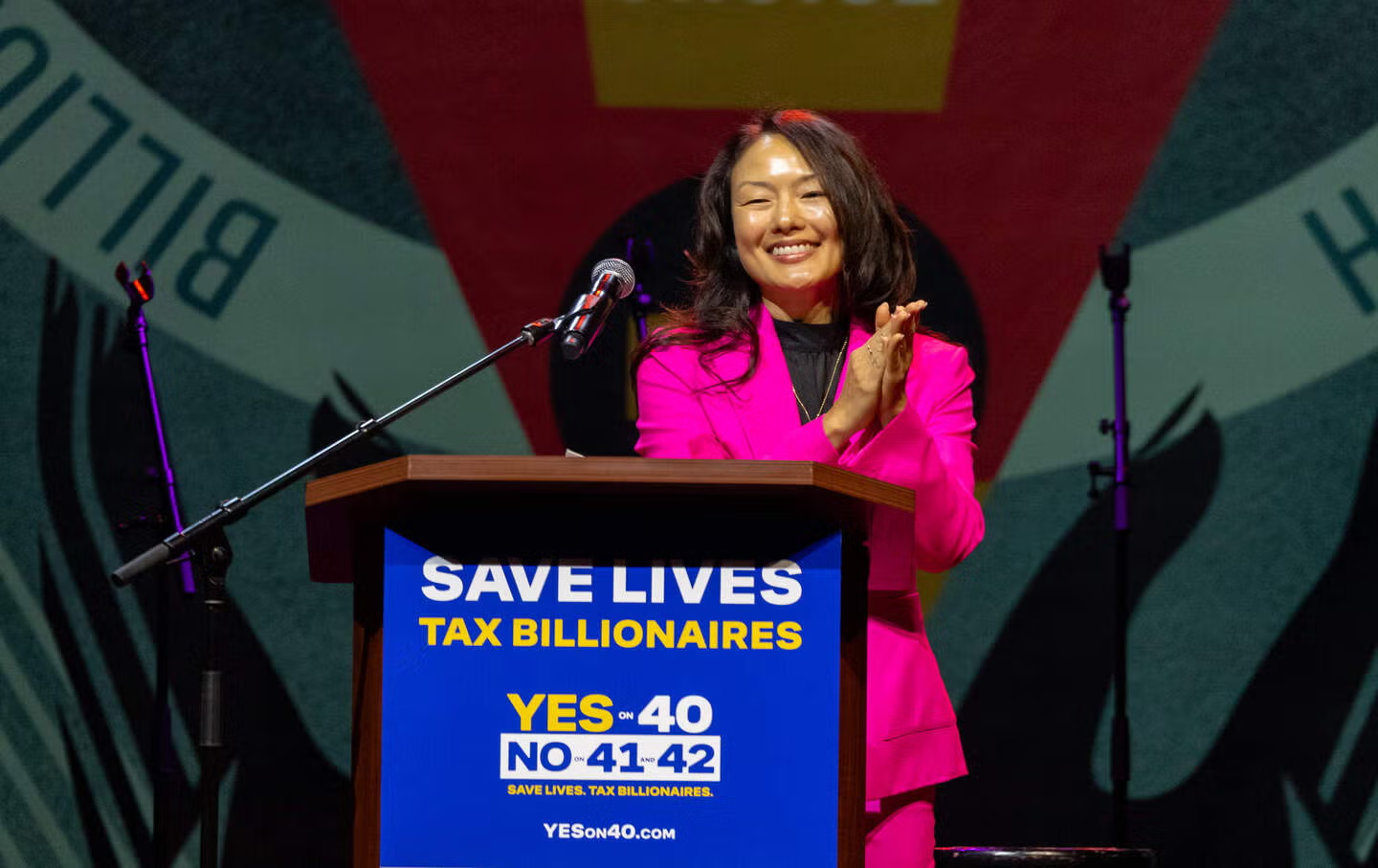
JW: Just want to point out here Bernie’s campaign schedule. Bernie Sanders is, what, 85 years old? He is doing an amazing amount of work in this election. He was out here in California the beginning of October to promote ballots over billionaires, prop 40, the billionaire wealth tax in San Francisco, and in L.A. He also campaigned in Bakersfield for Randy Villegas for Congress, our progressive out there. He’s been in Maine. He did three rallies with Troy Jackson. He was in Florida for rallies with Angie Nixon. He went to Texas, to Amarillo. El Paso and Houston with Representative Greg Casar and Beto O’Rourke. He went to Minnesota to Duluth to campaign for Peggy Flanagan and Keith Ellison. Just on Sunday, a couple of days ago, he was in Eau Claire in the middle of the day with Rebecca Cook running for Congress. And then he went to Grand Rapids, Michigan, that evening to campaign with El Sayed campaign the next day with El Sayed. He gave $1 million of his own campaign funds to El Sayed. Bernie Sanders, 85 years old. What a guy.
HM: What a guy. And he doesn’t have Trump’s advanced staff that Trump is using to campaign in Republican areas. No, there’s no question that Sanders is playing a key role. And I would add that he’s really the only major national Democrat campaigning for the wealth tax in California. That is, I think, extremely important, given that all the spending in that race is billionaire money against it. It takes a Bernie-type mobilization to even begin to counter that.
JW: Also, I wanted to ask you whether you agreed with Michael Tomasky, editor of The New Republic, who argues that Trump has a secret and perverse desire for the Republicans to lose. Now, let me just give you the argument here, because it seems so unlikely. He says, first of all, think about Texas. The only reason the Democrats have a chance in Texas is that the Republicans are running their worst candidate, Ken Paxton, and he won the primary only because Trump endorsed him. Trump easily could have endorsed the incumbent Republican. That would be the normal thing to do. John Cornyn.
HM: Cornyn. Yeah.
JW: And then there wouldn’t be a contest in Texas. So right off the bat, you have to ask whether Trump really wants to win the most important Republican state. And Tomasky has three other reasons. He says Trump is not on the ballot. And he actually kind of wants to say they can’t win without me. That would be completely consistent with his view of the world. The elections would prove how important he is. Next, Tomasky says he likes a mortal combat. And so, the Democrats taking power and come at him with their impeachment new impeachment plans. He’s at home there. He loves to fight, Roy Cohn’s lesson that if you’re not at war with at least ten enemies, something is wrong with you. And third, he welcomes the chance to condemn the Democrats for winning by cheating. His favorite topic over the last, you know, 8 or 12 years. And it’s easy to imagine him going on for weeks about how voting machines in Texas switched votes from Paxton to Talarico, or thousands of noncitizens voted for Abdul El-Sayed in Dearborn. What do you think of Michael Tomasky’s argument?
HM: Well, Michael is a good friend of mine, which means I think some of them are good and some of them aren’t so good. But that’s okay. And I think he does shine a light on the two that I think are very true: one, that Trump’s endorsements on occasion went to people who didn’t have a very good chance of winning. And that, yeah, he really likes to demonstrate that without him, the Republican Party is nothing. Because without him, everything is nothing — as Trump sees it. So, Mike is certainly right about those. And the other two are, let us say, nice conjectures.
JW: On the other side. Of course, Trump has offered to pay every adult citizen $5,000 if the Republicans win the midterms.
HM: Well, he’s offered to pay them with federal dollars, not his own dollars.
JW: But let me emphasize, this is not just Republican voters. Every Democrat will also get the $5,000 if the Republicans win. And as you point out, this is the taxpayers who would have to come up with $1.2 trillion, I think is the calculation there. He’s got a new one though – on Truth Social, he wrote, “anybody reporting voter fraud in past elections, or the upcoming 2026 midterm will be paid $1 million upon the arrest and conviction of those that created the fraud!” Exclamation point.
HM: That really underlines the failure of the Republican Party to actually find significant voter fraud anywhere. We take that as a sign of understandable desperation on the part of Trump and the party.
JW: “Understandable desperation.” Harold Meyerson – read him at prospect.org. Harold, thank you over the past weeks for all your help in understanding this election.
HM: And let’s hope that our provisional optimism means that everything I’ve said over the last few weeks isn’t just nonsense.
JW: [LAUGHTER] Okay.