What Trump Lost (and Won) With the Supremes
David Cole breaks down the Supreme Court’s latest rulings, while Amy Wilentz explains what the end of Temporary Protected Status means for Haitian immigrants.

The Nation Podcasts
Here's where to find podcasts from The Nation. Political talk without the boring parts, featuring the writers, activists and artists who shape the news, from a progressive perspective.
What Trump Lost–and Won–with the Supremes; plus Haitians after TPS / Start Making Sense
Trump biggest losses in the Supreme Court rulings announced this week were on birthright citizenship—widely anticipated—and the voting rights case where the majority ruled states could count ballots mailed but not received by election day. His biggest win was abolishing independent agencies except for the Federal Reserve. David Cole has our analysis—he’s the former legal director of the ACLU.
Also: The Court ended Temporary Protected Status, TPS, for Haitians (and others), but that does not mean deportations will begin immediately. Instead most of those with TPS will be given an opportunity to contest a deportation order or apply for remaining on a different basis. Amy Wilentz comments on the current responses in New York City, Miami, Springfield, Ohio, and in Congress.
Advertising Inquiries: https://redcircle.com/brands
Privacy & Opt-Out: https://redcircle.com/privacy
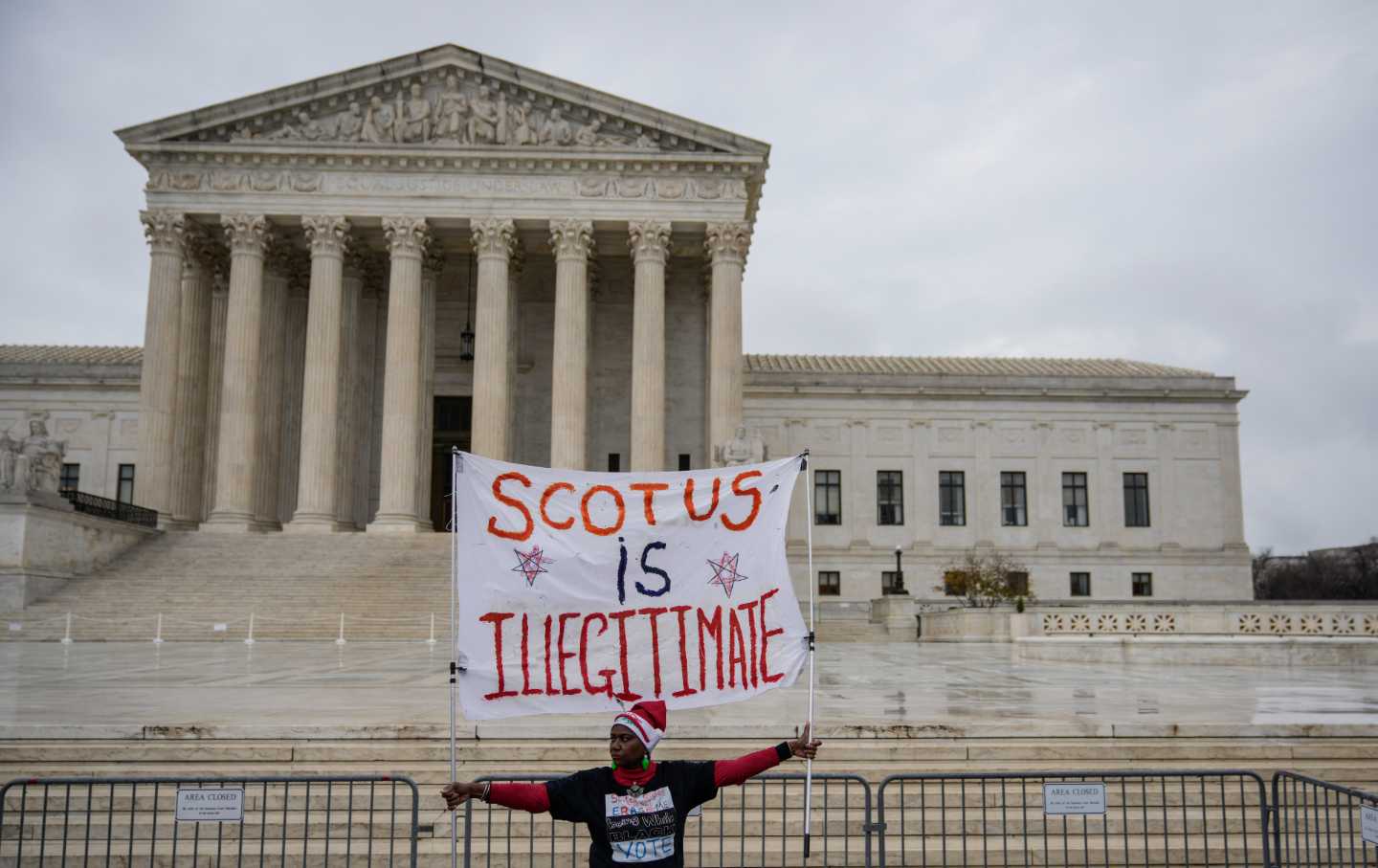
Immigration activists rally against the US Supreme Court’s ruling on temporary protective status on June 25, 2026, in Washington, DC.
(Kevin Dietsch / Getty Images)Trump biggest losses in the Supreme Court rulings announced this week were on birthright citizenship—widely anticipated—and the voting rights case where the majority ruled states could count ballots mailed but not received by Election Day. His biggest win was abolishing independent agencies except for the Federal Reserve. David Cole has our analysis—he’s the former legal director of the ACLU.
Also: The court ended Temporary Protected Status (TPS) for Haitians (and others), but that does not mean deportations will begin immediately. Instead, most of those with TPS will be given an opportunity to contest a deportation order or apply for remaining on a different basis. Amy Wilentz comments on the current responses in New York City, Miami, Springfield, Ohio, and in Congress.
Subscribe to The Nation to support all of our podcasts: thenation.com/subscribe.
The Nation Podcasts
Here's where to find podcasts from The Nation. Political talk without the boring parts, featuring the writers, activists and artists who shape the news, from a progressive perspective.
The Plan for No Kings-Vote Early Day, plus The Supremes and Trump’s voter list purge / Start Making Sense
Leah Greenberg, co-executive director of Indivisible, answers the question, “What’s the Plan — for the next No Kings Nationwide Day of Action?” This one shifts from mass protest in the streets to organizing for early voting – and preparing for whatever Trump does to disrupt or undermine the vote, the count, and the certification.
Also: The Supreme Court last Friday issued an order allowing states to use Trump’s SAVE database to purge their voter rolls of people the DHS considers ineligible – but it’s too late to apply to the midterms. Rick Hasen explains – he teaches law at UCLA and he’s Director of the Safeguarding Democracy Project and editor of the Election Law Blog.
Advertising Inquiries: https://redcircle.com/brands
Privacy & Opt-Out: https://redcircle.com/privacy
Search Results placeholder
Jon Wiener: From The Nation magazine, this is Start Making Sense. I’m Jon Wiener. Later in the show: When The Court ended Temporary Protected Status, TPS, for Haitians (and others), it did not authorize deportations to begin immediately. Instead most of those with TPS will be given an opportunity to contest a deportation order or apply for remaining on a different basis. Amy Wilentz will comment. But first: what Trump lost at the Supreme Court this week–and what he won. David Cole will explain – in a minute.
[BREAK]
For our analysis of this week’s Supreme Court rulings, we turn to David Cole. He’s the former national legal director of the ACLU, now teaches law at Georgetown. He also writes for The New York Times, The Washington Post, and The New York Review. And he’s The Nation’s legal affairs correspondent. David, Welcome back.
David Cole: Thanks for having me, Jon.
JW: The biggest one for the Supreme Court this term was birthright citizenship. Trump wanted to end the Constitution’s guarantee of citizenship for babies born in the United States to undocumented mothers. He issued an executive order to that effect. You and almost everybody else said he can’t do that. The 14th Amendment guarantees birthright citizenship for everyone born in the U.S.A., period. You were right. The Supreme Court majority agreed with you. That’s what the 14th amendment says. Were there any surprises here?
DC: Well, you know, I guess not huge surprises. The court decided this case after all, in 1890-something in a case called Wong Kim Ark. And essentially what Chief Justice Roberts did was reaffirm that decision which held that the14th Amendment was designed to make everyone a citizen who is born here with four narrow exceptions people who are born in embassies or of ambassadors because there’s foreign sovereign there, people who are born in a territory that’s controlled by an invading army because the United States is not in control there. People born on foreign ships because the United States doesn’t, isn’t in control there. And people born on – Native Americans born on tribal lands because they’re they allegedly have their own sovereignty, although we don’t really generally really honor that sovereignty. And that’s a closed set. And that’s what Chief Justice Roberts held, and the court strongly rejected President Trump’s signature effort to try to remake who is an American.
JW: There were three dissenting votes: Alito, Thomas, and Gorsuch. How could you dissent on this?
DC: Well, I think what they said was essentially they’re the issues presented today, namely, whether people who are illegally here, have a right to birthright citizenship and people and transient visitors, people who come here very briefly and then leave have a right to citizenship. We’re really not presented at the time that the 14th Amendment was adopted. We didn’t have restrictions on immigration. So, there was no such thing as illegal immigration. And because travel was much more onerous then, you couldn’t fly in, have a baby and fly out. And so, these are new questions. And they concluded that on these new questions the 14th Amendment does not preclude the president’s view. So, you know, it’s, it’s disturbing that three justices went that way and would rewrite what it means to be an American. But at the end of the day the majority prevailed.
JW: And we had another big victory for liberals, and for the Constitution, on voting by mail. Trump wanted to block the counting of mail ballots that arrived after Election Day. The court said “no” to him and approved a law that said ballots postmarked on election day could be counted, even though they arrived later than that. And Trump was more outraged, more crazed about this decision than any of the other decisions that went against him. He said on Truth Social that this shows there is “a powerful communist movement taking place in our country” — apparently led by John Roberts. Please explain why this was such a big deal for Trump and why his defeat is a big a big deal for liberals.
DC: Well, Trump has an obsession with mail-in ballots for some reason. Even though mail-in ballots don’t necessarily cut in favor of Democrats or Republicans in some elections, they’ve gone one way, other elections, they’ve gone the other way. And even though he in the past voted by mail he’s been obsessed with mail-in ballots. It’s, you know, one of the many irrational obsessions that he has. And this was a real a real shot at basically stopping many mail-in ballots from even being counted. And thankfully the Supreme Court, in a decision written by Justice Barrett, appointed by Trump, rejected Trump’s position, and said, “no, as long as the votes are cast by Election Day, the fact that they are received and counted thereafter does not violate the federal law that mandates a particular Election Day.” And that’s very important because many states do have rules that permit that. In many places, a lot of people vote by mail. Alaska, almost everybody votes by mail. And the exigencies of the mail being what they are, if you want to wait to make your decision until Election Day you wouldn’t have that option if your ballot had not only to be postmarked, but also actually received by Election Day.
JW: And there was another big defeat came when the court said Trump could not fire a governor of the Federal Reserve, Lisa Cook without cause. But that came with a related decision that was much bigger. There is a generation-long precedent that says that when Congress creates an independent agency, it’s able to make decisions without regard for what the president wants. And the president can’t fire the members of the commission if they do what he doesn’t want them to do. Trump himself made them all subject to his will, fired the heads of independent agencies who didn’t follow his wishes. And on Monday, the justices appointed by Trump said he could fire independent regulators for any reason or for no reason, with that one exception, the Federal Reserve Board, where they said its leaders could not be fired at will. Please explain what this is, how this works.
DC: The basic idea is that the president exercises executive power under the Constitution, and the conservatives have argued for some time now. That means that he has to be able to remove any principal officer, any head of an agency that is not acting as he wants them to act. And that’s required by the Constitution. That view, which has been sort of building in the court for, I would say two decades now. Basically, won the day in the case called slaughter in which the court overturned a unanimous decision from the Supreme Court from 1935 that said some agencies where there’s a reason to have independence and where they engage in quasi-judicial and quasi-legislative activities can be protected by for cause protection, meaning the president can remove their leaders only for malfeasance or neglect of duty, and not simply because he disagrees with something that they do. And so, now the president has unfettered power to remove at will any officer of any executive branch agency even where it would really undermine the effectiveness of that agency, the independence of that agency, the integrity of that agency, with this one exception, the Federal Reserve. And, the reality is that everybody on all sides from the most conservative to the most liberal, well, maybe not the most conservative, maybe not Thomas, but almost everybody agrees that it is absolutely critical that the fed make decisions about our national economy and our currency based on economic matters, and not on the partisan political desires of the president. And so, they carved out the fed. And then in order to make that carve out effective they rejected, at least at this point, President Trump’s effort to dismiss, fire, Lisa Cook, a one of the governors of the fed. He said it was for cause, so he said he was acting within the for cause limitation there. He pointed to her, an application for a mortgage that she submitted years before she was on the board and what the court said was, you have to at least give her an opportunity to respond a fair opportunity to defend herself.
JW: Let me just ask, on this mortgage application, had she been found guilty of lying on this application by any legal proceedings?
DC: No. Absolutely not. And it was a matter of whether a particular residence was a primary residence or a secondary residence. It’s not a major issue. It was obviously a pretext. He just wanted to get rid of her. He searched for a reason to get rid of her. And what the court said was, look, the fed goes back to the First National Bank of the United States, the second National Bank of the United States. Those were independent entities. And that history of independence allows Congress to give them a certain amount of protection that the Constitution forbids for anyone else. And is that a principled distinction? No. Is it an important distinction given what they held in slaughter? Yes. A better ruling would have been to say the Constitution doesn’t say anything about removal. It is silent on the question of presidential removal. The president’s power to remove officers, and therefore, it’s left up to the president and Congress to work out in a nuanced fashion, as has been the case for the last 200 years. But no, this Supreme Court said “no, there’s no nuance. There’s no working it out. One rule prevails, and it’s the rule we’re going to impose, even though the Constitution is silent on the matter.”
JW: And what Congress and all previous presidents had concluded was that there are some areas in which it is best to have professionals, experts making the decisions rather than political leaders. That’s the Consumer Product Safety Commission, the National Labor Relations Board, the Equal Employment Opportunity Commission, the Nuclear Regulatory Commission, the Postal Service, all of those places, we have thought for 90 years, some of them haven’t existed for 90 years, but the principle has been for 90 years. Some things should be ruled by expertise, not by politics. You think of the Nuclear Regulatory Commission. It’s more urgent now than ever that we have this kind of independent expertise making crucial what in some cases are life and death decisions, and the Supreme Court doesn’t seem to think so.
DC: Well, and one of the things that I think is most problematic about it is that, as I said, the Constitution is silent on this matter. The Constitution specifies how principal officers of the federal government are to be appointed. The president nominates them, then they get confirmed by the Senate. But it says nothing about how they are to be removed. And, elsewhere, the Supreme Court has said when the Constitution is silent, for example, on the subject of abortion, that means there is no constitutional constraint on the ability to regulate abortion. Well, the Constitution is silent on removal. That, you would think should mean that there’s not a constitutional constraint on the way removal is regulated. Under these four cause restrictions that Congress imposed, the president was still making the decision. He just had to make the decision within a framework of law, not for any reason whatsoever. And now he’s allowed to make those decisions for any reason whatsoever.
JW: One more big issue. The Supreme Court ruled on trans athletes permitting states to ban them in public school sports. This decision does not create an automatic nationwide ban. It’s up to the states. 29 states now have a ban in effect. And of course, it’s been a big talking point by Republican candidates. Democrats talk about affordability, Republicans reply by attacking them for favoring men competing in women’s sports, as they say. This case was about whether a state’s ban on trans athletes violated Title IX and therefore constituted discrimination based on sexual orientation. Tell us about that one.
DC: I think one way to think about this is by focusing on the facts. The main case the court decided is called “BPJ v. West Virginia”. That’s because it involved a minor. And so, the name the full name is not there, but BPJ. When this case began, BPJ was an 11-year-old transgender girl–identified as male as a birth, but very early on determined that she was a girl. Wanted to, you know, run on the cross-country team, the cross-country team in her middle school said, sure, you can run on the cross-country team. There’s no limit on who makes the team. So, allowing you to run doesn’t hurt anybody else. She did run. She was not particularly fast. She ended up finishing sort of last or close to last in most of her races. No one objected to her being on the team, who was on the team or who competed against her. And then the West Virginia legislature decided this was a good wedge issue. And so enacted a law that categorically bans trans girls from participating on girls’ teams. And the claim in the case was, this is somebody who has gone through hormone treatment for gender dysphoria so that she has never actually gone through puberty, she has reduced, her testosterone levels so that they are at the same level as an ordinary cisgender girl. She has no sex-based advantage over a cisgender girl. She doesn’t put anybody out and to apply a categorical ban to someone like that who does not have any sex-based advantage is sex discrimination. That was the claim. The court rejected that claim. The claim was founded both onTtitle IX and the Equal Protection Clause, and the court basically said “it’s good enough for us that, as a general matter, persons identified as male at birth have advantages over persons identified as female at birth.” Sex segregated teams are therefore generally permissible based on what the court called “biological sex or sex identified at birth.” And therefore, there’s no constitutional right or statutory right for someone like B.P.J. to participate. And what does that mean? It means she can’t play sports when nobody at her school objected, nobody who she was competing against objected, she is precluded from playing sports. She can’t make the boys team. She’d have to reject her identity as a girl in order to even participate on the boys’ team. And now the West Virginia legislature, for political reasons, not for any legitimate reasons, has excluded her from participation in any sports in school.
JW: I want to just take a step back and look at the big pattern here. Most of these votes were 6 to 3, the Republican appointees in the majority. And the pattern here is the Republican appointees give President Trump and all his successors much more power than they had before. I’m reluctant to call these people conservatives because that’s not really a conservative idea. To what extent is this simply Trump’s appointees being, what shall we say, reciprocating the favor of their appointments? To what extent is there something else going on here?
DC: So, I would say a couple things. One is I do not think this is a Trump court. This is not much to his dismay, as evidenced by his comments after the tariffs case and after the mail-in ballots case, and probably after the birthright citizenship case, we’ll see. Much to his dismay, this is not Donald Trump’s court. The court rejected his signature economic and international foreign policy tool, tariffs. It rejected his effort to rewrite who is an American. It rejected his effort to put National Guard troops on city streets against the people’s wishes. And it rejected his effort to politicize the fed by firing a Democratic governor. And in those cases, Trump appointees voted with Chief Justice Roberts and the liberal Democratic appointees to rule against Donald Trump. So, this is not a Trump court. On the other hand, it is a very conservative court, extremely conservative court, radically conservative court that doesn’t really care all that much about precedents that it disagrees with. And so, it overturned almost 100-year-old precedent in the case about the removal of officers in a campaign finance case that came out on the last day of the term, it overruled a 25-year-old precedent allowing parties to basically give unlimited amounts of money in coordination with candidates for elective office, further weakening any realistic limitation on campaign finance. And in probably the worst decision of the term Calais v. Louisiana. It radically rewrote the Voting Rights Act to basically make it impossible for minority voters to succeed on a claim that they have been iced out of the representational process. So no, it’s not a Trump court, and Trump can’t rely on it to simply, give him a blank check. But yes, it’s a very, very conservative court, one that ignores precedent that it doesn’t like, and I think is far to the right of the people of this country.
JW: “A radically conservative court” – David Cole, former national legal director of the ACLU. David, thanks for talking with us today.
DC: Thanks for having me. Jon.
[BREAK]
Jon Wiener: The Supreme Court last week ended Temporary Protected Status for Haitians in the United States, along with Syrians. The court ruled that Trump can expel all 350,000 Haitians, ending the humanitarian protections that have permitted them to live and work legally in the U.S. for more than a decade. For comment, we turn to Amy Wilentz. She’s written about Haiti for a couple of decades for The New York Times, The Washington Post, The Atlantic and The Nation, and in the award-winning books The Rainy Season and Farewell, Fred Voodoo. She was also Jerusalem correspondent for The New Yorker, and she taught in the literary journalism program at UC Irvine. She’s also a 2021 Guggenheim Fellow. Amy, welcome back.
Amy Wilentz: Thank you so much, Jon.
JW: The United States, as we’ve often said here in the past, has a long history of political and military interventions in Haiti. But they changed course in 2010 after the earthquake there killed 220,000 people and extended Temporary Protected Status to Haitians who came to the United States. This program had been created by Congress in 1990 with bipartisan support. It provides temporary legal status to people whose home countries have been determined to be unsafe because of war, natural disasters, or other crises. I wonder if you would say that Haiti today still qualifies as “unsafe.”
AW: I would say it’s still unsafe, and in fact, it’s less safe. The earthquake was a once in a century, one could hope event and killed hundreds of thousands of people. But from there, things went downhill, if that was possible, since the country was already in a state of some chaos and disrepair at that time. But this paralyzed what government did exist and things got more complicated, and arms flowed into the country to sort of embryonic, not embryonic enough, but embryonic gangs. And they picked up their arms and they began choosing territory, fighting over territory with utter and complete disregard for non-involved civilians who were living in places they desired. The government was basically non-existent. And when it was existent, it had a president who still was doing nothing to combat insecurity. And then he was killed. So, he was assassinated in his bedroom while his security guards cleared the way for the assassins. Now it’s a terrible state. Millions of people are homeless right now, and this is the environment considered by the State Department to be a place where Americans must not travel and if they are, there must be constantly in touch with the embassy there. So, you’re not supposed to go there? We’re not supposed to go there. Haitians in the diaspora, in New York and Boston and elsewhere are not supposed to go there. And now President Trump and Chief Justice John Roberts, I have to include him, would like to send 350,000 Haitians, basically to Port-au-Prince, where the chaos is the worst, and deposit them there. They haven’t been there in at least 15 years. Many of them were here in the United States before TPS was declared and are protected by TPS from having to go back to Haiti. And now they’re going to have to go back with their American born children and their old grannies and everybody. And it’s an insult to Haitians as the entire Trump 2 administration has been.
JW: Well, the ability of Trump to quickly expel people who previously had TPS protection isn’t immediate. They’re not immediately going to be rounded up and sent back. It depends on whether people already had pending deportation orders. And my understanding is most Haitians in the United States had not been subject to deportation orders before they got TPS. If they don’t already have deportation orders, they are what’s called subject to removal. That is not the same as instantly deportable. If you are subject to removal, you get notified and then you can contest your removal orders before an immigration judge, you can apply for asylum. You can apply for a work visa, or you can look for some other types of authorization to live and work in the United States. These are very difficult to get of course, the pathways are narrow, and the proceedings take a long time, but it’s not the same as people are going to be rounded up next week and sent to Port-au-Prince. And I want to look at their response to the Supreme Court action in three places that have significant Haitian populations New York City, Miami and Springfield, Ohio. And then talk about Congress too.
Brooklyn is the home of about 65,000 people who came from Haiti. New York mayor Zohran Mamdani went to a rally organized at the headquarters of the Health Care Workers Union, 1199 SEIU, very famous local, I think it’s the largest health care union in the United States. Mamdani wore a sticker of the Haitian flag and said, “no matter what this decision brings, in the weeks to come, you are not going to face this alone.” And New York Governor Kathy Hochul was also there. The sign on the podium said “Haitians care for New York,” referring to the prominent role they play in the health care field. Mamdani emphasized the city’s existing sanctuary framework: ICE is not able to enter New York City property, he emphasized, that schools, shelters, hospitals without a judicial warrant, and the City of New York is promising not just to advance what they call the language of solidarity, but actions of solidarity.
There’s a mayor’s Office of Immigrant Affairs that is helping patients who had TPS. There’s a hotline they can call to get a lawyer. It’s free. It’s confidential. It’s available in Haitian languages. And New York City has a real infrastructure to help people. Mamdani also emphasized that legal services, support services, case management. Hospitals are still open to Haitians in New York City. So, let’s talk about New York’s response, for starters.
AW: You know, it was extremely heartening to hear this from Mayor Mamdani. Another reason to be glad that he was elected mayor, a person with a moral backbone. I think that’s great for the Haitians in New York City. I expect there may be a lot of Haitians not moving to Haiti, but to New York City in the next few months. But, in terms of it’s great for anyone that they manage to help and protect. It’s very hard to go through the legal system you were talking about, Jon, for the average American English-speaking person to go through any government legal system is very difficult, painstaking, long and expensive. And for Haitians, it’s extremely confusing because they come from a country that doesn’t have any of that stuff. So, they have to, you know, figure it all out. I hope it can take two years because if it can be postponed for two years, maybe Trump will be out of office and the whole horizon will change for Haitians and other immigrants living here and other TPS protected immigrants. But if it doesn’t take long enough, the Haitians are going to be, they’re very serious people, just like the rest of us. They’re going to be estimating their chances of being deported and a directive of deportation or not. They’ve seen what ICE can do. So, they’re going to be very nervous, and they’ll be glad that Mayor Mamdani over in New York is on their side. But what if they live in LA or they live in Springfield? What’s going to happen to them?
JW: Well, that’s New York City. There is one city in the U.S. that has a bigger Haitian population. That is, Miami has more than 100,000 Haitians. It’s the largest Haitian community in the United States. And unlike New York, Florida cooperates with Trump immigration policy. Miami is not a sanctuary city, so the city government itself is not pledging to do anything to help Haitians. Instead, in Miami, the work is being done by a dense civil society network of nonprofits, legal aid groups, and faith organizations that have been preparing for this possibility for months, if not for more than a year. The lead organizations there are called the Florida Immigrant Coalition and the Family Action Network Movement. They’ve been emphasizing that Haitians need legal help, advice on preparing a family preparedness plan. Their message has been “know your rights, have a contingency plan.” So, in Miami, it’s been up to civil society nonprofits, and there are a lot of those in Miami.
AW: Yeah, well, this is a thing about Haitians. They know how to deal with nonprofits. They have non-governmental agencies galore in Haiti trying to help people sometimes satisfactorily, sometimes not with health care, all sorts of things. So, they’re used to networks. Networking is a Haitian thing. Community organizing is a Haitian thing. They have, they live in sort of little communities in Haiti within the larger urban community. And I think that’s important to remember. So, when, yeah, it’s not a sanctuary city. So that the planning has to be both for legal and governmental bureaucracy, but it also has to be for personal safety and security, as we saw in Minneapolis. I mean, many bad things can happen when, when ICE is unleashed to pick you up. So that’s going to be hard without the help of the Miami police, although the help of Miami police is not always a good thing. So, it’s worrisome that it’s not a sanctuary city, but there aren’t that many sanctuary cities in the US. And, also, because it’s 100,000 Haitians in a somewhat smaller city than New York, they’re very much felt as a part of the population in Miami. And I think that’s going to really help Haitians through this difficult period is the help of their neighbors and people coming out and saying, no, these are our neighbors, our equals, our friends, our protectors, the Haitians, in some cases.
I just saw a cartoon which showed a white guy lying in bed and obviously an American hospital, and it said, :night nurse on duty: Haitian nurse has been deported. Day nurse coming tomorrow: Haitian nurse has been deported.” So, you know, that’s the kind of situation you have in Miami, in New York. Also, a lot of the health care workers, as you said, are Haitians and people know them.
JW: And then there’s Springfield, Ohio, which perhaps the best-known small town that has a large Haitian population, 10,000 Haitians in Springfield and a city of 60,000 people. New York Times ran a big report from Springfield a couple of days ago. They described how the Central Christian Church started a group called “G-92” after the ancient Hebrew word for “stranger”: “You shall not oppress a stranger, for you were strangers in the land of Egypt,” from the Passover reading from Exodus.
The Central Christian Church in Springfield organized the City Hall rally last week, after the Supreme Court decision, to protest it. One activist there said, “we are not laying down. We’ve been planning for this for 18 months.” The Central Christian Church in Springfield has formed a rapid response group. They’re going to be driving through the streets to alert people if immigration agents are raiding people in Springfield. Several churches have gone beyond that, they have lists of congregants who are willing to care for the American born children of Haitian parents if the parents are detained or deported.
And in Springfield, Ohio, there are, according to The New York Times, our national newspaper of record, “there is a small secret network in place-to-place patients in the homes of citizens who will shelter them in spare bedrooms and basements, hiding them,” The New York Times says, “the way that another generation of Springfield residents hid people fleeing slavery in the 1850s as part of the Underground Railroad.” So that’s the Christians of Springfield, Ohio.
AW: Yeah. Well, Trump tends to bring out the best in his enemies, and his enemies are kind of righteous, I have to say, these people at the Christian Central Church are amazing, and they represent the large majority of Americans in Springfield, I think. I mean, there were demonstrations broader than just for the Central Christian church in Springfield since the decision. And again, if it’s sort of a microcosm of the whole scene in the American more or less urban world, with Haitian immigrants, if Trump were successful in removing every one of the 10,000 Haitians who lives in Springfield, Springfield would be a ghost town, as it was before they arrived.
JW: Yeah.
AW: It was a manufacturing city that had lost a lot of jobs. And most of the jobs that still remained Americans didn’t want to take, and that’s how the Haitians came in the first place. And then once they came, they said, “hey, there’s a city here where you can come. It’s nice. The people are good there. They’re Central Christians, come to Springfield” — and they did, en masse, and they’ve done tons of good for the city.
And from what I understand, downtown Springfield for what it is, many of the businesses there are Haitian-owned by people protected by TPS. If they leave, those businesses will close. Whoever’s employed by those businesses will not have jobs, and it’ll be a whole trickle down and around problem for Springfield. But the racists in the Haitian government, no, but the racists in the Trump administration will be happy, I suppose. I really don’t understand it. I think it’s the lifting of TPS at this moment is a ploy to make sure that the Trump administration can at least count on the heart of MAGA to support it during the midterms. But otherwise, I can’t even begin to understand the racism underlying this. I can’t believe that they are really so racist as the pronouncements of people in the administration, including the president, seem to indicate they are.
JW: And meanwhile, in Washington, Chuck Schumer, the Democratic leader of the Senate, urged the Senate to pass legislation he introduced that would extend Temporary Protected Status for Haitian immigrants until 2029, which, as you pointed out, is when Trump leaves office. This legislation extending TPS for Haitians has already passed the House, passed the House in April, and the vote was 224 to 204, which means that ten Republicans joined Democrats in supporting this legislation. Now it’s been sent to the Senate. The sponsor in the House was Representative Laura Gillen of New York. And as of now, the House passed. Bill is in the Senate waiting for action. Nothing can happen without action by John Thune, the Republican majority leader, he controls whether it will come up for a Senate vote. Even if Schumer’s proposal and or the House bill are voted on in the next few weeks, they face, of course, a presidential veto threat. But still, it would be a significant move, it seems to me. How does it seem to you?
AW: It would be a significant move if the Senate acted on it and voted it into law. Yeah. Even if the president vetoed it, I think it would be a significant sign that maybe the Senate has a brain and is still extant. Yeah, but I think that Thune probably is feeling very much cornered right now and doesn’t want to bring it up for a vote. Independence Day is coming. I’m sure they have the day off. I mean, they’ll do anything not to have to vote on it, probably. But if it does come to a vote, then. I don’t know how the Senate will go. I don’t think you can predict that it will be approved at all.
JW: So, I’m sure that Haitians in the United States are thinking about where can they go if they do get expulsion orders. And let me ask you about some of these. Can they go – how about Canada? Is Canada welcoming Haitians?
AW: Well, Canada has traditionally welcomed Haitians quite openly. But I I’ve heard that they have been restricting immigration recently. And I think it might be a lot harder now than it has been in the past. Then, I think Europe is, it has its own immigration problems. And I don’t know how friendly President Macron would feel toward a huge Haitian immigration right now. Normally, I don’t think he would be upset, but I think it’s like it’s troublesome in Europe. There are African nations that speak French. I’m not sure the Haitians want to go there.
JW: And let me ask specifically, a few years ago anyway, Haitians went to Brazil and Chile. Is that still possible?
AW: I don’t think so. They’ve really closed down on that. Yeah. They’ve canceled flights from Haiti. They’re not welcoming those. This is Brazil that I know about. Not so much Chile.
JW: Well, in Chile was where the that huge group of people started walking that ended up at the border in Texas. Weren’t they from Haitians who had started in Chile?
AW: Some had started in Chile, some had come from Brazil. Many of these Haitians who are now under the protection of TPS walked that whole walk, but also had worked in Brazil with their families for 4 or 5 years before they began to migrate to the US. So, they’ve been out of Haiti for a really long time. And let me say this, I know almost to a person how much these people would like to go back to Haiti, a Haiti that they remember from the old days, when it was semi-stable and livable and had the traditions that they love and know. I just know they must be longing for their country, but not the way it is today. It’s not proper or livable right now.
JW: I wonder if what your concluding thoughts are. What do you imagine it will be like for Haitians who’ve been here for ten years or 16 years, and for their neighbors, when the deportation proceedings do go into high gear?
AW: I think like in Springfield, the neighbors feel that the Haitians are – I mean, most of the neighbors feel that the Haitians are like them. And it’s as if you were living in a middle-class neighborhood in in Fairlawn, New Jersey, and suddenly all the people who lived in your neighborhood were, you know, disappeared. It would be very, very weird for the city of Springfield – the white American city of Springfield – to lose those people. For the Haitians, it’s almost inconceivable. Now imagine those people from Fairlawn, New Jersey, who look like us, Jon, white people down in a country where everyone is unhoused, where there’s no sanitation, no health care, no legal system, barely a government and gangs roaming the streets with guns. You know, this may change in Haiti, and it may change soon. Who knows? Maybe somehow the gangs will realize there’s no one left to kidnap, no one left to steal from. But in the meantime, a ripe crop of people to kidnap and steal from would be these Haitians deported back to Haiti and into the midst of Port-au-Prince and Cap-Haïtien.
JW: Amy Wilentz – Amy, thank you for talking with us today.
AW: You’re welcome, Jon.
Subscribe to The Nation to Support all of our podcasts
Become a Sustaining Donor This September
Between the reemergence of right-wing red-baiting and Donald Trump’s use of the chilling National Security Presidential Memorandum–7 to criminalize left political organizing, we’re seeing McCarthyism reborn before our eyes.
This assault on democracy cannot be ignored or wished away. Resisting it requires bravery in the face of threats and repression, a steadfast commitment to the truth, and the unwavering belief that we can—and will—overcome this darkness.
We must have an independent media that sets the record straight, unearths corruption and abuses of power, and advances a politics of justice and dignity for all if we’re to win this fight.
That’s why I’m writing to you today. This September, The Nation needs to add 100 monthly donors to sustain our progressive journalism. Your contribution makes the next investigative report, the next truth-speaking column, and the next pathbreaking essay all possible.
I hope you’ll support our work with a recurring donation today. If you donate $10 or more a month, we’ll send you a brand new “Hands Off the Free Press!” sticker to recognise your commitment to our cause. Please, donate today.
Onward,
Katrina vanden Heuvel
Editor and Publisher, The Nation