Trump, from Minneapolis to Caracas—Plus, How Capitalism Came to Communist China
On Start Making Sense, Harold Meyerson on Trump’s efforts to overcome collapsing support, and critic John Powers talks about the new TV series “Blossoms Shanghai” by Wong Kar Wai.

The Nation Podcasts
Here's where to find podcasts from The Nation. Political talk without the boring parts, featuring the writers, activists and artists who shape the news, from a progressive perspective.
Trump, from Minneapolis to Caracas—Plus, How Capitalism Came to Communist China | Start Making Sense
As Trump’s support collapses, he has lashed out in two directions–sending an unprecendented number of ICE agents to Minneapolis, where one of them murdered Renee Good, and sending the military to Venezuela, where he says he has seized control of the oil industry. Harold Meyerson comments.
Also: Twenty Minutes Without Trump: There’s a new TV series about how capitalism came to Communist China, 30 episodes made for Chinese TV by the great Hong Kong director Wong Kar Wai, running now on the Criterion Channel. John Powers, critic-at-large on Fresh Air with Terry Gross, explains.
Advertising Inquiries: https://redcircle.com/brands
Privacy & Opt-Out: https://redcircle.com/privacy
IN FLIGHT – JANUARY 11: U.S. President Donald Trump takes questions from the members of the press aboard Air Force One on January 11, 2026 en route back to the White House from Palm Beach, Florida. The President spent the weekend at his private club Mar-a-Lago in Palm Beach, Florida.
(Photo by Samuel Corum/Getty Images)On this episode of Start Making Sense, Harold Meyerson comments on Trump’s efforts to overcome collapsing support, and critic John Powers talks about the new TV series “Blossoms Shanghai” by Wong Kar Wai.
As Trump’s support collapses, he has lashed out in two directions–sending an unprecedented number of ICE agents to Minneapolis, where one of them murdered Renee Good, and sending the military to Venezuela, where he says he has seized control of the oil industry. Harold Meyerson comments.
Also: Twenty Minutes Without Trump: There’s a new TV series about how capitalism came to Communist China: 30 episodes made for Chinese TV by the great Hong Kong director Wong Kar Wai, running now on the Criterion Channel. John Powers, critic-at-large on Fresh Air with Terry Gross, explains.
The Nation Podcasts
Here's where to find podcasts from The Nation. Political talk without the boring parts, featuring the writers, activists and artists who shape the news, from a progressive perspective.
Protest after No Kings, plus Abortion after Dobbs / Start Making Sense
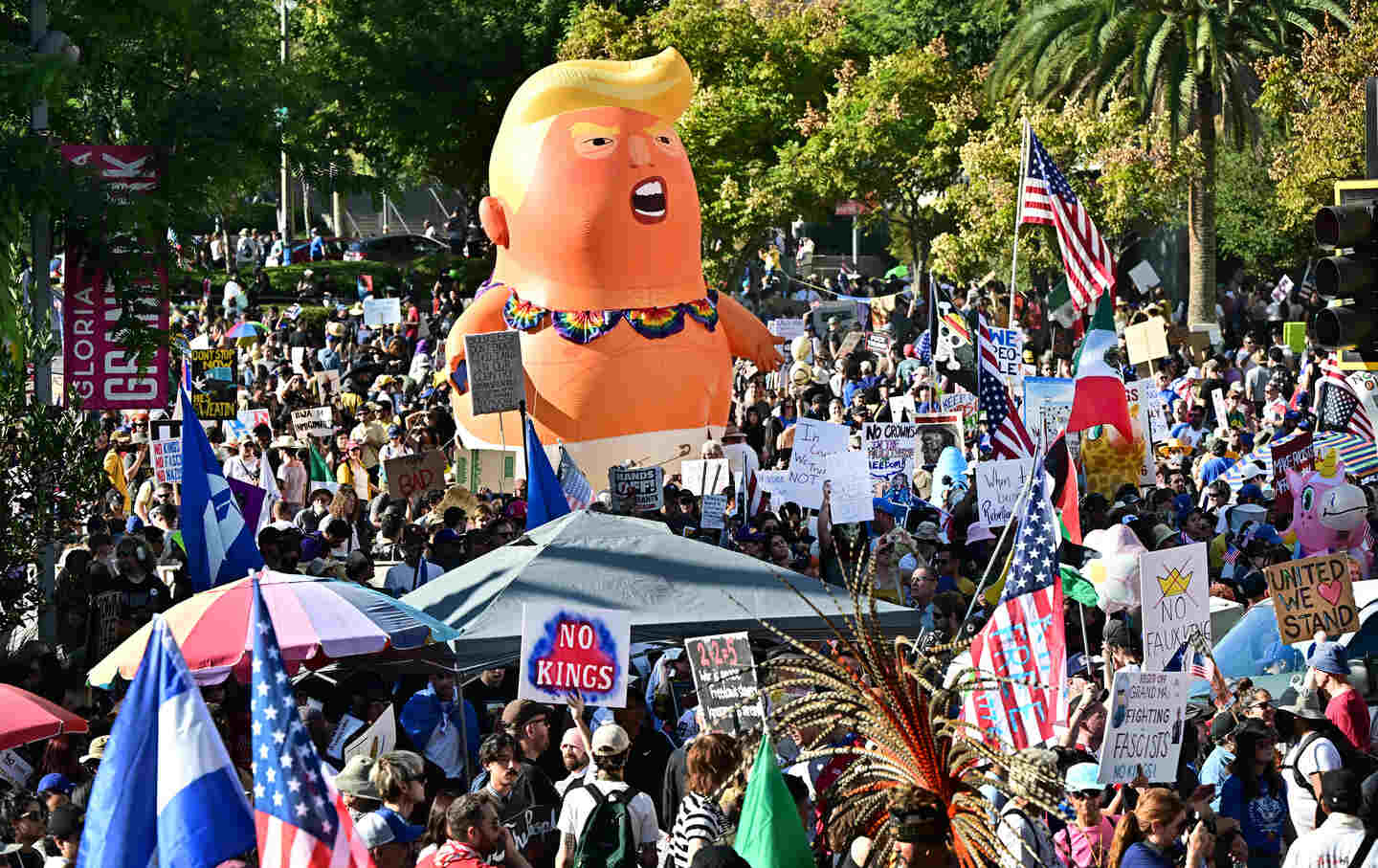
We’re still thinking about No Kings 3 day on Saturday: 8 million people. 3,300 events. ‘No Kings’ protests in almost every city and town in the country. 100 towns in Texas alone had No Kings protests! It was the largest single-day nonviolent protest in American history. John Nichols analyzes the possibilities for what comes next.
Also: No one expected that revoking the constitutional right to abortion would wind up expanding access to it. But ever since the Supreme Court's Dobbs decision in 2022 allowed more than a dozen states to ban abortion outright, the number of abortions in this country has actually risen every year. How did that happen? Amy Littlefield explains; her new book is Killers of Roe: My investigation into the mysterious death of abortion rights.
Advertising Inquiries: https://redcircle.com/brands
Privacy & Opt-Out: https://redcircle.com/privacy
Search Results placeholder
Jon Wiener: From the Nation magazine, this is Start Making Sense. I’m Jon Wiener. Later in the show: 20 minutes without Trump — a TV series about how capitalism came to Communist China, by the great Hong Kong director Wong Kar Wai. John Powers will comment. But first: from Minneapolis to Caracas, Harold Meyerson has our political update — in a minute.
[BREAK]
JW: Harold Meyerson is editor at large of the American Prospect. Harold, welcome back.
Harold Meyerson: Always good to be here, Jon.
JW: We’ve said for a long time that, as Trump’s support collapsed, as his approval ratings crashed, as voters overwhelmingly rejected his candidates, we’ve always said that, as he sinks, he would become more dangerous. And that’s what’s happened in the last week, on two fronts – in Venezuela, and in Minneapolis.
On January 5th, this is five years after his attempted insurrection, he sent 2,000 federal agents to Minneapolis, the largest federal enforcement operation ever launched. And the next morning, an ICE agent named Jonathan Ross shot and killed 37-year-old Renee Good as she was trying to drive away from him. The regime then labeled her a “domestic terrorist.” Her wife, Becca Good wrote, “we had whistles, they had guns.”
But this past weekend we also had marches and vigils and mass actions to call for action: “Stop ICE — for Good.” People organized nearly 1,200 events across the country, and the organization was virtually spontaneous; within 48 hours.
So as Trump becomes more dangerous, the opposition to him grows in size and gains in strength and commitment. It’s terrible to see the damage he’s doing, but it’s stirring to see the courage and solidarity of the resistance.
Tuesday this week, there were demonstrations in Washington DC. What kind of demands should we be making now of the Democrats in Congress?
HM: First of all, the Democrats in Congress had better win the November elections, because then they will have some power. What actually interests me is some Democrats in state legislatures’ reaction to this. In Maryland, for instance, a Democratic legislator has introduced a bill that would ban every in-state police agency from hiring anyone who’s been working for ICE or the Border Patrol — that would be viewed as a disqualification for doing police work within the state. I don’t see any reason why the 18 states that have trifecta Democratic control can’t enact such laws.
What we’re seeing with what Trump is doing with ICE and the Border Patrol, and I cite the Border Patrol because most of its employees have been stationed away from the borders and are really the most violent enforcers, including Jonathan Ross, of Trump’s war on immigrants and anyone he doesn’t like. We really need to curtail those agencies. At the federal level that’s going to be accomplished only by the Democrats turning out at the polls and recapturing the federal government. And one way to keep that going is indeed the kind of rallies that you just cited, Jon, but at the state level where Democrats do have control, they can enact laws such as the ones I cited of forbidding wearing masks and so on.
JW: The group Indivisible, which coordinated many of these demonstrations the past weekend, suggests that the demand should focus on the coming budget battle. We’re going to have another budget fight. There’s another deadline at the end of this month, and some are demanding “Defund ICE” as a requirement of Democrats as they go into the budget fight. Others, “no funding for the Department of Homeland Security unless they rein in ICE.” And this could lead presumably to another government shutdown, maybe, that the congressional leadership of the Democrats is very reluctant to do. What do you think about focusing on the budget battle?
HM: Well, I think the Democrats have to focus on the budget battle. They don’t have the votes, I think, to stop the budget from passing the House. They do, however, have the votes, because it will take 60 votes, to stop the budget from passing in the Senate. I don’t know if there are 40 Democrats, which is what it would take to completely defund ICE. I would imagine there might be 40 Democratic senators who would hold up the Department of Homeland Security budget based on the kind of conditions you just stipulated, Jon.
JW: So that’s the story as it stands today from Minneapolis and the response to what’s happened in Minneapolis. The second front where Trump has been trying to make himself feel strong as he becomes politically weaker, has been of course Venezuela.
When Trump returned to the White House in January, he had two ideas that he’d campaigned on: Tariffs, and “drill baby drill.” Tariffs had been a flop. I want to look more at the energy prices, which he says are going to be helped by invading Venezuela.
During the 2024 campaign, he promised to cut energy prices in half. In his inaugural address in 2025, he declared a national energy emergency, which required repealing environmental regulations. He promised that would “make us a rich nation again, and it is that liquid gold under our feet that will help us do it.”
This past Friday, Trump met with the top executives of the oil companies to discuss his plans for Venezuela. Meeting was basically a debacle. None of the oil executives were willing to commit to going back to Venezuela and investing there. And if you watch the video of this, Trump spent a substantial part of his meeting with the energy executives talking about his ballroom project and actually getting up and looking out the window. And of those executives only the CEO of ExxonMobil, a gentleman named Darren Woods, spoke out. He called Venezuela “un-investable” under current conditions. Remind us why the oil companies are so reluctant to go along with Trump on this.
HM: Well, when an oil company commits to drilling, this is a huge commitment of capital and requires a general sense that they will be permitted to do so by whoever the government is and that they’ll be secure from those who might seek to disrupt it. None of these conditions pertain in Venezuela, to put it mildly. You have the military establishment that’s completely against what Trump did in seizing Maduro. You have all kinds of factions. You have an infrastructure which has decayed over the years, as oil companies have largely pulled out of Venezuela, they seek a level of stability, which is rational for a company that is being asked to invest a great deal of capital. And absent that stability, they can’t really justify to Wall Street among others why they would spend capital doing that.
JW: Paul Krugman noticed that the day after Trump’s meeting with oil executives, the American Embassy in Caracas issued an alert do not travel to Venezuela. Americans in Venezuela should depart immediately. The alert said there are groups of armed militias setting up roadblocks and searching vehicles for evidence of US citizenship. The risk to Americans include, according to the embassy in Caracas, “wrongful detention, torture in detention, terrorism, kidnapping,” and “poor health infrastructure.” Does that sound like a great place to spend a hundred billion dollars?
HM: Probably not.
JW: And there’s one other factor which became evident the day after Trump met with the oil executives: when the Bureau of Land Management auctioned off more than 20,000 acres of public land in Colorado for oil and gas drilling, the kind of thing that Trump does, that the environmentalists – makes the environmentalists sick, let us say, but there were no bids, zero bids on the oil and gas land auction, despite the fact that the land was offered at very low prices. What does that tell us?
HM: Well, among other things, oil companies like there not to be an overabundance of oil on the market because that brings down their prices. So their interests are not necessarily those of well among others, American consumers, of a government that might want to for a variety of reasons, lower prices. I should also add though that in his war against wind and solar power, Trump is also restricting energy at a time when electric bills are soaring in much of the country, he’s sort of guaranteeing that they will continue to soar. “Drill baby drill” is only half of Trump’s message. The other half is, “and stop all other forms of energy production, even if they might lower, help lower prices.” So this is a bit of a house divided against itself, which is one of the kindest things I guess you can say about the Trump presidency.
JW: And the federal court this week ruled against Trump’s order to block the multi-billion-dollar wind project development Off Grid Island, and the judge ordered that to proceed. So Trump is being frustrated, defeated, and weakened on the wind power front as well.
HM: Yeah, but that will be appealed by the Trump administration, inept though its lawyers may be.
JW: Now, the oil executives who met with Trump didn’t completely refuse to have anything to do with the Venezuelan oil. Apparently, they said they would like to be repaid by the money that Trump says he’s going to make from Venezuelan oil for their losses when Venezuela nationalized the oil industry in 2007. Conoco Phillips, for example, claims it is owed about $12 billion, and suggested they should get that from the oil income that Trump is now claiming to make available. Trump did tell them, “We’re not going to look at what people lost in the past, because that was their fault” — Trump logic at its best; “you’re going to make a lot of money now, but we’re not going to go back.”
And then he signed an executive order on last Friday, just to make it clear, declaring yet another national emergency. Apparently, it’s his 10th national emergency. This one says, “Any use of the revenue from sale of Venezuelan oil to repay the billions of dollars owed to oil companies will materially harm the national security and foreign policy of the United States.” What do you think about that?
HM: It just emphasizes the elevation of his personal manias over what, among others in this case, what business logic, which presumably he was held himself as a model businessman, what business logic would dictate.
So this is a personalist regime for president. We need to look to the Bourbon Kings of France as much as any other, more post monarchial government as a model for what Trump is doing.
JW: Oil is kind of a special case for Trump here, not just because of the “drill baby drill” promise, but don’t I recall that during the 2024 campaign, he invited the oil executives to a fundraiser at Mar-a-Lago — and what was it he asked?
HM: Well, I think what he did was he invited the oil executives in, and he asked them just for $1 billion in campaign contributions, in return for which he promised that his administration would treat them royally. I think that’s an adverb we can attach safely to Trump.
JW: And do we know what the amount of funding for Trump’s election campaign ended up coming from the oil industry?
HM: I think it was about half a billion dollars. Jon. So, in Trump’s mind, they probably still owe him another half billion dollars, and one way or another, he’s determined to get it.
JW: One last thing: today’s news quiz. Harold, are you ready?
HM: I’m ready.
JW: Who is the acting president of Venezuela?
HM: Well, according to something that Trump posted on Truth Social, which was a fake Wikipedia page, he himself, Donald Trump, Donald J. Trump, is the acting president of Venezuela.
I would be happy to swap him for a modest repayment from Venezuela if he promised not to come back. But according to what he wrote, he is the acting President.
JW: Harold Meyerson, winner of today’s news quiz. You can read him @prospect.org. Harold, thanks for talking with us today.
HM: Always good to be here, Jon.
[BREAK]
Jon Wiener: Now, 20 minutes without Trump.
There’s a gorgeous new series streaming now, about the early days of China’s capitalist turn in the ’90s, by the great Hong Kong director, Wong Kar Wai. It’s called Blossoms Shanghai, and it’s on the Criterion Channel. For comment, we turn to John Powers. He’s critic at large on Fresh Air with Terry Gross, where, as I’ve often said, he has an audience of millions. He’s also the author of the definitive book, WKW:The Cinema of Wong Kar Wai, co-written by Wong Kar Wai himself. John Powers, first we should remind people about Wong Kar Wai. His film In the Mood for Love is one of my all- time favorites, and I think I’m not the only person to say that.
John Powers: No, no, it’s a much beloved film by audiences, but also by critics. In various rankings of the greatest films of all time, it is ranked 24th, I believe, which wouldn’t seem so impressive, except in some cases, that makes it the only film in this century in the top 25, because film critics can be past-loving. In other polls, it’s the second greatest Asian film, behind Ozu’s Tokyo Story. I mean, it is a hugely loved and acclaimed film.
JW: You say, in your introduction for Criterion, his DNA can be found in everything from award-winning movies like Lost in Translation to the TV show Mad Men. Now, I can see his mark in the languorous parts of Lost in Translation, but what did Mad Men take from him?
JP: Well, I was once interviewing Matthew Weiner, and he was saying that the first appearance of Tony Leung in In the Mood for Love is copied in the first appearance of Don Draper in the first episode of Mad Men. That he is a huge Wong Kar Wai admirer and admires many things, for instance, the way Wong Kar Wai uses clothing as a way of showing both status, but also aspiration. And he said he learned from that to put it in Mad Men. It is one of those cases where the person literally says, as did Sophia Coppola, “Oh, I copied this guy.” So I feel confident in making that attribution.
JW: Wong Kar Wai made this show, it’s important to note, for Chinese TV, not for us. That explains some of the, what shall we call them obstacles we have to fully grasping what’s going on in some episodes. It’s about the early ’90s. This is after Mao died and Deng Xiaoping turned the country down the capitalist road, proclaiming “to get rich is glorious.”
The Shanghai stock market opened in 1990. It’s the start of the series. And the film is very much kind of in the spirit of Deng Xiaoping. It’s about the excitement of getting rich, about going to fancy restaurants, being with beautiful women, wearing beautiful clothes. But the show is also very specifically about Shanghai, I understand, including the language.
JP: Oh, it is, yes. I mean, Wong Kar Wai was a boy when his parents moved him to Hong Kong from Shanghai. Then he lived in the Shanghainese community of Hong Kong. And the thing you need to know is that Shanghainese is a dialect of Chinese that is so, I guess, now so unfamiliar to most people that when the show played in China, it was subtitled. Hundreds of millions of people couldn’t follow the language.
JW: Well, the central figure in this story is Mr. Bao who learns to become a big-time player on the Shanghai stock market. How does Wong Kar Wai’s Mr. Bao compare to Oliver Stone’s Gordon Gekko?
JP: Well, he’s a nicer guy than Gordon Gekko. There’s a certain innocence in the Chinese beginning of the stock market where everybody’s excited and it seems fun and fresh. As the series progresses, you realize that there are darker figures emerging, that what seems exciting and fun – “Oh, you can actually make money. Oh, we can now find people who can make t-shirts that are as good as the French ones. We don’t have to import things. We can actually sell things to America” — As all that’s happening, that’s happy, at first. But over time, some of the ruthlessness of capitalism comes into play. And so the Gordon Gekko figure does emerge in the show -but it’s not as the hero.
JW: All the recent American films and TV series about capitalists like, I don’t know, Succession or Wall Street have the same very strong moral lesson: Riches do not bring happiness. Rich people are miserable. “I’m so glad I’m not rich.” That doesn’t seem to be the Chinese attitude expressed, at least in the early parts of this series.
JP: No, I would say that there’s not a lot of misery in this series of the kind that Americans have. I mean, our series really do seem to suggest that it just is completely ruinous. Whereas in fact, in China, especially coming out of a time where everybody’s wearing the same clothing, that there are no cars anywhere. You can go a long time with people enjoying capitalism. There’s a restaurant row where people eat all the time. And the question is, what is the hottest restaurant and what does it mean to eat at a particular restaurant? And that’s fun until you realize, yes, but if you’re not the hot restaurant, maybe you’re destroyed because in fact, capitalism is a system of winners and losers, and you actually see the losers. It’s just that it’s not in quite the same breast-beating way that Oliver Stone would give us.
JW: Well, the first thing that strikes me about Wong Kar Wai’s Mr. Bao is how impossibly gorgeous he is in those suits and how gorgeous the whole thing is. So many of the shots here are just ravishing. And of course, nobody does this like Wong Kar Wai.
JP: Nobody does romantic, glamorous visual style better than he does. And he’s always, from the beginning, always had incredibly beautiful actors and actresses working with him. And the actors are as beautiful as the actresses. In the first episode, you realize the construction of Mr. Bao partly involves him learning to wear those suits. So the opening episode is how you learn to be this high flying capitalist, and that involves knowing the kind of suits to wear, the kind of place to stay, the way to seem, because seeming is so much in inspiring confidence.
JW: Yeah. Mr. Bao has a mentor in all of this. When he starts out, he doesn’t really know anything, especially about the stock market. Nobody there does, except the wise old man, Uncle Ye. We would all like an Uncle Ye to tell us what to do.
JP: Uncle Ye was in fact part of the stock market or the finance world in China before the revolution. He’s so old that he actually knew all this stuff. And then when the communists came up, he’d run afoul of them with some of his wheeling and dealing. So in fact, he’s a brilliant guy, but a slightly tainted figure in certain people’s eyes because he was doing stuff that suddenly went from being probably acceptable to being completely unacceptable.
JW: Big part of the series is about how Mr. Bao gets rich. And there are lessons there about how to understand the new world of the stock market. The Chinese audience is told various kind of rules and maxims that seem wise and necessary. People intone things like “the market is ruthless.” “It’s a case of survival of the fittest.” And my favorite, “the market is always right.” This is said as a line of dialogue perfectly straight. I guess you could hear the same thing today on, I don’t know, Fox Business or CNBC.
JP: Oh, you hear it all the time. What’s weird is that when you hear it coming out of their mouths, you don’t want to believe that. You kind of want to warn them, ‘No, really, don’t think the market is always right.’ And yet we live in a country that believes it much more than they do. And we’ve even had the experience to know it isn’t.
JW: But the series isn’t just about getting rich. There’s romance too. You’ve described Wong Kar Wai as “a swooningly romantic filmmaker.” That’s certainly true here. There are three women in Mr. Bao’s life, and that’s a lot of the story that we get involved with. All beautiful, very different. Each one fascinating. Let’s talk about them starting with, I guess, the practical one.
JP: Okay. The practical one is Ling Zi. And I would just say in passing, she’s the best actress of the three of them. She runs a small restaurant that is owned by or co-owned with Mr. Bao. And she is very business-like and practical, but we know that she loves him. I mean, her way of showing the love is to scold him. She’s very bossy and she, like the other two women, the second woman is Miss Wang who works for basically a government office that controls import, export things. And she’s more or less Mr. Bao’s handler in his foreign transactions. And everything has to go through her. And then she has a foreboding boss who she has to answer to. She’s more girlish. She wasn’t when the show played in China, the one people liked the most. And that’s because she’s the sweetest and most innocent. The third is the sexy one named Li Li, who’s a woman with the past who owns the hottest restaurant on Huanghe Road, the road where you have to go to eat and where you’re measured by how well you’re doing on that road.
And she comes with a dark past. She has a darker beauty. She dresses more glamorously. You keep waiting for them to get together because somehow, she just seems hotter than the other two. And because Wong Kar Wai always makes romantic stories, it’s easy to think that it’s just about that. Yet what is interesting, if you get past the first 12 episodes that are now going, over the course of the series, each of the three women have a completely different arc than you would expect even in episode 12. By the end, each of them are more fully developed characters, not defined by Mr. Bao, but defined by their own action and each goes in a different direction.
JW: And do any of the three have elements of traditional Western romantic movies?
JP: I think that Li Li, the restaurant owner, is clearly the noirish heroine.
JW: Ling Zi is sort of the tough cookie.
JP: She’s the tough cookie, yes. Normally in the American versions, they would make them less a little – Betty Davis might be the model. I think maybe a little less pretty than – the American version was always the one that they would always say, “Well, she’s not the pretty one.” And then Miss Wang would be Meg Ryan, the one who’s sweet and smiley and everyone likes and who always treats people well. And she too is in love with Mr. Bao, but it’s problematic because there is a conflict of interest in any way acting that you’re in love, if you work for the Chinese government and you’re overseeing Mr. Bao, there’s certain things you can and can’t do. And so these are the romantic complications in the show.
JW: And Mr. Bao, of course, has a rival, a nemesis, an enemy in the stock market.
JP: Yes. I mean, it is someone who’s an enemy for many reasons. He doesn’t really emerge until the last 10 episodes, but in fact, he then becomes the driving figure because there’s a way in which Mr. Bao, you’re getting the arc of his big rise. And then the question is, you know, given the history of narrative that if you’ve risen this high, you’re going to have to fall to some extent. One of the agents of his fall will be Mr. Qiang’s attempts to make him fall.
In reading about it, some people are saying it’s so much about the stock market. Yikes. But almost all of the best parts of the show have to do with friendships, romantic entanglements, people trying to make sense of their lives, people losing money and what happens to them. The glamour part is partly the hook for the show, but that in fact, there are just fights between close friends that are unlike anything that’s ever been in a Wong Kar Wai – they’re intimate and kind of brutal and painful. There’s just a huge cast of characters. A lot of them are really good.
JW: Yeah, one of my favorite characters is the guy who runs the kiosk on the main drag. He’s very eloquent and perceptive. I loved it when he described Miss Wang as “ever scrappy, ever daring.” The guy who runs the kiosk.
JP: Yes. No, no. He went to that kiosk straight from Warner Brothers 1930s movies. The wise newsie who’s talking and who is kind of a Greek chorus figure. When something needs to be explained, he explains both conceptually, “here on Huang Hey Road, your fortune rises and falls, depending on how you’re doing in these restaurants” — but also then he kind of comments of the action along the way. He’s a great one.
There’s a businessman named Mr. Fan who is in 26 of the episodes, who is a provincial businessman who’s come because his company has learned how to make certain kind of t-shirts that are as good as the French ones. And in fact, he’s looking for business and you watch him get slightly transformed because when he comes, he’s a hick. Anybody who promises him a little bit more, his eyes light up and all the rest. He’s a great character.
All the assistants to the women are all good characters.
The people who eat at the restaurant that Mr. Bao owns, they’re kind of a family and all of them are interesting characters, all individualized. And one thing you can’t do in movies that are a hundred minutes is you can’t do a kind of a Balzacian panorama, whereas this show actually does much more with that.
JW: 30 episodes. American shows don’t have 30 episodes. If we’re lucky, we’re excited that a six-episode season has been renewed for a second season. What’s it like to have 30 episodes?
JP: It’s slightly daunting to actually have 30 episodes because it’s being made by somebody who is a filmmaker who’s used to telling one story. And in fact, you’re being told one story over 30 episodes. With a lot of shows, you have the feeling that they give you eight. And then for the second season, they’re having to think, ‘What do we do in this one? How do we build on this? We’ve just given you a cliffhanger.’ Well, when you’re doing 30 episodes, you don’t have those kinds of cliffhangers. You don’t have somebody where you have to wait a year and a half. There has to be something the next week. And in fact, what that means is you’re following it along and things change, but the arc is one huge arc of the story. And then each of the characters have their arcs within it, but you don’t have any of the kind of discontinuities you often do or the disappointments of saying, “’Oh, the second season wasn’t so good because it’s clear they had an idea what they wanted to do in the first one. And then it was so popular, they realized they had to have a season two, but they hadn’t thought of what to do in season two”.
Or it’s not like certain things that are coming out, shows that we’ve seen where they – Slow Horses kind of continues, but doesn’t. It’s not that. It is, if you can imagine the first season of Slow Horses being 30 episodes, which I think would be impossible to do. I think it would be hard to sustain that tone for 30 episodes.
No, but so it’s an interesting thing to see something that’s basically in a way conceived like a film or a novel, but that in fact is a TV series in an era where people don’t do that.
JW: American critics have talked about this as an exercise in nostalgia. Is that the way you see it?
JP: Well, certainly, I think when it played in China, it filled many people with nostalgia because it was capturing the era when things were opening up and it all looked like freedom and joy ahead.
And things under Xi have changed, so it’s a much more buckled down thing. A lot of the wealth that people are making has been made, but people are now seeing some of the darker sides of it. But this is back, especially for young people saying, “Oh, this is what it was like.” And then the people who lived through it, remember how happy they were. Maybe it’s almost like their ‘60s in some sort of weird way, which is when these people were so free now.
Wong Kar Wai is a nostalgic filmmaker. He missed the Shanghai of his childhood and he’s made these movies filled with, set in the past, In the Mood for Love is giving you a kind of poeticized, beautiful Hong Kong.
But usually the idea in it isn’t nostalgic. So it’s not like, “oh, you’re wallowing in the past.” You’re seeing, in fact, how the past shifted from, I’d say the happy first 10 episodes to the more dramatic, darker last 10 episodes, with then the middle part where things are in flux. And so it’s capturing that era, but I don’t think in a way that prettifies it, except for in a way that movies and TV prettify everything, but I don’t think it’s preeminent desire is to be nostalgic.
JW: Blossom Shanghai, 30 episodes by Wong Kar Wai about the early days of capitalism in Shanghai. Playing now on the Criterion Channel, they dropped three new episodes every week. John Powers wrote an introduction for the website, criterion.com. John, thanks for talking with us today.
JP: My pleasure, Jon.