Lining up for early voting in Richland County, S.C.(Sean Rayford / Getty Images)
Columbia, S.C.—Does Jaime Harrison really have a chance to unseat Lindsey Graham? Yes. But it won’t be easy—despite some current polls showing the race in a dead heat and Harrison raising money hand over fist.
In a hopeful mood, I’m curious to see how the state that introduced “interposition and nullification” to our ongoing racial strife, was the first to secede from the Union, and which remains the soul of the Confederacy handles sending two Black senators to Washington. I could be “just whistling Dixie” but here’s why Harrison beating Graham might be doable.
First, in this election year, one person makes all the difference for me and many others. That person is Donald Trump. I’m voting against him—and Harrison reaps the benefit.
Our BBQ restaurant, which shuttered in March and reopened in mid-June for take-out, sits across the street from the Richland County Administration Building housing the county election office. Since early voting began on October 5, lines have been around the block, with voters lining up early morning through late evening to cast their ballots.
Most of the early voters I’ve seen have been Black. Despite efforts to protect voting by mail, most Black voters are choosing not to trust mail-in voting and are showing up in person at early voting spots across the state. Once inside, voters are taking about 10 minutes or less to cast their ballot—which suggests they’re voting a straight Democratic ticket.
I come to work early in the morning and voters are out waiting to vote. When they have to use the restroom (the county building has been pretty much closed since March), they walk across the street to us. They need water, and we’ve given it to them with the joking stipulation (OK, we’re kind of serious) that they come back and buy some barbeque. They need a place to park; park in our lot. Maybe early voting will help Harrison win—but it sure has helped our restaurant financially survive the Covid-19 pandemic.
To have a winnable chance, Harrison needs to come close to, match, or exceed Barack Obama’s 2008 or ’12 turnout numbers. In 2008, though losing the state to his Republican challenger, Obama garnered 862,449 votes—and 865,941 in his second go-round in 2012. Presently, there are over 1 million nonwhite registered voters in the state.
Record turnout along with an erosion of support for Graham is critical for Harrison. Graham’s vote totals from 2008 to 2014 show significant erosion of support among Republicans.
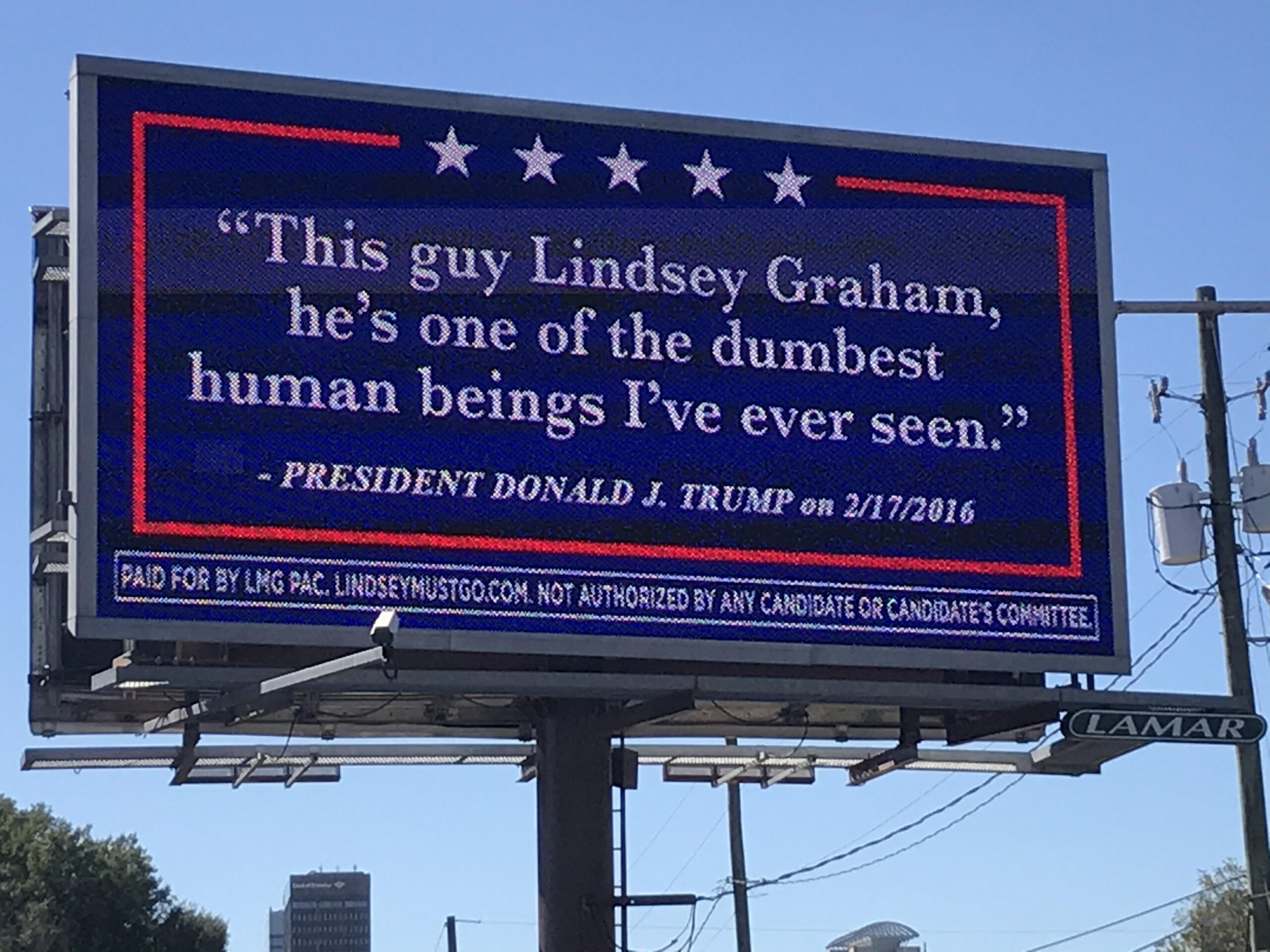
In a way, Lindsey is running against Lindsey. Harrison and the Democrats have spent money on billboard ads using Graham’s negative comments against Trump as a weapon. Comments like: “He’s a race-baiting, xenophobic, religious bigot” or “You know how you make America great again? Tell Donald Trump to go to hell.” Or “We have to reject this demagoguery, and if we don’t reject Donald Trump, we’ve lost the moral authority…to govern this great nation.”
Over the previous weekend, Graham quipped in a debate forum with Harrison, “If you’re a young African-American, an immigrant, you can go anywhere in this state, you just need to be conservative, not liberal.” In a couple days, Graham was buying time on Black radio stations for damage control to cover what was deemed an insult by Black people.
Although the Amy Coney Barrett Supreme Court confirmation hearings are once again putting Graham center stage, they also put the spotlight on his Achilles’ heel: his hypocrisy. Not just his hypocrisy as it relates to flipping over to the Trump cause, but also his “Use my words against me” quote when his party denied Barack Obama the opportunity to even get a hearing for his Supreme Court nominee, Merrick Garland, in the last 10 months of his term. Blacks see denying Obama the Garland nomination yet allowing Trump to place Barrett in Ruth Bader Ginsberg’s empty seat as not only hypocritical but racist to boot.
Even before February 28, the reasons for Donald Trump’s imploding approval rating were abundantly clear: untrammeled corruption and personal enrichment to the tune of billions of dollars during an affordability crisis, a foreign policy guided only by his own derelict sense of morality, and the deployment of a murderous campaign of occupation, detention, and deportation on American streets.
Now an undeclared, unauthorized, unpopular, and unconstitutional war of aggression against Iran has spread like wildfire through the region and into Europe. A new “forever war”—with an ever-increasing likelihood of American troops on the ground—may very well be upon us.
As we’ve seen over and over, this administration uses lies, misdirection, and attempts to flood the zone to justify its abuses of power at home and abroad. Just as Trump, Marco Rubio, and Pete Hegseth offer erratic and contradictory rationales for the attacks on Iran, the administration is also spreading the lie that the upcoming midterm elections are under threat from noncitizens on voter rolls. When these lies go unchecked, they become the basis for further authoritarian encroachment and war.
In these dark times, independent journalism is uniquely able to uncover the falsehoods that threaten our republic—and civilians around the world—and shine a bright light on the truth.
The Nation’s experienced team of writers, editors, and fact-checkers understands the scale of what we’re up against and the urgency with which we have to act. That’s why we’re publishing critical reporting and analysis of the war on Iran, ICE violence at home, new forms of voter suppression emerging in the courts, and much more.
But this journalism is possible only with your support.
This March, The Nation needs to raise $50,000 to ensure that we have the resources for reporting and analysis that sets the record straight and empowers people of conscience to organize. Will you donate today?
I like Harrison—although he’s no Bernie Sanders progressive, and most likely he’ll govern like the last Democratic senator, the late Ernest “Fritz” Hollings.
I haven’t been personally involved in South Carolina Democratic Party politics, other than as a critic, in decades. I met with Harrison and his staff along with the Rev. Jesse Jackson last summer during the state party convention. It was the first time that I had attended the convention in 35 years. Nineteen eighty-eight was the first and last time I spoke at the State Convention—after Jackson had won the state presidential caucus carrying 64 percent of the delegates. At the time, Blacks had no major role in the party leadership and our demand was for the chair of the party to be Black. Our cry then was, “If not now, when!” Harrison and the progress in leadership, and his ability to run a campaign and get support from the party, grew from our grassroots efforts.
I only mention this because Harrison began the work of reaching out to many of the disinterested and often ignored factions early in the process. The history of winning Democratic candidates in South Carolina, from former Governor Dick Riley to Fritz Hollings, shows that victory comes when the Democrats build a grass roots–based campaign, ignoring no one—as opposed to just spending money on media.
Still, Donald Trump is a powerful motivating force to get Black people to the polls. Ironically, that’s what Trump and Obama have in common: their ability to motivate Black voters. And that bodes well for Harrison.
Kevin Alexander GrayKevin Alexander Gray was Jesse Jackson’s South Carolina campaign manager in 1988. The author of Waiting for Lightning to Strike: The Fundamentals of Black Politics, he is co-owner of Railroad BBQ in Columbia, S.C.