
Crossing the Delaware
The Art of the American Revolution Across the Generations
The United States’ founding moment from Washington Crossing the Delaware to the paintings of Jacob Lawrence, Kara Walker, and Kent Monkman.
Although I must have visited the Metropolitan Museum of Art hundreds of times, I’ve never spared more than a glance for Washington Crossing the Delaware. The painting has always seemed to me more image than object, an untethered graphic whose transposability yields it to all sorts of uses—such as when, earlier this year, it was projected onto the Washington Monument. Having seen it on commemorative coins, ceramic plates, tea towels, and postage stamps, why would I need to seek it out in person?
It is perhaps this transposability, this reproducibility, that also leaves Washington Crossing the Delaware so open to reworkings. Almost a dozen modern and contemporary artists have riffed on it, among them Jacob Lawrence, Robert Colescott, Grant Wood, Alex Katz, and Kent Monkman. Some of these artists have drawn on the Crossing’s status as an American icon to make political statements. In 2017, Kara Walker reworked the painting to comment on Trump’s inauguration. Other explorations have tended toward formal reinvention. A young Roy Lichtenstein, before his Pop Art breakthrough, painted two versions in an abstract, naïve style around the same time that Larry Rivers offered a brushy, sketchy reinterpretation, at least partly as a figurative challenge to the hegemony of Abstract Expressionism among New York painters. Each refashioning is both a departure and a return.
These reworkings affirm the status of the Crossing as a foundational American image, even as they offer new visions of the nation’s past and future—and help us understand how the painting itself worked as a political intervention into both the myth and the politics of the United States.
To approach the many reworkings of Washington Crossing the Delaware, one must begin with the original. Heading to the Met’s American Wing, I spotted it practically a mile away, occupying one of the gallery’s foremost sight lines. It is oppressively large, at 12 by 21 feet, and insistently framed, in a gilded setting topped with a patriotic trophy—a replica of the frame it originally appeared in during its first showing in New York, in 1851, the year of its completion. The painting, by the German artist Emanuel Leutze, shows the crossing of the Delaware River on the night of December 25, 1776, a maneuver that allowed the Continental Army to launch a surprise attack on the Hessian forces at Trenton, yielding a victory that marked a turning point in the American Revolution. Maybe you can see it in your mind’s eye: George Washington standing in the prow of a rowboat, his raised leg firmly planted on the seat before him, gazing steadfastly ahead. All about him, soldiers strain at the oars, propelling the boat across an ice-choked river; one clutches a furled American flag. The scene is grand, the style exacting and meticulous.
The tour guides (five of them, to be precise) who pass through the gallery during the half-hour I spend with the painting invariably noted its “inaccuracies.” Leutze shows Washington and his men in narrow rowboats, when in reality they made the crossing in wide, flat-bottomed freight boats. Although the crossing took place at night, Leutze shows a breaking dawn. One guide questioned whether the central figure really looked like Washington, whose likeness survives only in paintings. Another noted the “German” elements of the work, pointing out that the chunks of ice that float on the surface of Leutze’s Delaware look more like formations on the Rhine than those on the waterways of America’s Northeast.
I found this strange. Washington Crossing the Delaware is a constructed representation, not a stand-in for Washington himself or a mirror of the historic crossing—an event that Leutze’s painting postdates by three-quarters of a century. While the Crossing reflects the wave of reverence for the “father of the country” that swept the United States upon the 50th anniversary of Washington’s death, another of its immediate contexts are the Revolutions of 1848.
Leutze, born in 1816 in Württemberg, immigrated with his family to Philadelphia as a child. In 1841, he returned to Europe to study at the Royal Academy of Art in Düsseldorf. There, he trained in the genre of history painting, developing large-format compositions with grand and consequential themes. While in Düsseldorf, he cofounded and led Malkasten (“paint box”), a democratic organization of liberal artists who supported the struggle to establish a unified German republic. Although the fragmentary and uncoordinated German uprisings of 1848 were ultimately crushed, Leutze did not abandon his democratic commitments. His Crossing, which toured in Düsseldorf, Berlin, and Cologne a few short years after ’48, was intended to reignite revolution in the hearts of his countrymen with its portrayal of a decisive moment in the struggle for an American republic. Astute observers, as the art historian Barbara Groseclose notes, might even have reflected on the fact that it was Hessian mercenaries whom Washington and his troops met on the shores of Trenton, hired out by the ruler of the Electorate of Hesse. During the German Revolution, the state briefly adopted democratic reforms that were soon undone in a reactionary backlash. Leutze’s Crossing, an American icon, was also a painting with a dual citizenship and an international politics.
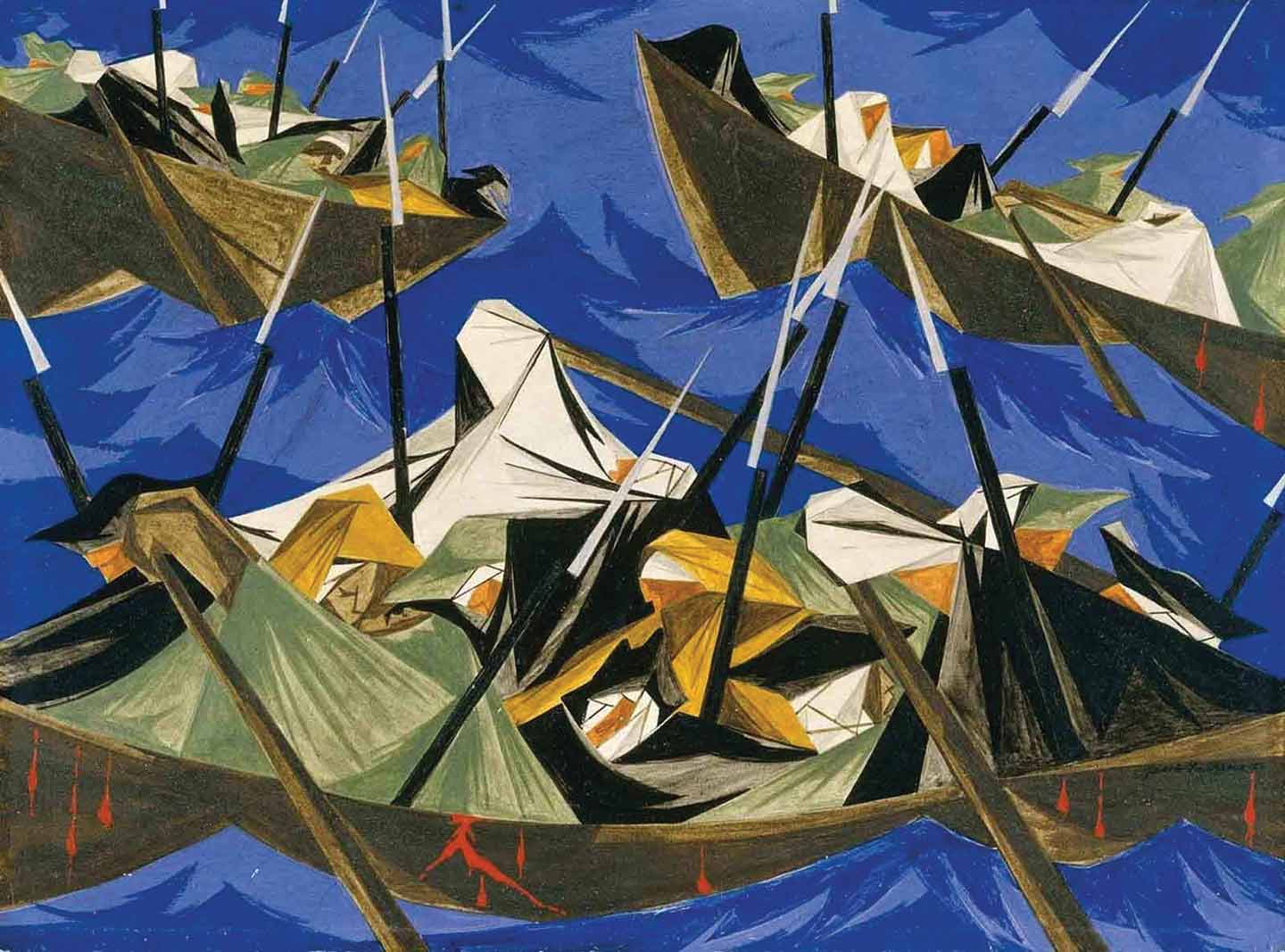
Just over 100 years later, Jacob Lawrence began a body of work he called Struggle. The small tempera paintings in this series would chronicle the early history of the United States from the American Revolution through the early 19th century. Lawrence, quoting Leutze, called the 10th painting in the series Washington Crossing the Delaware. (Like Leutze’s Crossing, this work is also in the Met’s collection.) The upright Washington of Leutze’s composition, however, is nowhere to be seen. Instead, in boats rocking on choppy waves, crouched figures huddle under blankets and cloaks. Spiky bayonets and oars fill the scene with violent diagonals as blood drips from the sides of the crafts, evoking the injuries sustained and the lives lost in the major defeats that preceded the crossing.
Lawrence subtitled the works in Struggle with voices from the past. His Washington Crossing the Delaware features a quote from Tench Tilghman, an aide to Washington: “We crossed the River at McKonkey’s Ferry 9 miles above Trenton…the night was excessively severe…which the men bore without the least murmur.” While Leutze condensed American independence into the figure of Washington in an image that also evoked Europe’s revolutions, Lawrence, in his remaking of the Crossing and elsewhere in Struggle, represents revolution and nation-building as a collective project undertaken by anonymous and forgotten actors.
Starting work on Struggle in 1954, the year of the Brown v. Board of Education ruling, Lawrence pointedly advanced an integrated history, foregrounding figures like Crispus Attucks, a man of African and Native descent whose death in the Boston Massacre is regarded as the first casualty of the Revolution. Two of the series’ paintings show slave uprisings, representing those internal bids for liberty and equality as equally significant to the American project as the battles against Britain.
Lawrence’s inclusion of Black figures and histories feels prescient, seen through contemporary eyes. Yet a close look at Leutze’s painting shows that this practice is not so new after all. In the prow of the boat in which Washington is standing sits a Black man, rowing hard. Sometimes identified as Price Whipple, an enslaved aide-de-camp, he is the figure closest to the commander in chief, whose firmly planted leg overlaps his body in two places.
The Black man in this painting points not only to the fact that Black people served in the Revolutionary War—on both sides, for that matter—but also to the fact that Leutze, a painter and propagandist, felt it important to make this known in 1851. If Lawrence advanced an integrated vision of American history against the backdrop of the early civil-rights movement, Leutze painted in a moment of impending civil war. As Southern states began to speak openly of secession and to demand the expansion of slavery into the Western territories, Leutze mustered a diverse crowd of individuals—a Black man and, near him, a fellow in a Scottish tam-o’-shanter, another in a coonskin cap (headgear associated with the Western frontier), and an Indigenous man working the tiller at the boat’s rear—who literally pull together under Washington’s steady guidance. Leutze claimed the first president as an enemy of secession, a message that would likely have resonated with the thousands of viewers who saw the Crossing at an 1864 benefit exhibition for the United States Sanitary Commission, a relief agency supporting Union soldiers.
Leutze’s painting allows us to see that the ideologically motivated inclusion of Black figures in representations of American history is far from a contemporary phenomenon, despite the Trump administration’s insistence that such gestures are a woke invention. The administration’s recent attempts to purge references to the enslaved people whom Washington owned from his former Philadelphia residence is, like Leutze’s painting, an attempt to recast the revolutionary commander in chief and first president to meet contemporary political needs. Although the subject of Leutze’s Crossing was indeed a slaveholder, all evidence indicates that the artist himself was an abolitionist. During the Civil War, he designed the banners for two Black regiments, the New York 20th and the 26th. At the time of his death in 1868, Leutze was at work on a painting of Abraham Lincoln delivering the Emancipation Proclamation. All that survives, however, is a written description of a preliminary sketch. Had Leutze fulfilled his vision, we would have another work for the American national canon and a Lincoln to stand alongside his Washington.
Both Leutze and Lawrence’s Crossings, in their own ways, celebrate the democratic origins of the American republic. Robert Colescott’s reworking in the collection of the Lucas Museum of Narrative Art casts a more skeptical eye on the nation’s foundations. Created in 1975 in the lead-up to the US Bicentennial, George Washington Carver Crossing the Delaware: Page From an American History Textbook features a bevy of caricatured Black figures—a cigar-smoking banjo player, a chef, a mammy, a shoeshine boy, and others—who tumble over one another in a boat steered by Carver, the agricultural scientist.
Sometimes read as a statement about the exclusion of Black figures from the Western canon, the painting seems to me more of a commentary on the inclusion of racist tropes in the popular American imagination. If George Washington is one of the stock characters in our national drama, Colescott seems to say, well, then here are some others. His painting recalls the prints that circulated alongside reproductions of Leutze’s Crossing during the 19th century. A few years after that painting made its New York debut, Currier & Ives, a local printmaking firm, released a lithographic version (which, notably, omits the Black rower from the scene). In the following decades, the company would enjoy a brisk trade in prints from its extensive “Darktown” series, which relied on racist gags about the failings of an imaginary Black community. In his reworking of the Crossing, Colescott merges these images into a single composition. To Leutze, American history is a grand theatrical tableau. In Colescott’s recasting, it is a minstrel show.
Colescott’s painting deals in jokes, even if it is not exactly funny. More straightforwardly humorous is Grant Wood’s 1932 take on the Crossing, which is in the collection of the Cincinnati Art Museum. In a painting he called Daughters of Revolution, Wood (the creator of American Gothic) shows us a framed print of Leutze’s painting, as faded and spotted with age as the three thin-lipped women who sit before it. As the story goes, Wood was commissioned to create a stained-glass window for the Veterans Memorial Building in Cedar Rapids in 1927 and contracted artisans in Munich to execute his design. The local chapter of the Daughters of the American Revolution objected strenuously to a window manufactured in a nation with which the United States had so recently been at war. Their resistance delayed the window’s dedication until 1955. Wood’s painted riposte slyly juxtaposes the sanctimonious Daughters—one of whom primly clutches a Blue Willow teacup—with Leutze’s heroic Washington and perhaps points up the tension between their anti-German sentiment and the German origins of the iconic painting.
At first glance, Alex Katz’s riff on the Crossing also reads like satire. Katz rendered Washington, his troops, and a trio of redcoats in his signature flat and simple style, then cut them out and pasted them on plywood. These near-life-size toy soldiers originated as set pieces for a one-act play about the Delaware crossing by the New York School poet Kenneth Koch. Today, they are in the collection of the Smithsonian American Art Museum. Both Katz’s painted set and Koch’s play offer a camp blending of irreverent send-up and sincere, patriotic attachment to the first president. But how tongue-in-cheek is it really when Koch has Washington, addressing General Cornwallis, declaiming, “Americans shall be masters of the American continent! Then, perhaps, of the world!”
Washington’s line in Koch’s play rhymes with the covertly expansionist ideology of Leutze’s Crossing. Washington and his followers ostensibly sail toward the Jersey Shore, but they also evoke movement in a different sense. Although on the night of December 25, 1776, the Delaware River was crossed from its west bank to its east, or from left to right, in Leutze’s painting the movement is from right to left, suggesting a westward direction. This makes for a better composition—it has been suggested that we read paintings the same way we read text, from left to right, meaning that a Washington who moves in the opposite direction comes forward to meet our gaze, rather than seeming to flee from it. But Leutze’s Washington also seems to lead the nation west, reflecting the belief that America’s destiny was to expand into the inward territory of the continent.
Popular
“swipe left below to view more authors”Swipe →Leutze’s own expansionist politics became overt in an 1862 mural created for the US Capitol: Westward the Course of Empire Takes Its Way, also known as Westward Ho! Both the Crossing and this later work represent a multiracial republic in the making. In Westward Ho!, figures who recall the diverse crew of Washington’s rowboat—among them a Black man—move steadily into the vastness of a golden West.
Westward expansion and the government seizure of Indigenous land, as well as the ensuing conquest, colonization, exploitation, and exile—these form part of the context not only for Leutze’s Crossing but also for its most recent reworking. At 11 by 22 feet, Kent Monkman’s Resurgence of the People is the only reworking to match Leutze in terms of scale. The massive painting is half of a diptych, mistikôsiwak (Wooden Boat People), commissioned by the Metropolitan Museum of Art from the Canadian artist in 2019. While Leutze’s painting offers a fictionalized vision of the nation’s founding, crafted by an artist looking back in time, Monkman’s articulates the possibility of a border-transcending refounding and a future that might be available to us.
The boat in this painting is riding low in rising, dirty waters—the seas of climate change. It is crowded with people: Indigenous women, men, and others whose tribal identities are reflected by their clothing, tattoos, and adornments, as well as people from other backgrounds. In the same pose as Leutze’s Washington appears Miss Chief Eagle Testickle, Monkman’s longtime alter ego. She stands tall in red-bottomed Louboutins, clad only in the gauziest of chiffon draperies. Monkman has described Miss Chief, whose name puns on mischief and egotistical, as a “time-travelling, shape-shifting, supernatural being” and an embodiment of the Indigenous Two-Spirit tradition, a third way in gender and sexuality beyond the male-female binary. Under her guidance, in Monkman’s vision, life is renewed. Children are born and cared for. Lives are saved, as a Black man leans overboard to haul a limp and pallid figure out of the water. Oarspeople steadfastly row the boat ahead as, on a rocky outcropping rising just above the water, emissaries of the state—a US soldier, a police officer—jeer, heedless of their imminent demise. It is an image of collective self-rescue.
There is something on the nose about Monkman’s reinterpretation of Leutze. But the power of the appropriative gesture is impossible to deny. Unlike other reworkings of the Crossing, Resurgence of the People deploys the language of 19th-century academic painting—its representative clarity, its grandeur, its theatricality—to powerful effect, wielding these techniques against the nationalism, expansionism, and America First–ism that the work evokes. Leutze, in 1851, knew that he was crafting a compelling fiction, creating a North Star in a moment that needed it. Does Monkman feel the same? It might be that each historical moment gets the Washington Crossing the Delaware that it needs.
Support The Nation’s June Fundraising Campaign
With the midterm elections now firmly upon us, the question is whether Democratic candidates will do more than merely occupy ballot lines as mild alternatives to the red-hot crisis that is Donald Trump.
As Trump spends over $1 billion a day on a globally destabilizing war on Iran and admits that he doesn’t “think about Americans’ financial situation,” millions across the country are struggling with the surging costs of essentials. Democrats must seize this moment and advance bold, small-“d” populist ideas—not settle for cynical caution that once again snatches defeat from the jaws of victory.
The Nation elevates progressive ideas, movements, and elected officials achieving real change across the country into the national conversation. At the same time, our journalists are exposing how crypto and AI-funded super PACs are spending hundreds of millions of dollars to knock out candidates they oppose, reporting on the devastating impact of the Supreme Court’s evisceration of the Voting Rights Act, and sounding the alarm on attempts by red states to quickly redraw electoral maps, disenfranchising Southern Black voters.
We can play this critical role because of support from readers like you. This June, we’re raising $20,000 to power The Nation’s independent journalism in the run-up to November’s immensely consequential elections.
It’s in our power to build a more just society, and your support at this critical moment brings us closer to that bold vision. I hope you’ll donate today.
Onward,
Katrina vanden Huevel
Editor and Publisher, The Nation
More from The Nation
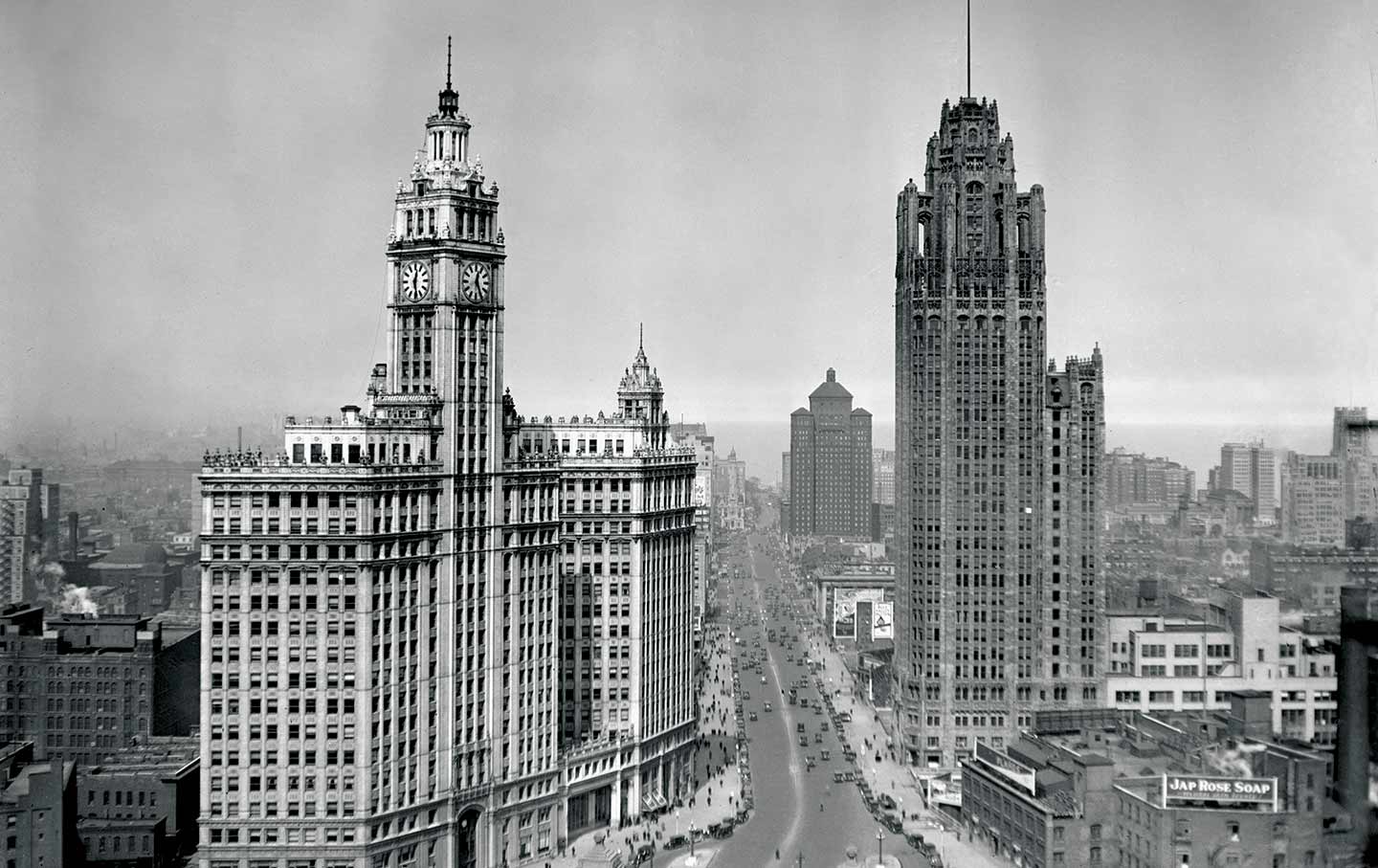
What Makes American Architecture American? What Makes American Architecture American?
It’s never been afraid to play fast and loose and big.

Marjane Satrapi’s Rebellious Art Marjane Satrapi’s Rebellious Art
The radical legacy of the cartoonist and filmmaker who created Persepolis.
The Cruel Optimism of Being a Mets Fan The Cruel Optimism of Being a Mets Fan
A new book by A.M. Gittlitz tells the story of a beloved baseball team.
The Ghosts of Antonio Gramsci The Ghosts of Antonio Gramsci
Andy Merrifield’s Roses for Gramsci, a highly personal history of the Italian thinker and his work, examines his influence across generations.

