
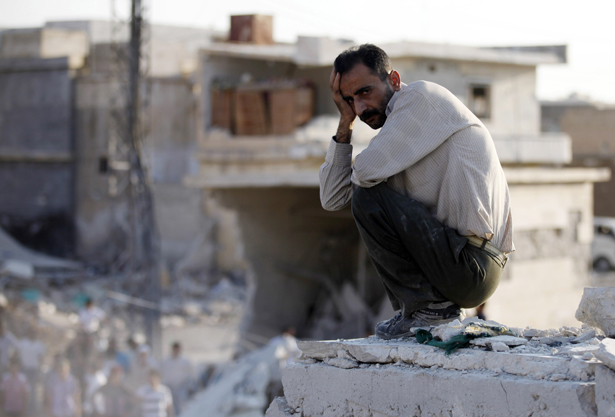
A Syrian Air Force air strike destroyed houses in Azaz, north of Aleppo, August 15, 2012. Reuters/Goran Tomasevic.
As the Security Council begins the process of writing a resolution on Syria, the negotiations are likely to be less a debate than a grand jury investigation. With the United States and Russia on opposite sides of the argument—at least in public statements and accusations—over which side of the Syrian civil war is to blame for what was apparently a sarin gas attack on a suburb of Damascus that killed more than 1,200 people, the evidence presented will be central to the outcome in the Council.
Hans Blix, a Swedish diplomat and leading international expert on the destruction of weapons of mass destruction who headed the International Atomic Energy Agency in the 1990s and later UN inspections in Iraq before the American-led war in 2003, says that the scope of the chemical attack in Syria “suggested government sponsorship.” But he added in an e-mail: “I have not ruled out the possibility that rebels, too, have used CW [chemical weapons]. The UN inspectors came to Damascus to investigate other incidents. They might yet come back with more reports. If any member of the SC has info contradicting or adding to the inspectors’ reports they could present it in the Council.”
At the United Nations, officials say that about six weeks ago, the Russians gave the UN inspection team in Syria eighty pages of findings showing that the rebels were responsible for an earlier chemical attack at Khan al-Assal on March 19, which was attributed also by others to the rebels’ side, suggesting that they had access to chemical weapons and some means to deliver them.
In May, Carla del Ponte, a Swiss former UN chief prosecutor for Criminal tribunals in the Balkans and Rwanda who serves on an independent human rights commission reporting the Human Rights Council in Geneva, said in an interview on the Italian RSI network that rebels had used sarin gas in perhaps another attack in April, according to victims and doctors.
In early September there were also reports from unnamed sources in the region that a cylinder of sarin gas had been found in the home in Turkey of a Syrian Islamic fighter from the Al-Nusra front. The Los Angeles Times reported later, however, that according to Turkish media, Turkish officials had denied that, but said that prosecutors in southern Turkey have alleged that Syrian rebel groups were seeking to buy materials that could be used to produce sarin. Indictments were reportedly issued in the southern Turkish city of Adana that alleged that a Syrian was in Turkey trying to procure chemical materials for the Al Nusra Front and the Ahrar al-Sham Brigades, the LA Times said, sourcing its information again to Turkish media. The United States lists the Al Nusra Front as a terrorist group linked to Al Qaeda.
The UN inspectors, a joint team drawn from the UN and the Organization for the Prohibition of Chemical Weapons, were most recently in Damascus to investigate such earlier incidents when they were directed by Secretary-General Ban Ki-moon to look into the August 21 attack.
The inspectors who were in Damascus this month are expected to return to Syria later this week to revive work on allegations made against both sides before and since August 21. Syria submitted its list of chemical weapons and facilities on time on Saturday, and this information is being studied, with more detail expected from the Syrians.
The Obama administration, albeit with no new evidence from the Russians to work with, has nonetheless been relatively silent on the recent charges that the rebels were responsible for the August sarin attack. Charles Duelfer, a former leader of UN inspection teams in Iraq, said that both in and out of government, there is an uneasy sense that the rebels, or factions of them, are “bad” and getting badder. Some of them may have obtained sarin or other chemical material from Syrian government stores. That, in turn, could prove an embarrassment to the government of President Bashar al-Assad.
Blix said that “verification and removal or destruction will not be easy,” and that there will be a debate over whether experts from any of the permanent five Security Council members—Britain, China, France, Russia and the United States—will be part of international teams formed to dismantle Syrian weapons. In the case of Iraq, experts from those countries, the United States in particular, were accused of using their UN cover to spy for national intelligence agencies.
The framework for a UN resolution and a plan for dismantling weapons was apparently largely the work of Russia’s foreign minister, Sergey Lavrov, working with Secretary of State John Kerry, Blix said, adding that the plan gave Russia the advantage of insuring that any potential action on Syria would have to go through the Security Council. The United States continues, however, to insist that it has the right to act independently against Syria, following earlier threats of military strikes. The plan, Blix said, “gives benefits to all except the rebels.”
Though Washington may press for a Chapter 7 resolution, which carries enforcement powers, Blix does not see this as a necessary deal-breaker. “The resolution to be worked out now does not need to be under Chapter VII,” he said. But a paragraph that leaves open punitive action, not necessarily military, needs to be part of any document that speaks about measures that the council would take in case of nonfulfillment by Syria, he added.
In an interview with an Iranian journalist last week, Blix looked ahead: “What is now in focus—the elimination of the Syrian chemical weapons program—while practically taxing, may be the least difficult part,” he said. “The deal also confirms the commitment from the G8 meeting in June 2013 to stop the bloodshed—presumably under a cease-fire—and to set up a conference that can create a ‘transitional governing body.’ With more than 100,000 dead and millions of refugees, these tasks are as urgent as they are politically daunting.”

