
The Palestinian Authority Is Being Strangled to Death
Israel is engineering the collapse of the West Bank’s governing body—a key step on the way to full annexation.
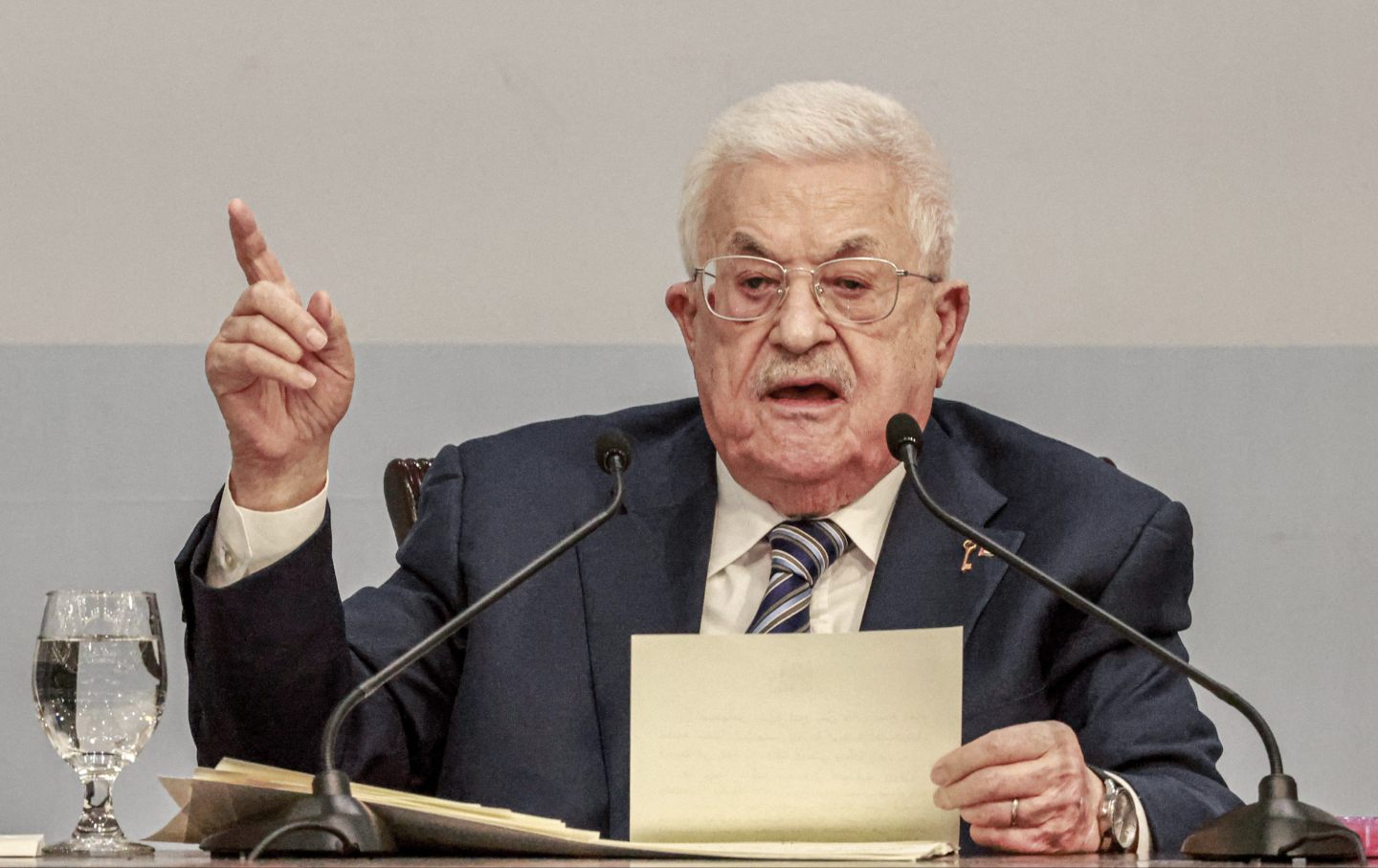
Palestinian Authority President Mahmoud Abbas delivers a speech during the eighth Fatah Conference in the Israeli-occupied West Bank city of Ramallah on May 14, 2026.
(Jaafar Ashtiyeh / AFP via Getty Images)Ramallah—“I feel like I am going to work with zombies,” Lutfi said. “People who have had all of their hopes destroyed. They don’t feel like they’re going to get their money.”
Lutfi works for the Palestinian Authority, the body that nominally governs the occupied West Bank. (He asked that his last name be withheld so that he could speak freely about his work.) But it’s unclear how long he will hold on to his job, because the PA’s ability to carry out basic public services, let alone employ people, is collapsing.
The PA is currently facing a deficit of more than 4.5 billion shekels (about $1.9 billion). Amid the financial emergency, Palestinian youth are attending school only three days a week, as schools struggle to pay rising electricity costs and teachers go without salaries. Ministerial offices, even in the relatively insulated city center of Ramallah, are mostly empty. As of late 2025, civil servants were being paid only 60 percent of their salary, in a slow decline since October 7 that reflects the increasingly dire financial straits the PA finds itself in.
To make matters worse, this crisis is not an accident. It is the direct result of Israeli government policy—specifically the policies of far-right Israeli Finance Minister Bezalel Smotrich, who has made no secret of his desire to eliminate the PA completely. “As far as I’m concerned, let the [Palestinian] Authority collapse. It is an enemy,” Smotrich told Israel’s Channel 14 in June 2025.
“There is a systematic approach by certain members of the coalition to bankrupt the PA and to dissolve it.”Mouin Rabbani, senior fellow at the Middle East Council, explained. “They need to get the PA out of the way in order to exercise complete control over the occupied territories.”
In the aftermath of October 7, Smotrich cited the PA’s failure to condemn the attack as justification for withholding revenue. He has also pointed to the PA’s “Martyrs’ Fund”—a program providing stipends to Palestinian prisoners, which critics call “pay for slay”—as further grounds for the freeze. The fund became the basis of a March 2026 US appeals court ruling finding the PA liable for financing attacks on American citizens. PA President Mahmoud Abbas ended the payments in February 2025 at the Trump administration’s urging.
The distribution of the PA’s “clearance revenues”—which, per the 1994 Paris Protocol, Israel collects on behalf of the PA and is then supposed to distribute every month, to the tune of roughly $188 million—is still on hold. If Israel does not soon resume transferring the withheld revenue, it will be completely insolvent, “completely bankrupt,” said Zaha Hassan, a human rights lawyer and a senior fellow at the Carnegie Endowment.
Lutfi has seen the impact of Smotrich’s crusade firsthand. He works for the PA’s land registry, documenting Palestinian claims to land in the West Bank. His job is one of the most basic prerequisites for any final settlement: quite literally, who owns what.
But his team’s work is now on indefinite pause. Equipment that they use to assess land in the most remote areas of the West Bank is falling into disrepair, and Lutfi’s union, the Jordan Engineers Association, recently urged its employees to stop showing up to work entirely.
The PA owes Lutfi 17 months of back pay, and, as he recounted to me, the consensus among fellow employees is that they’re never going to get it.
To make up for the budget deficit, the PA has been forced to borrow funds from Palestinian banks, and even if the clearance revenues are released in full, “which is never going to happen,” Lutfi emphasized, it wouldn’t be enough to cover the salaries.
Without some kind of outside intervention, the PA won’t be able to climb out of its fiscal hole. But help does not seem forthcoming. “In the past, the US or Europeans would swoop in to save the PA from complete bankruptcy. But this time, there may not be a savior,” Hassan explained.
For decades, the European Union and its member states have been the PA’s largest external donors, pumping hundreds of millions of euros annually into the West Bank. But times have changed, and Smotrich has shattered the status quo. When Palestinian Prime Minister Mohammad Mustafa recently asked the EU and its other backers to make up the shortfall, caused by what Rabbani calls Smotrich’s “economic warfare,” the EU declined.
This is not to say that the PA was a beloved institution before Israel’s latest assault. Far from it. Part of why Abbas’s approval rating is, as Rabbani put it, “somewhere between zero and zero,” is that Palestinians in the West Bank view the PA for what it is: a mechanism for Israel to administer the Palestinian territories without having to do so itself.
So why does Israel’s far-right coalition want to dissolve the body that has been administering its occupation of the West Bank? It comes down to land and annexation. “If you no longer have a PA, you no longer have a counterpart for the implementation of the Oslo agreements, which neither party has officially renounced, even though they’re functionally nonexistent. Israel will then use that as a pretext to reestablish direct control and annex whatever it wants,” Rabbani explained.
Also at play is the desire to push Palestinians to flee the West Bank, voluntarily at first, and potentially later, involuntarily, explained Nathan Brown, a professor of political science and international affairs at George Washington University. By collapsing the PA and keeping the West Bank in perpetual economic crisis, Israel can make conditions so unlivable that residents choose to emigrate, shifting the territory’s demographic balance even further in Israel’s favor.
While the capital, Ramallah, has been somewhat insulated from the worst of the PA’s financial collapse, an economic crisis is operating in tandem across the wider West Bank.
Shut off from Israel after October 7 under the justification of a “security concern,” the 125,000 or more Palestinian workers who once worked in construction inside Israel, and whose wages injected an estimated $380 million per month into the Palestinian economy, are suffering too. “I grew up in Palestine around the time of the First Intifada. That period of the Israeli occupation seems like a golden age compared to the kinds of deprivation and poverty I saw last summer,” Hassan said.
Palestinian families are used to financial hardship. But many of them are now at a breaking point, Lutfi explained. “I think most people can’t lend money from their family members anymore. Because they don’t have it.”
Meanwhile, the PA’s higher-ups have been largely insulated from the economic crisis. They dine in the finest restaurants in Ramallah, discussing monetary policy. (I have seen this firsthand.) Lutfi pointed to the fact that while salaries have been cut, other PA benefits and compensation are still being paid in full, and if you work at one of the PA’s consulates, salaries are still fully intact.
Popular
“swipe left below to view more authors”Swipe →“They have the choice of what gets cut, and they always choose to cut the workers—the actual workers—and anything that does not touch them.” More than half of PA public-sector employees earn the equivalent of $664 a month or less, while some senior officials take home more than $10,000 a month.
“Many Palestinians ask: Why are senior PA officials still enjoying VIP status and a lifestyle that far outpaces any normal Palestinian lifestyle in the occupied territories?” Hassan asked.
The PA is out of the picture for the Palestinian youth I interviewed in Al-Manara, a traffic circle in the heart of Ramallah. They have few prospects, economic or otherwise. Jobs are almost impossible to find; permits to enter Israel have been cut off; and movement restrictions have only escalated since October 7.
“Who cares if [the PA] dies,” one person said. “Let them go. What have they done for us but serve the ihtilal [the occupation]?”
The Trump administration, via its “Board of Peace,” vaguely attempted to rehabilitate the PA, to give it a place and renewed legitimacy in the postwar governance of Gaza. But this is a nonstarter for the Israelis. Brown said PA bureaucrats are still waiting in hotels in Cairo for a call that they will be part of the deal. They still haven’t gotten it.
Now it is only a matter of time before Israel’s de facto annexation becomes a legal one, and collapsing the PA while keeping the West Bank in dire economic straits is part of the plan. It was when the PA stopped working toward the objectives of Oslo that it fell apart, according to Rabbani.
“If I were Smotrich’s adviser, I’d tell him to just pass a law tomorrow declaring the West Bank an eternal part of the Jewish state. Nobody’s going to do anything about it,” Rabbani said.
Support The Nation’s June Fundraising Campaign
With the midterm elections now firmly upon us, the question is whether Democratic candidates will do more than merely occupy ballot lines as mild alternatives to the red-hot crisis that is Donald Trump.
As Trump spends over $1 billion a day on a globally destabilizing war on Iran and admits that he doesn’t “think about Americans’ financial situation,” millions across the country are struggling with the surging costs of essentials. Democrats must seize this moment and advance bold, small-“d” populist ideas—not settle for cynical caution that once again snatches defeat from the jaws of victory.
The Nation elevates progressive ideas, movements, and elected officials achieving real change across the country into the national conversation. At the same time, our journalists are exposing how crypto and AI-funded super PACs are spending hundreds of millions of dollars to knock out candidates they oppose, reporting on the devastating impact of the Supreme Court’s evisceration of the Voting Rights Act, and sounding the alarm on attempts by red states to quickly redraw electoral maps, disenfranchising Southern Black voters.
We can play this critical role because of support from readers like you. This June, we’re raising $20,000 to power The Nation’s independent journalism in the run-up to November’s immensely consequential elections.
It’s in our power to build a more just society, and your support at this critical moment brings us closer to that bold vision. I hope you’ll donate today.
Onward,
Katrina vanden Huevel
Editor and Publisher, The Nation
More from The Nation
Daniel Ellsberg vs. “Ordinary Insanity” Daniel Ellsberg vs. “Ordinary Insanity”
A new documentary issues an urgent warning about our dangerous nuclear delusions.

How Trump Has Boxed Himself Out of a Face-Saving Iran Deal How Trump Has Boxed Himself Out of a Face-Saving Iran Deal
By failing to absorb the lessons of Iran’s strategic victories, the White House is on course to turn the present stalemate into a disastrous quagmire.

The Revolution Heard Around the World The Revolution Heard Around the World
The global politics of 1776

How Jared Kushner Sparked a Political Crisis in Albania How Jared Kushner Sparked a Political Crisis in Albania
Outraged Albanians are targeting the presidential son-in-law for pursuing a $4 billion luxury resort deal in a business climate rife with corruption and environmental neglect.

Trump’s Disregard for International Humanitarian Law Won’t End When the Iran War Does Trump’s Disregard for International Humanitarian Law Won’t End When the Iran War Does
As political pressure to end the war grows, Americans must not overlook the president’s blatant violations of the rule of law, abroad and at home.

