
The AfD’s Secret Plan to Deport Millions From Germany
An explosive report on a meeting between the far-right Alternative für Deutschland and neo-Nazis has ignited the largest German protest movement since the fall of the Berlin Wall.
Berlin—The story appeared on the morning of January 10 on Correctiv, the website of a research network most people hadn’t heard of before, but the evidence was unmistakable. In a secret meeting held on November 25 at a hotel in Brandenburg, representatives from Germany’s far-right political party Alternative für Deutschland (AfD) met with Identitarian and neo-Nazi activists. “It was much more than a coming together of right-wing ideologues,” reported Correctiv. The meeting was to map out a “master plan” for mass deportations should the AfD gain the power to implement it. “Asylum seekers, non-Germans with residency rights, and ‘non-assimilated’ German citizens” were all candidates for “re-migration,” explained Austrian neo-Nazi Martin Sellner, who according to Correctiv had been the first speaker at the meeting.
Within a few hours, the first headlines about the November meeting began to appear on other news sites, but it was Correctiv’s account that had everyone riveted. An undercover reporter at the hotel was able to convey details of the meeting and had talked to some participants. Grainy photos taken through a window showed who had been in attendance. And Correctiv listed the attendees as if they were in a theater production: It included AfD politicians, neo-Nazis, the far-right owner of a fast-food chain, a board member of the conservative Verein Deutsche Sprache (German Language Association), and at least two members of the center-right political party Christian Democratic Union (CDU).
The AfD was founded in 2013 as a Euroskeptic party and began to promote an anti-immigrant and nationalist agenda in 2015—shortly before Germany admitted 1.5 million asylum seekers. Entering the Bundestag for the first time in 2017 with a 12.6 percent share of the vote, the party’s support dropped to 10.3 percent in the 2021 elections. A recent survey, though, shows it polling at almost 23 percent nationally. It has some support in western German states, but it is in the eastern German states (aside from Berlin) that the AfD has gained the most ground, ahead of all other parties in polls, gaining its first governing post in a city election in June, and winning a mayoral contest for the first time in December.
“You had far-right parties entering regional parliaments in eastern Germany already at the end of the 1990s and the 2000s,” said Manès Weisskircher, a political scientist at Technische Universität Dresden. “So the potential for an electorally successful far-right party was already visible back then…. The early strength of the far right is also related to a Neo-Nazi subculture emerging in the 1980s in the GDR—a violent street scene that was ignored and downplayed by officials.” The decline of the Party of Democratic Socialism and Die Linke (The Left Party), post-unification successors to the East German Socialist Unity Party, also meant that some dissatisfied voters in eastern Germany were searching for another party presenting itself as “anti-establishment.”
But eastern Germany is not an outlier in terms of support for the far right in Europe, Weisskircher points out. Austria, Italy, Denmark, and Sweden have all seen far-right parties of similar strength, with some of them also becoming part of the government. Germany overall has been an outlier, because, since the end of the Second World War, its far-right parties have been contained. Other political parties have refused to enter into coalitions with the AfD, while civil society has also contained the AfD, notes Bénédicte Laumond, a political scientist who compares responses to the far right in France and Germany.
Restaurant and venue managers who refuse to allow AfD members to hold meetings and events in their properties “have an impact on the AfD and it prevents them from pursuing their daily activities,” said Laumond. But when mainstream political parties co-opt “some of the argumentation of the AfD—especially on policy issues such as immigration and asylum” they normalize the AfD’s stances. “In Germany, that’s something that happens mostly with right-wing parties in broad terms: the CDU/CSU [Christian Social Union] [alliance], the FDP [the pro-business Free Democratic Party].”
Germany has been termed a “militant democracy” or a “defensive democracy.” In the aftermath of the Second World War, it adopted specific legal measures to prevent the destruction of its democratic system again. The constitutional court can ban political parties if they are found to be a threat to the country’s Constitution—and has done so twice, banning the neo-Nazi Socialist Reich Party in 1952 and the Communist Party of Germany in 1956. The bar for banning a party is set high, though: The court ruled against banning the neo-Nazi National Democratic Party (NPD) in 2017 because, although it recognized the party’s “anti-constitutional goals,” it determined that public support for the NPD was so low that it was not a threat to the Constitution.
Germany’s Federal Office for the Protection of the Constitution began investigating the AfD in 2021. When the AfD challenged its classification as a suspected right-wing extremist party, the Administrative Court of Cologne ruled that there was more than sufficient evidence that the AfD’s aims were anti-constitutional and ethnically discriminatory. Public debate about banning the AfD, underway since 2022, has been ignited by the Correctiv report. CDU Bundestag member Marco Wanderwitz had been ready to introduce a motion to ban the AfD last year, but more recently said it was “high time for a ban procedure.”
“The report is great material for those who want the AfD to be abolished,” said political scientist Constantin Wurthmann “but as I haven’t studied law, I’m not sure whether this will be the turning point.… What I do know is that if there would be a time to make the decision to abolish the AfD, it’s now, because we don’t know how the political situation will change in the future.”
What about the argument that banning the AfD will only allow it to say it’s being victimized? The AfD has always claimed to be victimized, said Wurthmann, “from the very beginning.” He wonders, though, “Where do these voters go? What happens with them?” Wurthmann, whose research predicts voter behavior, carried out a recent study that showed at least half of the AfD electorate is likely to support the new political party launched by former Die Linke politician Sahra Wagenknecht. Aimed at “culturally conservative and economically left-wing voters,” the party also promotes an anti-migrant agenda, but with “soft, critical remarks on migration policies we have in Germany right now,” said Wurthmann.
To most people observing the AfD, the content of the November meeting was not a surprise. “It really fits with what the radical right in Germany has been saying in the past and today,” said Laumond. “The data shows that people already know…the AfD to be right-wing extremists,” Wurthmann observed. “And people saying that AfD is getting just elected because it’s a protest party are simply wrong.” Weisskircher said the most surprising part of the Correctiv report for him was that CDU members were part of the November meeting.
But across Germany, the Correctiv report has galvanized people. Headlined “Secret Plan Against Germany,” the story details what AfD politicians, center-right politicians, and neo-Nazis in attendance said to one another in private. Sellner, the report said, spoke of deporting people to “a model state” in North Africa. “Sellner’s concept is eerily reminiscent of the Nazis’ 1940 plan to deport 4 million Jews to the island of Madagascar,” Correctiv noted. “It is unclear whether Sellner had this historical parallel in mind when devising his plan. It may also be mere coincidence that the organizers of the event chose a location less than eight kilometres away from the villa where the Wannsee Conference took place—the meeting where the Nazis coordinated the systematic extermination of the Jews.”
AfD politicians—for example, Bundestag member René Springer—have confirmed support for the deportation plans. “We will send foreigners back to their homelands,” he wrote on Twitter/X. “Millions of them. That is not a #secretplan. That is a promise.”
Germany is a country where almost 30 percent of the population are migrants or the children of migrants, where the majority of people are opposed to the AfD, where the ramifications of allowing an authoritarian party to gain power through an election (the 1933 election that became known as the last free election until after the Second World War) are still being felt today.
Popular
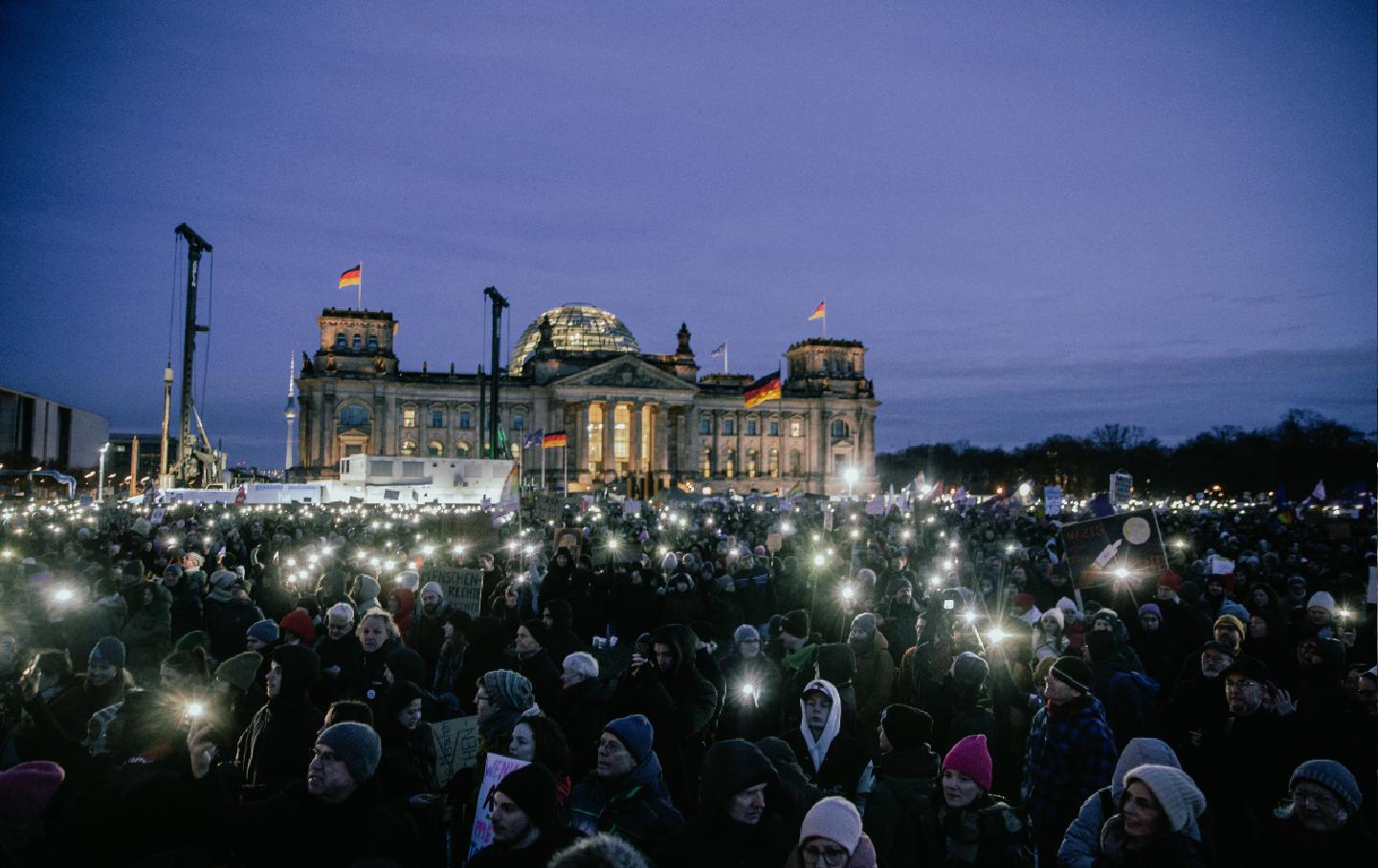
“swipe left below to view more authors”Swipe →On Friday, January 12, as weather reports predicted black ice (Blitzeis), protesters gathered in front of the Federal Chancellery in Berlin to call for the AfD to be banned. The protest was organized by an 18-year-old student, and an estimated 1,000 people came on short notice. In the days that followed, protests gathered support and began to take place everywhere: in cities and small towns in eastern and western Germany, and with turnout significantly higher than was expected (350,000 in Berlin, 250,000 in Munich). In the eastern German cities of Halle and Jena, protests of this size have not taken place since those that helped bring down the Wall.
On January 17, the legendary theater company Berliner Ensemble presented a staged production of Correctiv’s research that was livestreamed to theaters in Germany and Austria and could be viewed online; through that production, Correctiv released more information about the meeting, which then dominated headlines again.
The Correctiv report has launched a movement. It’s estimated that over a million people have taken part in protests in the less than two weeks since the report appeared, and more protests are planned for weeks ahead. At one gathering in Berlin, protesters carried signs that read, “Danke Correctiv.”
This does not mean, by any stretch of the imagination, that Germany’s far right has been dealt with. But it does mean that a proper understanding of who the AfD is, and what might be called for to address them, is starting to take hold.
Support The Nation’s June Fundraising Campaign
With the midterm elections now firmly upon us, the question is whether Democratic candidates will do more than merely occupy ballot lines as mild alternatives to the red-hot crisis that is Donald Trump.
As Trump spends over $1 billion a day on a globally destabilizing war on Iran and admits that he doesn’t “think about Americans’ financial situation,” millions across the country are struggling with the surging costs of essentials. Democrats must seize this moment and advance bold, small-“d” populist ideas—not settle for cynical caution that once again snatches defeat from the jaws of victory.
The Nation elevates progressive ideas, movements, and elected officials achieving real change across the country into the national conversation. At the same time, our journalists are exposing how crypto and AI-funded super PACs are spending hundreds of millions of dollars to knock out candidates they oppose, reporting on the devastating impact of the Supreme Court’s evisceration of the Voting Rights Act, and sounding the alarm on attempts by red states to quickly redraw electoral maps, disenfranchising Southern Black voters.
We can play this critical role because of support from readers like you. This June, we’re raising $20,000 to power The Nation’s independent journalism in the run-up to November’s immensely consequential elections.
It’s in our power to build a more just society, and your support at this critical moment brings us closer to that bold vision. I hope you’ll donate today.
Onward,
Katrina vanden Huevel
Editor and Publisher, The Nation
More from Linda Mannheim
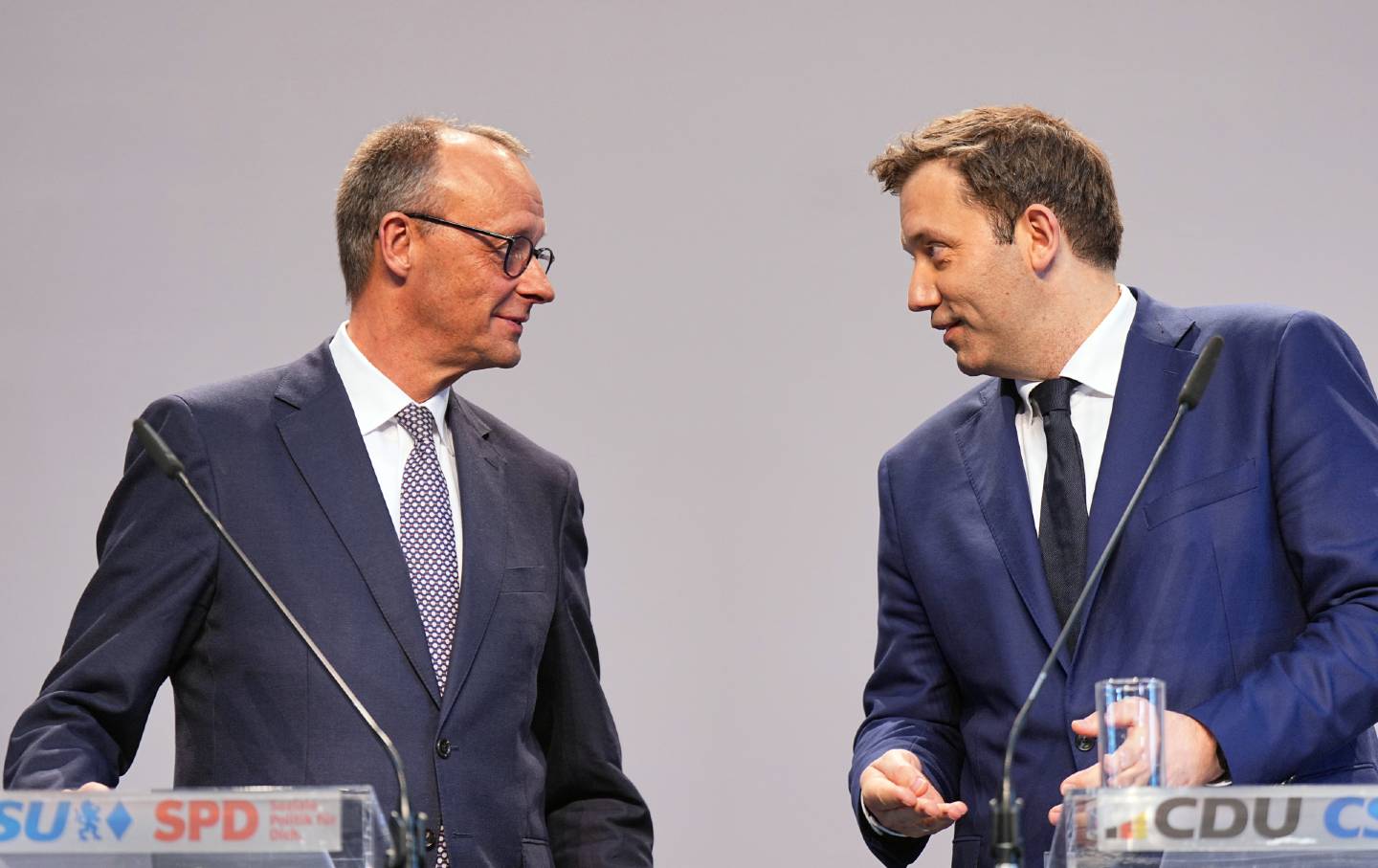
“A Matter of Survival”: Germany’s New Coalition Government “A Matter of Survival”: Germany’s New Coalition Government
Is the country’s latest grand coalition a shaky marriage of convenience—or “democracy’s last bullet”?
The Berlin International Film Festival in a Time of Crisis The Berlin International Film Festival in a Time of Crisis
During the Berlinale’s 75th anniversary, it felt like the world was coming apart—but at least we had the “borderless realm” of film.
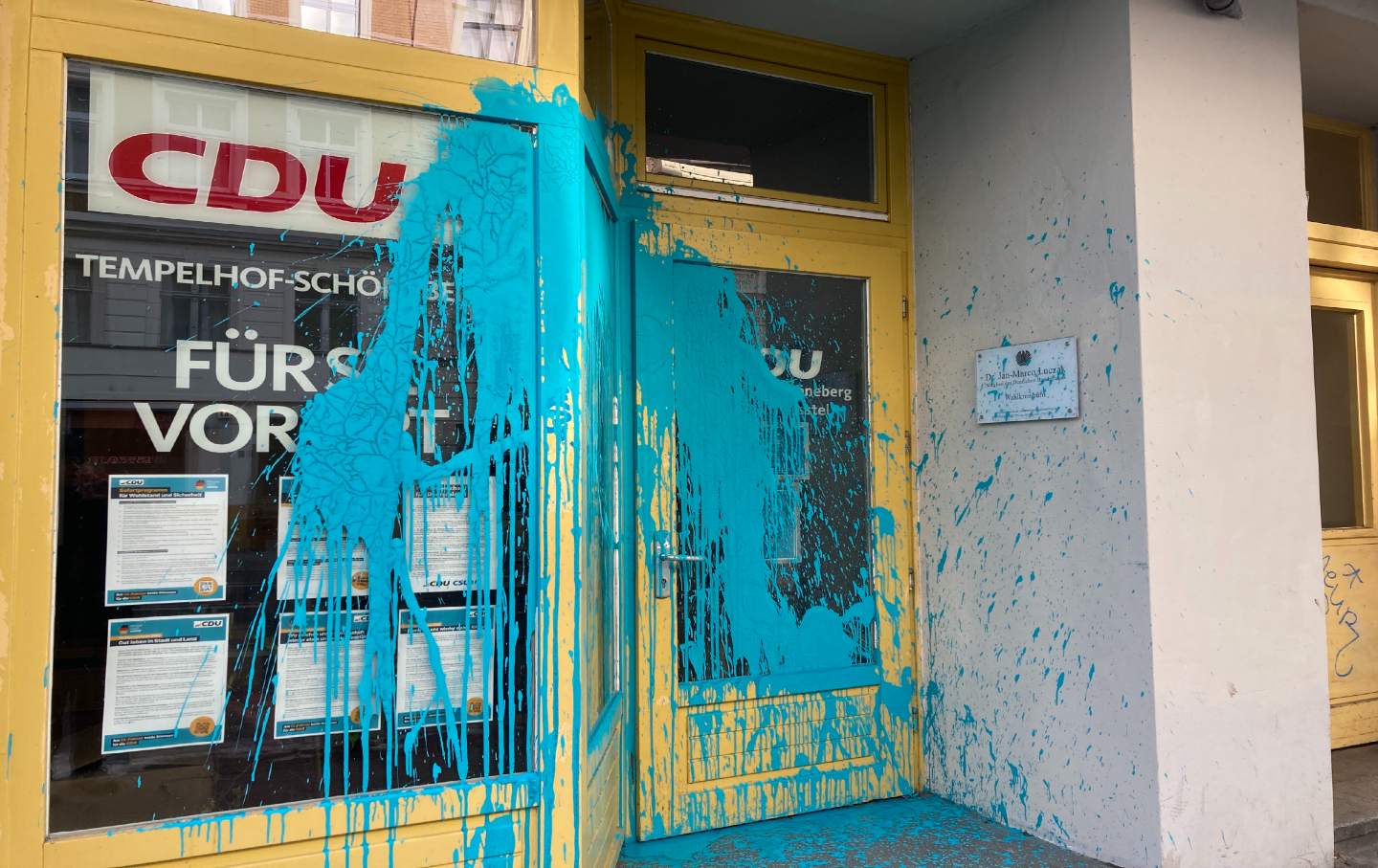
Germany’s Suddenly Turbulent Election Germany’s Suddenly Turbulent Election
In the wake of Trump’s victory—and his administration’s transformation from staunch ally to sneering adversary—Germany’s firewall against the far right is beginning to crack.
The Syrian Diaspora in Germany After Assad The Syrian Diaspora in Germany After Assad
Some refugees may return to Syria because they want to live there again. But many won’t—for the same reasons many refugees from Nazi-occupied Europe didn’t after World War II.
Germany’s Theater of Memory: “Some People Already See the Flames. Others Don’t Even Smell the Smoke.” Germany’s Theater of Memory: “Some People Already See the Flames. Others Don’t Even Smell the Smoke.”
A conversation with Max Czollek about Germans, Jews, Muslims, migration, and the aftermath of October 7 and the war in Gaza.
The Moral Triangle: Palestine, Israel, and Germany The Moral Triangle: Palestine, Israel, and Germany
A conversation about “peace and justice and freedom for all Palestinians and Israelis” with Sa’ed Atshan and Katharina Galor.

