Less than two weeks before Election Day, Americans are drowning in opinion polls. New surveys are released at a rate of about a dozen per day. We are, by turns, heartened and tormented by the respected Quinnipiac, the troubling Times/Siena, the right-leaning Rasmussen. People who are not paid to attend to such matters can be heard using phrases like “sample size,” “margin of error” and even “cross tabs.” We are a nation obsessed.
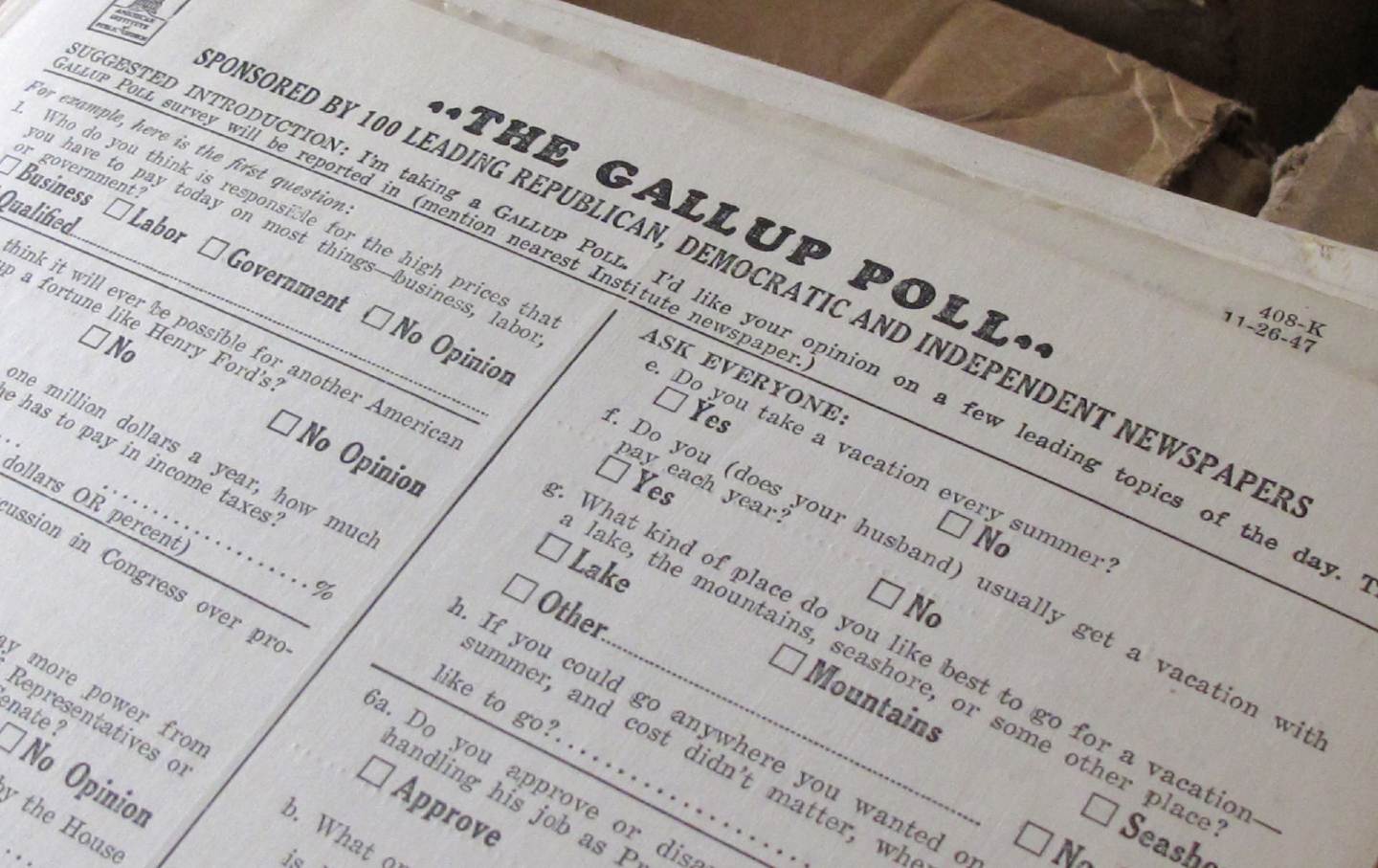
For this obsession we can thank, in part, George Gallup, who took public-opinion polling from the private-sector world of market research and applied it to American politics in the mid-1930s. He saw a problem with the informal and unscientific way polls were being conducted at the time. In 1936, Literary Digest went about surveying the public by scouring the phone book and car registration data and then sending millions of people a postcard asking whom they planned to vote for in the presidential election: Democratic incumbent Franklin D. Roosevelt or Republican challenger Alf Landon. Most respondents opted for Landon. The magazine predicted he would pick up 370 Electoral College votes. Landon wound up with eight. The magazine closed not long thereafter.
George Gallup, by contrast, knew that poorer voters who tended to support Roosevelt were less likely to have phones or cars. A former professor of journalism at Iowa State University, Gallup sought to craft a sample of voters that better reflected the voting public. By doing so, he predicted Roosevelt’s landslide in the 1936 election. On the strength of that success, he built a polling operation based in Princeton, New Jersey, which began publishing surveys of the American electorate’s opinions about both candidates and policies.
In early 1940, The Nation published an article about Gallup and the brand-new world of opinion polling, written by a 24-year-old James Wechsler, later the influential editor of the New York Post. Wechsler noted that, partly thanks to Gallup’s predictions in Roosevelt’s favor, most criticism of opinion polling was coming from conservative opponents of the New Deal, who argued that “polls are intrinsically a menace to the republic: they reveal only the sum total of popular ignorance; they foster the heresy that Mr. Milquetoast has something to say and a right to be heard even between election days; they thereby imperil the structure of ‘representative government.’”
While Wechsler didn’t share such antidemocratic concerns, he warned Nation readers to be skeptical of the profusion of opinion polls. After witnessing employees of Gallup’s American Institute of Public Opinion conduct interviews in three cities, he concluded that the potential for “manipulation of the polls by the conservative interests which ultimately pay for them” was a legitimate concern. (Gallup’s operation was funded by newspapers that subscribed to receive his data and reports.) “There is ample chance for sabotage along this assembly line,” Wechsler wrote.
Wechsler depicted Gallup as a nonpartisan expert “conscientiously groping for a vantage point above the battle where questions can be formulated in a spirit of peace and neutrality.”
Nearly five years later, Nation readers had a chance to hear from the man himself in a December 1944 article headlined, “I Don’t Take Sides.” He was responding to a critical essay the magazine had published two weeks earlier by a New Deal economist named Benjamin Ginzburg, who accused Gallup of refusing to share how he conducted his polling operations on the eve of that year’s presidential election. Whereas four years earlier conservatives had criticized Gallup, now it was Democrats who accused the pollster of putting out cooked survey figures.
In his Nation piece, Gallup dismissed the criticism as “unintelligent” and accused Ginzburg of “careless reporting,” while insisting that he welcomed any investigation of his polls. He also noted that, since both parties were accusing him of bias, he must be doing something right. “You can‘t make much of a case of political bias out of this record, unless perchance you regard us as chameleons who change political colors every two years,” Gallup wrote. “In this case at least one would have to admit that we distribute our political favors evenly.”
Gallup pledged that he and his institute had no political preferences and wanted only to predict the outcomes of elections correctly. He also insisted that, while he recognized there was “no social value in predicting elections,” his work contributed to the refinement of statistical methods that could perhaps be applied, more usefully, in other spheres of public life.
In his 1940 article, Wechsler depicted the polls as a useful addition to the democratic process. They gave voice to the common voter, who otherwise was rarely represented in the public discourse. “What have the answers to good questions, addressed intelligently to the right cross-section, proved about America?” Wechsler asked. “Above all they have revealed an incredibly animated populace anxious to articulate its fears, resentments, and loyalties.”
For Wechsler, it was the process, as much as the outcome, that gave polls their meaning. “[T]here is a perceptible undertone of excitement in these interviews which the statistics don’t record; to a host of Americans the polls represent a unique adventure in democratic life,” he noted. “On issues which have immediate personal impact, like involvement in war, they grasp at the chance to divulge what they are thinking, with the hope that someone in Washington will see the answers.”
“After watching fifty interviews,” Wechsler went on, “I could cite a large number of cases in which the answers were based on half-knowledge and intuition. But against those I could cite many others in which keen insight was revealed by people who were, in a sense, just learning to talk because nobody had previously asked them anything.”
“[T]he polls,” he concluded, “have encouraged the suspicion that Americans have minds.
It’s not obvious that opinion polls these days do much to encourage such suspicions, and one could hardly say that ordinary citizens are otherwise denied the chance to have their say in the public square. In a world overwhelmed by data, perhaps we might all do better to tune out the cacophony of polls and look to more qualitative sources of information in order to understand what truly animates the pulse of American democracy.
Popular
“swipe left below to view more authors”Swipe →Support The Nation’s June Fundraising Campaign
With the midterm elections now firmly upon us, the question is whether Democratic candidates will do more than merely occupy ballot lines as mild alternatives to the red-hot crisis that is Donald Trump.
As Trump spends over $1 billion a day on a globally destabilizing war on Iran and admits that he doesn’t “think about Americans’ financial situation,” millions across the country are struggling with the surging costs of essentials. Democrats must seize this moment and advance bold, small-“d” populist ideas—not settle for cynical caution that once again snatches defeat from the jaws of victory.
The Nation elevates progressive ideas, movements, and elected officials achieving real change across the country into the national conversation. At the same time, our journalists are exposing how crypto and AI-funded super PACs are spending hundreds of millions of dollars to knock out candidates they oppose, reporting on the devastating impact of the Supreme Court’s evisceration of the Voting Rights Act, and sounding the alarm on attempts by red states to quickly redraw electoral maps, disenfranchising Southern Black voters.
We can play this critical role because of support from readers like you. This June, we’re raising $20,000 to power The Nation’s independent journalism in the run-up to November’s immensely consequential elections.
It’s in our power to build a more just society, and your support at this critical moment brings us closer to that bold vision. I hope you’ll donate today.
Onward,
Katrina vanden Huevel
Editor and Publisher, The Nation
More from The Nation
Trump Wants You Talking About His Manners—Not His Election Lies Trump Wants You Talking About His Manners—Not His Election Lies
Don’t let Trump’s blowup on NBC’s Meet the Press distract from what he actually said.
Graham Platner Is About to Find Out Whether Mainers Really Have His Back Graham Platner Is About to Find Out Whether Mainers Really Have His Back
Voters, not DC insiders, will determine whether the Senate candidate is credible and viable.