Quantcast

December 24, 2001 | The Nation

In the Magazine

December 24, 2001

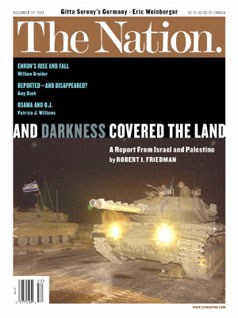
Cover:

Browse Selections From Recent Years

2013

2012

2011

2010

2009

2008

2007

2006

2005

2004

2003

Richard Falk defends "just war" thinking, Harvey Cox examines fundamentalist ideology, William Greider looks at Enron's troubles, Robert I. Freidman reports from Israel and Palestine and Eric Alterman mourns the death of objectivity.

Letters


'NO ONE WILL CARE...'

Washington, D.C.

On behalf of the members of our organization, each of whom is a survivor of torture, we wish to express our appreciation to Alexander Cockburn ["Beat the Devil"] and Patricia J. Williams ["Diary of a Mad Law Professor"] for their comments on torture and the US government, in your November 26 issue. Both of us are, unfortunately, well acquainted with our government's involvement in torture. The eagerness with which some in the media are willing, if not eager, to support its use does come as a distinct disappointment, as does the silence of Congress on the subject.

It is not uncommon for the tortured to be told by those who torture them, "Even if you survive to tell others what we did to you, no one will listen; no one will care." We are gratified to know that The Nation does care. Sadly, it seems that we cannot expect the same of the Bush Administration or most in Congress.

SISTER DIANNA ORTIZ, OSU
DR. ORLANDO TIZON, PhD
Torture Abolition and Survivors Support Coalition (TASSC)


HELP FAMILIES OF 'DISAPPEAREDS'

Charlottesville, Va.

I just read Miriam Ching Louie's "The 9/11 Disappeareds" [Dec. 3]. Is there an address to which donations to the Asociación Tepeyac can be sent?

VICTORIA ENGLE

Contact information for Asociación Tepeyac de New York: 251 West 14 Street, New York, NY 10011; phone (212) 633-7108; fax (212) 633-1554; e-mail AsocTepeyac@tepeyac.org.


TALKING TURKEY

Washington, D.C.

Ian Urbina's "US Bows to Turkey" [Nov. 12] certifies that some may get everything wrong indeed. Here are some essential facts on Turkey:

§ Turkey is a pluralistic secular democracy under the rule of law. It is party to the European Convention on Human Rights and is subject to, among others, the Council of Europe, the UN and OSCE monitoring on human rights.

§ Over the past seventeen years, we've had to fight the PKK terrorist organization, which attempted to divide our country and destroy the fabric of our society.

§ The terrorist PKK does not represent the Kurds, who constitute the majority of its victims. Our citizens of Kurdish origin prosper in every walk of life in Turkey. They enjoy the same rights of representation and regularly assume the highest offices, including in our Parliament.

§ Our Parliament decides whether our land and facilities may be used for military purposes by foreign troops. The Incirlik base is no exception.

§ In addition to the recent sweeping constitutional amendments, we have made important reforms in the way our economy is run. The benefits of those will be seen in the period ahead. Despite our economic turbulences, we have maintained our perfect credit servicing record.

§ Finally, Turkey has never, ever asked anything in return for its support for the campaign launched against terrorism, including our decision to give troops to "Operation Enduring Freedom." This is an outcome of our longstanding, principled policy to combat terrorism. And the sentiments of the Turkish people toward the September 11 attacks have probably been best conveyed in the letters, flowers and the fireman's helmet left at the gate of the US Embassy in Ankara.

SALIH BOGAÇ GÜLDERE
Counselor, Turkish Embassy


URBINA REPLIES

Washington, D.C.

A few comments from the Turkish Embassy merit response.

Indeed it is true that Turkey has been subject to international monitoring of human rights, the result of which has been a rather abysmal record. Even the State Department's Human Rights Report for Turkey discusses continued "serious human rights abuses, extrajudicial killings, including deaths in detention from excessive use of force, 'mystery killings,' and disappearances. Torture remained widespread.... Security forces continued to use arbitrary arrest and detention. Prolonged pretrial detention and lengthy trials continued to be problems."

The consequences of these abuses and Turkish military behavior have been dire. As early as 1997, before the current market crash in Turkey and recent upswings in its military budget, the CIA's State Failure Task Force reported that Turkey was a nation in danger of collapse, due in large part to its ongoing war effort.

It is also certainly true that for the past seventeen years the Turkish Army has been fighting the PKK, an organization that has engaged in serious human rights abuses against civilians. But the PKK implemented a unilateral cease-fire starting in 1999, and their repression by the Turkish military has steadily risen. Is this the logic of self-defense?

The biggest stretch of all is the claim that Kurds have full and equal rights in Turkey. The nation's first Kurdish woman elected to Turkish Parliament, Leyla Zena, now sits in prison on a fifteen-year sentence for having committed the crime of speaking Kurdish from the floor of Parliament. In October a Turkish radio station was closed down for having played a love ballad in Kurdish. What was true in the 1999 Human Rights Watch Report is no less true in the current political climate: "Turkish journalists face fines, imprisonment, or violent attacks if they write about the role of Islam in politics and society, Turkey's ethnic minority, the [Kurdish] conflict in southeastern Turkey or the proper role of the military in government and society."

IAN URBINA
Middle East Research and Information Project (MERIP)


US TERROR IN CHILE

Fredonia, N.Y.

It is most appropriate to be reminded of acts of terrorism promoted by the United States ["Indict Pinochet," Nov. 5] by citing the CIA's covert operations in Chile (1970-73).

Since September 11, 1973, Chileans have been honoring the memory of thousands who were killed and are still missing after Gen. Augusto Pinochet, with US support, put an end to Salvador Allende's democratic government of the Unidad Popular. And as you point out, an "infamous act of political terrorism committed in our nation's capital" occurred three years later: the car-bombing murders of Orlando Letelier (who had served in Allende's cabinet) and his American associate Ronni Moffitt.

Those involved were a US terrorist, Michael Townley (who operated in Chile), and three anti-Castro Cubans, all supposedly following orders from Pinochet himself.

One would have expected that the FBI and the CIA had some idea of how these terrorists found their way to the nation's capital and detonated a bomb in broad daylight not far from the center of the national government.

By the way, the Director of Central Intelligence at the time was George Bush, the father of the current occupant of the White House. Christopher Hitchens's "Minority Report" in that same issue gives other insightful views on the Nixon-Kissinger plan to destabilize democracy in Chile.

OSVALDO CHINCHON


OF OIL AND AFGHANISTAN

St. Paul

Warm thanks for Michael Klare's "The Geopolitics of War" [Nov. 5], which provides a much-needed historical background for the current war on Afghanistan. Two brief comments may supplement his fine work: Klare's list of Carter's militarization of the Persian Gulf in 1979, in the wake of the Iranian revolution and the Soviet invasion of Afghanistan, omits one particularly notorious action--the decision to invest millions of dollars in military aid in the oppressive but convenient dictatorship of Mohamed Siad Barre in Somalia. As the New York Times reported at the time, this client relationship was meant to replace the strategic and intelligence base the United States had lost in Iran. The dismal continuation of that story, where any pretense of "nation-building" has long been abandoned, may well be instructive for what we can expect from the current pageant of US policy in Afghanistan.

And speaking of Afghanistan: Klare argues that the war against Osama bin Laden is primarily an attempt to safeguard a friendly government in oil-rich Saudi Arabia. But Bush Administration officials have cautioned us not to expect the bombing in Afghanistan to produce bin Laden's capture or death. The prime strategic importance of Afghanistan is that it provides the only convenient land route for the oil pipeline Unocal wishes to build to extract the vast oil reserves in Uzbekistan. Unocal reluctantly suspended its $2 billion pipeline project last year, when the Taliban became intransigent. The Bush Administration was unable to win further concessions from the Taliban even after paying them $43 million last spring, ostensibly to congratulate them for their helpful initiatives in the "war on drugs." It would appear that Big Oil's man in Washington has resorted to a more conventional method for guaranteeing access to oil.

NEIL ELLIOTT


KLARE REPLIES

Amherst, Mass.

I certainly agree with Neil Elliott on the significance of the US alliance with Mohamed Siad Barre of Somalia in the wake of the Iranian revolution. On Afghanistan, however, I choose to differ. The United States is very eager to tap into the oil and gas reserves of the Caspian Sea basin, but the top priority for Washington has always been to build a pipeline from Kazakhstan and Turkmenistan across the Caspian to Baku in Azerbaijan and then on to the Turkish port of Ceyhan on the Mediterranean. This pipeline would make it easy to ship Caspian energy to Europe and the United States. The proposed pipeline through Afghanistan to Pakistan might be of economic benefit to Unocal, but it has little strategic significance for the United States. So I remain persuaded that the strategic epicenter of this war is Saudi Arabia, not Afghanistan.

MICHAEL T. KLARE


BRUSSELS SPROUTS?

Fredericksburg, Tex.

What have we here (on page 13 of your Fall Books issue)? The van of an Anglophilic booklover from Belgium (according to the letter "B" in the white oval)?

HORST WOITALLA

Editorials

We, the undersigned Nobel Peace Laureates gathered for the centennial of
the Nobel Prizes, express our joy at this year's award to the United
Nations and its Secretary General, Kofi Annan.

On November 27, Samira Dahduli waited in the Amman, Jordan, airport to pick up her husband, Ghassan, who was being deported after two months in a Denton, Texas, INS detention facility. Having lived in the States for twenty-three years, she had arrived in Jordan just weeks before with her five children, all US citizens, with the expectation that Ghassan would follow. But when the flight came, she saw no sign of her husband, a Palestinian with a Jordanian passport. She was about to leave when her 15-year-old son spotted his father surrounded by Jordanian security and American INS agents. Her son recognized one: Donna Chabot, an INS criminal investigator who had attended hearings in Dallas wearing a jacket with an antiterrorism task force insignia.

Samira Dahduli returned home and waited for her husband's call. After a week she still hadn't heard from him. "I would love to hear his voice," she said from a furnished apartment she has rented in Amman. Friends there tell her not to worry. "They need to make sure that he is not a danger to his community," she said. "Everyone says that this is normal procedure."

If the first chapter of the 9/11 detention story was the rounding up of 1,200 people, Dahduli's case ushers in the next phase, in which the government will decide their fate. Amnesty International believes that Dahduli is the first 9/11 deportee who could be facing ill treatment or torture in another country, says Angela Wright, Amnesty's chief US researcher. The arrest at the Amman gate and the accompaniment by a US task force member are troubling and unusual, according to immigration advocates and Dahduli's Dallas lawyer, Karen Pennington. "Nobody represents him now," said Pennington. "They took him away, and now he will be without the protections of American law, and they can torture him as much as they want."

Dahduli had a tense relationship with the US government well before September 11. He had been a leader of the Islamic Association for Palestine, an Illinois-based nonprofit with an office in Texas that has been the subject of federal scrutiny for allegedly having ties to Hamas. On September 25, 2000, federal agents confronted Dahduli in a Wal-Mart parking lot and then threatened to deport him, but offered to halt the proceedings if he agreed to become an informant on the IAP and other Islamic organizations. The FBI warned him that if he refused and was deported to Jordan, officials there would not be so understanding, according to three lawyers who worked on his case. Says Pennington, "The FBI said he would be treated a lot better by them than he would be by Jordanians." Elise Healy, a lawyer who represented him during the early deportation proceedings, adds, "He was perfectly willing to give information if he had it. But he was unwilling to be a lifetime mole." Dahduli not only rejected the government's offer but made it public, and news of it soon appeared on the Internet. "He became useless to them," says Healy. The INS began deportation proceedings but set him free on $50,000 bond.

Meanwhile, Dahduli was pursuing several avenues in immigration court to stay in the United States. He also filed an asylum claim, arguing that the FBI would paint him as a terrorist if he was returned to Jordan, rendering him vulnerable to torture. Amnesty has documented Jordan's practice of torturing terrorist suspects. In a trial last year in Jordan of Al Qaeda associates accused of planning bombings in Israel and Jordan during the millennium celebrations, the defendants testified that they had falsely confessed after beatings that included shabeh (suspending the victim by the feet with arms tied behind the back) and falaqa (lashings on the soles of their feet, sometimes followed by dousing in salt water). In the mid-1980s, in order to penetrate the Abu Nidal organization, responsible for 900 deaths or injuries in twenty countries, Jordanian security moved against suspects' family members.

In the wake of the September 11 attacks, INS officials revoked Dahduli's bond and arrested him on September 22 at his home in Richardson, Texas. A few days later, news accounts said, the name of Dahduli had turned up in an address book of Wadih el Hage, a former personal secretary to Osama bin Laden who was convicted in the 1998 bombings of the two US embassies in Africa. Pennington says that in the 1980s, when the two were students in Tucson, Dahduli and el Hage were members of the same mosque, the Islamic Center of Tucson. Later, they had a brief encounter in 1998 at a Dallas restaurant.

In late November, Dahduli gave up his asylum claim and agreed to be deported to Jordan. Now, in the Dallas Muslim community, "everybody is sick and worried," said a colleague at Dahduli's mosque, where he was a leader. INS spokesman Russ Bergeron said the INS accompanies deportees who pose a risk of flight or a risk to public safety. He declined to comment on Dahduli and denied the possibility of torture. "As a signatory of the torture convention it is a US policy not to deport someone to a country that there is reasonable cause to believe that person will be tortured or physically or mentally abused," he said. (Chabot's voicemail says she won't return calls until December 11. Lynn Ligon, INS spokesperson in Dallas, says Chabot is "on leave" until then. The Jordanian Embassy did not return e-mails or calls.)

Other 9/11 detainees could encounter similar problems. The government has reported links to Al Qaeda among only ten to fifteen detainees; the rest are being held on material-witness warrants and on immigration charges for violations like overstaying visas or lying on documents. It is doubtful that they'll be allowed to stay, although under the revamped "responsible cooperators" program, some who offer helpful information might remain. Many, however, will likely be deported, often to countries that don't offer protection from interrogational abuse.

It's possible that the Jordanian government is holding Dahduli as part of a routine check on a man with a native passport who has been detained in the United States; or maybe Jordan has some information on Dahduli; or Dahduli may have made an extradition deal with the United States and Jordan, in which he agreed to work as an informant (his lawyers and wife deny this); or perhaps, as Pennington fears, the FBI hopes to reap the benefits of interrogation tactics that contravene US law.

Why did Dahduli decide to abandon his fight with the US government and agree to be deported to Jordan? Pennington says it was because his application to the United Arab Emirates took too long, and he wanted to get out of jail. An Amnesty memo on post-September 11 human rights abuses, which describes Dahduli's case without naming him, says he was shackled during contact visits, held in solitary confinement for months and allowed only one hour of exercise per week. "He seemed to be treated more harshly than other detainees," said Wright of Amnesty. Could America's justice system have appeared so bereft of due process that he preferred the possibility of torture in Amman? "We had exactly that discussion," said Pennington. "If he didn't end up killed in Jordan, he thought he would be treated much more fairly there. He thought he would get out much more quickly."

The rise and fall of Enron is an instant classic in the annals of capitalism because, in one calamitous stroke, it wipes out so many sanctified illusions that rule in the magic marketplace. Enron embodies Nobel-class hubris like that of the market sophisticates who brought Long-Term Capital Management to ruin in 1998. It also smells of the raw monopolistic greed common a century ago. An energy-trading company that Wall Street had valued at $80 billion ten months ago is now a penny stock. Meanwhile, California consumers and businesses are stuck with the ruinously inflated electricity prices that Enron rode to brief financial glory. The firm's gullible creditors include some of the best gilt-edged names in American banking--J.P. Morgan Chase, Citigroup--whose ancestral houses were big players during the first Gilded Age too. Unfortunately, then and now, these venerable financial institutions lured millions of innocents to the slaughter, unwitting shareholders who bought the exuberant promises.

In this case, the lambs include Enron's own employees (thousands of whom are abruptly out of work) because top management cleverly prohibited their 401(k) accounts from selling Enron's plummeting stock while the big boys were dumping theirs. If the financial losses to banks are severe enough--we don't yet know the full truth--then US taxpayers may be burned too, their money used once again to rescue delinquent financiers from their just deserts in the name of "saving the system." Nobody ever said capitalism was pretty.

Markets are imperfectible human artifacts and always subject to gross error, not to mention high-stakes fraud, because the transactions are always the work of human beings. Computerization and esoteric mathematical formulations do not change that humble fact; neither does the Internet. This same lesson was learned from great pain and loss in the early twentieth century and led eventually to the political understanding that markets without governors and regulators will repeatedly throw off disastrous consequences--extreme price swings, occasional busts and clever larcenies--so stabilizing rules and limits were imposed. That knowledge was pushed aside by the modern era's deregulation.

Enron was a massive experiment in e-commerce--a commodity-trading firm that used the Internet to connect distant buyers and sellers of everything from electricity and natural gas, steel and newsprint to pollution credits and financial derivatives hedging against interest rates or the weather. If you check out Enron Online, you will see the hubris still on display, despite the bankruptcy. "Why Enron?" the company's website asks. "We have strong skills in risk intermediation and good systems to control risk.... We have successfully sourced capital for all potential investments." As it turns out, these are the very qualities that were missing, the "new economy" conceits that brought it down. Enron's siren song was plausible enough (if you left out the human folly and greed). Deregulation, combined with Internet trading, exposed the old-line utilities to fierce, continuous price competition, the firm explained, forcing them to eliminate inefficiencies or get out. Consumers would win from the lower wholesale prices; so would producers of "soft energy" alternatives, like wind or solar. Enron would preside like a wise monarch.

But while Enron promised to scrutinize the soundness of buyers and sellers, nobody was scrutinizing the trader king. The middleman is unregulated in this brave new world. When Enron management made a series of outrageous and self-interested off-the-books deals to raise capital, its auditor, Arthur Andersen, gave approval. The credit-rating agencies remained mute. Enron's bankers were busy touting the stock as on its way to the moon. Enron and chairman Kenneth Lay, meanwhile, pumped nearly $2 million into the election of George W. Bush, who returned the favor by letting Enron pick federal regulatory appointments. Lay and his agents were all over Vice President Cheney's secretive energy task force, and White House economic adviser Lawrence Lindsey received $50,000 last year as an Enron "adviser."

The disaster of California's blackouts and soaring electric bills was a prima facie case of monopoly price-gouging--artificial scarcity induced by utilities simultaneously shutting down electricity generation for "repairs"--that cries out for criminal investigation. Collusion has not yet been proved nor Enron's involvement, as far as I know, but the firm profited spectacularly. While California groaned, Enron's share price more than doubled. Enron then used its new glamour status to leverage still more debt, expanding its reach worldwide and opening more trading tables--financing it all in ways even savvy analysts couldn't understand. It was the classic behavior of unfettered freebooters, and it ended in the familiar way.

What did we learn? First, wholesale deregulation has a vicious downside for ordinary citizens and is open to gross manipulation. Second, as Floyd Norris of the New York Times pointed out, Enron is essentially not an energy company but a financial institution that trades various financial instruments, utterly free of regulating limits. Like a bank, it must raise huge capital flows to maintain liquidity to underwrite the transactions, but unlike a bank or a financial market, it operates without oversight. Third, nearly every party to this debacle--Enron itself, its auditor, the bankers and brokerages--is guilty of profound conflicts of interest. They do not tell the truth to retail customers like small-scale investors for fear of offending their big investment clients. Enron, it seems, didn't tell the truth to its bankers either, and they didn't ask.

As we learn more, the fall of Enron may be seen as the logical result of repealing the Glass-Steagall Act, which prohibited commercial banks from merging with investment houses. The remedial agenda would start with the reregulation of banking and finance, in order to restore a milieu of prudence and honest dealings at the heart of capitalism. Other sectors should follow: energy, telecommunications and airlines, for starters.

It would be comforting to think this event will turn politics around and put a little spine in our legislators. Certainly many state governments have learned from California's pain. But don't count on Washington. Even after Enron's meltdown, leading Democrats continue to shill for more deregulation, aware that their money patrons will be most upset if they reopen fundamental scrutiny of how wealth is created in the magic market. Elite opinion leaders will probably stick with the laissez-faire dogma, as it continues to fall apart, until the bloody losses lap over their shoes too.

"It is almost impossible even now to describe what actually happened in Europe on August 4, 1914," Hannah Arendt wrote in 1950, in words that also seem to apply, with uncanny aptness, to September 11, 2001. "The days before and the days after the first world war are separated not like the end of an old and the beginning of a new period but like the day before and the day after an explosion.... [That] explosion seems to have touched off a chain reaction in which we have been caught ever since and which nobody seems to be able to stop." The chain reaction was the abrupt, unstoppable plunge into the protracted, unprecedented savagery of the two world wars and the two great totalitarian regimes, Soviet and Nazi, of the century's first half. It's still too soon to know whether September 11 (let us avoid the trivializing, disrespectful notation "nine eleven") will touch off a comparable--or worse--spiral of violence in the twenty-first century. An "explosion" we have definitely had; whether an unstoppable "chain reaction" of violence has been triggered we do not know. Yet already the elements of not one but at least three distinct possible kinds of disaster have appeared with astonishing swiftness.

First (to list them briefly), is the threat of a much wider conventional war. Even as the war in Afghanistan still rages, voices in and out of government are calling for new wars against new countries. The targets and justifications for attacking them shift with dizzying rapidity. The war most often mentioned is one to overthrow the regime of President Saddam Hussein of Iraq. The justification first given was a possible connection to the September 11 attack or the anthrax attack that followed; but when this justification seemed to fade (hard facts are impossible to come by), a new one--Saddam's refusal to let UN inspectors into his country to search for weapons of mass destruction--was brought forward. Next, we were hearing from inside sources that the targets might in fact be Somalia or Sudan. (The attack on Iraq would be considered later.) Meanwhile, other crises are sucked into the vortex. In the latest round of violence between Israel and Palestine, Israel, seeking to associate its own war on terror with the American one, has responded to the suicide bombings by the Islamic organization Hamas by attacking the head of the Palestinian Authority, Yasir Arafat. If this development leads to the collapse or expulsion of Arafat from Palestine and definitively ends hopes for a Palestinian state, it could rouse the fury of the Islamic world against the United States and Israel alike, and bring on the full-scale "clash of civilizations" predicted by the political scientist Samuel Huntington.

Second, the Bush Administration has responded to the terrorist threat with executive measures that some are calling the most serious threat to civil liberties in recent memory. The list already includes a roundup of more than a thousand people without charges; eavesdropping on conversations between terrorism-related suspects and their attorneys; a huge, ill-defined expansion of wiretapping in the United States; and, of course, the creation by presidential order of military tribunals that try and execute noncitizens in secret by majority vote. If, as George W. Bush says, we must not allow terrorists to use our freedom to attack us, then how much less should we destroy our own freedom in order to attack the terrorists? Freedom is not some glittering abstraction that hovers in the air; it is the Constitution and the rights it guarantees to citizens. To lose these will be to lose the war no matter how many terrorists the United States kills in Afghanistan.

Third, looming over all these developments is a threat unknown in 1914--the use of weapons of mass destruction against the United States, by the United States, or both. Osama bin Laden has stated that he possesses nuclear weapons ("as a deterrent"), and Administration sources are telling reporters that there is reason to fear that he may have radiological weapons (which use conventional explosives to spread radioactive materials across a wide area). Meanwhile, Defense Secretary Donald Rumsfeld has pointedly declined to rule out first-use of nuclear weapons by the United States at some point in the conflict.

What protection does the world have now against a new chain reaction, in which these dangers will feed on and produce one another? To the people--a large majority, according to the polls--who favor present policy, the protection probably seems adequate, or as good as it can be, but to someone like me, who, as this Letter has made clear, opposes both the war abroad and the inroads on liberty at home, Arendt's description of a world in which events are outrunning understanding and response seems frighteningly current. Neither widening war abroad nor loss of liberty at home nor the danger of mass destruction seems to have stirred a response anywhere near the level of the danger. We seem to be gliding in a kind of glassy calm toward a multitude of horrors. There is incontrovertible evidence--including a shocking series of photographs in the New York Times--that our new ally the Northern Alliance has been executing prisoners of war, but there is little reaction in the United States. Serious allegations have also been made that the Alliance, with the help of American bombers, has massacred hundreds of prisoners in the city of Mazar-i-Sharif. The Administration has shown no interest in discovering the truth. The nation's shock was intense when Americans were killed in the September 11 attacks. But reports that villages have been destroyed by US bombing in Afghanistan go uninvestigated. Asked about the press coverage of the subject, Brit Hume of Fox News commented, "The fact that some people are dying, is that really news? And is it news to be treated in a semi-straight-faced way? I think not." The Administration is clearcutting constitutional protections, but few legislators take an interest.

It's one thing to face possible disasters; another to let them draw near without protest or action, as if in a trance or dream. "Nothing which was being done...no matter how many people knew and foretold the circumstances, could be undone or prevented," Arendt wrote of the earlier period. The question now arises whether an opposition today can find the ground on which to take its stand. Or will "every event," as Arendt wrote of the earlier time, "have the finality of a last judgment, a judgment that was passed neither by God nor by a devil, but looked rather like the expression of some unredeemably stupid fatality"?

On the evening of Saturday, December 1, when three bombs went off in Jerusalem, causing mass carnage, CNN, MSNBC and Fox News all pounced on the story, showing footage from Israeli TV accompanied by interviews with Mideast experts. ABC and CBS stayed with their college football games, and NBC remained with the NBA. The contrast provided further evidence of how the center of gravity in television news is shifting from broadcast to cable. At any time of day or night, Americans have three newscasts they can tune into. That's the good news. The bad is that all three remain of pretty poor quality. Since September 11, Fox has solidified its reputation as the most blatantly biased source of news on TV. As Jim Rutenberg recently observed in the New York Times, the network has become "a sort of headquarters for viewers who want their news served up with extra patriotic fervor" inflected by "unabashed vehement support of a war effort, carried in tough-guy declarations often expressing thirst for revenge."

Yet CNN and MSNBC are not much better. If you watch the former for even a short while, for instance, you're likely to see retired general Don Shepperd standing before a map of the Middle East discussing US military capabilities. Shepperd makes no effort to divorce his role as a news commentator from his position as a former Air Force officer. Worse, CNN seems increasingly to rely on him to comment on political matters that extend well beyond his expertise. On a recent segment, for instance, reporter Catherine Callaway fed the general a series of leading questions about which countries the United States should go after next in its war on terrorism. "Do you think Somalia could be a likely target?" she asked. Well, yes, Shepperd said. "If you're serious about terrorism, you have to go against Somalia at some time."

The problem extends beyond flag-waving, though. For all its aspirations to be a global news network, CNN remains relentlessly parochial. Its anchors love to engage in happy talk, making the network at times seem like a local TV station. Interviewing Danny Glover about a benefit he was planning for Afghanistan, the endlessly effervescent Paula Zahn fawned all over him. Stories about September 11, meanwhile, tend toward the mawkish. "When we went by ground zero, what went through your mind?" a reporter asked tourists aboard a Circle Line trip around Manhattan.

Even more troubling, CNN, while devoting far more time to international affairs since September 11, has narrowed its definition of the world. In the initial weeks after the attacks, the network made at least a token effort to explore the nature of Islam and the politics of the Middle East. Over time, though, it has essentially conflated foreign news with the war on terror and the fight in Afghanistan. While obsessively covering the hunt for Osama bin Laden, it has spent next to no time examining Third World poverty, the exploding AIDS epidemic, the economic meltdown in Argentina or the changes sweeping Putin's Russia.

MSNBC has seemed similarly fixated. In recent days, for instance, as the military campaign in Afghanistan has progressed, it has become fascinated with the caves of Afghanistan, flashing sophisticated diagrams of underground bunkers as military experts describe how to penetrate them. Its daily show "A Region in Conflict," meanwhile, seems largely a star vehicle for correspondent Ashleigh Banfield. With her stylish haircut, designer glasses and plucky reporting style, Banfield has become TV's new "It" girl, but her dispatches from the field often seem cartoonish. In one early report from Peshawar, Pakistan, she charged into a marketplace in the middle of the night to interview displaced Afghans about their political preferences. "OK, which do you support, king, Taliban or Northern Alliance?" she asked over and over, moving restlessly from one startled subject to another, conveying little to viewers beyond the fact that she, Ashleigh Banfield, was willing to go out among the great unwashed at 2 in the morning.

In the past two weeks, however, MSNBC has given some sign that it is willing to break the mold of cable news. As retired general Anthony Zinni arrived in the Middle East on his peaceseeking mission--an event largely ignored by CNN--MSNBC correspondent Gregg Jarrett began a week of on-the-ground reports from Israel and Palestine. Peering into places TV cameras rarely venture, Jarrett took us to a neighborhood in southern Jerusalem that is so often targeted by nearby Palestinians that each apartment has at least one room with bulletproof glass, where family members can gather when the shooting starts. He also filed from a Jewish settlement in the West Bank--the first time I recall seeing such a report on American TV. Jarrett spoke with the parents of Yaakov Mandel, the 13-year-old boy who last spring was beaten to death while hiking in the nearby hills. Despite the guilt they said they felt over his death, the couple expressed their determination to remain.

On the other side, Jarrett reported from a refugee camp in Ramallah. "A lot of Americans wonder why Palestinians are so angry," he said. "They feel this is their land, and that it's occupied." In many areas, he went on, there are no running water, no toilets, no jobs. At an Israeli-manned checkpoint, Jarrett highlighted the humiliations Palestinians must endure, and in Bethlehem he showed the physical scars left from ten days of occupation by Israeli troops. One family showed him the remains of their house after the Israelis got done with it; they were living in a tent.

Overall, Jarrett did an extraordinary job of capturing the grievances on both sides and of showing the need for a peace settlement to end the escalating bloodshed in the region. He also showed what cable news is capable of, if only it has the imagination, and the nerve.

In mid-November Secretary of State Colin Powell delivered the Bush Administration's long-delayed statement on its plans for re-engaging in efforts to bring peace to the Middle East. "We have a vision of a region where two states, Israel and Palestine, live side by side within secure and recognized borders," he said. Other than the purely symbolic use of the term "Palestine," a breakthrough in the semantic wars that punctuate the decades-old conflict, nothing in Powell's speech showed any indication that the Administration has a clue about how to get the parties back to the negotiating table. Powell ritually admonished both sides, seemingly with objective balance. Terror and violence against Israelis must stop, he told the Palestinians. Settlement activity and killing of innocent Palestinians must stop, he told the Israelis.

But if Powell had been really serious about reversing the cycle of violence, he would have admitted Washington's role in the conflict--continuing to arm and fund Israel despite its steady expansion of settlements and its systematic violation of Palestinians' human rights in the occupied territories. Ten years ago, the first Bush Administration refused to meet officially with then-Housing Minister Ariel Sharon because of his aggressive role in building settlements. And it took a modest step in the right direction by telling Israel that it would delay $10 billion in loan guarantees if Israel kept expanding settlements. The threat helped bring right-wing Prime Minister Yitzhak Shamir to the table with the Palestinians, paving the way for recognition of the PLO and the beginning of the Oslo process.

Powell showed no such resolve, with the result that his speech had no effect. Instead, the blind rush of events has propelled the White House to a far more dangerous course. After a horrendous series of violent acts--which began with the killing in Gaza of five Palestinian children who tripped a booby-trapped bomb planted by the Israeli army, and the provocative assassination of a Hamas leader who, Israelis said, was behind recent suicide bombings--three more Palestinians blew themselves up in crowded streets and on a bus, killing at least twenty-five Israelis and wounding hundreds more. And this time, there were no calls from the Bush Administration for Israeli restraint.

The Palestinians' desperate and appalling turn to terrorism has backfired. For there seems to be little willingness in Washington to see equivalence between their tactics and Israeli military operations even when those parallels may exist. "We're not about to tell Mr. Sharon what he should do," said Powell, in the least belligerent of several statements to come from the White House. Given that green light, Israeli Prime Minister Ariel Sharon took the unprecedented step of bombing Yasir Arafat's offices and attacking several police headquarters, even though the Palestinian Authority had arrested about 100 Palestinian militants. The last time Washington gave Sharon a green light was in 1982, when as commander of Israeli forces in Lebanon he occupied Beirut and was responsible for the deaths of thousands of civilians. That war, which Sharon supposedly devised to destroy the PLO, instead solidified its international status. As we go to press, it looks as though Sharon is intent on tearing apart the PA in the dubious belief that he can find quislings to deal with instead of Arafat.

Of greater concern is the new analogy taking hold in Washington. "The PLO is the same as the Taliban, which aids, abets and provides safe haven for terrorists," said Senator Chuck Schumer. "And Israel is like America, simply trying to protect its home front. To ask Israel to negotiate with Arafat is like asking America to negotiate with Mullah Muhammad Omar." This, almost verbatim, is the line that Sharon has been pushing since September 11. But that analogy is false, not only because the Palestinian Authority is recognized by the 189 members of the United Nations as the legitimate representative of the Palestinian people but because in no way can the West Bank and Gaza be considered part of Israel's "home front." 200,000 Israeli settlers are occupying lands that belong to and are inhabited by more than 3 million Palestinians, and there can be no peace until that central fact is undone.

The last time a US President referred to the settlements as "obstacles to peace" was under Bush I. Israel's settlement policy and Sharon, the bulldozer of a man who has been its mastermind almost from the beginning, have won, with the result that the Palestinians have lost all hope in any kind of peaceful resolution to their grievances. The hell described so painfully and eloquently in this issue by Robert I. Friedman is here. "The biggest factory for suicide bombers is your policy," Mohammed Dahlan, the former head of Palestinian Preventive Security in Gaza, told an Israeli reporter recently. "I can put out a table to sign people up at the Rafah roadblock and in two minutes I'll have 200 suicide bombers. Once it was difficult to persuade people to commit suicide. Today everyone wants to. Don't you people understand that?"

The grim future now facing Israel/Palestine can be changed only by active international intervention, led by the United States. To begin, the United Nations could send in peacekeepers to separate the warring sides, as it has done in other parts of the world. The United States could set up a fund to help repatriate Jewish settlers, using that portion of US aid that now goes into expanding the settlements. Or, thinking more ambitiously, the Security Council could impose a solution, by claiming international jurisdiction over the occupied territories. Under such a scenario, the Council could offer to recognize a Palestinian state in the West Bank and Gaza, contingent on Palestine's recognition of Israel as a Jewish state within the pre-1967 borders and with full security guarantees. The details of a final compromise on Jerusalem, refugees and territorial swaps, as we now know from various post-mortems on the last round of intensive Israeli-Palestinian negotiations, are not far from reach. What's needed is the political will. The question now is whether Washington really cares about peace in the Middle East, or whether US policy-makers don't mind what Israel does there as long as all-out war does not break out.

With the war against the Taliban nearing conclusion, many in Washington are urging Bush to expand the current conflict into a vast, open-ended campaign against assorted terrorist groups and "rogue" states like Iraq. The President has encouraged such thinking. The current struggle in Afghanistan is "just the beginning on the war against terror," he told US soldiers the day before Thanksgiving. "There are other terrorists who threaten America and our friends, and there are other nations willing to sponsor them. We will not be secure as a nation until all of these threats are defeated."

Originally, in his address to Congress on September 20, he said the war would extend to every terrorist group that has "a global reach" and to states that knowingly aided or harbored such groups. But on November 26 he expanded the target list to include states that "terrorize" other nations by secretly pursuing the manufacture of nuclear, chemical or biological weapons, a category that conceivably could include Iran, Iraq, Libya, Syria and North Korea.

With the door open to so many options, hawks and hard-liners of many stripes have been arguing for a wide range of punitive military strikes. At the top of the list is a campaign to kill or oust Saddam Hussein of Iraq. Other oft-mentioned targets include Abu Sayyaf in the Philippines, Hamas and Hezbollah in the West Bank and Lebanon and assorted rebel groups in Somalia.

With fighting still under way in Afghanistan, the White House is reluctant to provide any specifics about the next stage of the war. But various officials have suggested that the Pentagon is already gearing up for a wider range of attacks, including a stepped-up campaign against Saddam Hussein. From all that can be discerned these plans envision far more extended and risky operations than those now under way in Afghanistan.

Many signs point to preparations for an expanded war. Most conspicuous, of course, are the threatening comments by senior Administration officials. "The objective is to dismantle the global terrorist networks and state support for terrorism," said Deputy Defense Secretary Paul Wolfowitz on November 18. "There are a number of states that support terrorists. Saddam Hussein [leads] one of them." Equally suggestive is the Defense Department's continuing mobilization of forces for deployment to the Persian Gulf area even as the Taliban regime appears to be disintegrating. Several aircraft carrier battle groups have already been stationed in the area, and at least one other group is on the way. "We want to continue planning, so that we can...provide the President of the United States with credible military options," Gen. Tommy Franks, commander of the US Central Command, said on November 8.

A war with Iraq would conceivably jeopardize the flow of oil from the Gulf, so it is particularly significant that George W. Bush has ordered the Energy Department to completely fill the Strategic Petroleum Reserve for the first time ever. The reserve is designed to provide the United States with a secure supply of oil in the event of war or a major national emergency.

Although none of this evidence can be considered definitive, it makes it increasingly apparent that the Administration plans to start a new round of attacks once the fighting in Afghanistan is over. This could entail an intensified air campaign against Iraq or commando raids on suspected terrorist camps in Somalia, the Bekaa valley of Lebanon or other sites in the greater Middle East or Asia. Stepped-up US involvement in the Philippines' counterinsurgency campaign against Muslim rebels in southwestern Mindanao is also likely. (US military advisers have already been assigned to the government forces involved in this effort.)

Whatever the immediate outcome of these engagements, the United States is likely to find itself embroiled in one bloody and uncontrollable conflagration after another. Except possibly in the Philippines, where support for the rebels is limited, US intervention will provoke a hostile reaction from at least some segments of the local population, leading to a larger conflict and/or new outbreaks of terrorism. It will also divert resources from the effort to track down surviving offshoots of Al Qaeda--groups that most directly threaten the United States. In addition, an expanded US war effort will alienate our partners in the global antiterror coalition, most of whom insist that the current campaign be confined to attacks on Al Qaeda and the Taliban.

A US attack on Iraq presumably would be justified on the grounds that Iraq is manufacturing weapons of mass destruction that threaten the world community. But there is no clear evidence of such activities. The only way to find such evidence is by sending UN arms inspectors to Iraq--a step Saddam has opposed since 1998. The best way to compel him to let inspectors in is to impose "smart" sanctions of the sort proposed by Secretary of State Colin Powell and by others who oppose the current regime of sanctions, which inflicts great suffering on ordinary Iraqis. Any US military action that pre-empted such an effort would invite worldwide condemnation.

The Bush Administration enjoys strong support from Americans and the international community for the campaign against Osama bin Laden. As Richard Falk suggests in this issue ["In Defense of 'Just War' Thinking"], a war limited to the destruction of Al Qaeda can be considered a just and proportionate response to the September 11 terror attacks. But a larger effort, aimed at any number of states and individuals with no apparent connection to September 11, must not be viewed in that light. Such a campaign should be denounced as a dangerous example of "mission creep," intended to further the ambitions of certain strategists and politicians in Washington while exposing US soldiers and the American people to additional bouts of deadly violence.

Columns

scheer

Enron is Whitewater in spades.

Something quite odd is going on with media coverage of this war. Critics on all sides of the political equation have historically attacked the media for bias in one direction or another, but rarely were willing to admit that they were doing so on behalf of biases of their own. Weekly Standard executive editor Fred Barnes did just that, however, in a recent cover story celebrating top journalists' willingness to throw the old objectivity rulebook out the window as a result of the attacks of September 11.

Barnes does not have all his facts straight. He seems to think that the media have reached a new low in the eyes of the public. In fact, a recent study by the Pew Research Center demonstrates that just the opposite is true; 77 percent of those surveyed rate the media's coverage as excellent or good. Barnes also calls Geraldo Rivera a "liberal media icon" when, in fact, he is a "liberal media" joke.

Nevertheless, Barnes is quite understandably excited about Dan Rather's post-9/11 appearance on the David Letterman show, when the anchor declared: "Wherever [the President] wants me to line up, just tell me where. And he'll make the call." Given that Presidents routinely lie about matters of war and peace, Rather is volunteering here to be a mindless propagandist rather than a thinking journalist. Rather also explained to Letterman that the terrorists attacked us because they're evil, and because they're jealous of us. Such anti-intellectual pronouncements may warm the cockles of right-wing hearts, but they signal the death of a journalist's commitment to the ideal of objectivity.

A second source of Barnes's glee is no less instructive. During a recent class at the Columbia Journalism School, ABC News president David Westin was asked whether he considered the Pentagon to be a legitimate target for attack by America's enemies. Westin replied, "I actually don't have an opinion on that...as a journalist I feel strongly that's something I should not be taking a position on." As a lesson in the pretense of objectivity, Westin was right on point, if not exactly credible. No further questions on this topic were asked.

Thanks to a C-SPAN broadcast, however, Westin soon found himself chewed up and spat out by the nation's vast, right-wing media food chain. Brent Baker of the Scaife-funded Media Research Center sent it out on a daily "CyberAlert." There, it was picked up by Rupert Murdoch-funded Fox News Channel anchor Brit Hume, then rereported by the Murdoch-funded New York Post and later trumped by Matt Drudge and Rush Limbaugh, who spent about an hour on it on his radio show. While Limbaugh was still on the air, Baker received a call and an e-mail from Westin containing what Barnes accurately terms Westin's "total capitulation." "I was wrong," he wrote. "Under any interpretation, the attack on the Pentagon was criminal and entirely without justification."

This is silly. There are millions of people all over the world whose interpretations of the attack lead them to believe it was justified, however wrong they may be. Even so, the question is a no-brainer. Of course the Pentagon is a legitimate target for an attack for those at war against us. Hello? War is the Pentagon's entire reason for being. It's where we plan our wars and figure out how to carry them out. By what conceivable definition of war could the Pentagon be excluded as a potential target? The shock of that aspect of the attack was that we didn't know we were in a war with these people in the first place. Now we do.

What's most interesting about Westin's answer was his willingness to drop any pretext of objectivity upon having his patriotism questioned and offer an apology no less indefensible than Rather's pathetic pandering. Following Bill Maher's craven apology for speaking his mind on Politically Incorrect, the rest of the media's message to the patriotic correctness police appears to be, "ain't nobody here but us chickens." Don't forget that these are not nobodies or typical Murdoch mouthpieces. They are the nation's best-known anchor and the president of one of its top network news divisions. They make the rules.

Barnes credits some of the change in atmosphere to the emergence of right-wing "media critics, watchdog groups, press websites, and astute journalistic observers like Andrew Sullivan." And he may be right: As Joseph McCarthy demonstrated, using terms like "fifth columnist" to smear reporting with which one disagrees may not be pretty, but it is effective.

Most infuriating about the right's capture of the media since the war is the fact that, according to the Pew study, nearly three-quarters of the respondents say they want news that includes the views of America's enemies, and just over half say reporters should dig hard for information rather than trust official sources. So just why are the media wimping out exactly when tough, critical reporting is not only crucial for the functioning of democracy but is also being demanded by their audience?

Conservatives will never stop whining, but it is hard to remember a time when they were riding any higher in this country. Liberalism is in disarray, as evidenced by the New York City mayor's race, and the mainstream media are indecently obsequious to the right's worldview. Al Hunt, the Wall Street Journal's token moderate, recently observed that Bush's selection as President, however shamefully executed, has turned out to be a lucky break for the nation. Why? Because liberals are more patriotic than conservatives and far more civilized in their opposition. The far right--including, no doubt, the folks on the other side of the page from Hunt--would have been merciless in their attempt to exploit September 11 as a stick with which to beat Gore, just as they used Kosovo to pummel Clinton. Hunt reminds us that House Republicans refused to pass a resolution supporting the troops there, even after the fighting began. Tom DeLay and Don Nickles both suggested that the atrocities in Kosovo were more Clinton's fault than Milosevic's. In other words, conservative hysteria has made America all-but ungovernable for anyone but conservatives.

Objectively speaking, you'd think there might be a story in there somewhere...

What times. Give the government the power to assassinate terrorists, comes the call on chat shows. Don't burden citizens with the obligation of serving on juries for people who hate us, say the TV audiences. Spare us the circus of long public trials, say the letters to the editor. According to most polls, approximately 60 percent of Americans wholeheartedly endorse such measures through the vehicle of President Bush's recently ordered military tribunals. The figures also show that many of those same Americans seem to feel that such measures will affect only a few noncitizens and that the real subject of such tribunals will be Osama bin Laden. "They had to do it this way because you can't make a law against just one person," opines a friend.

Yet there are about 17 million noncitizen residents in America. By the terms of President Bush's order of November 13, all those people are now effectively living under martial law. I think that's a tad overbroad, although I concede that my opinion is currently in the minority. Rather, I wish to pursue my concern that the practical divide between "aliens" and "citizens" is a very thin one, one that is melting away quickly beneath the sun of this go-for-the-throat, to-hell-with-human-rights rage.

If Osama bin Laden is the icon by which noncitizens are deprived of constitutional protections, my sense is that O.J. Simpson has re-emerged as the justification for doing the same to certain citizens. "We wouldn't want Johnnie Cochran trying Osama," I keep hearing. "He'd end up in Florida, playing golf with O.J."

The Simpson case, a wholly anomalous piece of bread and circus, has come to symbolize a widely shared and unfortunately politicized understanding of the criminal justice system. "O.J." means: the misuse of public resources, the helplessness of prosecutors, the predatoriness of defense lawyers in particular and of trial lawyers generally, the cravenness of judges and the bias of black jurors. The case remains an object lesson in the sensational potential of reality TV. And in the fallout, the English language gained an ugly new phrase--"playing the race card"--that has been used to pulverize any constructive discussion of race or civil rights ever since.

The problem is that this rendering of the Simpson case is deeply misleading. And its reappearance in the context of whether Osama bin Laden should be tried or just "offed" is dangerous.

To back up a bit: When Simpson was acquitted of murdering Ron Goldman and Nicole Brown Simpson, the big question was why a very racially mixed jury (it intrigues me that people always think of that jury as "all black") acquitted him when the whole rest of the world wanted to hang him. Most people blamed the supposed stupidity of the jurors. But I think Simpson was acquitted not so much because defense lawyers befuddled the wits of the jury--however much the media bemoaned Alan Dershowitz's and Johnnie Cochran's theater--but more because the prosecution's chief witness, officer Mark Fuhrman, lied on the stand, was caught at it and was ultimately convicted of perjury for it. There really are very few cases where you can ever get a conviction if the credibility of a major prosecution witness is as shaky as that.

Moreover, LA residents--the jury pool in other words--were perhaps more aware than the rest of the nation of the LAPD's history of flagrant frame-ups, particularly racialized ones. The now-notorious revelations of corruption in the LAPD's Rampart division grew out of this precise concern: Hundreds of criminal cases had to be dismissed in Los Angeles in the past few years because of officers so eager to convict that they suppressed relevant evidence, or relied too heavily on snitches intent on plea-bargaining their way to lighter sentences, or lied, framed and even attacked minority defendants.

To this day, few people recognize the relation between the attitudes of the jury pool in the Simpson case and the Rampart scandal. My only point is that the practiced corruption--of lowered evidentiary standards, of self-interested witnesses and of shortcuts to conviction--poisons not just individual cases but the public trust and perception of fairness upon which all else rests.

To bring this back to military tribunals, such trust-eroding "street justice" is precisely the "cure" now being proposed in the name of "avoiding" more O.J.-like trials: indefinite detention in undisclosed locations, less than unanimous decisions to convict, execution without right of appeal, unidentified informants paid with promises of expedited American citizenship, ethnic profiling, etc. And therein lies the unsettling meeting point between the fates of those who dwell in the "mean street" and those in the "Arab street." People who have been marked as "suspect," or "other," whether citizens or noncitizens, understandably want--yes, even deserve--the Johnnie Cochrans of the world out there making sure the prosecution lives up to its burden of proof rather than just sending out a posse because a CNN poll says you did it.

I sometimes wonder if the historical role of defense attorneys has become too hard to see in our culture. It's about becoming an extension of the defendant. A "mouthpiece" in the literal sense. It is democratizing to have an advocate who knows the law and, theoretically at least, can present one's side as nominally well as the prosecution. Alas, it is also true that none of this makes us feel better about the fact that celebrity status, extreme wealth and not one but teams of lawyers can sometimes whip up a script--much like those hardworking Hollywood propagandists we are told the government has hired--that no one could resist.

What's that proverb about the exception proving the rule? It is as wrongheaded to think that O.J. Simpson represents the mass of citizens who are viewed as suspect profiles (and who are overwhelmingly poor, who are already convicted with far too much dispatch and who can rarely afford even one lawyer, never mind a dream team) as it is to think that Osama bin Laden represents the 20 million resident aliens in the United States, who if summoned before a military tribunal--just to begin with--would not have even the right to choose their own lawyers.

"Arafat is guilty of everything that is happening here," Israeli Prime Minister Ariel Sharon declared on television Monday night. "Arafat has made his strategic choices: a strategy of terrorism." In sync with these fierce words, Israeli forces launched attacks close to the Palestinian leader's house and destroyed his helicopters, an onslaught that the US government conspicuously failed to condemn.

So, in the wake of the recent suicide bomb attacks launched by Hamas, the sky is now the limit for Israeli reprisals: the killing of Arafat and, not so far down the road, perhaps forced expulsion of tens of thousands of Palestinians from the West Bank. In other words, untrammeled military repression by Israel's forces, and a deaf ear by the United States to all Palestinian calls for fair dealing. Write FINIS to all efforts over the past thirty-four years to secure a just settlement in Israel and some measure of satisfaction for Palestinian aspirations.

But isn't that exactly what Israelis like Ariel Sharon have wanted all along? Can anyone claim with a straight face that Sharon and those like him actually want a just peace that would see an end to Israeli settlements on the West Bank, the rise of a Palestinian state in any guise other than pathetic little bantustans ringed by Israel's security forces?

There are those in Israel who outlined clearly in November Sharon's plan to force matters exactly along the lines they have now taken.

Alex Fishman is the main commentator on security matters for Israel's largest mass-circulation paper, Yediot Ahronot, a publication with right-of-center politics. Fishman is known for his excellent contacts in the military. On Sunday, November 25, Fishman issued a prediction based on the November 23 assassination by Israel's security services of the Hamas leader Mahmoud Abu Hanoud. It was featured in a box on the newspaper's front page.

It began, "We again find ourselves preparing with dread for a new mass terrorist attack within the Green Line [Israel's pre-1967 border]." Since Fishman was entirely accurate in this regard, we should mark closely what he wrote next. "Whoever gave a green light to this act of liquidation knew full well that he is thereby shattering in one blow the gentleman's agreement between Hamas and the Palestinian Authority; under that agreement, Hamas was to avoid in the near future suicide bombings inside the Green Line, of the kind perpetrated at the Dolphinarium" discotheque in Tel Aviv on June 1.

Fishman stated flatly that such an agreement did exist, even if neither the Palestinian Authority nor Hamas would admit it in public. "It is a fact," he continued, "that, while the security services did accumulate repeated warnings of planned Hamas terrorist attacks within the Green Line, these did not materialize. That cannot be attributed solely to the Shabak's [Israel's security service] impressive success in intercepting the suicide bombers and their controllers. Rather, the respective leaderships of the Palestinian Authority and Hamas came to the understanding that it would be better not to play into Israel's hands by mass attacks on its population centers."

In other words, Arafat had managed to convince Hamas to curb its suicide bombers. This understanding was shattered by the assassination of Abu Hanoud. "Whoever decided upon the liquidation of Abu Hanoud," Fishman continued, "knew in advance that that would be the price. The subject was extensively discussed both by Israel's military echelon and its political one, before it was decided to carry out the liquidation. Now, the security bodies assume that Hamas will embark on a concerted effort to carry out suicide bombings, and preparations are made accordingly."

Ever since September 11 Israel's leaders followed with deep trepidation the building of the coalition against the Taliban and Al Qaeda. The months of studious indifference displayed by the Bush Administration toward the crises in the Middle East suddenly gave way to President Bush's abrupt, post-September 11 statement that he had always nourished the dream of a Palestinian state.

Consequently, the prime task of the Israeli government and of its supporters here has been to turn back any serious pressure for accommodation with even the most modest of Palestinian demands. In parallel, the faction mustered around Deputy Defense Secretary Paul Wolfowitz and Defense Policy Board chairman Richard Perle has been to push for the United States to reopen direct hostilities with Iraq and settle accounts with Saddam Hussein once and for all.

The Wolfowitz-Perle group knows perfectly well that any serious new confrontation with Saddam would probably be a prolonged and bloody affair. There is no Northern Alliance ready and eager for US intervention in Iraq. The Shiites in the south remember well what happened in 1991, when they rose against Saddam and the United States stood by while he methodically slaughtered them. The Kurds know that a post-Saddam regime might move against them, with similar US indifference. If the United States acted as supervisor and guarantor for an invasion by Ahmed Chalabi and his Iraqi National Congress, the military and diplomatic consequences would be both messy and far-reaching.

It's clear that the Wolfowitz-Perle group is equable in the face of such uncertainties, since whatever the ghastly consequences for ordinary people in Iraq, the one outcome that would be certain is that Israel would be confirmed in its status as the United States' prime ally and supporter in the region, even as the post-September 11 coalition with Islamic countries falls apart. Small wonder they rapturously echo Sharon's denunciations of Arafat as a man of terror even though they, being smart people, probably don't need Alex Fishman to explain how the game is actually being played.

These are the stakes. They're far larger than the present tragicomic efforts to assemble a coalition to run Afghanistan, and there isn't much sign thus far that President Bush understands that comic-book advisories such as "You're for us or against us" do not, in this situation, really apply.

Articles

Read David Corn's full report on John Ashcroft's December 6 hearing before the Senate Judiciary Committee.

Bruce Blair was among several speakers at a conference in November
organized by the Institute for Policy Studies
. Also featured were Jonathan Schell, Frances
FitzGerald, Michael Klare and Patrick Cockburn, among many others.
Transcripts of speeches from that event, which was co-sponsored by
the Nation Institute, are being posted at
the IPS website.

A report from Israel and Palestine.

As envisioned by the Administration, it's unilateralism with a multilateral face.

The only acceptable purpose of war is to restore peace on a more durable basis.

Disdained by the majority culture, Muslims turn for self-respect to absolutism.

Europe and the United States have begun to follow diverging scripts on the war.

"Modernity" isn't the archfiend. But as often preached, it appears so to many.

Books & the Arts

Book

I'm just old enough and haute enough to have been taught that middle-class liberals were all that stood between democracy and Orwellian tyranny. Suspected as fascists in utero was the "uneducated lower middle class," which sought stability in things like unions (and possibly the Communist Party), and teen-agers, who were susceptible to silly trends and thus would be easy pickings for charismatic authority figures.

With the end of the cold war, the true believer as bourgeois folk demon fell into disuse like an action figure from last summer's blockbuster. Since September 11, however, true-believerism has been staging a comeback as experts falter in explaining the mindset of the terrorists: They are desperate men from oppressed and dispossessed nations with nothing to live for. They are "fundamentalists" who believe that God sanctions their deeds. They are in the thrall of a charismatic leader. They are insane.

This child of the 1970s has heard this before (see: Iranian revolutionaries, the Baader-Meinhof gang, the People's Temple). In fact, Westerners, Americans especially, have not made peace with the moment when our great romance with utopianism went sour, when some communities of high principle violated their own precepts and harmed their own members or outsiders.

Reckoning with the intellectual and spiritual legacy of 1960s and '70s California, both novelist and playwright Michael Downing, and Rod Janzen, a professor of history and social sciences at Fresno Pacific University and editor of the journal Communal Societies, have written accounts of an American community of ideals: Downing with Shoes Outside the Door, about San Francisco Zen Center, and Janzen with The Rise and Fall of Synanon. Although, superficially, these groups seem completely unalike--Zen Center was helping to transplant a centuries-old religious tradition; Synanon was experimenting with a garden of social theories to help the human species--both took root in the restless quest for transcendent experience during the Eisenhower years of overabundance, hypocrisy and repression. They proposed universalism and humanism when the cold war enforced a rigid "us" and "them." And they both evolved into multimillion-dollar mini-empires under charismatic leadership before being decimated by scandal.

San Francisco Zen Center, like most Zen monasteries, traces its lineage to the thirteenth-century Japanese master Dogen Zenji, but its real story begins in 1959, when an elderly priest, Shunryu Suzuki, arrived in the Bay Area to become the head of a neighborhood temple. The Beats had broken in Americans to some of the concepts of Buddhism, at least enough for "That's so Zen" to be heard at smart cocktail parties and for a few Americans to recognize an alternative to their own cultural heritage. And as consumerism was coming to dominate life, college kids were inspired by the example of Gautama Siddhartha, the Indian prince who forsook his riches to find an end to suffering. As Emerson and Thoreau had found a hundred years earlier, Buddhism has a beautiful equality--all beings have the Buddha nature within them and are capable of enlightenment.

But the few Americans in those days who made their way to Bush Street at six in the morning to study and meditate with Suzuki-roshi (roshi is the honorific used for Zen masters) were among the first Westerners to engage in the essence of actual Zen practice: zazen, which Downing describes as "cross-legged, mind-emptying, mantraless, motionless...no-point meditation." That is at the heart of Downing's story. Suzuki's school of Zen held that enlightenment was something that happened gradually (not as satori, the Ginsbergian instant of clarity). And before the teacher's death in 1971, he had inspired dozens of students to "just sit," as the Buddha had done thousands of years earlier.

Suzuki was on a mission--literally. By teaching monastic Buddhism to Westerners, particularly Americans, he wanted to reform Buddhism in Japan. "[Suzuki-roshi] was opposed to the whole tradition that temples are passed from father to son," points out Richard Baker, a dissatisfied fortunate son who turned to Zen as a young man and eventually became Suzuki's chosen successor. "Suzuki-roshi thought that the fact that Buddhism would have to be reconceived in America gave it a chance to survive."

Without Baker, college students today might not lug futons from dorm room to dorm room. With his guidance, in 1967 Zen Center established a real monastic practice at Tassajara, an idyllic old hot-springs resort in the Sierra Nevadas. "In the first summer that we took ownership of Tassajara, everyone was desperate," remembers an initiate, who had dropped out of Harvard in the early 1960s. "The quality of practice then--it was like being in the catacombs. We were fugitive heretics--junkies, prostitutes, screwed-up adolescents, and runaways--and most of us were too young to know what to do with the serious life experiences we'd had in the world."

Yet they belonged to an institution many Americans wanted to believe in, a new "karma-free zone" plopped into a time in history when such a thing seemed long overdue. Though Buddhist monks traditionally beg for their livelihood, in order to pay for property, renovations and student stipends Zen Center embarked on a journey of near-constant fundraising and entrepreneurship. In the 1970s, Downing notes, it magically managed to "translate its spiritual practice into cultural, retail, and social experiences that made it possible for a few hundred devoted Zen Buddhists to transmit the ancient teaching of the Buddha, the dharma, to countless Americans who might not be ready or willing to meditate or bow nine times at four or five in the morning." It did this by publishing cookbooks, welcoming guests for the summer at Tassajara, serving high-end vegetarian food at the San Francisco restaurant Greens (still going strong), selling fresh-baked bread, sewing meditation cushions and growing organic produce.

The businesses grew from Zen Center's mission and led to friends in high places. Stewart Brand (founder of the Whole Earth Catalog) remembers that "important ideas were in the air" there. The place had the feeling of a university. Downing recounts that "you could listen to astronaut Rusty Schweickart talk about walking in space, or a harpsichord concert, or a Dave Fishberg performance; take a course with poet Diane DiPrima, translator Thomas Cleary, or Buddhist scholars Masao Abe and Robert Thurman; attend a special dinner meeting of the California Coastal Commission; spend an evening with actor Peter Coyote; or sign up for a conference at Green Gulch [Farm, another Zen Center property] led by Gregory Bateson on the pathology of mind/body dualism." Jerry Brown and members of his staff even put in appearances.

Why, then, were people there so unhappy? "I got up at midnight and worked [at the bakery] until noon, or two in the afternoon, six days a week," a longtime resident says. "I was not on Dick Baker's A list.... And most people weren't, so maybe it didn't occur to him to ask, How are these people in the bakery finding any time to practice?" "Zen slaves," they called themselves. Baker, who was married, was also having sexual relationships with female students, some of whom also served as his personal assistants. Then there was the matter of his expense account, which seemed to grow in proportion to his profile among the Bay Area culturati, and which paid for a very un-Zen-seeming white BMW, which students bowed to as Baker drove away from Tassajara.

Shoes Outside the Door actually begins with "the Apocalypse"--when, in 1983, Zen Center's board ousted Baker for conducting an affair with a student who was married to a benefactor--then flips back and forth in time, closing in on the events of that pivotal year. Woven throughout are reflections by the people who were actually there. Kicking out its abbot was traumatic for Zen Center--it caused a reckoning with authority, both that of its beloved founder, who had chosen an imperfect successor, and that of its own authority to teach Zen. "There were people lined up around the block waiting to tell [Richard] what a piece of shit he was," says one of Zen Center's original members. "And people who should have left Zen Center for all the right reasons stayed for all the wrong reasons." "Zen Center was in decline for at least five years," one abbot in the 1980s told Downing. "We had meetings where people were saying, 'Why should we have to obey the rules?' It became anarchic.... [People] had lost their faith in the practice."

In his introduction, Downing (who isn't Buddhist) calls zazen "the unspeakable truth of this story." "Unspeakable" in the sense that Buddhist truth, of course, must be perceived, not explained. But also in that zazen led plenty of seasoned practitioners to do nothing when they knew what Baker was up to. "There was a kind of complacency," one said. "We were doing zazen. And the main point was, zazen leads to enlightenment, enlightenment leads to perfection, and the rest will work itself out. We were Buddhist heroes. That was part of the shock. We were blind. We're not so special."

Like Zen Center, Synanon was a residential community of ideals, and it too developed a practice that was supposed to lead to an understanding of truth but figured in the group's decline. It was called the "game," and it was a noisy, confrontational two-to-three-hour encounter-group session in which players were "indicted" or "gamed" by the group in "collective bombardments of radical intensity" for hypocrisy in their behavior. As Rod Janzen explains, "game conversations allowed employees to criticize employers, newcomers to criticize old-timers, with whatever words they chose, all with general impunity." Players became adept at defending themselves with equal bombast and wit, and learned to empathize with those doing the accusing as well as the accused. Distinctions between self and other fell away; prominent psychologist Abraham Maslow, an early supporter, said the game was like "a candid motion-picture camera that could show me myself as other people see me."

The game developed partly from the practice of sharing one's experiences with the group developed in Alcoholics Anonymous--a method that helped Charles Dederich, Synanon's founder, turn his life around after twenty years of hard drinking, two marriages and numerous jobs. His belief that AA could help drug addicts, and his enthusiastic participation in a UCLA study on LSD, put him at odds with the AA leadership, so in 1958 Dederich started a residential recovery community for "dopefiends" in Venice, California, which became Synanon.

If Zen had a patina of graceful Eastern timelessness for Westerners, Synanon in the 1960s was about jump-starting the new age. (Dederich coined the expression "Today is the first day of the rest of your life.") By the mid-1960s Synanon began to welcome "squares" (nonaddicts) who wanted in on the lifestyle of equality, integration, social justice and self-knowledge that came out of the game, as well as, oddly enough, the exacting discipline asserted by Dederich (the founder believed in telling addicts exactly what to do to overcome their addiction). "It is possible for us to consciously participate in the evolution of our own species," Dederich said, following Maslow's theory of self-actualization, which would form the basic intellectual underpinning of the human-potential movement. "The power which resides in [man] is new in nature, and none but he knows what it is that he can do, nor does he know until he has tried," read part of the Synanon Philosophy. "Bravely let him speak the utmost syllable of his conviction. God will not have his work made manifest by cowards."

Dederich played the game like everyone else, and though he told members what to do, he brought all new policies to general meetings for exhaustive discussion before they were implemented. But the game began to change around the time Synanon tried to reorganize itself as a church in 1974--ostensibly, this was because it functioned as a religion for many, but the move was actually a strategy to avoid the IRS. The boundary between the game and everyday life evaporated, and people were disciplined for things they said in the game. Instead of responding with "critical analysis," "when the game dealt with social policies, participants tore into those who dissented from community norms," Janzen writes.

Since "the only infallible principle" in this new church "was a commitment to continuous change," Synanites were forced either to accept bizarre new social policies or split. In a radical turn, these policies accepted violence, much of it apparently against the group's own young people and its boot camp for juvenile offenders, which brought negative media attention to the community. In 1976 hostility to children was institutionalized as childlessness became official policy. Men over age 18 with five years' standing in the community were required to get vasectomies; pregnant women were encouraged to have abortions. A year later, in a "moral revolution," Synanon required all married couples to "change partners" in a public ceremony.

By the late 1970s Synanon had dwindled to a population of about 700 (down from about 2,000 in 1971) and had moved to western Marin County and the Sierra Nevadas. Splitting the group seemed less feasible, especially for long-term residents, and "splittees" became the object of "paranoid obsession." Synanon filed intimidating lawsuits against critics in the media, sponsored a "self-described 'holy war'" against Time magazine and went after an attorney representing one of its adversaries with a rattlesnake. Dederich began drinking again in 1978. After years of decline, Dederich was stripped of his authority in 1987; he died ten years later. Synanon disbanded in 1991, after its tax-exempt status was finally rejected by the courts.

I wish Janzen were equal to his promise of providing Synanon "a just analysis," especially because he seems to have done so much remarkable original research. Yet The Rise and Fall of Synanon is stingy with the long, muddled quotations from insiders that make for a complex picture of a community and the motivation of people who willingly stick with it (the kind of quotations Downing provides in abundance). Nor are there examples of the kinds of brilliant exchanges that apparently made the game so powerful; without that kind of detail, the practices at the center of Synanon come off like a lot of macho bullshit.

Janzen also neglects to draw any conclusions about the influence of Synanon and its place in revolutionary California, which succored everything from the John Birch Society to aerobics to the most esoteric stuff to come down the pike since Madame Blavatsky. That's unfortunate, because these histories of Synanon and Zen Center raise questions about the force of authority, especially because American society at the time was evolving toward openness and individualism. These are questions that those of us who have leaned for so long on true-believerism, or Weber's charismatic leader and Adorno's authoritarian personality, are not used to asking. Although Richard Baker and Chuck Dederich were definitely charismatic--in that they inspired people, and in that they usually got what they wanted--they didn't offer their followers an easy solution to social problems or, conversely, a convenient scapegoat. Disciplined self-knowledge, not a surrendering of one's will to the leader, led to enlightenment. Suzuki-roshi said that to sit zazen is to study the self; Dederich wanted Synanon's people to find the self-actualized "wizard" inside them. It is no surprise that Baker and Dederich were both avid Emersonians. As one Synanite explained, "Synanon thinking" was really "a broad American cultural assumption that individuals are responsible for their lives and conditions around them."

Synanon disbanded a decade ago, but San Francisco Zen Center lives on, even though democratic decision-making has proved vastly more headache-ridden and time-consuming. Now it installs co-abbots for four-year terms; its spiritual teachers not only take refuge in the Buddha, the dharma and the sangha (spiritual community) but also, when necessary, "the newly assembled, cross-cultural, ecumenical Trinity of confession, counseling, and compassion."

Downing's ironic tone scores easy points against the newly demonized post-cold war bugaboo: therapeutic tyranny, which supposedly has everyone agog about "closure" and has left no one "accountable." Instead of fascist teenagers and true-believers, it's self-help books, it's Oprah Winfrey, it's liberal touchy-feeliness and baby boomer narcissism. But Shoes Outside the Door and The Rise and Fall of Synanon seem to make the case that this regime wasn't an inevitable consequence of the openness and humanism that felt so new in the 1960s and so abused by the 1980s. Idealism then didn't necessarily preclude discipline; neither did self-scrutiny preclude engagement with the world at large. These weren't crazy people. They were hopeful.

Book

The incomprehensibility of the Holocaust is no less true for being a truism. And it extends beyond the obvious historiographical no man's land: How to explain genocidal anti-Semitism in Germany? For everywhere we turn in Essays on Hitler's Europe we find imponderables. Why did Bulgaria refuse to deport
Jews from within its own borders, yet give up practically all the Jews who lived in the territories it occupied? Why did Romania, one of only two Nazi satellites that carried out mass exterminations on its own initiative, stop persecuting Jews well before it turned against Germany? Why did Pope Pius XII hide Italian Jews after having done nothing to warn them about their imminent fate? How can we compare the behavior of French and Polish "bystanders," when the punishment for assisting Jews in France varied, and Poles caught doing so were executed, along with their families? In the countries allied with Germany--Romania, Finland, Hungary, Bulgaria and Italy--proportionately, more Jews survived the Second World War than in anti-Nazi Poland and the democratic Netherlands: Why?

These are just some of the questions István Deák raises in his new book. Hitler's Europe consists of review essays that Deák wrote over the past eighteen years, mostly for The New York Review of Books and The New Republic. In its first three parts it addresses, among other topics, Hitler's popularity among everyday Germans, the debates over Daniel Goldhagen's Hitler's Willing Executioners, Victor Klemperer's diaries, German Jews who collaborated with the Nazis and the ambiguities of Italian Fascism. Much of this is familiar ground. By uncovering complexities that other scholars have passed over, Deák does us the great service of making that ground less familiar. For example, when I Will Bear Witness, the diaries Klemperer wrote during the Third Reich, appeared in English several years ago, many critics and scholars hailed them as a triumphant deed and their author as an inspired humanist. A German Jew whose marriage to an "Aryan" kept him out of the camps, Klemperer took it upon himself to "bear precise witness," creating a unique record of life in Nazi Germany. Deák shares the general enthusiasm for the book's richness as a historical source. And he, too, admires Klemperer's courage: Had his journals been found Klemperer probably would have been put to death. However, without any revisionist bravado Deák also directs our attention to Klemperer's misanthropy. This includes the cruelty with which Klemperer treated the people who risked their lives to help him, his gratuitous recklessness with their safety (Klemperer names these resisters in his journals, thereby endangering them), his Schadenfreude toward fellow victims.

But Deák is even more effective in a less well-trodden area. For various reasons, such as the new availability of sources, it might be the most dynamic in Holocaust studies: the Holocaust in Eastern Europe. This is Deák's field. It is also where his roots are, a fact that he laconically adverts to as he discusses certain fateful Eastern European resentments. "As a former Hungarian, I would like to add that the grumblings of the East Central Europeans about a callous, uncaring, and ungrateful West are, in fact, not wholly unwarranted." Deák also tells us that he experienced the "fascist rule" of the Hungarian Arrow Cross, although he does not say just how he experienced it. A longtime professor at Columbia University, Deák has produced a number of influential works on Hungarian history. And while all of the carefully argued, elegantly written essays in Hitler's Europe will inform and impress, Deák is at his most redoubtably erudite when he reviews books that deal with Hungary, Poland, Romania and Lithuania during the Third Reich.

Reviewing historical studies is like translating poetry--at least in one basic respect. The latter activity entails choosing between sound and sense, the former between text and context. For space limitations make it hard to interrogate a work thoroughly while acquainting readers with its topic. And unless the book under review analyzes a well-known, uncontroversial subject, it will be hard to express the significance of its claims without acquainting readers with its topic. Deák's reviews are unrhymed. Of course, he engages with authors and their hypotheses, but the substance of his essays lies in his own narratives of the historical developments at issue. For example, his review of Thomas Sakmyster's book about Miklós Horthy, Hungary's Admiral on Horseback, offers intricate accounts of Horthy's path to power and of the difficulties he faced in answering his country's Jewish Question. We learn that Horthy owed his greatest triumphs to the Nazis, who enabled him to take back land Hungary had lost after World War I, and that Horthy was an anti-Semite who regarded Hitler's plans for the Jews as impractical and inhumane, in that order. We also learn about the Hungarian fascists who pressured him. Horthy set himself up to be squeezed. In the end, that is what happened. The Nazis even kidnapped his son to secure his compliance, for he had not acquiesced in all of Hitler's demands. Horthy argued that the "war industry" would not survive without Hungary's 825,000 Jews whenever Hitler pushed him "to take drastic measures" against them. Could he have done more? Probably not, Deák suggests. He adds that this hardly exculpates Horthy.

Yet Deák does not simply give us a balanced interpretation, according to which the theory "that Hungary collaborated with the Germans mainly to save Jewish lives is unconvincing," as is the widely held "belief...that Hungary could and should have resisted the Germans outright." With his next remark Deák unsettles our equanimity:

Horthy was right in arguing that the Jewish community would have been annihilated had Hungary resisted. Such was the case in Poland and in the Netherlands. It is true that anti-Jewish legislation in Hungary prepared the way for the wholesale robbery of Jewish property as well as for the 1944 deportation by brutal gendarmes of nearly half a million Jews before the eyes of an indifferent public. But it is also true that in such countries as France--where there had been no anti-Jewish laws before the German occupation--thousands of Jews were also deported by brutal French gendarmes before the eyes of an indifferent public. Meanwhile, in fascist Italy--where Mussolini had introduced some anti-Jewish measures as early as 1938--the public (and the Italian occupation forces in France and Yugoslavia) sabotaged the efforts of the Germans and their Italian henchmen to deport Jews to Auschwitz.

If we want to emphasize the causal link between the discriminatory laws that existed in Hungary before the Nazi takeover, and the atrocities that followed it, we should be able to locate analogous connections elsewhere. But when we broaden our scope, a welter of counterexamples confronts us. That France did not have such legislation mattered little. There, similar indifference greeted similar brutality. So how can we be sure that uncoerced anti-Semitic laws in Hungary facilitated what happened later, under Nazi supervision? This is not an isolated problem. In "Poles and Jews," for instance, which first appeared in the New York Review of Books, Deák cites events that militate against recent arguments about the extent of Polish anti-Semitism. Even as he tries to explain the notorious depth of anti-Semitism in Poland, Deák reminds us that "there are more trees at Vad Yashem in Jerusalem dedicated to the memory of Polish helpers of Jews than all such memorial trees combined." Deák shows that although large, terrifying trends dominate the landscape in Hitler's Europe, general tendencies--the kind that bolster historical understanding--are scarce.

"Horthy was right in arguing that the Jewish community would have been annihilated had Hungary resisted": Most historians focus on the causes of actions and their effects. In Holocaust studies, by contrast, inaction is a major theme. The reasons for this range widely, from the sense that Jewish victims displayed passivity, to the ways in which the criminal character of the Holocaust determines scholarly approaches to it. Inaction matters here partly because inaction in the face of crime is a moral problem, one that cries out for historical scrutiny. When Deák asks what might have happened if Horthy had resisted, he does so to illuminate Horthy's constraints, or the roots of his inaction, and also to test the plausibility of Horthy's justification for not acting. What if he had defied Hitler? Just as Horthy himself maintained, the consequences for Hungary's Jews would have been catastrophic. Indeed, Hungary's two attempts to reach an armistice with the Allies resulted in "massive slaughter of the jews." This means that Horthy easily could have believed his own claim. We cannot know for sure. Yet we can say, as Deák does, that opportunism and indifference alone probably do not account for his passive behavior. Deák has evoked Horthy's moral resonance. Accordingly, he writes, Horthy "was not an evil man, but he was not a humanitarian either."

Such "what would have happened if" questions do more than help historians to assess character and assign responsibility. By their nature they argue for a principle that sometimes gets lost in discussions of the Holocaust: Things could have turned out otherwise. These gestures are important. However, set in the wide-open subjunctive mood, they build momentum fast and often go too far. Deák makes this point in the fifth and final part of Hitler's Europe, which reckons with two famous "what if" questions. What if Pope Pius XII had been less conciliatory toward Hitler? And what if the United States and Britain had bombed the gas chambers? His answers are sobering in both cases--especially in the latter:

But let us assume that such raids would have been successful and that only a limited number of inmates of the camps would have been killed even though some of the barracks were only a few hundred yards away from the gas chambers. And let us assume further that many inmates would have managed to escape. Where would they have gone, without any knowledge of the Polish language (by then most Polish Jews were dead), emaciated and dressed in prison garb? In Poland, the penalty for hiding Jews was the execution of the host and his entire family. And even if all the gas chambers and crematoria were destroyed, experience had already demonstrated to the Allies that even greater complexes could become functional again in just a matter of weeks. (In August 1943 the US Army Air Force sacrificed more than 500 airmen and fifty-four bombers in an attempt to smash the vast Romanian oil refineries in Ploesti, which were vital to Germany. Despite horrifying losses, the raids destroyed nearly half of Ploesti's total capacity; within weeks, however, the refineries were producing again at a higher rate than before the raid.) Moreover, the Germans would have been able to fall back on their time-honored method of shooting their victims. And if the rail lines had been bombed? The inmates in the cattle cars and those at the departure points would have been allowed to die of thirst, of the heat or of the cold while the lines were being repaired.

Deák puts the factual complexity of the Holocaust into his contrary-to-fact scenarios. As a result, they offer only bloody alternatives to a bloody reality, and little reason to impugn the United States and Britain for not trying to destroy the Nazi killing machines. Where the book that he is reviewing in this instance, Richard Breitman's What the Nazis Planned, What the British and the Americans Knew, suggests otherwise, it loses sight of the intransigence of its topic. But here as well there are twists: Deák agrees with some of Breitman's main criticisms. Not only did the United States and Britain know more about the Final Solution than they let on; according to Deák they could have done more to help. Late in the war they could have pressured Hitler's allies to undermine his genocidal practices. By then the outcome of the war had become clear, and the prospective victors had leverage. What prompted the inaction? Deák asserts that strategic issues, like the vagueness of their knowledge about the camps and the scarcity of flight crews skilled at precision bombing, deterred the United States and Britain from combating the Final Solution more aggressively. Yet he states that Anglo anti-Semitism probably did too. And so Hitler's Europe concludes by showing how the historiographical challenges of the Holocaust extend beyond Europe. Deák's focus, however, generally remains closer to the scenes of destruction. In fact, he recently wrote a characteristically searching essay on Polish collaboration and Bulgarian resistance. So perhaps Essays on Hitler's Europe will have equally unsettling sequels.

Poetry

With a chain saw and axe, we've spent a long

Morning cutting up a sycamore the storm

Brought down. For all twelve years we've lived here,

It has shaded over our kitchen window,

Upheld the various tire swings and feeders,

The candle-lit rice paper Japanese lanterns,

And even, on one occasion, one corner

Of a straw-hooped canopy for a wedding.

So borne in mind, we've come to find that,

Rinsing our dishes in the sink at lunch,

The clearing it leaves over-brims itself

And turns what's not there outside in,

But how good the sun feels in its absence,

And how like absence to surprise us this way.

Film

When I tell you that In the Bedroom is a suspense movie, please don't imagine that I mean it's a thriller. The world's been getting its fill of those, and more than its fill: stalker and slasher pictures, neo-film noirs and updated Grands Guignols, police stories, spy stories, international-jewel-thief stories, heart-stopping roller-coaster rides of all kinds. Those films live or die on momentum; whereas In the Bedroom moves toward a stasis and then prolongs it, so that you're truly kept hanging.

Hanging over what? A precipice of violence, certainly. You know, from the start, that blood will be shed, and that more blood must ultimately answer for it. But if you're Matt and Ruth Fowler, the grieving couple of In the Bedroom, the plunge that you most ache for, and dread, is the one that will plummet you back to routine.

It seems a pleasant enough routine at first. Matt (Tom Wilkinson) and Ruth (Sissy Spacek) live cozily in Camden, Maine, where he works as a family doctor and she teaches school. They mark their time with Fourth of July picnics and Labor Day concerts, Little League games and lobster-fishing excursions. The refrigerator is always full and a Red Sox broadcast always on the air. Except for the harborside bustle of a cannery, you might imagine the setting as small-town pastoral.

So why does the movie's first human utterance--a squeal of delight--sound so much like a scream for help? The images begin with Frank (Nick Stahl), the Fowlers' college-age son, chasing across a ripe field after Natalie (Marisa Tomei); and given the distant viewpoint and her ambiguous cry, you can't initially judge the urgency of the pursuit. Neither can Frank and Natalie, it turns out. When at last they're lying together in the tall grass, smooching, she murmurs "I love you," to which Frank answers, "I know."

Their affair is just a summer fling, he tells his mother--nothing serious. She shoots him one of those impatient Sissy Spacek glances and asks whether the not-yet-divorced Natalie would agree. Her growing dependence on Frank is unmistakable. So, too, is Frank's reluctance to separate from her and go back to school. He's already behaving like a father to her two young boys. Meanwhile, their real dad (William Mapother) glowers in the background, or sometimes glares right into the Fowlers' faces.

The first crisis hits when he sends Frank home with a black eye. Ruth rages, ordering her son to end the affair and call the police; but to her disgust, Matt overrules her, counseling patience. Like most guys of the mild and amiable type, he'd prefer not to deal with a psychopath. Never mind that the code of manhood demands a response. The estranged husband will calm down on his own--maybe. Frank can enjoy his fling, while it lasts, and Matt can sneak the occasional glance at Natalie's skirt as it clings to her haunches.

The second crisis confirms that Ruth was right.

So the suspense begins, after the funeral. In a series of short, exquisitely rendered scenes, Ruth and Matt pretend to get on with life, and you understand they can't. They merely hover in place. Late at night they kill time before talk shows, sitting at a distance from one another, not speaking, not touching, just letting the blue light wash over them. That's as much as they now can share. While Matt stays out of the house during the days and keeps himself busy, Ruth lies in bed, or watches more television and broods. A brief image of her, lingering by the stair before a curtained window, sums up the state of her suspense: As if puzzled to learn that she isn't alone, she stares at Matt as he mows the lawn.

The quiet eloquence of that image says a lot about the merits of In the Bedroom. You can admire the shot, first of all, for the way it's composed, with Ruth framed in a narrow enclosure. To her left is a staircase, which she doesn't ascend; to her right is a mirror, which she doesn't look into; in front of her hangs a veiled rectangle of light, which for Ruth illuminates nothing. Add to these qualities the rightness of the setting. You feel that the hallway you're seeing has really been inhabited, and (more to the point) inhabited in Maine. On top of that, you can enjoy the image for the sake of Sissy Spacek, who conveys more with her back turned, through her elbows and shoulders, than other actresses show in their most loving close-ups. Everything's legible in Spacek's body: not only exhaustion, grief, hollowness and anger but also the curiosity that first brought Ruth to the window, and that somehow isn't satisfied by the sight of Matt.

Perhaps most of all, the image is worth mulling over because of what it says about men and women. Matt is outside, being practical, while Ruth stays indoors with her emotions. As the tension builds between the characters--that, too, is part of the suspense--you see how consistently Matt fails to ask Ruth about her feelings, and how she'd rather let them eat through her stomach than offer them up uninvited. Of course, for all Matt's inattention, he's the nice guy. (Wilkinson is brilliant at the shambling gait, the smiling drawl.) She's the hard case, who keeps forfeiting his care--but then, she was right, wasn't she? She'd tried to take action against Frank's attacker, the way men are supposed to. He just went along; and now Ruth has no better use for her force than to slam down the groceries when she unpacks.

All this would be remarkable enough; but there's more, since In the Bedroom also tells us something about money. Ruth and Matt have a little of it; they live simply but well. The estranged husband, though, has a lot, which is why he can take Frank's life and walk around free. That cannery in the harbor, the town's big industry, happens to belong to his family. Trucks that bear his name rumble by at all hours; they're even visible through a window when Matt talks about the case. So justice is deferred, and suspense continues to build. Is it any surprise that money should figure directly in the scene where Matt reaches his moment of decision? Talking to the district attorney, who can offer only a shrug, Matt begins jingling the change in his pocket. Its noise drowns out the excuses. Matt's ready for the plunge.

Based on a story by André Dubus, In the Bedroom is the debut feature of director Todd Field, which is another good reason to praise the film. Unlike so many novice directors, Field doesn't want to turn pirouettes with the camera. He's far more interested in conveying a sense of place--in knowing, for example, when the Red Sox games are broadcast. In that sense, Field has less in common with the average first-timer than with veteran regionalist Victor Nunez, for whom he acted in Ruby in Paradise.

Field also differs from most first-timers in truly caring about work and sex and money. He's put them into his film not because they spark the plot but because they move the characters, who (like the rest of us) can't always talk plainly about these things.

Outwardly modest, inwardly tough, In the Bedroom ends on a note of calm that should not be mistaken for peace. As Ruth and Matt reach an understanding that had better remain tacit, the images recede in stages from their house, gradually absorbing the couple into the quiet of a Maine town at dawn. Everything looks as it should. The suspense is over; they're back in the flow.

And you know the price.

Department of Rorschach Testing: Like quite a few moviegoers, I had a good time watching the Coen brothers' new picture, The Man Who Wasn't There. But as I look back on it, blinking my mind's eye, I keep seeing something that seems to be going unmentioned.

As you may know, The Man Who Wasn't There is an imitation film noir, set in a small California city in the late 1940s. Billy Bob Thornton plays a taciturn barber, who makes a single, clumsy attempt to escape from his quiet desperation and so sets off a chain of fatal consequences. Everyone seems to agree that as an exercise in style, the movie is first-rate. What's missing from the discussion, I think, is any mention of the subject matter.

When a character introduces himself by saying he doesn't talk much; when he keeps his lip buttoned throughout the movie; when he concludes by remarking that in a better world he'll say things for which he's never had the words in this life, I have to wonder: What can't he talk about? So I begin to catalogue the barber's strange behavior. He goes to visit a gay man in a cheap hotel, because he can't stop thinking about...dry cleaning. He visits the in-laws with his heavy-drinking wife and hears the classic question, Why haven't you two ever had children? He runs into a high school girl to whom he's formed a sentimental attachment and turns shy--not to her, but to her boyfriend. These may be some of the reasons why, twice in the picture, people shout at the barber, "What kind of a man are you?"

I believe The Man Who Wasn't There is about a deeply closeted gay man, living in a time and place when it was hard to admit such desires, even to oneself. That's why I like the picture so much: It's perfectly, elegantly reticent about its subject matter, as suits both the theme and the tradition of film noir (a type of filmmaking that thrives on unstated motives). Of course, when I pick up on these clues, I may be Rorschaching; but I still think there's a there in The Man Who Wasn't There.

Book

Surprisingly, Gitta Sereny's new book on Germany turns out to be a book about love. There, among her many interviews, essays and investigative pieces spanning the past half-century in the life and memory of Europe's dominant nation, is Leni Riefenstahl, at the age of 90, confessing her ancient love for Adolf Hitler, an ardor shared by the unlikely figure of François Genoud, a Swiss lawyer and fixer and unabashed Nazi until his death in 1996, who in the same sentence absolves Hitler and exalts him. "It was some time before I realized that, and he was wrong," Genoud says of Hitler's bigotry and warmongering, "but I'm very forgiving to those I love, and the truth is, I loved Hitler."

And then there is Sereny herself, on the man she has become most closely associated with, culminating in a 750-page book after his death: Albert Speer, Hitler's architect and armaments minister who so narrowly escaped the hangman at Nuremberg, of whom it was said that his organizational genius prolonged the war by at least a year. Yet Speer was a man of taste, intelligence and profoundly distressed conscience--"in many ways a man of excellence," Sereny wrote in Albert Speer: His Battle With Truth. And Sereny writes in this one: "It was a long time before I grew to like Speer, but by the end of our first three weeks together [in 1978], I fully believed, and loved, that feeling of guilt in him." It is not as preposterous as it sounds. One is moved by most struggles, even those of criminals when their conscience is involved; and as the book makes clear, Sereny has a lot of love to go around, starting with her many old, old, often aristocratic friends (French, German and Austrian) to whom she devotes rather too much attention in the early pages. And, she says, recalling, collectively, her "most important years," as a child and young adult swept up in the mid-century cataclysm (born in Vienna in 1923, a teenager in occupied France caring for children in a Loire Valley chateau, escaping France through the Pyrenees, returning to Germany in 1945 as a children's relief worker), young people then were "creatures of emotion. We could love."

As Sereny notes in her introduction, The Healing Wound essentially comprises her autobiography--which she hadn't intended, but there it is. It is a march of triumph, a lap of honor, an honorary degree and career award--it presumes, without any real arrogance, that hers has been an important life, and that her witness must be shared. It is the only way to justify its organization, which is a collection of journalism over many decades, twenty pieces in all, most of which are prefaced by an essay on its circumstances and aftermath. Throughout the book she thanks editors and patrons, her American husband (frequently her co-researcher and photographer) and many friends; these are the most boring parts of her book, yet excusable. She has had an extraordinary life and made friends of the most remarkable people, yet she is not a show-off nor, apparently, even that interested in herself; self-absorption is not something a reader of The Healing Wound will have to live with. Frivolous herself in her youth--aspiring to be a dancer and actress in pre-war Vienna, loving parties in Paris--she has reworked her native emotionalism into something steely and unfazed for the only task she knows, the grim obligation of facing up to the twentieth century.

She is no intellectual, however. In none of her books does Sereny reveal herself as a profound thinker, or even a thinker, really, at all: She is in the truest sense a witness, and it is her patience and lack of easy judgment that explain her journalistic success. She deals in simple terms, speaking a simple idiom. The same ideas--trite as they sound--recur. She is emotional, loves children, believes they are born good. Crimes are committed by individuals, against individuals. Something must happen to people--probably in their childhood, or elsewhere in their moral formation--to make them commit unspeakable acts of evil, for she acknowledges that evil exists. Her conclusions can be simplistic--affronts, perhaps, to the discriminating intelligence. She believes that it was a lack in Speer's childhood that made him unable to feel or know empathy, hence his struggle. Similarly with the subjects of two other of her books: Into That Darkness, about Franz Stangl, commandant of Treblinka; and most recently Cries Unheard, about the Englishwoman Mary Bell, now living under another name, who in 1968 at the age of 11 killed two little boys in her hometown of Newcastle. Bell does not feature in The Healing Wound--it is a book about Germany, after all--but the other two do, from her original magazine profiles of them, before the books came out: Stangl in 1971, Speer in 1978. And her conclusions about the men, which appear in the books (both, it should be said, at two or three times the length they need to be), point to the resolution of Sereny's seeming simplicity, which is that when your beliefs are very basic and unchangeable, a certain mysticism is the inevitable result.

As is now widely known, Stangl died in prison nineteen hours after his last meeting with Sereny. This clearly has had a profound effect on her, who in Into That Darkness writes: "I think he died when he did because he had finally, however briefly, faced himself and told the truth; it was a monumental effort to reach that fleeting moment when he became the man he should have been." Her book about Speer, published in 1995, ends similarly: "To me it was some kind of victory that this man--just this man--weighed down by intolerable and unmanageable guilt...tried to become a different man."

The man one should have been, the man one tried to become... In the Sereny view of the world (which we might not be wrong ourselves to adopt), to be worthwhile life has its limits, and there is always our perfection, toward which we are striving. She quotes one of Stangl's prison guards, who wonders how Stangl can do what he has done or "even see it being done, and consent to remain alive." She quotes very close language from Speer's daughter to analyze Leni Riefenstahl. And there is a third person, the daughter of a Dutch collaborator, who says nearly the same thing, too: that for her parents to confess the "extent of their commitment...they would have to commit suicide." The repetition, because from so many voices, is uncanny; and it suggests that for human beings, survival is secondary beside the truth of one's life. This final rejection of materialism to me seems the essence of mysticism, a denial of the supremacy of our own lives. Not everyone will believe in it, but Sereny's iron consistency, in this as in many things, is impressive to behold.

Calling Sereny a mystic, however, won't carry very far with her; for her, the answer to problems of morality always "lies in a personal and human rather than a theoretical or intellectual realm." What she believes comes from the stories she has recorded; she truly does seem to come in on a blank page. And here--and yet--in her simplicity and directness, she has things to teach us. A nearly universal ignorance about the difference between concentration camps (Dachau, say), slave-labor camps and extermination camps (Treblinka, Sobibor), and the presence and use of the gas chamber in all three, has created openings skillfully exploited by neo-Nazis and revisionists. It might seem enough, in the spirit of "never again," to organize modern education around the study of the Holocaust, whose symbol is Auschwitz; but Sereny has been meeting with young Germans for more than thirty years and has observed more closely than most how they have learned their country's past. It is riveting to see where an education concentrating on the murder of the Jews has failed them. A 1978 report, published in The Healing Wound, shows the stricken response of teenagers understanding for the first time that the Nazis slaughtered their own: 80,000 handicapped Germans and Austrians, a third of them children, gassed before the war. "Children? German children?" cries a stunned youth. "Here? In Hamburg?" Dachau, which Sereny saw as a UN relief worker after its liberation, does no good to anyone as a restored, sanitized museum piece: One teenager perceptively (if disturbingly) observes of one renovated barracks, where the "bunks, tables and chairs smell agreeably of pine," that it is much like the youth hostels he has visited on his school holidays: "Our sheets are blue-checked too."

Witnessing in 1993 the chaotic end of the trial of John Demjanjuk, the Ukrainian Clevelander extradited to Israel and condemned (in a decision later reversed) as the unspeakable Treblinka guard "Ivan the Terrible," Sereny reached conclusions that seem common-sense now: Victims should not try their tormentors. And it is time for the trials to stop--not for the sake of the old criminals but out of sympathy for the witnesses, whose memories are no longer safe, whose pain has been terrible and who should now be allowed "to let go of it--to rest."

Reviewing these essays, all these articles, one bends before the righteousness and moral force of Gitta Sereny, marvels at what she has seen. There is no furor or controversy she has avoided; she has not been afraid. Her iron is in every fire, and this book is the putting out of all those fires, whether the purported Hitler "diaries" that turned up in 1983 (she was part of a team investigating the fakery), Demjanjuk, Speer, Riefenstahl and Kurt Waldheim. Even before Deborah Lipstadt, Sereny tangled with David Irving, the only near-formidable one among the abject yet active class of Holocaust deniers, revisionists and Hitler enthusiasts. Irving sued her for libel before suing Lipstadt and her publisher, Penguin, in a case he conclusively lost, last year in London, when his research was exposed as bogus [see D.D. Guttenplan, "History and the Holocaust," May 1, 2000]. But of course Sereny was there first, in 1977 reviewing Irving's citations in his book Hitler's War to refute his claims about Hitler's ignorance of the Holocaust. She is invincible, it seems. Beyond her relentless attention to detail, her mastery of archives, her exhaustive research and fact-finding, her interviews that go on for weeks or months, there is her own longevity and her native command of German and its many inflections. In her book about Stangl, an Austrian, it is fascinating how Sereny studies Stangl's voice and changing accent as he accounts for certain times of his life, speaking one way about youthful happiness and quite another about Treblinka, his crimes and complicities. She knows more than we will ever know--even Irving, to whom she condescends by none too slyly rubbishing his German: "I made him most angry in 1977 when I accused him of mistranslating something. Anyone who speaks German as a foreigner can make mistakes. He speaks very good German, but obviously my knowledge is deeper."

Naturally Irving cannot bear this, but Sereny is, among her other skills, a master psychologist. It is how she has insinuated herself so deeply into the lives of her subjects. Ever the haughty Viennese and friend of privilege when she needs to be, Sereny begins her "encounters," as she calls them, not by pretending gratitude to these men who have agreed to receive her, but by laying down rules:

My rule is to tell [her subject] at the very start how I feel about him. I do not pretend to come as his friend, to help or console him.... In the case of people involved with the Third Reich, I tell them what I feel about the Nazis and how I feel about them personally.

Of course, this is exactly the way to talk to men or naughty boys, for Sereny, in addition to everything else, is a woman; a wife and mother. And with these men--Stangl, Speer--it produces the hoped-for result: "Making such a statement creates a special atmosphere: people respond to it, speaking more openly, saying, perhaps, things they would not otherwise have said."

Speer lasted a bit longer than Stangl's single day or nineteen hours, but until his death he was in constant touch with Sereny, and it is in his profile published in The Healing Wound that he admits, most subtly and wearily, the truth that would have got him hanged in Nuremberg. Immediately Sereny concludes her profile: "He is a haunted man who has battled for three decades to recapture his lost morality. Unless we deny all men the potential for regeneration, this man, I believe, must now be allowed peace."

That was in 1978; Speer had three more years. When he died, Sereny "was not sad.... I thought that his death was right." But still she thanks him, and honors his legacy to her, "a new understanding of the significance, in political events, of human emotions." Because, of course, Speer had loved Hitler, and because of that love, for which Speer had sustained the Reich well beyond its final breaking point, a world was changed. And strangely the love goes on, for Sereny herself, in what is the most perfect meeting of her subject and her own life, her personal history that this book is. In giving her "the gift of himself," Speer has provided Sereny the vital, life-cherishing context or opposition "against whom I could place, consider, deplore and mourn all those events, and all those human beings who had lived and died in my time."

But as to the living--there are always the children, as Sereny reminds us. Her introduction cites her love of children, and her previous book was about a child who killed children and is full of policy recommendations about how child criminals should be cared for and counseled or tried, if it comes to that. In The Healing Wound, hope for Germany must lie in its young, and she has had several generations to contemplate; there are reports here from 1967, 1978 and now 2000 and 2001. But even in her other articles they are never absent, and they are always intelligent, earnest, probing, serious--admirable, in fact. Again, the essence is the barest simplicity. Here Sereny presumes to speak for all of us: "It is time that we say loud and clear to the young Germans that we do not consider the children responsible for the parents' sins; that we do not believe in inherited guilt; that we do not accept the transferred image of the 'ugly German.'"

This is from 1978, but Sereny has always believed it, and believes it still, with the same triumph of hope over experience shared by any parent. It seems small-minded to call it anything but love.

Close