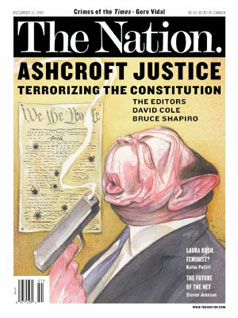
Ellen Willis discusses religious fundamentalism in culture wars at home and abroad; Bruce Shapiro reports on John Ashcroft's strategy to resuscitate and expand secret-evidence trials; David Cole insists that, on the domestic front, we've already abandoned core principles; and Gore Vidal takes on the New York Times coverage of the media recount of Election 2000 votes in Florida.
San Francisco
Jack Newfield knows as much about boxing--and injustice--as any writer at work today. His article "The Shame of Boxing" [Nov. 12] captures the tragedy of this sport as few writers can. Anyone who cares about boxing knows that it can no longer be enjoyed without a drastic overhaul that puts fighters first. And anyone who cares about people must recognize that it is cruel to subject fighters to corruption, exploitation, manipulation and the real prospect of poverty, dementia and death.
RICHARD NORTH PATTERSON
Chalmette, La.
As a lifelong, die-hard fan of the "sweet science" and someone who deeply cares about the sport, I found myself giving Jack Newfield a standing ovation at my computer after reading his great article. It should be mandatory reading for all state officials in the sport. Bravo.
FELIX CASTRO
Brooklyn, N.Y.
Less than two months after the biggest terrorist attack ever, is The Nation not finding enough news so that it has to resort to a feature on...boxing?! (I admit I didn't read it, because I have no interest in it.) It seems irrelevant, given the urgent situation in the world now.
MARISA BLACKWELL
Los Angeles
Thank you for Jack Newfield's article, which I thoroughly enjoyed. I was surprised to see an article about boxing in a progressive publication that wasn't a screed about how boxing is violent and therefore should be banned. As a boxing fan I agreed with all Newfield's prescriptions for fixing what's wrong with the sport, and I'd like to add one of my own: for fighters to wear helmets, as is done in Olympic boxing.
DIANA WAGGONER
Denver
Boxing has no place in a civilized society. The only way to improve it is to ban it, immediately.
STEVE READ
Portland, Ore.
I am totally impressed with one of the best- written and most thorough articles I've read on boxing. I cover men's and women's boxing, and Jack Newfield is right on.
SUE T.L. FOX
WBAN Network
www.womenboxing.com
www.womenboxingrecords.com
www.boxeofemenino.com
New York City
For nine years, when I was working for radio station WMEX in Boston, I broadcast many boxing bouts--some with nationally known fighters as well as club fighters. I also spent a lot of time backstage, getting to recognize "connected" managers and promoters. The Mob was pervasive.
Over the years, I saw a number of club fighters become cognitively disabled (punch-drunk). As with capital punishment, any "reforms" of the industry will be cover-ups of the fundamental brutality of a "sport" in which the participants are intended to maim each other--the more seriously, the better. During my years at ringside, often when there actually was a boxing bout--skill rather than assault--the crowd would derisively sing in waltz rhythm.
As usual, Jack has done a first-rate job of muckraking, but there is no way to disguise that boxing is planned savagery. In a civilized society, it should be outlawed. Unless, of course, we are much less civilized than we claim to be.
NAT HENTOFF
Nashville, Tenn.
Jack Newfield has demonstrated once more why professional boxing remains the most relentlessly corrupt and racially exploitative business enterprise in the United States. The most recent law from Congress, named for Muhammad Ali, won't bring the velvet out of the sewer. It won't begin to deal with the depth of sleaze that rips off fighters and fans. John McCain's commitment is admirable, but without a new, searching Congressional investigation with extensive public hearings, including confronting the meat-merchant promoters and managers, proponents of a national commission will never build support from the public or Senator McCain's Congressional peers.
When we think of state-sanctioned death, capital punishment comes immediately to mind, and we are horrified at the thought of televising an execution. At the same time, the public is entertained twice or more a week with matches where state-sanctioned death is a sad possibility.
There's another option. Because of the deaths and brain damage, the American Medical Association has called for a ban on boxing. Every credible health organization in the world has done the same. Newfield will argue that a ban won't work, that it would drive the filth underground or to other countries. Even a moratorium--a temporary ban until there's a national commission to clean it up--has no chance in today's environment.
I congratulate The Nation for giving Jack Newfield's cause resonance. His has been a lone voice. And once every few months--in the faint hope that I will love it again--I feel the magnetic pull of the once "sweet science" and pay HBO or Showtime to prove that I hate it still.
JOHN SEIGENTHALER SR.
Chicago
A trivial point, perhaps, and yet... Jack Newfield, in his great, definitive piece on the rottenness of the boxing game, has cited sixteen top writers on the subject. For some reason, he failed to mention the nonpareil: Nelson Algren. Two of those Jack named, Pete Hamill and Budd Schulberg, have often referred to Algren as the best of the lot. Whether it be in his short stories or his novels, his lyric style as well as his bite into the core of the rotten apple has always knocked me out. When will this guy ever be recognized as the keenest observer around? The constant ignoring of this man drives me nuts.
STUDS TERKEL
Alamosa, Colo.
Jack Newfield mentions Bob Dylan's indictment of boxing in "Who Killed Davey Moore?" by saying "he has the manager, the referee and the crowd all defensively rejecting responsibility for the calamity." The song also includes a verse about the sportswriter's responsibility for the calamity. Did this strike a little too close to home?
JOEL KAUFMAN
San Luis Obispo, Calif.
I disagree with Jack Newfield's claim that boxing takes such poor care of the fighters because they are black and Latino. Boxing was always rotten at the core. In the days when Jews, Irishmen and other white fighters dominated, the fighters usually got screwed much as they do today. Newfield also implies that white guys never could really fight. Tell that to the likes of Jerry Quarry, Carmen Basilio, Rocky Marciano and Jack Dempsey.
TOM OGREN
Davis, Calif.
I was sure Jack Newfield would recommend abolishing professional boxing. A contest in which the object is to inflict enough injury to an opponent's brain that he falls to the canvas and cannot get up for at least ten seconds is not a sport any more than cockfighting is a sport. No reforms can get around that. As for the old cliché that boxing provides a ticket out of the ghetto, Floyd Patterson observed long ago that for everyone who escapes by boxing a hundred others are doomed to stay because they developed no other skills. We got rid of dueling and we can get rid of boxing.
SHERMAN STEIN
Los Angeles
The International Brotherhood of Prizefighters is in the process of completing our 2001 fighter registry. We are also looking to break ground on our seventeen-story boxing glove, which will house the IBOP Hall of Fame. We are also implementing various pension plans and medical/life insurance plans for fighters. All sorts of things the boxing community has only talked about. Well, it is finally going to happen.
ANTHONY TORRES
International Brotherhood of Prizefighters
Scottsdale, Ariz.
I hold an Arizona manager's license, and I've been involved in professional boxing for more than fifty years in virtually every position, which qualifies me as--at the very least--knowledgeable about the sport. I would rank Jack Newfield's "The Shame of Boxing" as one of the most incisive, well-thought-out, honest pieces ever done. He has cast light on so many problem areas that I am moved to nominate him as the first national boxing commissioner--should that post ever be created.
STEVE EISNER
Honolulu
Newfield sure knows his stuff. In Chicago, I fought in smokers as an amateur, billed as a hero of the "Famous Japanese American 100th Infantry Battalion," a Golden Gloves runner-up, 1946. I learned to fight as a kid in Eastside Los Angeles, Boyle Heights. We learned racist attitudes early--"Jew boys" can't fight, and never hit a "colored" fighter in the head, hit 'em in the stomach. I was taken aback when given the same advice by my handlers in Chicago.
In close decisions I won over black fighters and lost to whites. I had to knock the white boys out to win. To beat the black fighters, all I had to do was remain standing at bell, no matter how groggy. Worse, I was once told to take it easy on a white prospect. Didn't knock him out, and lost. I figured then and there that I was just another bum. I quit. Newfield is right, only a union can clean out the Augean stable. "Stables"! We're animals--all of us in boxing and out in the real world too. Good thing I turned down Nichols, a black man, a nice guy not a Don King, who wanted me to join his stable. Worked in the steel mills, but they were worse.
By the way, Newfield left out of his list of boxing greats Henry Armstrong, who held three championships at the same time, feather-, light-and welterweight, and fought the middleweight champ Ceferino Garcia to a draw. He left off his list of writers who touched on boxing James Jones (From Here to Eternity). God, what that Kentucky-born soldier in Farewell to Arms went through. Like me, he quit boxing for the rotten army officers and steel bosses. Like me, he got blacklisted. Unlike me, he didn't stick with the miners' union. Too bad, because the UMW got rid of the gangsters. Marx said, We're not a bunch of oxen. We're Spartacists, we're fighters.
DON MATSUDA
Santa Barbara, Calif.
Readers may be interested in Sartre's discussion, in his posthumous (and unfinished) Critique of Dialectical Reason, of several of the themes broached by Newfield. Sartre writes, "Every boxing match incarnates the whole of boxing as an incarnation of all fundamental violence." Sartre's reflections on boxing were, in a sense, beholden to his larger philosophical agenda (e.g., rendering intelligible "struggle" as an incarnation of capitalist scarcity), yet they provide cogent reasons in support of Newfield's perceptive proposition that boxing is "more about Marx's concept of surplus value than notions of literary symbolism." Sartre seems to suggest that boxing is a concomitant of capitalism and will thus persevere as long as the latter, giving credence to Newfield's assessment of the impotence of calls to abolish the sport. Perhaps the many--I hesitate to use the words--reformist steps will someday lead to a vista atop the mountain in which both the elimination of boxing and capitalism are on the horizon.
PATRICK S. O'DONNELL
"The government destroyed my life," Mazen Al-Najjar said with both anger and wonder. "Slandered me with secret evidence. And all that time, they were after the wrong man. While I was in jail, the terrorists were loose."
A few days before Thanksgiving Al-Najjar sat across a coffee table from me, explicating the relationship between T.S. Eliot and contemporary Palestinian poetry, repeating a Ramadan joke he'd heard at his mosque the night before, pensively analyzing what he called the "terrible crime" of September 11 and how its perpetrators could best be fought. But mostly Al-Najjar talked about the three and a half years he spent in jail, based on still-secret evidence alleging terrorist associations. He stayed locked up until a no-nonsense federal judge declared his detention unconstitutional in May 2000, and an immigration judge, in a new and more fair proceeding, declared the charge unfounded and last December ordered his release. Neither of us had an inkling that just a few days later, Mazen Al-Najjar would end up as one of the post-September 11 "disappeared."
On the morning of November 24, Al-Najjar left his apartment near the University of South Florida, where he used to teach, to get quarters for the laundromat. His wife was at work, his three daughters still in bed. Federal agents arrested him. A Justice Department press release, repeating the same allegations that had been thrown out of court last year, described his arrest as an effort to "address terrorism by using all legal authorities available."
I sought out Al-Najjar before his unexpected second incarceration because the case of this Gaza-born, US-educated PhD is a bellwether challenge to the constitutionality of secret-evidence antiterrorism trials. He had attracted supporters ranging from Republican Congressman Bob Barr to Democrat David Bonior. Yet here was Al-Najjar arrested again, once more labeled a terrorist, locked up for yet another Ramadan. Has the Justice Department uncovered new evidence linking him to Palestinian Islamic Jihad, the group he was once accused of aiding? Or to the September 11 plot?
According to the Justice Department, there is no new evidence. Al-Najjar's latest arrest is ostensibly on technical grounds. Although freed by court order of terrorism charges, he still is under a deportation order for overstaying his student visa. Although he is contesting that deportation (in mid-November he lost a case before the US Court of Appeals for the Eleventh Circuit, which he plans to take to the Supreme Court), the INS may hold someone under a final deportation order for up to six months while it seeks to deport him--but only if he poses a danger to the community or a risk of flight, neither of which the INS has been able to establish.
But the visa issue is just a smokescreen. In fact, Al-Najjar's latest detention appears to be the leading edge of an alarming strategy by John Ashcroft's Justice Department to resuscitate and expand secret-evidence trials and to prepare the way for the imprisonment of noncitizens for virtually unlimited terms.
Until September 11 the use of secret evidence in immigration cases appeared to be finished: All but one of the noncitizens held on the basis of secret evidence had been freed, a Congressional bill restricting the practice had passed the House Judiciary Committee and last year candidate George W. Bush himself denounced secret-evidence trials, after hearing complaints from Arab-Americans in Michigan. But now his Justice Department is seeking broader secret-trial powers than ever--with Mazen Al-Najjar a convenient guinea pig.
Al-Najjar's case aroused strong emotion in Florida even before he became a civil liberties cause célèbre. He arrived in the United States in 1981 after living in the United Arab Emirates. While earning a PhD from University of South Florida and teaching there, Al-Najjar helped establish an Islamic studies center that invited to its conferences a wide range of scholars and speakers from the Muslim world--some of whom espoused controversial views on Israel. In 1995, Al-Najjar's co-editor at the center's journal disappeared and later turned up in Syria as general secretary of Palestinian Islamic Jihad. As a result, the FBI--apparently convinced the center was a front-- seized its computers, videotapes and files and froze its accounts; USF, under intense media scrutiny as "Jihad U," conducted its own independent investigation.
Both inquiries cleared the center of any connection to terrorism--it was, a federal judge would later declare, "a reputable and scholarly research center." But local FBI officials arrested Al-Najjar, its executive director, anyway and detained him on secret evidence. What lay behind the charge was never made public, but court papers hint that agents decided, on murky evidence, that he helped raise money for Palestinian Islamic Jihad and Hamas.
Al-Najjar now believes the FBI may have been hoping to make him an informant. "But I hadn't done anything," he insists. "I hate violence. I have never been a paramilitary. I have never raised money for killers." Finally, last fall, Immigration Judge R. Kevin McHugh heard two weeks of evidence allegedly supporting the government's claim--and promptly slammed the Justice Department for a case "devoid of any direct or indirect evidence" to support imprisonment of Al-Najjar. He refused to rely on secret evidence, because the government did not provide a summary that offered Al-Najjar a meaningful opportunity to respond. Janet Reno, after a personal review of the record, open as well as secret, declined to bar Al-Najjar's release.
Facing the collapse of its terrorism case, the only face-saving course for the INS was to deport Al-Najjar through conventional channels. He had indeed overstayed his student visa. But deportation is no simple matter: Many of the logical destinations for Al Najjar--Egypt, Saudi Arabia--have grown hostile to stateless Palestinians. The INS ostensibly plans to deport him to the Emirates, but his attorneys (including Nation legal affairs writer and Georgetown law professor David Cole) believe it unlikely that the Emirates would welcome him back. Even as the INS is seeking his deportation, Al-Najjar has applied for political asylum, claiming he would face persecution in any of his former homes.
All this still leaves the matter of Al-Najjar's arrest a mystery. Even if the government intends to deport him, why jail a man who repeatedly demonstrated that he is not a flight risk and whose name has been cleared by an Attorney General and a federal immigration judge? Why issue a press release that resurrects allegations already thrown out of court?
The answer may lie, in part, with an accident of geography. Al-Najjar may not be a terrorist, but he is guilty of living in the territory covered by the Eleventh Circuit, one of the most notoriously pro-prosecution, law-and-order appellate benches in the country. Arguments presented by Ashcroft aide Douglas Ginsburg at a November 8 circuit court hearing on Al-Najjar's case suggest a specific goal: establishing a blank-check policy for terrorism prosecutions. Ginsburg argued that even though Al-Najjar has no connection to the September 11 attacks, those attacks should convince the appellate court to set aside a district court ruling that his detention on secret evidence was unconstitutional and simply grant the Justice Department virtual unreviewable power to bring secret-evidence cases. Clearly, Justice thinks that in this courtroom it has perhaps the strongest chance in the nation of securing a new secret-evidence precedent.
At the same time, Mazen Al-Najjar's case plays into a little-noted Justice Department change in policy with sweeping implications for Palestinians and other stateless or unpopular migrants. In mid-November Ashcroft quietly issued a new regulation allowing indefinite detention of noncitizens under a final deportation order if they are deemed to be national security risks and if no country can be found to accept them. Call it Mazen's Law: Should the Eleventh Circuit hand the government its secret-evidence authority, under this new regulation Al-Najjar, a man never indicted or convicted of a crime, would once again be labeled a terrorist and face imprisonment without end.
During his first 1,307 days in prison, Al-Najjar came to believe, he said, that "the government's intention all along was to detain me, not deport me." His new arrest, and Justice's cynical use of discredited charges, suggests that he's right. This time Justice appears determined to keep him far away from the press and his Tampa supporters: Instead of a nearby immigration jail, he's been shipped to solitary confinement in Coleman federal penitentiary seventy-five miles away and may not make phone calls or receive visits from his family for thirty days. The latest--perhaps indefinite--imprisonment of Al-Najjar deeply calls into question the factual and moral basis for the Justice Department's ongoing dragnet.
The Justice Department, Attorney General John Ashcroft declared in his confirmation hearings, is "the role model for justice the world over." But under Ashcroft that role model is rapidly losing the confidence of allies abroad and at home in the campaign against Al Qaeda. Spain--a country that after decades of Basque separatist movement bombings knows about fighting terrorists--openly declared that it will not extradite eight imprisoned Al Qaeda suspects if they could face military tribunals or the death penalty. Around the United States police chiefs--who know they need the ground-level trust of immigrant communities--are resisting Ashcroft's plan for an open-ended trawl among young men from Middle Eastern nations. Serious voices from Milwaukee to Madrid say that secret immigration trials, unreviewable military tribunals and warrantless monitoring of attorney-client conversations have little to do with real security.
While the cops speak up, most of Washington keeps its head down. Just before Thanksgiving, Senate majority leader Tom Daschle ducked questions about the military tribunals. Daschle now says he is "concerned" but adds, "until we see exactly how they will promulgate this new concept it's pretty hard for us to come to any conclusions." Translation: I'd rather not deal with this.
A few Congressional voices are at last beginning to ask bolder questions. It's mildly encouraging, for instance, that Democratic Senator Patrick Leahy succeeded in getting GOP colleague Orrin Hatch to sign a letter "inviting" Ashcroft to explain himself before the Judiciary Committee. In the House, Bob Barr and John Conyers have joined forces to breathe down the neck of their slow-moving Judiciary chairman, James Sensenbrenner. What has legislators rumbling--if still too quietly--is the sudden realization that through a barrage of executive orders and legal maneuvers, Ashcroft and Bush are systematically seizing on the Congressional prerogative to make the laws governing crime and punishment.
Pollsters declare that civil liberties have little resonance with the broad public now. But the public's sophistication and even outrage about legal issues sometimes runs ahead of the Beltway. What it will take to ignite that latent sensibility, though, is leadership, starting with vigorous questioning of Ashcroft when he appears before Leahy's committee.
The need for those questions grows daily. On November 27 Ashcroft announced that at least 550 people rounded up after September 11 remain in federal custody on immigration violations and another fifty-five on federal criminal charges. But once again he refused to provide details--claiming, absurdly, that he was protecting the privacy of detainees. Still left unanswered are basic questions including how many have been detained on the basis of secret evidence, a discredited practice that Ashcroft is now trying to revive, as Bruce Shapiro notes on page 6.
The relentless Spanish investigative magistrate Baltasar Garzón, prosecutor of Gen. Augusto Pinochet as well as those eight Al Qaeda suspects, warns against the direction Ashcroft seems to be headed in: "It is not sufficient to say: 'I have the evidence but I cannot make it public for fear of endangering my sources.' That is not a serious approach--it is simply illegal."
It is already a cliché that the attacks of September 11 "changed everything." One thing they do seem to have changed is liberals. Harvard law professor Laurence Tribe, a stalwart defender of civil rights and civil liberties, has condoned the use of military tribunals and the detention of more than 1,200 people, even though not a single detainee has been charged in connection with the attacks. His colleague Alan Dershowitz has suggested that torture may sometimes be justified, as long as it is authorized by a warrant. And George Washington law professor Jeff Rosen has argued that "the real story after September 11 is that America hasn't yet come close to abandoning any immutable principles of its national identity."
I cite these scholars not to single them out for criticism--all are important and courageous liberal voices--but as illustrations of a larger trend. Even liberals these days seem reluctant to criticize the government's response to the new threat of terrorism.
But a brief overview of what we've done so far in the interest of "homeland security" makes clear that we have already abandoned several of our "immutable principles" and have already begun to repeat the mistakes of the past.
Consider first the USA Patriot Act, an omnibus law of 342 pages enacted under in terrorem threats from Attorney General John Ashcroft, who suggested that if another terrorist incident occurred before Congress passed it, the blame would rest on Congress. The nuts and bolts of the law were worked out in a couple of all-night sessions and approved by large majorities the day they were introduced, even though members could not possibly have read the bill before casting their votes.
The Patriot Act imposes guilt by association on immigrants, rendering them deportable for wholly innocent nonviolent associational activity on behalf of any organization blacklisted as terrorist by the Secretary of State. Any group of two or more that has used or threatened to use force can be designated as terrorist. This provision in effect resurrects the philosophy of McCarthyism, simply substituting "terrorist" for "communist." Perhaps not realizing the pun, the Supreme Court has condemned guilt by association as "alien to the traditions of a free society and the First Amendment itself." Yet it is now the rule for aliens in our free society.
The Patriot Act also authorizes the Attorney General to lock up aliens, potentially indefinitely, on mere suspicion, without any hearing and without any obligation to establish to a court that the detention is necessary to forestall flight or danger to the community. Moreover, most of the more than 1,200 detentions already effected have not relied upon this authority; the detainees are instead held on pretextual criminal charges, as material witnesses and under pre-Patriot Act immigration authority. The government claims that about ten to fifteen of the detained may be linked to Al Qaeda, but what about the other 1,185? We can't know the answer to that question, because the Justice Department refuses to disclose even the most basic information about most of the detainees, such as who they are, what they are being held for or where they're imprisoned. On November 27 Ashcroft reluctantly identified about fifty people in custody on federal criminal charges but refused to identify more than 500 held on immigration charges, or even to put a number on those held as material witnesses or on state charges. Never in our history has the government engaged in such a blanket practice of secret incarceration.
Secrecy has become the order of the day. Criminal proceedings are governed by gag orders--themselves secret--preventing defendants or their lawyers from saying anything to the public about their predicament. The INS has conducted secret immigration proceedings, closed to the public and even to family members. The Patriot Act authorizes never-disclosed wiretaps and secret searches in criminal investigations without probable cause of a crime, the bedrock constitutional predicate for any search. And in a federal court of appeals in Miami in November, the government renewed its defense of the use of secret evidence in immigration proceedings, arguing that it needs the authority more than ever after September 11 to detain aliens by using evidence they cannot confront or rebut.
We can look forward to more secrecy still. A major impetus behind George W. Bush's presidential order authorizing the trial of suspected terrorists in military tribunals was the desire to avoid the constitutional necessity of disclosing classified evidence to the defendant in an ordinary criminal trial. In military tribunals, defendants have no right to a public trial, no right to trial by jury, no right to confront the evidence or to object to illegally obtained evidence and no right to appeal to an independent court. The military acts as prosecutor, judge, jury and executioner, and a death sentence can be imposed by a two-thirds vote of the military officers presiding.
We have used military tribunals to try our enemies in times of war before. There has been no declared war here, but perhaps that can be excused as a technicality. What cannot be excused is the extension of the tribunals to US residents who have no connection to Al Qaeda whatsoever but who are merely charged with "international terrorism," a wholly undefined offense, or of harboring someone so charged. Military tribunals have always been limited to the trial of belligerents--those fighting for the enemy, as the Supreme Court ruled in Ex Parte Milligan during the Civil War. Bush's order, however, allows the President to dispense with a criminal trial for any noncitizen accused of terrorism.
In one setting--attorney-client communications--secrecy will no longer be the rule. At the end of October, Ashcroft asserted the authority to listen in on such highly privileged discussions without a warrant.
Finally, we have succumbed to ethnic profiling. The Justice Department has instructed law enforcement agents across the country to "interview" more than 5,000 immigrants based not on any evidence that they are connected to Al Qaeda or the events of September 11 but solely on their age, gender and country of origin. The list looks suspiciously like what an enterprising lawyer would come up with if instructed to make a list of immigrant Arab men but to make it look like it wasn't based on ethnicity.
After facing some initial, albeit muted, opposition to its first antiterrorism legislative proposal to Congress, the Administration has chosen since then to bypass Congress altogether. It has also bypassed the public, instead instituting radical changes through rule-makings that go into effect the moment they are published and without notice or comment.
The Administration has made no case that its pre-existing authorities were insufficient. We have successfully tried serious terrorist crimes in open court with all the protections that customarily apply, without regard to whether the defendants were citizens or aliens. Before the Patriot Act, we could deport aliens who supported terrorist activity in any way and could detain aliens who posed a threat to national security or posed a risk of flight. And we had authority to conduct wiretaps and searches in foreign intelligence investigations without probable cause of a crime, as long as that authority was not used as an end-run around the constitutional rules that govern criminal investigations. The government has not even tried to show that the absence of any of its newfound powers contributed to its failure to identify and thwart the September 11 attacks.
Rather, what the Administration has said, time and time again, is that we are "at war." Apparently this statement renders any further argument unnecessary. Thus, Ashcroft tells us that because we are at war, "foreign terrorists who commit war crimes against the United States...are not entitled to and do not deserve the protections of the American Constitution." But putting aside whether we are "at war" without a declaration of war, the bigger problem is that we can't know whether someone is a "foreign terrorist" until those charges are proven in a fair proceeding. The military tribunals eliminate virtually every procedural check designed to protect the innocent and accurately identify the guilty.
These initiatives have sparked opposition from unlikely quarters. Police officers in Portland, Oregon, have refused to take part in the interviews of the 5,000 immigrant men, citing local laws against racial profiling. Spain has said it will not extradite eight men charged with complicity in the September 11 attacks unless we promise not to try them in military tribunals. Even William Safire has called the military tribunals "kangaroo courts." And on Capitol Hill, Republican Orrin Hatch has joined Democrat Patrick Leahy in calling on Ashcroft to answer questions before the Judiciary Committee about his recent executive initiatives.
So why are so many liberals satisfied with the government's response? Why hasn't there been a louder outcry about the measures adopted? Why hasn't the Administration been asked to justify its newfound authorities on a power-by-power basis? For one thing, we are afraid, and in times of fear we crave security above all. For another, in the face of an attack we naturally and properly seek to stick together, to show a united front. But in times of fear and crisis we also panic. And panic causes us to abandon our principles.
So have we abandoned any "immutable principles," as Jeff Rosen calls them? Well, political freedom has given way to guilt by association. Due process has given way to detention on the Attorney General's say-so. Public scrutiny has given way to secret detentions and secret trials. Equal protection under law has given way to ethnic profiling. And we're only three months into this. We can't afford to let liberal vigilance give way to complacency.
Few books in recent times have received a greater boost from events than Germs: Biological Weapons and America's Secret War. A study of bioterrorism by New York Times staff members Judith Miller, Stephen Engelberg and William Broad, the book was arriving in stores even as the twin towers were falling, and Simon & Schuster quickly upped its press run from 15,000 to 115,000. In early October, Germs made the Times's bestseller list, and, propelled by the anthrax attacks, it soon hit number one. The Times itself has helped, putting the book on the front page of the Book Review and allowing Miller to write a rare first-person account of her experience of receiving a letter laced with powder. Miller herself has been ubiquitous on TV, appearing on every channel, it seems, but the Food Network.
All the while, she and her two co-authors have been covering bioterrorism for the Times. To a degree, this has been a plus for the paper. In Germs, Miller, Engelberg and Broad provide a detailed history of bioweapons programs, including the United States' largely secret experiments during and after World War II, the former Soviet Union's massive buildup after signing a ban on such weapons in 1972 and Saddam Hussein's push to develop a smorgasbord of deadly pathogens in Iraq. Drawing on this research, the trio has contributed some sharp stories about the lax security in Russia's remaining labs and about America's lack of preparedness for dealing with a biological attack.
But such a situation poses some clear risks. Reporters covering a story about which they have a book out can get locked into pushing a particular story line and relying on a fixed set of sources. And they face the constant temptation of covering events in a way that promotes their book. With a story as complex and fast-moving as the anthrax attacks, of course, missteps are inevitable, but surveying the Times's coverage, I think the paper has often gotten it wrong.
The first sign of trouble appeared on October 17, the day after it was revealed that the anthrax mailed to the office of Senator Tom Daschle was highly refined. "Sign of Escalating Threat," ran the headline atop a front-page analysis by Engelberg and Miller. According to them, the high quality of the anthrax suggested to officials that "somewhere, someone has access to the sort of germ weapons capable of inflicting huge casualties." An "adversary armed with anthrax in this form would have a host of possible targets for mass terrorism," including "a city or large office building," they wrote. Citing a "former scientist," the article stated that the discovery of such anthrax "casts serious doubt on the theory advanced by some investigators that the germ attacks were the work of a lone amateur with a smattering of knowledge about biology." "I do think that in one form or another, a state was involved," another unnamed scientist was quoted as saying. The article also named three states that have developed anthrax as a weapon--the United States, the Soviet Union and Iraq--the same three that Germs focuses on.
With its alarmist language and strong suggestion of state sponsorship, this article set the tone for subsequent Times coverage. Thus, on October 19, William Broad and David Johnston reported that investigators suspected that the anthrax letters were "related to the September 11 attacks" and that they were investigating "the possibility that Al Qaeda confederates of the hijackers are behind the incidents." Noting that the letters sent to Daschle and to NBC both had a Trenton postmark, the article pointed out that several of the hijackers lived in New Jersey. Investigators, it added, were focusing on Mohamed Atta, a "hijacking ringleader."
Meanwhile, as the Bush Administration attempted to calm public fears about the extent of the danger, the Times was fanning them. "Despite Bush Administration officials' earlier efforts to minimize the threat," Miller and Sheryl Gay Stolberg stated in an October 25 front-page story, "public-health and law-enforcement officials agreed today that the anthrax in the letter to Senator Daschle was especially dangerous." Dr. Anthony Fauci, director of the National Institute of Allergy and Infectious Diseases, was quoted as being "angry" about Administration statements suggesting that the Daschle anthrax "posed only a limited threat." The next day, Miller and Stolberg, back on the front page, reported with satisfaction that the Administration, in a "180-degree turnabout," was now acknowledging the seriousness of the threat posed by the Daschle letter. "With two postal workers in Washington dead and others falling sick, presumably from exposure to the Daschle letter and perhaps from others like it," they asserted, "it is no longer possible for the Administration to speak in such reassuring tones."
In the same edition--but not on the front page--Miller and Broad reported that Administration officials, in a private briefing, had steered senators "away from linking Iraq with the anthrax strain" found in the Daschle letter. While some experts had said that "only three countries" were known to make the high-grade anthrax powder, "others," they wrote, said that "the techniques used in those programs were now sufficiently common that a well-trained scientist in a private laboratory could have produced similar results." In short, the Times was backtracking from its October 17 story, but with the account buried on page B7, only the most diligent readers would have noticed.
In the end, it was the Washington Post that broke the news about where the anthrax investigation was heading. "FBI, CIA Suspect US Extremists in Anthrax Cases," the Post declared on its front page on October 28. According to Bob Woodward and Dan Eggen, officials had come to believe that the anthrax attacks were "likely the work of one or more extremists in the United States who are probably not connected to Osama bin Laden's al Qaeda terrorist organization." Officials, they added, were considering a "wide range of domestic possibilities, including associates of right-wing hate groups and US residents sympathetic to the causes of Islamic extremists." One official told them that "nobody believes the anthrax scare we are going through" is the next wave of terrorism.
The Times ignored this. Only in passing did it report on investigators' suspicions about the involvement of domestic extremists. Meanwhile, the paper continued to play up the risks from the attacks. "Hospital Worker's Illness Suggests Widening Threat," it blared on October 31, after Kathy Nguyen tested positive for anthrax.
On November 13, PBS--adding fuel to the fire--aired a ninety-minute Nova special based on Germs. It was as much about the book's three authors as it was about bioweapons. Over and over we were treated to glimpses of Broad earnestly scribbling notes while interviewing experts, and to shots of Miller--dressed in various protective raiment--preparing to enter germ plants around the world. Interviewed at her desk, Miller dramatically recreated the moment when she opened the powder-filled envelope. "I realize that this really is a weapon of mass disruption...and that the disruption can be just as debilitating to a society...as actual deaths," she said. Yet the Nova program itself seemed to go out of its way to stoke public fears about bioterrorism, describing mass-death scenarios against a backdrop of creepy horror-movie music. The program ended with an 800 number viewers could call to order Germs.
The investigation into the origins of the anthrax letters will no doubt take further twists and turns. On November 25, in fact, the Post, in another important story that partly contradicted its earlier one, reported that the Ames strain used in the attacks--once thought to be widely accessible to researchers--"now appears to have circulated in only a small universe of laboratories." According to reporters Steve Fainaru and Joby Warrick, investigators "have had to face the possibility" that the Ames strain "may have slipped through an informal network of scientists to Iraq." That country, they observed, had sought the strain from a British biodefense institute in 1988. It was turned down, but investigators were trying to determine whether Baghdad managed to obtain the strain elsewhere.
Reading this, I was reminded of Watergate, in which big-name reporters were scooped by hard-working police reporters developing their own sources. Here, the Times, despite having a glamour team on the beat, has missed some of the major turns in the anthrax investigation. Worse, the paper has uncharacteristically joined in the general sensationalism over the attacks, thereby contributing to the sense of panic in the land.
How short the memory of even our more respected pundits. Take Thomas L. Friedman, who argued in the New York Times on Sunday that because we now face an enemy unlike any other, "Atty.
What if Hillary Clinton, not Laura Bush, had taken to the airwaves during her husband's first year in office and become the first First Lady to deliver the entire weekly presidential radio address--about women's rights, no less? Dragon lady! Castrating feminist man-hating bitch! All together now: Who Elected Her? The Republicans would have started impeachment proceedings that very day. In fact, the down-to-earth and nonthreatening Laura Bush spoke so eloquently in support of Afghan women's rights I actually found myself not wanting to believe the Democratic Party accusation that this was a cynical attempt to appeal to women and narrow the eleven-point gender gap that bedeviled Bush in the 2000 election--not that a shortage of votes turned out to matter, but that's another story. Perhaps Mrs. Bush--and Cherie Blair, who gave a similar speech on November 19--was sending a message to the sorry collection of warlords and criminals, power-grabbers and back-stabbers vying for power in the new Afghanistan: This time around, women must have a seat at the table. As I write, Afghan women are swinging into action, with a major conference planned for early December in Brussels to insist on equality and political power in their post-Taliban nation.
Wouldn't it be wonderful if the defeat of the Taliban also marked the end of the cultural-relativist pooh-poohing of women's rights? Only a few weeks ago, a Bush Administration spokesperson was refusing to promise that women would play a role in a new Afghan government: "We have to be careful not to look like we are imposing our values on them." A week before it began, no women had been mentioned as participants in the UN-sponsored Bonn conference to plan for a postwar Afghanistan. As it turned out, there are three among the twenty-eight delegates: two in the delegation of the former King and one in that of the Northern Alliance, plus at least two more attending as advisers. Whether it means anything, who knows--of the four factions gathered in Bonn, only the Northern Alliance controls any actual territory, and its record with regard to women's rights and dignity is nothing to cheer about. While some alliance leaders speak encouragingly of girls' education and women's right to work, early signs are mixed: In Kabul, women can once more freely walk the streets, but the newly reopened movie theater is off-limits and a women's rights march was halted by authorities; in late November, according to the Los Angeles Times, women were banned from voting for mayor in Herat, whose de facto ruler, Ismail Khan, has presented himself as sympathetic to women's rights.
Still, whatever government takes shape in Afghanistan will probably be better for women than the Taliban--how could it be worse?--as long as the country does not degenerate into civil war, as happened the last time the Northern Alliance was in power. But let's not kid ourselves: This war is not about freeing women from government-mandated burqas, or teaching girls to read, or improving Afghan women's ghastly maternal mortality rate of 17 in 1,000 births--the second highest in the world. Those things may happen as a byproduct of realpolitik, or they may not. But if women's rights and well-being were aims of US Afghan policy, the Carter, Reagan and Bush administrations would never have financed the mujahedeen, whose neanderthal treatment of women, including throwing acid at unveiled women, was well documented from the start; the Clinton Administration would not have initially accepted the Taliban even after they closed the girls' schools in Herat; and the current Bush Administration would have inundated the millions of Afghan women and girls in Pakistan's refugee camps with teachers, nurses, doctors and food.
As other commentators have pointed out, if Laura Bush wants to make women's rights a US foreign policy goal, she's got her work cut out for her. Saudi Arabia, our best friend, is positively Talibanesque: Women are rigidly segregated by law, cannot drive, cannot travel without written permission from a male relative; top-to-toe veiling is mandated by law and enforced by a brutal religious police force. In a particularly insulting twist, US women soldiers stationed there are compelled to wear the veil and refrain from driving when off base; so far the Bush Administration has refused to act on soldiers' objections to these conditions.
One can go on and on about the situation of women in Muslim countries--unable to vote in Kuwait; genitally mutilated in Egypt and Sudan; flogged, jailed, murdered with impunity and even stoned to death for sexual infractions in a number of countries--and Muslim women everywhere are fighting back (for a serious, nonsensationalist approach, check out the website of Women Living Under Muslim Laws, www.wluml.org). But the Islamic world is hardly the only place where women are denied their human rights: How would you like to have to get a divorce in an Israeli rabbinical court or need an abortion in Chile, where it's illegal even to save your life? The United States makes no bones about using its economic and political might against illegal drugs--in fact, the Administration rewarded the Taliban for banning opium production by making a $43 million donation to the World Food Program and humanitarian NGOs (not, as is usually reported, to the Taliban proper). If it cared to do so, the United States could back the global women's movement with the same zeal.
Instead, it does the opposite. In order to curry favor with conservative Catholics at home, Laura Bush's husband has shown callous disregard for women's rights and health abroad: He reinstated the Mexico City policy, which bars family-planning groups receiving US funds from discussing abortion; he sent anti-choice delegations to wreck the consensus at international conferences on children's rights and public health; he tried to nominate John Klink, former adviser to the Holy See, to head the State Department's Bureau of Population, Refugees and Migration, which would have thrown the United States behind the Pope's call to deny emergency contraception to raped women in refugee camps.
That the Taliban are gone is cause for joy. A world that cared about women's rights would never have let them come to power in the first place.
Yes, jury trials in public are a right,
Says Cheney. Then he says that in this fight
No terrorist deserves that sort of trial,
Though otherwise it's certainly our style.
Without a trial, though, how do we decide
To whom this definition is applied?
We grab a guy, but is the guy we've got
An undeserving terrorist or not?
The United States of America has just succeeded in bombing a country back out of the Stone Age. This deserves to be recognized as an achievement, even by those who want to hasten past the moment and resume their customary tasks (worrying about the spotty human rights record of the Northern Alliance is the latest thing). The nexus that bound the Taliban to the forces of Al Qaeda and that was symbolized by the clan relationship between Mullah Omar and Osama bin Laden, has been destroyed. We are rid of one of the foulest regimes on earth, while one of the most vicious crime families in history has been crippled and scattered. It remains to help the Afghan exiles to return, to save the starving and to consolidate the tentative emancipation of Afghan women.
The AFL-CIO has opened its 24th Biennial Convention here in the glitzy neon heart of this very unionized Sin City, but Big Labor's mood is anything but frivolous.
In early November, as American B-52s pummeled Taliban positions, a team of United Nations scientists surveyed the wreckage of the world's last major bombing campaign, the 1999 siege of Kosovo.
Transgender activists may force us to rethink basic assumptions about sex.
Florida revisited: Schadenfreude amid the carnage of the democratic process.
There is a link between our own cultural conflicts and the logic of jihad.
Moral concern begins with the local, but shouldn't stop there.
Embattled campus activists hone their message about the crisis in Afghanistan.
David Mamet didn't stand a chance in Hollywood. His Samuel Beckett-influenced plays hacked back plot to an ominous implication, pared each nobody's thought to an elliptical repetitive essence and anguished common English. Take the rants in Obie-winner American Buffalo (1976) about a botched rare-coin heist: "What are we saying here? Loyalty. (Pause.) You know how I am on this. This is great. This is admirable.... This loyalty. This is swell.... All I mean, a guy can be too loyal, Don.... What are we saying here? Business.... Loyalty does not mean shit in a situation like this!"
Like his hero Theodore Dreiser, Mamet works out his characters' scummy scams in their own sweet time ("Midwestern legato," he calls it) and mutant demotic tongue. It was all wrong for movies: the half-comprehensible compression, the unadmirable characters, the habit of following words wherever they plotlessly led.
So movie men screwed him at first. They rewrote his scabrous 1974 play Sexual Perversity in Chicago as 1986's simpering flick About Last Night. But scalawag director Bob Rafelson saw the pre-castrated play and hired him to write The Postman Always Rings Twice (1981). Mamet abruptly got it: movies want plot and genre straitjackets. Postman hit big, then The Verdict (1982). Rewritten again on The Untouchables (1987), Mamet got even by satirizing Hollywood in Broadway's savage Speed-the-Plow (1988). (Increasingly rich, he skewered it with increasing affection in 1997's Wag the Dog and 2000's State and Main.) His directing debut, the card-sharp drama House of Games (1987), fused classic noir with his own brand of con. He got so much clout that his career capstone play, Glengarry Glen Ross, made it unscathed to film. The 1996 movie American Buffalo almost did too, weighed down by Dustin Hoffman's stagey ego, but with Mamet's words intact.
In plays, Mamet transmogrified straight-ahead Chicago slang into sentences that come at you like sidewinders. In movies, he managed to magic himself into a mainstream master. Look what he's pulled off lately: The Spanish Prisoner (1997), State and Main and Heist, his first big studio star vehicle and self-conscious genre pic. It's like three-card monte with two aces and a king.
We'll get to why Heist isn't quite aces in a minute, but first, here's why it's tasty. As heistmeister Joe Moore, Gene Hackman is Mamet's first hero who breathes air not previously exhaled by David Mamet. In the opening setup--Mamet's smoothest action scene yet--old pro Joe blows what should be his last job: a ritzy jewelry store.
At first (and fast), Joe's crew does everything right. Joe's sashaying wife (Rebecca Pidgeon) impersonates a waitress squirting Visine in her eyes, only she's pretending--it's knockout drops, squirted on the sly into four takeout coffees headed for the jewelry store. Joe's thug philosophes Bobby (Delroy Lindo) and Pinky (Ricky Jay) stage an explosion, don creepy translucent masks, down the store's door and deftly smash and grab. But Joe spots one coffee undrunk. He whips off his mask and assumes a face of compassionate rectitude, steps around the corner and instructs the sole unsedated clerk to call 911. She turns; he stun-guns her. Joe is a take-charge guy. So is Hackman. At last, Mamet's gang gets what it's always needed: a charismatic gang leader.
But the security camera spots Joe, and the cops' dopplering sirens won't give him time to grab the tape. He's "burned," identified. So the fence, Bergman (Danny DeVito, vigorous but too familiarly DeVitoid), refuses to pay the vulnerable Joe unless he does one last heist: get a Swiss gold shipment from a jet just before takeoff and take Bergman's fanged nebbish nephew (Sam Rockwell) along on the job.
Joe's spat with Bergman over the Swiss job ultimatum is an extended quibble, the opposite of the ultratight Hammettesque exposition that's supposed to be the big idea of Heist. As ever in Mamet, compression yields to digression whenever a pretty phrase is in view. He's like the helpless star Alec Baldwin played in State and Main, who interrupts work for play at the sight of a teen skirt. "She could talk her way out of a sunburn," says Joe of his conniving wife. "My motherfucker is so cool, when he goes to sleep, sheep count him," says Bobby of Joe. As Bogey noted, "The cheaper the crook, the gaudier the patter." Though much of the lingo in Heist is a God-given gaudy gift, too much of it is labored, not up to the Mamet standard. When he tries to top a line about being "as quiet as an ant pissing on cotton" with the stern retort, "I want you to be as quiet as an ant not even thinking about pissing on cotton," the old phrase-slut momentarily succumbs to his besetting sins, smugness and faux portentousness.
Mostly, though, the buildup to the Swiss job is niftily executed. Working with hoary noiry archetypes, Mamet and a killer cast keep us on our toes. The gang impersonates a telephone crew in order to wire a bomb at the airport; a cop drives by, stops and scarily approaches. In the phone-company car, the fence's simpleton nephew reaches for his gun. Bobby seethes. Did the cop see? Joe ably fast-talks the cops--Heist triumphantly leavens Mamet's overdetermined style with seeming improvisation. After the heat beats it, Joe and Bobby let the nephew know he's a Cocky Hothead Who Could Get Them All Killed.
But is he simply a simpleton? Or does he have plans for Joe's wife, who's closer to his age than Joe's? Joe dispatches his missus to boff the kid into a false feeling of security; whose hood is really getting winked? As Pidgeon's character says in The Spanish Prisoner, "Anybody could be anybody." At every step, as the gang boards the plane, unloads the gold and attempts to fulfill Joe's prime injunction ("It's not getting the goods, it's getting away"), Mamet redeems numbly familiar routines with his patented style of who's-screwing-who suspense.
OK, Mamet's style is pretty familiar, too. Don't expect any big, hairy Crying Game surprises. But compare Mamet going through the Rififi heist-flick paces and any number of studio movies abominably failing to do the same. (Tom Cruise's tortured attempt to explain the Rififi-riffing but nonexistent plot of Mission: Impossible to the LA Times is the funniest star interview on record.) Mamet has succeeded in movies because, despite the oddity of his personal signature, he can concoct a logical con. The final shootout and fakeout in Heist isn't just tacked on, it's a gratifying resolution.
Hackman, Lindo and Jay juggle Mamet's verbal baubles with aplomb. Though there isn't much character development, they expertly suggest long common experience, if not deep bonds, by the merest gesture and the flawlessness of their ensemble acting. The only calamity is Rebecca Pidgeon. Except for her bit in the bravura opening scene, she's a stale cliché, a hard-chick fatale who mutters monosyllabic witless-isms.
And she was so fresh in The Spanish Prisoner. There, she got a wide-eyed character worth watching--she even lent that Boy Scout Campbell Scott a touch of sexual intrigue. The problem with Heist (not a fully crippling one) is that nobody really cares who the dame tumbles, or why. You could almost snip her right out of the film to salubrious effect, as in that Star Wars fan's Jar Jar Binks-less re-edit of The Phantom Menace that popped up on the Internet. More generally, Heist is lesser than the similar Spanish Prisoner because in that film, Mamet gave himself Dreiserian elbow room to let his concatenating con games and loping, ambiguous relationships unfold. Heist is his Beckett mode of excessive compression without the ambition part.
Still, all three are keepers. The Spanish Prisoner is a rare example of a trick narrative that works, though the filmmaking is tentative. State and Main, about the cons of the film game, proves Mamet can crack wise and share the love too, screwball-comedy style. Heist shows a new visual fluidity, and that Mamet can play a simple game on the suits' home court and win.
Brushes With Poetry
"Before the hour I cried, 'Let there be light!'/I tossed out some three hundred early versions./Revisions help. What clatter in the firmament,/though, when mountains fell, stars fizzled out," intones a God with both an authorial work ethic and a puckish sense of humor in Grace Schulman's The Paintings of Our Lives. And we've seen that authorial wink before: In this, the Nation poetry editor's fourth collection, she carries on with concerns we first noted in For That Day Only, Hemispheres and Burn Down the Icons.
Schulman writes a personal poetry that is both warm and clever; religion seems to float in as lightly as a chorale in the background, when it isn't coloring our lives outright: "Through leaded windowpanes, the light pours down/less on the holy figures than on objects/waiting to be used, that tell the story: a fringed towel hung askew, a kettle-laver,//unlit wall sconces, the windblown pages/of a book laid open on a table," she writes in the title poem. "Somewhere are the paintings of our lives,/invisible to us," she continues; the search for that underlying canvas permeates much of Schulman's work. (The poem is based on a triptych of the annunciation by Flemish master Robert Campin; many of Schulman's poems are based on or make reference to a historical context, object or event--e.g., "Henry James Revisiting, 1904"--in the process creating a tension between the reader's expectation and the poet's play with the concept. (One of her favorite techniques is to juxtapose historical context and modern detail for effect: In "Balm in Gilead" we move from Jeremiah to the traditional black spiritual to the underside of the California condor, "once thought doomed,/now flapping wide like the first bird from ashes.") Schulman's poems are learned and serious--the transom of death and the transcendence of delight in the physical are among her major concerns--but she is a poet of joy verging on prankish as well, speaking to us tongue in cheek, often as not. Schulman closes the book with a series of fifteen sonnets about the death of her mother. The book's last words: "Praise life."
Russia Without Blinders
"During President Bush's first months in office, his administration showed no signs of understanding the immediate need for cooperative measures designed to help stabilize Russia's economy and nuclear infrastructure and avoid any kind of new arms race," warns Stephen F. Cohen, Nation contributing editor, former "Sovieticus" columnist and currently professor of Russian studies and history at New York University. In fact, beyond the government, the press and professoriate appear to be working in tandem with the same set of blinders, as Cohen's updated edition of Failed Crusade finds the vexing problems of statecraft and vision that existed in the effort to remake Russia in our image during the Yeltsin years still at work. Journalists have been "stubbornly missionary and uncritical of their own professional record," ignoring horrific conditions inside the country or explaining them away, Cohen reports. A top editor of the Washington Post and former correspondent "saw no tragedy to explain" on a visit to Russia this April, remarking that the "debris" he observed was "a sign of prosperity." Worst of all, writes Cohen, "in 2001 America's Russia-watchers were still sleepwalking through the new nuclear era, seemingly unaware that lethal dangers in the country they study now exceed any in history." And "scholarly Russia watchers seem equally oblivious," with the head of Russian studies at a major university denouncing Moscow's own economic proposals to stabilize the country as "neo-Sovietism" and a Carnegie Endowment economist urging more "shocks" to Russia's economy and society. The Clinton Administration, its time running out, "continued to insist, contrary to all evidence, that the crusade it had launched eight years before was still on course." But a new Russia policy is possible "only by replacing those dangerous anachronisms with common sense, political-diplomatic thinking, and the imperative of mutual security interests--that is, authentic cooperation," Cohen writes. His argument is all the more trenchant in the aftermath of September 11, which showed in a very small way what is at stake.
Everyone knows that Plato mistrusted the politics of music, and most Nation readers probably recall that Adorno saw pop music, in particular, as an insidious form of brainwashing. That current of suspicion runs through philosophy worldwide, reminding us to be grateful that we don't live in Plato's Republic or in a fundamentalist theocracy. (The joy at the sudden return of music to Radio Afghanistan became an instant symbol of this recently.) In this context, Nietzsche was rare in his praise of music's historical and social functions, an embrace that let him appropriate its textures and effects into his sensibility and prose.
It's clear that music--even popular music, which includes jazz--has a power that unsettles philosophers and politicians. The figure of the bard, the Orphic seer whose power can penetrate the world's veils and change its bent, still exerts a strong, if largely subliminal, pull on the imaginations of artists and audiences alike.
It's striking, then, that both left and right nurture a disdain for and suspicion of popular culture, unless it's nostalgic or carefully defined, and hence safe. Today in America, art swims in a near-all-encompassing commercialism. "At least we valued art enough to censor it," a Russian expatriate professor-friend once remarked to me. "Here you just let anyone shout whatever they want." But commercialism can be an efficient censor as well: I cited Lenny Bruce, whom he'd never heard of; when I tried to explain, he didn't understand. "Dirty words?" he asked, shaking his head. My attempted point: Gatekeepers exist always and everywhere, and even in freewheeling consumer America, entertainment capital of the world, art is understood, at least by some, to possess gravity.
There are always some artists who aspire to be Shelleyan bards, no matter their medium. They take the time to study and learn, sometimes in tidy or systematic ways and sometimes in meandering, maddening fashion. In our postindustrial culture, their status and power, like old magic, ain't what it used to be. Still, most people, like most philosophers, tend to think of musicians as talented beasts. Rafi Zabor's fairy-tale novel, The Bear Comes Home, inverts that notion with whimsical charm and some nice satiric turns. Zabor's bear plays cutting-edge jazz saxophone and develops a whole quasi-human life, including human lovers, inside the jazz world, where he's mostly accepted, even considered a star. Now jazz musicians, thanks no doubt partly to race, have long been treated as, well, semitrained bears--especially insulting given the body of work and extended discipline they developed over the past half-century. Some, like Charles Mingus and Anthony Braxton, to name two men who are very dissimilar in most other ways, raged against it in extensive writings and speaking. Louis Armstrong and Duke Ellington, in their very different ways, sidestepped it or ignored it, at least in public. Beboppers subverted it, as Amiri Baraka pointed out in Blues People, adapting and tweaking the costumes and mannerisms of European bohemians in their claim to be artists.
Political or social commentary has always been part of jazz, implicitly or explicitly. How could an art form originally formulated by outsiders be otherwise? There are famous examples: "Black and Blue" by Armstrong. We insist: Freedom Now Suite by Max Roach and Abbey Lincoln. "Fables of Faubus" by Charles Mingus. A Tribute to Jack Johnson by Miles Davis. "Alabama" by John Coltrane. But now, post-9/11, new resonances have been added, unlooked-for surplus value, to art that has something to tell us about who we are now, much as it has to so much else--normal bits of life in our times, like airplanes falling out of the sky, suddenly acquire newly active potential meanings, a spreading shadow of possible contexts.
Enter clarinetist Don Byron, 43, and trumpeter Dave Douglas, 38. Both have garnered lots of press coverage, gathered awards, attracted musicians and followers, produced varied and important bodies of work that are stylistically and conceptually diverse as bandleaders and composers. Both are those fortunate jazz rarities, possessors of major-label deals. Both are widely read and intellectually cultivated, and infuse that sensibility into their art, which includes how they use liner notes, album illustrations, the whole package surrounding the disc that effectively embeds it in a perspective. Both recorded their latest albums before the World Trade Center came down. Each had particular social as well as musical concerns, creative speculations, the process of rebraiding reality's DNA into something that, in that magical way of art, steps out of time while simultaneously reflecting a vision, a personality, a series of moments rooted like Ygdrasil in our world. Both albums have acquired new echoes, courtesy of history, as inevitable as they were unforeseen.
Byron first. Articulate and funny with a sarcastic wit that can annoy or offend, he says, "I don't think everything I do has to be explained. That's one of the weak parts of this era: Everything has to be literal, you have to get it right now. I often end up having to justify what I'm doing in interviews: Something about me rubs up against their belief systems."
Twenty years ago, studying clarinet at the New England Conservatory of Music, he discovered Mickey Katz, whose klezmer music, which featured intricate possibilities for clarinet, was pretty much forgotten. Byron revived it and inadvertently became a novelty act that was extremely smart and musical. The elderly Jewish couples who came to Manhattan's old Knitting Factory years ago for his shows loved it, maybe even more because Byron is dreadlocked and black.
Byron is generally credited with bringing the clarinet back into jazz as more than an instrument for sax players to double on. Stiffer, less able to flow and bend notes and sounds than the saxophone, the clarinet stopped being crucial to jazz's mainstream around the time of Benny Goodman and Artie Shaw, despite subsequent technical extensions like Buddy DeFranco's bebop clarinet. During the 1960s and 1970s, it was mostly avant-gardists or nostalgic traditionalists who picked it up.
Byron's clarinet, which carries this history within its sound, is at once ancient and modern. His licorice stick moves from dry woody piping to edgy squeals to hiccups and vocalizing growls, and his penchant for chromaticism, polytonality and hanging odd passing tones in unexpected places doesn't engage in nostalgia. His circuitous, unexpectedly jumping lines are stamped with his harmonic knowledge and melodic invention, informed by Bach and Schoenberg, Armstrong and Trane. And his rhythmic sense is sharp: He can make any two notes dance. A tireless experimenter, he's played silent-movie accompaniments, hip-hop rhythms, spoken-word performance pieces. That range was one reason Byron was jazz artistic director at the Brooklyn Academy of Music's Next Wave festival for four seasons.
As a composer, Byron is eclectic, thoughtful and provocative, usually with a political or social agenda. He exudes attitude. His album debut as a leader was The Tuskegee Experiments (Nonesuch), inspired by the federal government's horrific wartime syphilis experiments on unsuspecting African-Americans. His first Music for Six Musicians album (Nonesuch) followed.
"Most of that record," he explains, "was inspired by political events around the time I was writing it. So there are pieces about Ross Perot and Clarence Thomas and Shelby Steele. My music refers all the time to intellectual concerns. Why do that? Why not just play? My answer is, I think a lot about Max Roach and Abbey Lincoln and Mingus, and you can't strip the politics away from that music. The music holds up without it--if it didn't, it wouldn't be worth discussing--but it's the motivation. If you read what they were saying and thinking then, it makes even more sense. People can learn the notes Coltrane played, but unless they're willing to embrace some of the politics that produced them, there's a whole piece of him they're skirting.
"The flip side is, listeners expect political music to sound a certain way: If it's about race, it's either got a McCoy Tyner sound or it's free. But every tune on that first Six Musicians record has techniques that dealt with the subject matter differently. Take 'Shelby Steele.' It states the melody, then states it upside down in the clave, then states it two beats off in the clave; so it talks about how if you state something out of context it changes meaning. My point is that you can talk politically in any context, even repertory. Any lump of clay you pick up, you can use to say anything you need."
And Byron has become an accomplished bricoleur. Bug Music (Nonesuch), like The Music of Mickey Katz (Nonesuch), shows what he means about the cultural politics of repertory music. In his historical revisionism, Duke Ellington, Raymond Scott and John Kirby are presented side by side as listeners heard them in the 1930s. Scott recorded mostly novelties; many became classic Warner Bros. cartoon soundtracks. Kirby led a popular small swing-era unit with a proto-chamber-jazz style. Byron's sly goal: to recontextualize Ellington and the others, changing the angle of vision and hence the potential meanings of the music. His last album, Romance With the Unseen (Blue Note), did something similar with ghosts from Goodman to Disney.
Byron's recent album is entitled You Are #6: More Music for Six Musicians (Blue Note). It alludes to The Prisoner, the late- 1960s TV show starring Patrick McGoohan as a British spy who tries to resign and is kidnapped to The Village, a pleasantly surreal totalitarian holding pen for such as he, where he is expected to be broken. Instead, he mounts one escape attempt after another and plots to undermine the nameless powers (which seem to include his own government) who run the place. Failing to get cover art from the show, Byron substituted A.G. Rizzoli's equally surreal "The Bluesea House," an intricate system of buildings and symbology that, as it sprawls across the opened CD booklet's innards, resembles a board game for a Platonic life system. It had, Byron felt, the right resonances to enhance his music.
Why The Prisoner? "What's interesting," says Byron, a self-described connoisseur of pop culture, "is the scenario. Essentially, The Village is a comfortable place, a nice place to live, had all the amenities, but no one was really free. They kept wanting The Prisoner to get relaxed in that. In some ways they were right; once you're clean and comfortable and everything is taken care of, it really doesn't matter what's happening, in a certain kind of way."
Byron is of West Indian descent; his father played bass in calypso bands in the Bronx when the clarinetist was growing up. Hence another embedded context for his music: the non-Latino-Caribbean tradition, whose cultural roles in the West African diaspora he feels may be forgotten in the current Latino renaissance. "Calypso," he says, "Haitian music, they're part of it; the English-speaking part of Nicaragua and the Caribbean is part of it. When people see me they often think, you're an avant-garde guy. Actually, no, I'm very West Indian. My politics, the way I approach the humor in my music. West Indians are pretty ironic, nastily judgmental, frugal, angrily political and yet joyfully political--West Indian politics is usually a band. When I was growing up there were lots of Sparrow songs about Martin Luther King. The lyrics unfold into pretty long stories, always with a twist and irony. Take my approach to Brazilian music--funny twists and turns, Schoenberg type of harmonies, stuff in places that if you look hard they shouldn't necessarily be together and yet they go together, because they're in my imagination." That, and the fact that clave plays on the ambiguity between duple and triple meter--which multiplies out to six--helped shape an album that is wide-ranging, effective and shot through with knowing, releasing humor.
It opens with Henry Mancini's "Theme From Hatari," which Byron has remade in clave with percussionist Milton Cardona overlaying a santeria chant--a wicked irony for a comic film starring John Wayne as a big-game hunter in Africa. "You Are #6" Latinizes the show's theme, tagging the end with a taped quote from a sardonic panhandler, who classifies people's habits about giving on the street. "Klang" mixes Brazilian and funk beats with deft sonic touches like plinking guitar as mbira. "B-Setting," with its musical and extramusical puns, draws on classic soul--the bridge is pure acoustic-jazz-style James Brown--and sports a witty vocal mixed nearly into the background. "A Whisper in My Ear" nods to Afro-Cuban jazz architect Mario Bauza; the band here best demonstrates its rhythmic suppleness and torque. "Shake 'Em Up" was a local calypso hit for the band his father played in, and it grooves like Eastern Parkway's annual West Indian-American Day Parade, which it invokes. "No Whine" is pointedly blues-free but poignant, resigned, moving. "Dark Room" blends Miles Davis, film noir and Machito. "Dub Ya"--taken, Byron says, from a suite he is writing "about animals that look and sound dumb"--is a tape-loop foray with Mingusy overtones that's hilarious. And one of Byron's growing number of film pieces, "Belmondo's Lip," gets two treatments, the second a stuttering, psychedelicized remix by DJ Spooky that reassembles its deconstructed pieces over its irresistibly chugging beats. That closes the disc.
It's one of the best albums I've heard this year.
From one perspective, Dave Douglas's Witness (Bluebird) got a horrible boost when the Twin Towers fell. Inspired by Edward Said's Representations of the Intellectual, the suite-like album draws extensively on Arab music sources for its celebration of cultural activists: the Ruckus Society, Nawal El Saadawi, Eqbal Ahmad, Naguib Mahfouz, Taslima Nasrin, Pramoedya Ananta Toer and Ken Saro-Wiwa. Though it doesn't address the complicated, tangled role of music within Islamic and Arab societies, it does, with good reason, stake a claim for Douglas as jazz bard.
Like Byron, Douglas has become a jazz-based bricoleur. In fact, one of his first prominent recording gigs was with Byron's Mickey Katz lineup. He attended Berkleeand the New England Conservatory, came to New York in 1984 and studied and worked with Joe Lovano. In the late 1980s he became interested in central and eastern European folk musics, which later led to his forming the Tiny Bell Trio. He worked with pianist Myra Melford, performed with and wrote for dance troupes, and joined John Zorn's Masada, which uses eastern and central European Jewish idioms as thematic materials for free-ish improvisation.
His chosen horn was already the subject of a renaissance, thanks to Wynton Marsalis. Whatever you think about Marsalis's abilities or depth as player or composer, you'd be hard pressed to deny he is the best-known jazz musician alive, that he's pursued Armstrong's position in American cultural mythology, the iconic man with the trumpet, with single-minded intensity and success. Besides, unlike the clarinet, the trumpet has never been benched with jazz's backup squads. In fact, in his early days, Douglas sometimes seemed like a downtown white alternative to Marsalis: in his serious and self-conscious intellectualism (he wowed jazz critics with references to Walter Benjamin, Foucault and Said, much as Marsalis had by talking about Thomas Mann and Ralph Ellison), in the cerebral virtuosity and golden tones of his horn, in his controlled approach to music and the world, in the image he cultivated of straddling the classical and jazz genres.
Sometimes I tend to think of Byron as more Dionysian and Douglas as more Apollonian, sometimes I think of them as the fox and the hedgehog, sometimes I think of them in McLuhanesque terms as warm and cool. For me, as Douglas unfolded a variety of projects with different personnel and goals, his solos, especially in Zorn's "Masada," exhibited more of that unselfconscious grace that I look for in matured artists, what Castiglione called sprezzatura. I admired Douglas's work with his Tiny Bell Trio and Sextet and Charms of the Night Sky, but at a distance, where I felt the music's sensibility in some ways kept me. But his tribute to Mary Lou Williams (Soul on Soul, RCA/Victor) struck me more deeply; Douglas seemed more emotionally attached to this project, and it coincided with Linda Dahl's Morning Glory, a solid biography.
Now he's assembled a first-rate cast of players for Witness, which grew from his several-year-old "Thoughts Around Mahfouz." He says, "The music, just like the culture and the society, has retreated from experimentation quite a bit, retreated into entertainment. And yet I think--and I don't want to overgeneralize--that in the American improvised idiom there's been a lot of awareness of other art forms--dance, poetry and so on--but also of politics/social justice movements and the like. But that awareness has been muted in the ways it's been able to speak. Over a period of time it became much harder to make any kind of statement in the art itself. While we're seeing things like Ani DiFranco and Steve Earle, and even Springsteen making statements in song, for those of us who are instrumentalists and dancers and even novelists in the United States it's been harder to make any kind of impact. The resurgence of community spirit and activism in the wake of 9/11 has made that easier to do, in some ways."
He's also looking to move beyond what he sees as the end of postmodernism. "I don't relate at all to postmodern ideas. If anything, what's going on in the music now is postpostmodern, if there can be such a thing. I think artists are believing in something again. This music is passionate. There are melodies and harmonies and sequence and flow. The juxtaposition of genre language is not happening gratuitously or in a forced way. If you look across the spectrum of the music, that's a fairly universal new area, that there's not this edgy self-awareness and self-consciousness, that artists are looking for meaning."
This is somewhat disingenuous; like Byron, Douglas will talk on, given the chance, of how he's mixed and matched previously un-mixed and -matched genres and styles in unique ways. But more than Byron, who prefers to be subject to interpretation, Douglas has embedded his music as deeply in extramusical signposts as he can to fix the inherent instability of the relationship between sounds and meaning, especially when translated into another idiom. And so his CD booklet cites and briefly glosses the people and materials that inspired each piece, proffers lists of suggested readings (Arundhati Roy, Howard Zinn and so on) and websites (www.ruckus.org, www.indymedia.org), describes the epiphanic moment behind his need to speak out more directly in his music, which produced this project (reading a newspaper on the Yugoslav border "on the rising stock of American weapons makers during the NATO assault on Yugoslavia").
Like Byron, Douglas is well aware that the history of engaged music in whatever form is littered with detritus that was neither good propaganda nor good art. He says, "One of my big fears was that the message not cut into the artistic strength of the project. That was one of my reasons for not using dogmatic statements, even on the tune where I chose to use voice. I don't think anyone is gonna want to listen to it if the art doesn't come first. Said being such a big influence on how I think about the world, the quote on the liner notes steered me along: maintaining a constant state of alertness. The message of the record is, if anything, for people to think. I think that's what the arts are capable of doing--getting people to think. The music in itself confronts a lot of categories, people's assumptions about what jazz should be or could be, what world music should be. Where do I put this in my cultural file?"
Listening to the album's enveloping, often dazzling sense of textures and depth, which adheres and coheres as the well-paced CD runs, should also be enjoyable and entertaining, and it is. "Ruckus" kicks off lustily by doffing Douglas's cap to the Seattle riots against the WTO; it also rather neatly fits Byron's observation about genre expectations for "protest" music, with Arab sounds replacing Trane's Indian sounds. The title track, emotionally centered on a brilliant, achingly beautiful violin solo by Mark Feldman, juxtaposes plaints with bursts of rage over a droning backdrop. "One More News" is a short and lively dance piece about "tragedy fatigue." "Woman at Point Zero" takes its title from the El Saadawi novel and boasts a scintillating use of moods and tension-and-release tactics. "Kidnapping Kissinger," dedicated to Ahmad, lacks Ahmad's "sharp sense of humor" but is an effective genre piece, right down to the electronic music portions. As for "Mahfouz," the nearly twenty-four-minute work is the album's deserved centerpiece, and allows Douglas and several sidemen (there are eleven in total on the album) extensive improvisational freedom within well-developed arrangements, and they all shine. Tom Waits reads excerpts from Mahfouz and Gilles Deleuze, his voice mixed as far back as Mick Jagger's on the early Stones recordings, occasionally dissolving into smoker's laughter. Here, in the music, Douglas finds meaning by layering, interweaving, creating possibilities for interpretations and, in fact, loosening his control.
"How do you protest a system," Douglas writes in the liner notes, "that coopts and marginalizes almost every unique and original thought that confronts it? And how do you stay silent?" When I read that, I thought of my old Russian professor. One critic, reviewing the album, raised and dismissed this issue by noting that Douglas has a rare major-label deal. I'd just note that such Chomskyite rhetoric, the self-defeating vision of totalitarian control of culture that arises from Adorno, can't adequately account for the shape of Douglas's own career.
Consider that idea another external puzzle piece of meaning to ponder while you spin this disc, which I'd rate alongside Byron's as one of the year's best.
In 1813, as part of a correspondence with Isaac McPherson, Thomas Jefferson penned a mini-disquisition on the peculiar issues confronting patent law: "That ideas should freely spread from one to another over the globe, for the moral and mutual instruction of man, and improvement of his condition, seems to have been peculiarly and benevolently designed by nature, when she made them, like fire, expansible over all space, without lessening their density at any point, and like the air in which we breathe, move, and have our physical being, incapable of confinement, or exclusive appropriation."
Information, to borrow a more recent slogan, wants to be free. According to Lawrence Lessig's dazzling new book, The Future of Ideas, that freedom is under assault, despite recent technological developments that would seem to embody the Jeffersonian vision. "The digital world is closer to the world of ideas than to the world of things," Lessig writes. "We in cyberspace, that is, have built a world that is close to the world of ideas that nature (in Jefferson's words) created: stuff in space can 'freely spread from one to another over the globe, for the moral and mutual instruction of man, and improvement of his condition."
And yet the freedom of cyberspace and its capacity for mutual instruction is under fire. The very ethos of the web--a kind of organized anarchy, free of both government and private-sector control--has been gravely injured by recent events: changes in copyright law, changes to the underlying architecture of the net, changes in the competitive landscape of the digital economy. "The essence of the changes in the environment of the Internet that we are observing now are changes that alter the balance between control and freedom on the Net. The tilt of these changes is pronounced: control is increasing."
The word "control" itself is used advisedly. Lessig, now a professor at Stanford Law School, begins The Future of Ideas with a shout-out to his former colleague Andrew Shapiro, whose book The Control Revolution discussed the battle between control and freedom without necessarily predicting which side would win (or even which deserved to win). "Shapiro did not predict which future would be ours," Lessig explains. "Indeed, his argument was that bits of each future were possible, and that we must choose a balance between them. His account was subtle, but optimistic. If there was a bias to the struggle, he, like most of us then, believed the bias would favor freedom. This book picks up where Shapiro left off. Its message is neither subtle nor optimistic.... we are far enough along to see the future we have chosen. In that future, the counter-revolution prevails. The forces that the original Internet threatened to transform are well on their way to transforming the Internet."
Translated into another revolutionary's language, Lessig's is a story of all that is air melting into solid. But is our digital future--not to mention the present--really as grim as Lessig claims? Whether you accept the premise of Lessig's argument, The Future of Ideas confirms what his first book, Code and Other Laws of Cyberspace, originally promised: Lessig is one of the brightest minds grappling with the consequences of the digital world today, as deft and original with technical intricacies as he is with broad legal theory. He manages to breathe new life into seemingly exhausted economic ideas--his take on the tragedy of the commons is likely to entrance even the most jaded game theorist--and tell some fascinating stories along the way, on the freewheeling early days of the radio spectrum, or the distributed computing project that harnesses spare processing cycles from thousands of computers around the world to search for evidence of extraterrestrial life.
The Future of Ideas is also a deeply iconoclastic work, at least when measured against the standard assumptions of American politics. Lessig is sometimes cast as a trustbusting progressive after his brief involvement as "special master" in the Microsoft antitrust case (appointed by Judge Thomas Penfield Jackson to advise the court, he was subsequently removed after Microsoft protested that he was biased against the software giant). Lessig's positions can seem contradictory: The book is fundamentally a celebration of decentralized innovation, and yet it is deeply distrustful of too much power concentrating in the hands of the private sector. Lessig is no middle-of-the-road New Democrat: He's a radical critic who doesn't fit readily into any existing ideological camp. In a sense, you can see his politics as distinctly net-native, closest in spirit to those of open-source software, the semi-anarchic collective movement that engineered the now-legendary Linux operating system.
Open-source software projects tilt heavily in the direction of freedom: No one owns the underlying code behind Linux, and thousands have contributed to it. The software grows more sophisticated over time for three central reasons: (1) The ethos of the hacker community has a strong communitarian tradition that encourages contributions, which are rewarded only by the respect of one's peers, (2) modern software applications are modular enough to be built by committee, with thousands of dispersed participants chipping in their ideas, and (3) because the code base is openly shared with anyone interested in looking at it--unlike Microsoft's hidden Windows source code--interesting new ideas "freely spread from one to another over the globe," if not for the moral and mutual instruction of man, then at least for the improvement of his printer drivers.
This is the story of the triumph of the commons--free of both government and corporate control. Its principles animate nearly every page of Lessig's book: a mix of the libertarian's contempt for centralized control and the socialist's belief in the power of communal property. This would sound schizophrenic and impractical if it weren't for the empirical success of open-source projects like Linux, or the widely used web server Apache--or indeed the web itself, which was founded on nonproprietary standards. What are the politics of these new systems? It is not, according to Lessig, "the traditional struggle between Left and Right or between conservative and liberal. To question assumptions about the scope of 'property' is not to question property. I am fanatically pro-market, in the market's proper sphere.... The arguments I draw upon...are as strongly tied to the Right as to the Left.... Instead, the real struggle at stake now is between old and new."
The trouble, as Lessig sees it, is that the new is being challenged by the old. We are in the midst of a kind of digital-age Restoration, in which the old emperors of centralized control are returning to power after a brief but dizzying spell of Glorious Revolution. The free flow of code and information is being channeled once again in conventional directions, and the burst of innovation and media diversity that the Net produced over the past decade is regressing to the days of concentrated media oligarchies. "The promise of many-to-many communication that defined the early Internet will be replaced by a reality of many, many ways to buy things and many, many ways to select among what is offered," Lessig writes. "What gets offered will be just what fits within the current model of the concentrated systems of distribution."
Lessig cites a number of recent developments to support his grim prognosis, including the increased role of cable companies in the net economy:
As the Internet moves from telephone wires to cable, which model should govern? When you buy a book from Amazon.com, you don't expect AOL to demand a cut. When you run a search at Yahoo!, you don't expect your MSN network to slow down anti-Microsoft sites. You don't expect that because the norm of neutrality on the Internet is so strong...
But the same neutrality does not guide our thinking about cable. If the cable companies prefer some content over others, that's the natural image of a cable provider. If your provider declines to show certain stations, that's the sort of freedom we imagine it should have...
So which model should govern when the Internet moves to cable. Freedom or control?
Lessig is not optimistic about the cable companies' ability to adapt to the open-access neutrality that has been a founding principle of the Internet to date--particularly when those companies are part of massive content empires like AOL Time Warner. Lessig is typically persuasive in his argument against these controlled systems, an argument that he brilliantly mounts not by thundering against "evil" corporations but rather by pointing to the success of previous open systems whose existence we now take for granted. "When the United States built its highway system, we might have imagined that rather than fund the highways through public resources, the government might have turned to Detroit and said, Build it as you wish, and we will protect your right to build it to benefit you. We might then imagine roads over which only American cars can run efficiently, or exits and entrances that tilt against anything built outside Detroit." Instead, the government built a highway system that was open to all users and (almost all) uses--a foundation for commerce and recreation that was biased only in the sense that it "tilted" against mass transport. The Net was an equivalently open platform, engendering a thousand unforeseen uses--everything from sharing music files to creating hypertext archives of public domain books to hosting online auctions for Pez dispensers and million-dollar artworks. The strength of the system lay in the fact that there were no gatekeepers deciding which were approved activities and which weren't.
Lessig is particularly concerned about the resurgence of gatekeepers in the domain of copyright law. The past few years have witnessed a dramatic expansion in the legal rights granted to copyright holders: Books can now take more than a hundred years to enter the public domain, and entertainment industry organizations like the Motion Picture Association of America and the Recording Industry Association of America have won a number of high-profile lawsuits--most notably against Napster and against the hackers who broke the DVD compression scheme and distributed it over the web. Lessig's fear is that the great connectedness produced by the Net may lead to a system of near-perfect copyright control, as all appropriations of intellectual property can theoretically be tracked, and unlawful appropriations prohibited. Jefferson's "freely spreading ideas" starts to look more like Foucault's take on Bentham's panopticon, with every bitstream monitored for pilfered data. "The content layer--the ability to use content and ideas--is closing," Lessig writes. "It is closing without a clear showing of the benefit this closing will provide and with a fairly clear showing of the harms it will impose.... [It is] mindless locking up of resources that spur innovation. Control without reason."
The Future of Ideas succeeds marvelously at its primary task, which is to persuade the reader of the virtues of a balance between control and freedom in this new world, and of the importance of understanding how technological changes can unintentionally alter that balance. (In this respect, the book builds on the argument of Code, which demonstrated the ways in which software architecture possesses the force of law in digital environments.) There may be no thinker today grappling more tenaciously with the legal issues unleashed by the digital revolution, and the book's maverick positioning on the conventional political spectrum should make it a landmark work for that reason alone. Ever since the open-source software movement entered mainstream culture, its followers have been wondering about what a larger political philosophy based on its values would look like. The Future of Ideas is the first significant step in the formulation of that philosophy.
That said, it's hard to read a book that makes such bold claims about such a dynamic and complex field, and not pose a few counterarguments, even if they run against the grain of your habitual assumptions about the world. I've long shared Lessig's amazement at the explosion of ideas and new voices unleashed by the Net over the past decade, but because his argument rests so heavily on this premise--the uncontrolled nature of the Net's underlying architecture as an unparalleled engine for innovation--I found myself questioning the assumption the more I heard it repeated. Two potential objections spring to mind. First, the Internet proper is more than three decades old; its open protocols have been evolving steadily since then, and yet compared with other high-tech industries over that period--personal computers, semiconductors, nontelecom software--its overall rate of innovation was not particularly noteworthy until the mid-1990s, when the web took off. The period that followed was without question one of tremendous innovation, but it was also a period bankrolled by an unprecedented infusion of venture capital, which fueled both the exploration of just about every conceivable web-based activity and the mass adoption of the medium itself. Now, it may well be that the capital influx was a secondary effect, and the primary cause of the explosion was the Net's open protocols. But then why did it take so long to blossom?
The distinction wouldn't matter so much if Lessig didn't point to the Net's track record of innovation so often in his argument for maintaining--or replicating--its distinctive balancing act between too much control and too much freedom. Consider another area of software development: applications created for the DOS/Windows platform over the past ten years. In areas where Microsoft doesn't control the market with its own products--pretty much everything other than the core applications in MS Office--the Windows-based software industry has produced a staggering number of programs in a short amount of time, including whole new genres of software: sales-force-automation applications, accounting packages, video-editing tools, games. The Windows software ecosystem is broad enough to support huge corporate giants with millions of customers, along with niche producers selling to tiny markets. (It has also managed to cultivate something that the web has had trouble with thus far: profitable companies.) And yet Windows is the epitome of a closed architecture, its source code controlled by a mighty centralized authority and defended by a phalanx of lawyers. So where does that innovation come from? It's worth remembering that the Napster client software itself, while inconceivable without the underlying connectivity offered by the Net, was nonetheless originally written for the Windows platform.
Napster brings us back to the question of Lessig's pessimism, and his vision of a control counterrevolution. Nowhere is Lessig's dark outlook more convincing than in his survey of recent changes to copyright law, and yet even here the dystopian tone seems unwarranted: "The content layer--the ability to use content and ideas--is closing." Closing on what time scale? Compare my ability to copy books, music tracks and video clips today with what it was just five years ago. Electronic books barely existed, and so copying books meant a laborious trip to Kinko's; borrowing music from a friend meant swapping cassette tapes; and the idea of high-quality video residing on your hard drive was laughable, given the slower CPUs and smaller hard drives of the day. Even after the shutdown of Napster, I have access to terabytes of music files via the more distributed--and thus harder to shut down--Gnutella service, and soon those Napster-descendants will be serving full-length movies as well. The law may be cracking down on the technological explosion that made all this possible, and thus in some sense it might be true to say that "control is increasing," particularly if you're trained as a law professor. But on the ground--or perhaps it's better to say in the ether--the technology is still outmaneuvering the counterrevolutionaries. That's not cause to ignore Lessig's warnings, or ignore the remarkably sophisticated model of technopolitics that he develops in The Future of Ideas. But perhaps it's reason to hope that the forces of freedom--if they have technology on their side--are still stronger than the forces of control.